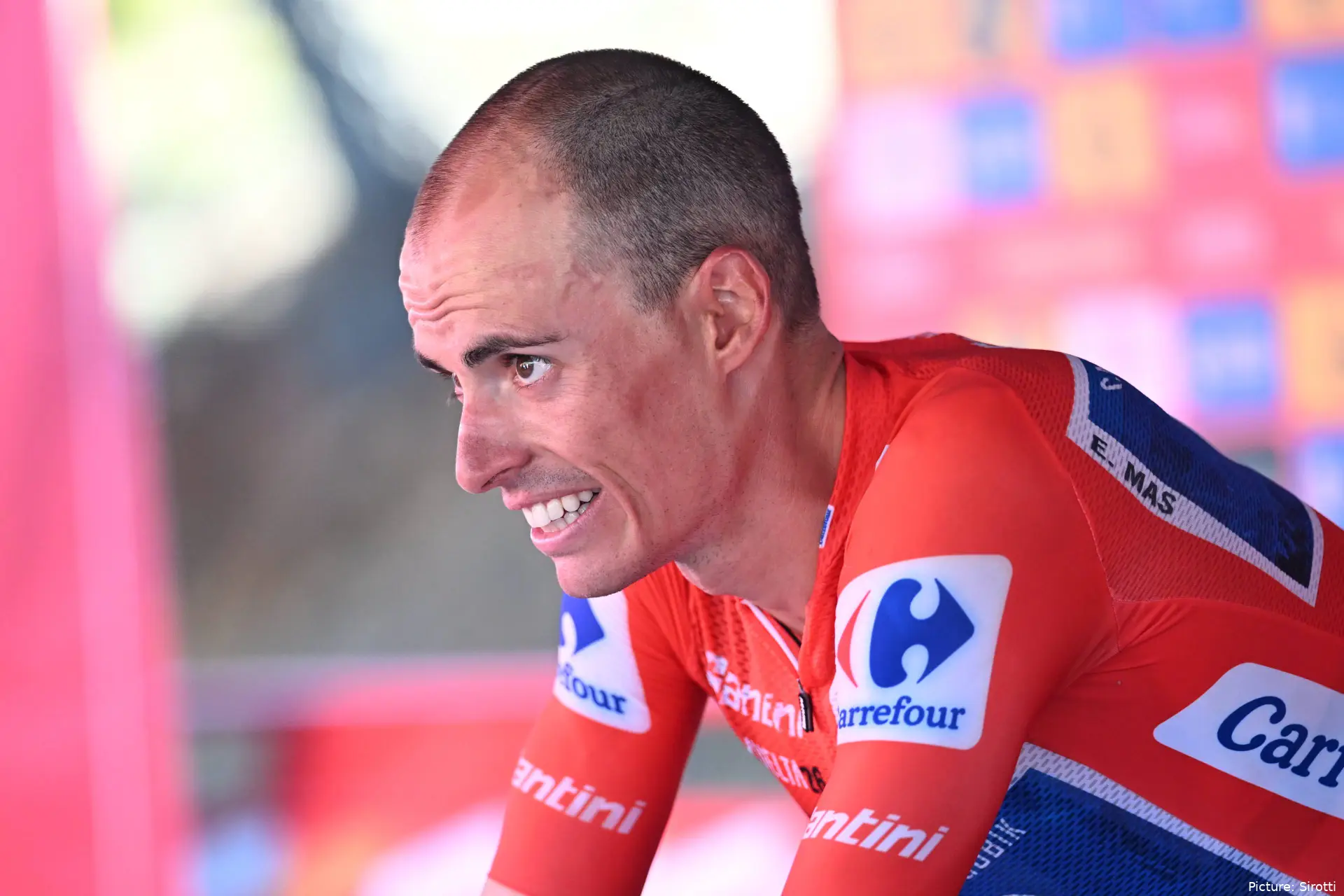
Enric Mas will face a different challenge in 2027 after completing the best season of his career. The Mallorcan won the Vuelta a España and finished second at Il Lombardia, confirming his ability to compete in both Grand Tours and the toughest one-day races on the international calendar. Now, the Movistar Team leader has a chance to take another step forward and establish himself among the peloton’s most versatile riders.
His runner-up finish in Lombardy, behind only emerging talent Paul Seixas, reinforced an idea long overshadowed by criticism of his Grand Tour results. Mas can target the general classification in a Grand Tour and also contend for top places in one-day races. His 2027 programme should make the most of that versatility.
The ideal calendar for the Mallorcan would feature three major blocks: the Ardennes Classics in spring, a summer build-up focused on defending his Vuelta title, and a final stretch centred on Italy’s biggest races. These are three distinct goals, united by one ambition: to carry his strong 2026 form into the new season and turn his sporting maturity into even greater consistency.
With the Vuelta as his overriding priority, Mas will need to strike a balance between racing at the highest level throughout the year and arriving fresh for the decisive events. Movistar Team must plan his season to bring out his strengths without overloading him, especially after he showed he can excel beyond stage races.
The Ardennes triple-header, the first test of his ambition
The first major block of the season should centre on the Ardennes triple-header, with Amstel Gold Race, La Flèche Wallonne and Liège-Bastogne-Liège as its key races. Each offers a different opportunity for a rider who has shown stamina, climbing strength and the tools to compete on demanding finishes. Spring would be the ideal time to test how far he can go in this terrain.
On paper, Amstel Gold Race looks the toughest fit for his attributes. Its succession of short climbs and tactical moves could make life difficult against more explosive specialists. That does not mean he should skip it. Instead, he could use the race to build rhythm and gauge his form against top-level rivals.
La Flèche Wallonne should offer a better opportunity. The Mur de Huy could suit Mas if he can get ahead of the action and attack from the foot of the climb, rather than letting the race come down to a final acceleration. His ability to sustain long efforts could make the difference if he picks the right moment to thin out the group.
Liège-Bastogne-Liège would complete this opening block as a key test. Winning a monument of such difficulty takes many things coming together, but the course suits a rider who can handle plenty of climbing and maintain a high level for many hours. Racing all three events would also give him quality miles before he turns his focus fully to the Vuelta.

Enric Mas won the 2026 Vuelta a España.
A measured summer, with the Vuelta a España as the priority
After the spring Classics, Mas should take a more selective approach to racing and skip the Tour de France, a perennial fixture on his calendar. The key will be to avoid unnecessary accumulated fatigue and focus his build-up on arriving in September in the best possible shape. After a season as demanding as 2026, managing his recovery will be just as important as maintaining his racing rhythm.
The Clásica de San Sebastián, scheduled for 31.07, stands out as a particularly important date. Its demanding course and place in the second half of the season make it an ideal opportunity for the Mallorcan to rediscover his race legs and assess his form. He need not treat every race as a priority; selected events can instead help sharpen his preparation.
From that point on, the Vuelta a España should dictate his schedule. His specific training, recovery and choice of tune-up races should all serve one goal: reaching the start line ready to face three weeks of climbing, time trialling and accumulated fatigue. The experience he gained in 2026 could prove a major asset in handling the pressure.
Defending the red jersey would be the year’s biggest challenge. After many attempts and several podium finishes, Mas knows what it takes to win the general classification. In 2027, he will have to show he can do it again against rivals determined to take the title from him. Movistar Team will need to support him with a strong squad and a strategy that lets him make the most of his best days without sacrificing consistency.
Read also
The Italian Classics, a fitting season finale
The final part of the calendar should be reserved for the Italian classics, with the Giro dell'Emilia and Il Lombardia as the main targets. Mas has shown he can finish the year in outstanding form, and his one-day race performances deserve as much attention as his Grand Tour results. The key will be reaching October with enough motivation and freshness.
The Giro dell'Emilia would offer an early chance to test his legs on a demanding course and see how he responds after the Vuelta. The race could help him regain his rhythm in the classics and prepare for Il Lombardia, without changing a plan designed to bring him to peak form at the right time.
Il Lombardia would once again be the centrepiece of this final block. His second place in 2026, after beating Giulio Ciccone in the fight for the runner-up spot, confirms that Mas can compete with the best in one of the toughest Monuments on the calendar. Repeating a similar performance, or even targeting victory, would be an exceptional way to end the season.
Three blocks, three challenges and one clear conclusion: Enric Mas no longer needs to prove only that he can fight for a Grand Tour. His 2026 season has opened up new possibilities, and 2027 should be the year to explore them. Defending his Vuelta title will remain the priority, but the Ardennes and the Italian classics give the Mallorcan a chance to establish himself as a much more versatile contender.
The key races Enric Mas should target in 2027
These are the races we have included in Enric Mas’s 2027 programme, listed in chronological order and divided into the season’s three blocks.
| Block | Race | Date in 2027 |
| Spring: Ardennes | Amstel Gold Race | 18 April UCI |
| La Flèche Wallonne | 21 April UCI | |
| Liège-Bastogne-Liège | 25 April UCI | |
| Summer: Vuelta preparation | Clásica de San Sebastián | 31 July |
| Vuelta a España | 4–26 September | |
| Season finale: Italian classics | Giro dell'Emilia | 2 October |
| Il Lombardia | 9 October |
Javier RampeCycling Journalist
Javier Rampe is a sports analyst with more than 15 years of experience. He holds a degree in Economics from the University of Rome and a Diploma in Business Studies from the University of Cádiz. Despite coming from an academic background not particularly associated with cycling, his passion for both cycling and journalism was instilled in him from an early age. He grew up following Miguel Indurain and José María “El Chava” Jiménez. An admirer of Michael Robinson’s communication style and journalistic approach, he was inspired to pursue a degree in Journalism at the University of Buenos Aires, which he is currently completing.
He has always maintained close ties with the worlds of sport and culture, contributing from a young age to sports blogs and film and music review websites. His work has appeared in media outlets such as Cope, RAI, and Radio Con Vos. He is also the founder of the cycling-focused podcast El Contraanálisis and the football interview channel Días De Fútbol, dedicated to conversations with professional footballers.
In addition to his work at Ciclismoaldia, Javier has interviewed some of the most influential figures in modern cycling, including Alejandro Valverde and Tadej Pogačar, as well as key voices in anti-doping policy such as Alberto Yelmo, David Varillas, and Marcelo Milano. Marcos Maynar, in relation to the ‘Operación Ílex’ case, is also among the personalities he has interviewed. He enjoys conducting in-depth analysis of the cycling ecosystem and has attended major events such as Strade Bianche, the Vuelta a Andalucía, and Itzulia, as well as numerous national cyclo-cross races.
His background in economics, combined with extensive experience in marketing and corporate communications, drives his continuous study of positioning strategies and ensures that he always keeps his focus on crafting compelling and evocative headlines.
claps 2visitors 2
Just in


Popular news

Latest comments
- They didn’t have or need “extraordinary information”. All they needed was for a French judge to sign off on the night-time testing for it to go ahead.Lozza25-11-2026
- If the sponsors voted for Primoz then you get him, otherwise not.flyer25-11-2026
- It sure can feel or seem that way but I wonder if the same amount of prodigious performances (compared to the others) would occur if no one was ever doping at all.flyer25-11-2026
- Given the similarity of two articles (published on I think the same date), I'm reusing (copy-n-pasting) my post from the twin: I've always thought the last day of each of the grand tours was problematic mostly in that the GC is considered completed before the race starts when that is not really true. There is some tension, but not desirable tension. What saves the awkward practice is the race finish is legit for those who participate - so it's not wholly different from the other stages. That neutralizations usually make good sense demonstrates their necessity so if that has to be the way to go I agree that the design plan for the neutralization should be completed before the race starts. This years end stage in the Vuelta had one of the best first half's I've seen in that many of the riders looked to be thoroughly enjoying themselves making it a joy to watch. But I think it was slightly closer to the exception rather than the rule.flyer25-11-2026
- Even I often win without being there at all, not even breaking a sweat. Beat that!flyer25-11-2026
- It is not about rest and peaking again - 5 weeks is not enough for that. It is about recovery while maintaining form. 4 weeks is easier for that. With a Giro-Vuelta, the 12 week break is enough to rest and then peak again. Not for the Tour
 Rafionain-Glas25-11-2026
- I fully agree that "2027 could completely reshape the pecking order" because this competition is a mix of skill, team support, luck opposition, and health. (What BS - as I start writing this post a popup hides what I've written so my only sane options are to hit POST prematurely or leave or reload the page. What a pathetic operation. I forgot where I was so I'm getting out of this crap trap.)flyer25-11-2026
- I've always thought the last day of each of the grand tours was problematic mostly in that the GC is considered completed before the race starts when that is not really true. There is some tension, but not desirable tension. What saves the awkward practice is the race finish is legit for those who participate - so it's not wholly different from the other stages. That neutralizations usually make good sense demonstrates their necessity so if that has to be the way to go I agree that the design plan for the neutralization should be completed before the race starts. This years end stage in the Vuelta had one of the best first half's I've seen in that many of the riders looked to be thoroughly enjoying themselves making it a joy to watch. But I think it was slightly closer to the exception rather than the rule.flyer25-11-2026
- Apparently that week is a MAJOR training disadvantage as "three major benefits" were claimed. When I read a proposal such as this, I want to also read the reasons why changing might not be so good - the CONS.flyer25-11-2026
- most likely they fudged it but i think they want to set an example to the riders that even the top riders are not exempt in the top races even during nighttime as a precedenceabstractengineer25-11-2026
Loading
2 Comments