"There is still room for me to improve, all I can do is become the best version of myself": Jarno Widar remains optimistic despite a season disrupted by setbacks
CyclingSaturday, 20 June 2026 at 22:12
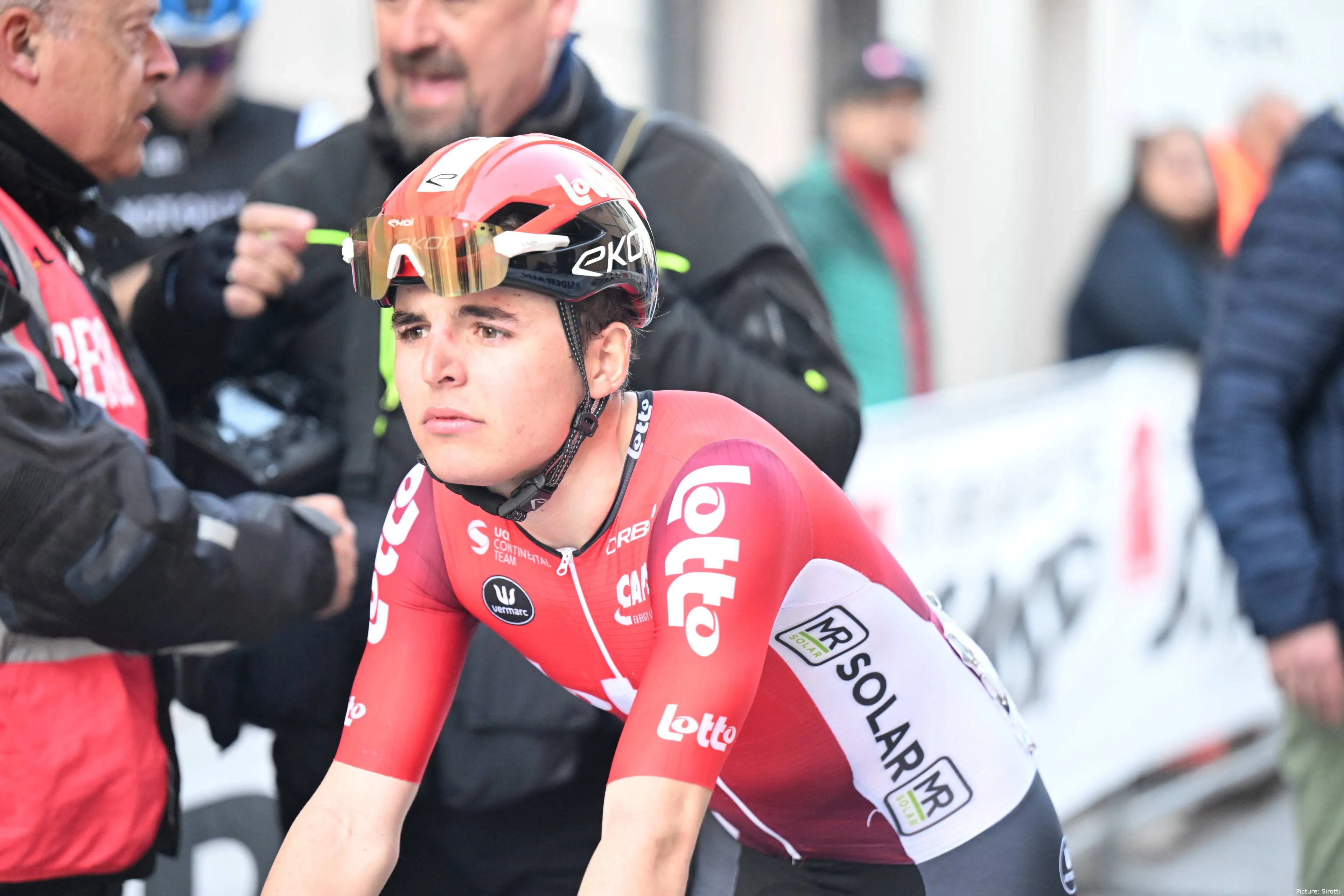
Jarno Widar’s first season as a professional has been shaped by setbacks, but the Belgian talent is beginning to see signs that his campaign is turning around. After months disrupted by illness and a persistent knee problem, the Lotto-Intermarché rider has returned to racing and is drawing confidence from both his improving form and the success of former rival Paul Seixas, while keeping his long-term ambitions firmly in check.
A difficult spring and a gradual return
For years, Widar and Seixas were regarded as two of the brightest talents of their generation. Widar even got the better of the Frenchman on several occasions, including twice at the 2025 Tour de l’Avenir. This season, however, their trajectories have diverged sharply.
While Seixas announced himself among cycling’s elite with victories and podium finishes in major races (he has already won seven times this season), Widar spent much of the spring on the sidelines. Illness first disrupted his preparation and forced him to miss key races, before a training crash led to a knee injury that left him struggling for weeks.
Reflecting on the growing gap between the two riders, Widar pointed out that their development has not followed exactly the same timeline. “Seixas has been training seriously for a few years longer than I have,” the 20-year-old explained in an interview to Het Nieuwsblad. “There is still room for me to improve. At the same time, you never know how a body will develop. All I can do is become the best version of myself.”
Read also
The first signs of trouble appeared early in the season. Widar felt unusually weak during training and racing but initially believed it was simply a matter of lacking form. Medical tests later revealed that illness was playing a role, forcing him to miss several important races, including Strade Bianche.
The setbacks did not end there. After a training crash, he developed a knee problem that left him facing weeks of uncertainty. Surgery was considered, but the team opted for a conservative approach and hoped rest would solve the issue. However, that was not the case.
“It was mentally difficult,” Widar admitted. “There was plenty of frustration. But I could start training again at the beginning of May.”
The rise of Seixas has only strengthened his belief that he can eventually compete at the highest level. “Of course it was not pleasant to see him win a race I had really wanted to ride [Flèche Wallonne],” he said. “But watching what he is doing also gives me confidence. I have beaten him in the past.”
Widar also revealed that his current power numbers are approaching the benchmarks of riders like Remco Evenepoel, who recently attracted attention after reports suggested he had recorded an estimated FTP of around 425 watts during altitude training, equivalent to roughly 6.5 watts per kilogram.
According to Widar, his own figures are not far from that level. “Power meters are not always equally accurate, and the body weight being used might not be exact,” he cautioned. “The important difference is that Evenepoel has already proved those numbers in competition. I have not.”
The Belgian believes such values are increasingly becoming the minimum requirement for riders hoping to compete for overall victories in Grand Tours. “In my opinion, you probably need more than 6.5 watts per kilogram now to fight for the general classification in a Grand Tour,” Widar suggested, adding that he believes Pogacar may even be capable of approaching seven watts per kilogram.

Jarno Widar has had a difficult 2026 season
No rush to define his future
Despite the encouraging data and the widespread perception that he is destined to become a Grand Tour contender, Widar remains cautious about placing himself into a specific category too early in his career.
“I do not want to decide already that I am a Grand Tour rider,” he said. “I have never raced one, so I have no idea how my body will respond.”
That question could soon receive an answer. If his recovery continues as planned, Widar is expected to make his Grand Tour debut at the Vuelta a España later this season, with the Tour of Austria and Vuelta a Burgos likely to form part of his preparation.
But for now, however, the Belgian is focusing on rebuilding his condition. “My ambition is straightforward,” Widar concluded. “I want to be as good as possible in every race.”
claps 1visitors 1
Just in
Popular news
Latest comments
- Jarno certainly did give Seixas quite the thrashing at the Tour de l'Avenir last year, dropping him on both summit finishes. That fact is rather intriguing when you consider what the Frenchman has done since then. Widar is of course 20 cm shorter and 10 kg lighter, so he can be better as a pure climber (though Seixas has a bigger engine). There is also the reason that Seixas's teammate Maxime Decomble was in the yellow jersey, but that only explains why Seixas did not attack. So I think that Widar definitely has a very high ceiling climbing-wise. He does talk too much though, and seems genuinely insecure as a result of Seixas's success
 Rafionain-Glas20-06-2026
 - So desperate to have him there so someone will care about his race - sadCrashjames20-06-2026
- Does anyone know what the biggest gap in a one-week race has ever been, because Pogi could have an 8 minute lead tomorrow?mus-musculuspeedypogigonzales20-06-2026
- Hey MajorPayne, you're one of the guys who understands cycling. Most of these amateur fans just can't acknowlege, that Pogi is making cycling interesting, not like boring Jonas.mus-musculuspeedypogigonzales20-06-2026
- Just keep yawning. I wish you willl be yawning throughout the Tour de France, until Pogi demolishes Jonas, Seixas and Lipowitz.mus-musculuspeedypogigonzales20-06-2026
- Pogi using a pro race as a training week. And someone thinks that Jonas has a chance? Day 1 70km breakaway for a 2min stage win and the lead. And look at him as he is doing it. I honestly think he might have been able to go from even farther out and gotten a huge lead...not just 2minmd197520-06-2026
- ngl I'll be disappointed if he doesn't attack before the final climbRafionain-Glas20-06-2026
- Not unexpected but a 37 km solo win is certainly impressive. Visma struck gold with PiganzoliRafionain-Glas20-06-2026
- MOU. Just to clarify. Slovenians don’t really like you , much as you do the compatriot thing.mobk20-06-2026
- and BTW, you can watch PFP’s accident and see pics of her infection - so we don’t have to guess.mij20-06-2026
Loading
1 Comments