“That’s like a red flag in front of a bull” – Tom Pidcock driven by doubters as Q36.5 plot Tour de France surge
Cycling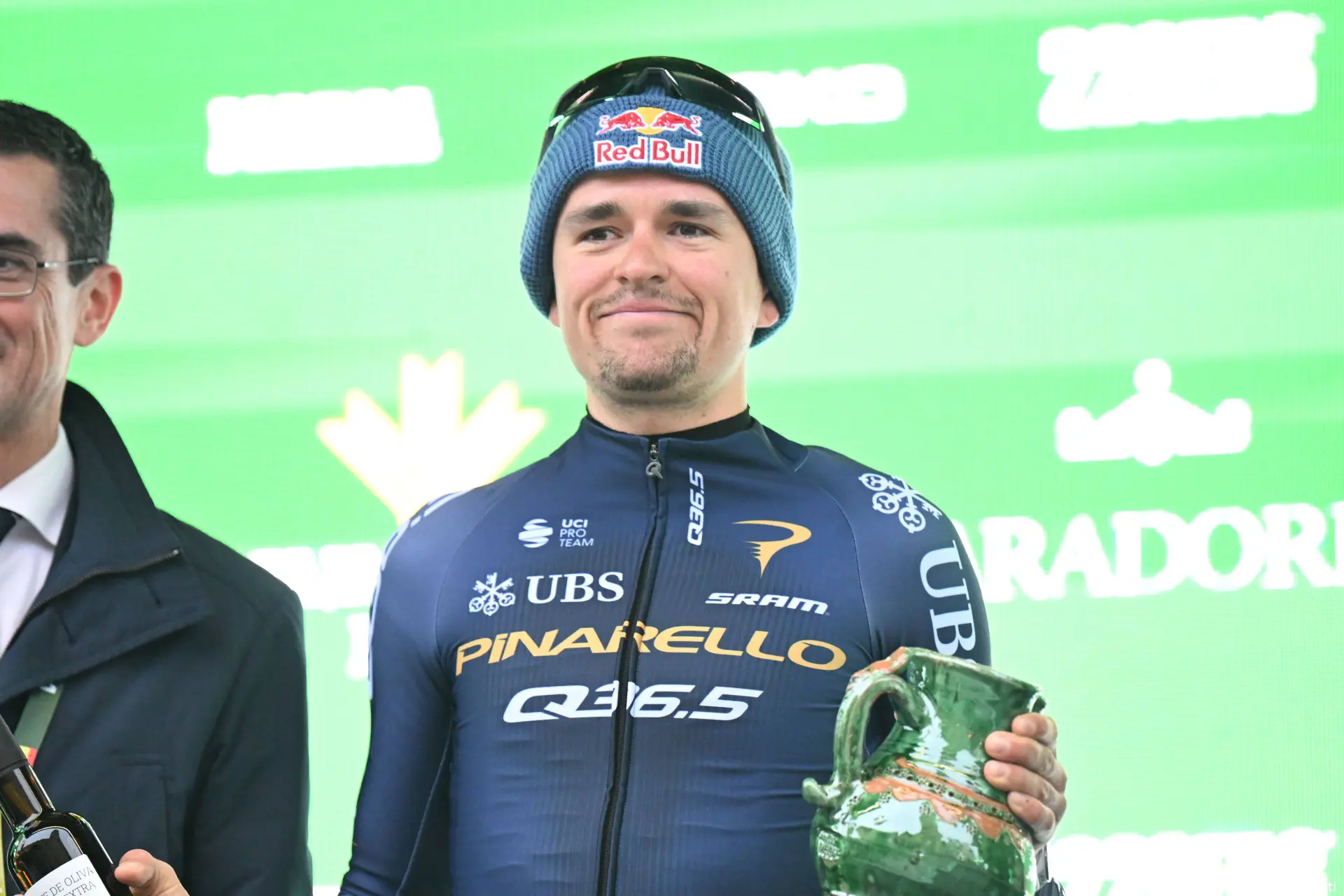
There are riders who chase Grand Tour ambition cautiously, and there are riders who seem to need friction. For Tom Pidcock, according to his team boss, doubt is not a warning sign. It is ignition.
“The worst thing you can do with Tom is to say, ‘I don’t think you can do that,’ because that’s like putting a red flag in front of a bull,” says Pinarello Q36.5 Pro Cycling Team manager Doug Ryder in conversation with Domestique, a remark that cuts to the heart of the most compelling subplot of Pidcock’s 2026 season.
Not whether he can animate a race. Not whether he can win a stage. But whether he can genuinely shape the general classification at the Tour de France.
From Vuelta validation to Tour escalation
The idea that Pidcock could develop into a three-week contender once felt speculative. His first season with Q36.5 Pro Cycling Team changed that conversation.
After a heavy early programme in 2025 as the team hunted ranking points and credibility, he fell short of a serious overall tilt at the Giro. Ryder has since suggested that the campaign was compromised by the workload required to secure a Grand Tour wildcard in the first place.
But by the Vuelta a Espana, the recalibration was visible. Pidcock finished on the podium, climbing with consistency, racing aggressively rather than defensively and proving that his engine holds up across three weeks. Ryder was unequivocal in his assessment: “At the Vuelta, he’s obviously shown that he is a three-week rider when he puts his mind to it.”
That line matters. It moves Pidcock from stage hunter to structural contender. And now the stage shifts to France.
Freedom, responsibility and the leadership shift
When Pidcock left INEOS, the outside perception was complicated. Talent was never in doubt. Leadership was. The Netflix narrative painted a gifted individualist, brilliant but volatile.
Ryder’s framing is starkly different. “Tom is a leader in every sense of the word.”
More than that, he argues, Pidcock has altered the fabric of the organisation itself: “Tom has improved our whole organisation.”
That is not casual praise. It is institutional language. Ryder describes a rider who pushes innovation with partners, demands performance standards and ensures developments filter across the roster rather than remaining personal advantages. In a sport increasingly defined by resource concentration at the very top, Pidcock’s arrival has shifted Q36.5 from hopeful project to gravitational centre.
The transfer activity that followed only reinforced that shift. Established names and emerging talents alike have been drawn into a team now built around a clear competitive axis.
Yet Ryder insists the key ingredient is not control, but trust. “He didn’t have that kind of freedom and trust… On this team, he’s been able to exercise that freedom and that responsibility.”
Freedom has not diluted ambition. It has sharpened it.
An attacking Tour, not a defensive one
If the Vuelta was proof of concept, the Tour will be an escalation. Ryder is careful not to reduce the French race to a single objective, but his comments reveal a clear philosophical stance. “The one thing he doesn’t ever want to hear in a team briefing is ‘Our objective is to not lose time.’ Tom wants us to race.”
That is a defining difference. Conservative general classification racing has long been the norm for podium hopefuls. Pidcock’s instinct, and Q36.5’s apparent commitment, lean in the opposite direction.
The team’s planning for 2026 has been facilitated by automatic invitations to WorldTour events after last season’s UCI ranking surge. That removes one layer of pressure. It allows the focus to shift from proving worthiness to pursuing performance.
For Pidcock, that means balancing stage opportunities with overall ambition. Ryder makes clear that the GC aspiration is present, but not suffocating. If an early stage presents itself, he will go for it. If the race opens up and the overall remains viable, they will not shy away.
What ties the entire strategy together, however, is psychology.
When Ryder recalls their earliest conversations, he describes a rider who openly stated he wanted to discover whether he could become a Grand Tour contender because others had told him he could not. That internal challenge now underpins the external campaign.
Doubt, in this case, is not something to quieten. It is something to weaponise.
The Tour de France remains the sport’s ultimate test. For Pidcock, it is also the next arena in which to confront a question that has followed him for years.
Tell him he cannot do it. Then watch what happens.

Kieran WoodDeputy Editor-in-Chief
Kieran Wood is a sports journalist based in Wales and has been active in journalism since 2022. He regularly contributes to DartsNews.com and CyclingUpToDate.com, where he covers professional cycling and darts. In cycling, his work includes liveblogs from major races, including the Tour de France, the Giro d’Italia, and La Vuelta a España, alongside race reports and analysis. He has also conducted interviews with professional riders.
His reporting spans the full racing calendar, from one-day classics to stage races, with a focus on accurate, real-time coverage and clear contextual analysis. For statistics, results, and historical context, he regularly uses resources such as ProCyclingStats. To support reporting on rider activity and training context where relevant, he also references Strava.
In his work, Kieran places strong emphasis on careful sourcing, editorial accuracy, and updating articles as new, verified information becomes available.
claps 7visitors 5
Just in

Popular news
Latest comments
- Bummed to see an Austrian guy not make it on what is nominally (ok ok not really) a German team. He didn't have a good 2026, and I hope that he finds his footing at Bardiani. They've got a long history of excellent coaching and development.RidesHills27-10-2026
- Subject to the top riders DNS DNF or sick/crash.abstractengineer27-10-2026
- Pogi has no challenger since 2024. Jonas is one level below, Remco has no balls, Sexias is too young. Whether ASO acknowledge or not is immaterialabstractengineer27-10-2026
- People keep referring to Pogačar and mountain-top finishes, and sure, he's succeeded on those often enough. Thing is, he succeeds on mountains, period. How often has he attacked on a climb, made time on the descent, and added time on the flat run in to the final? Often enough that they'd have to remove mountains for it not to be a Pogačar route. And then they'd have hills, and the guy who has won Flanders 3 times isn't going to suffer there, either. So if you remove those they have sprints and TTs, and last year he was mixing it up in a few sprints, as well. So, yeah, good luck folks. Let's see how he recovers before we make too many other claims. The seasons from 2024 to 2026 are three of the top 10 best cycling seasons ever (Merckx has something like 5 of the remaining), and I'm going to predict that 2027 is going to be up there with them.RidesHills27-10-2026
- The US has gone through a long convoluted process of defining how athletes can make money off their "Name, Image, and Likeness," and I see the point that Pederson and the other athletes are making here. Also, how very Mads Pederson to say, "Everyone has seen the somewhat tacky advertisements." You can almost see that sly smile on his face when he says it.RidesHills27-10-2026
- Vine coming from his background and then succeeding on a team full of superstars, so great. He's got solid wins (GC and TT), would be even more successful in the TT if he didn't live in the era of Ganna and Evenepoel, and seems to have a thing for the Vuelta. Aren't something like 1/3 of his wins there? (Checks procyclingstats - yes, 5 of the 14) Great guy, and I wish him all the success he can find!RidesHills27-10-2026
- Such a soft spot for Vine. To watch him come from the Zwift Academy to the levels he is at, now, is incredible. Always rooting for a Vine win.anonymouscyclist27-10-2026
- glad you're still making it happen!mij27-10-2026
- With the exception of Axel Laurence, the rest are in their 30's. My opinion is I think, perhaps, we're beginning to see the effects of younger riders coming into the pro ranks. I believe we're going to see those effects in the coming years. All teams are looking for the next Pogi, Jonas & Seixas. Of course, Seixas hasn't proved himself yet. He's just a kid. I believe he will though. Remco is a strange case. I believe if he can overcome being erratic, he should wn a few Tours, What do you guys think?Paggss27-10-2026
- And, at 2% he'll still destroy the competition...Paggss27-10-2026
Loading
1 Comments