Vuelta a Espana 2026 Stage 21 preview, profile, favourites & prediction - Final explosive circuit might see GC battle or a Visma win
Cycling
The 2026 Vuelta a España will be the third and final Grand Tour of the men's calendar and will take place from the 22nd of August to the 13th of September. Starting in Monaco, the World Tour peloton will travel through the eastern and southern half of Spain for a mountain-packed edition. We preview all the race's stages, as well as analyzing its profiles and providing predictions.
The Vuelta was first raced in 1935, at first featuring 14 stages. The first two connected editions were won by Belgian Gustaaf Deloor, before a five-year break. From 1955 'La Vuelta' has been held uninterrupted, becoming the third Grand Tour together with the Giro d'Italia and the Tour de France. Until today it holds a very high reputation as the last Grand Tour of the season.
The likes of Jacques Anquetil, Raymond Poulidor, Eddy Merckx, Bernard Hinault, Pedro Delgado, Sean Kelly, Tony Rominger, and Jan Ullrich are only amongst the many historical winners of this race. The record holders currently are Roberto Heras and Primoz Roglic, both of whom have won all of their titles already in the 21st century.
Most of Spain's best over the past few decades have won the Vuelta, including Alejandro Valverde and Alberto Contador, with the latter being the most recent home winner back in 2014. The likes of Vincenzo Nibali, Nairo Quintana, Chris Froome, and Remco Evenepoel, as generation-marking riders, have all put the Vuelta on their palmarès.
In 2025 it was Jonas Vingegaard who took the overall win for the first time, beating João Almeida and Tom Pidcock. In 2026, Tadej Pogacar will try to write his name in the history books by winning it—becoming one of the few riders to win all three Grand Tours throughout their career.
Vuelta a España 2026 route and stages
| Stage | Date | Start | Finish | Distance (km) | Stage type |
| 1 | 22/08/2026 | Monaco | Monaco | 9.4 | Time trial |
| 2 | 23/08/2026 | Monaco | Manosque | 214 | Hilly |
| 3 | 24/08/2026 | Gruissan - Aude | Font Romeu | 174 | Mountainous |
| 4 | 25/08/2026 | Andorra la Vella | Andorra la Vella | 106 | Mountainous |
| 5 | 26/08/2026 | Falset | Roquetes | 173 | Hilly |
| 6 | 27/08/2026 | Alcossebre | Castelló | 177 | Hilly |
| 7 | 28/08/2026 | Vall d'Alba | Aramón Valdelinares | 149 | Mountainous |
| 8 | 29/08/2026 | Puçol | Xeraco | 171 | Flat |
| 9 | 30/08/2026 | La Vila Joiosa / Villajoyosa | Alto de Aitana | 188 | Mountainous |
| 10 | 01/09/2026 | Alcaraz | Elche de la Sierra | 185 | Hilly |
| 11 | 02/09/2026 | Cartagena | Lorca | 153 | Flat |
| 12 | 03/09/2026 | Vera | Calar Alto | 166 | Mountainous |
| 13 | 04/09/2026 | Almuñécar | Loja | 192 | Hilly |
| 14 | 05/09/2026 | Jaén | Sierra de la Pandera | 155 | Mountainous |
| 15 | 06/09/2026 | Palma del Río | Córdoba | 180 | Hilly |
| 16 | 08/09/2026 | Cortegana | La Rábida / Palos de la Frontera | 181 | Flat |
| 17 | 09/09/2026 | Dos Hermanas | Sevilla | 185 | Flat |
| 18 | 10/09/2026 | El Puerto de Santa María | Jerez de la Frontera | 32.1 | Time trial |
| 19 | 11/09/2026 | Vélez-Málaga | Peñas Blancas, Estepona | 210 | Mountainous |
| 20 | 12/09/2026 | La Calahorra | Collado del Alguacil | 187 | Mountainous |
| 21 | 13/09/2026 | Carrefour Granada | Granada | 112 | Hilly |
Read also

Preview of Stage Vuelta a España 2026 stage 21
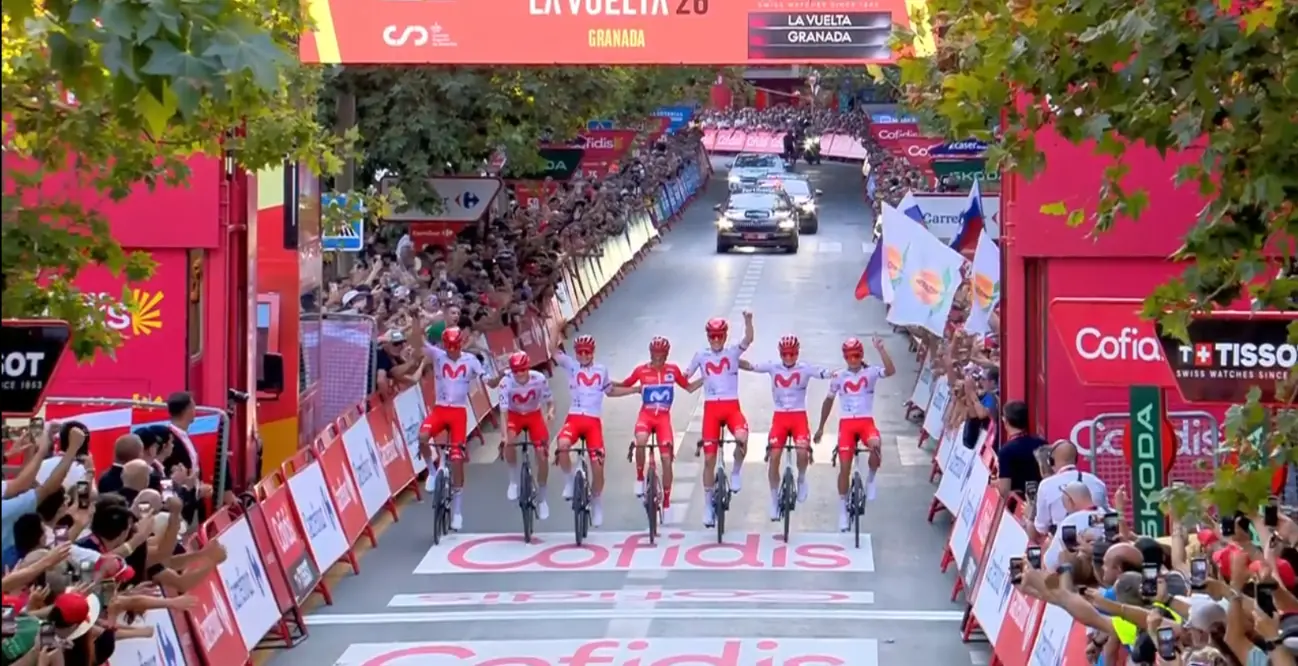
The final stage is one with interesting dynamics. Fatigue after such an insanely hard day, and such a hot race, is real, and some riders are finishing the race well above others who are dragging themselves.
Visma have won so much, more than enough, but they can again win the final stage. The climb is explosive, and I feel Wout Van Aert will be able to follow any uphill attack. Certainly the tactic will be that, whilst Matthew Brennan climbs very well, he should be around if it comes back. Not easy to execute, but a simple plan.
If it comes back to a sprint, the likes of Magnus Cort Nielsen, Pau Miquel, Thibau Nys, Alessandro Romele, Bastien Tronchon, and maybe even Bryan Coquard can do quite well.
Attacks are expected, though, and certain. The likes of Nys and Miquel might do it, but I would put more chips on the riders still seeking a stage win, such as Richard Carapaz, Santiago Buitrago, or Tobias Johannessen. It is a stage that can be quite explosive.
Prediction Vuelta a España 2026 stage 21
*** Matthew Brennan, Wout Van Aert, Magnus Cort Nielsen
** Pau Miquel, Thibau Nys, Alessandro Romele
* Enric Mas, Eddie Dunbar, Axel Laurance, Ramses Debruyne, Tobias Johannessen, Primoz Roglic, Bastien Tronchon, Bryan Coquard, Richard Carapaz, Santiago Buitrago
Pick: Matthew Brennan
How: Small Peloton sprint.
Profile stage 21: Granada - Granada (Alhambra)
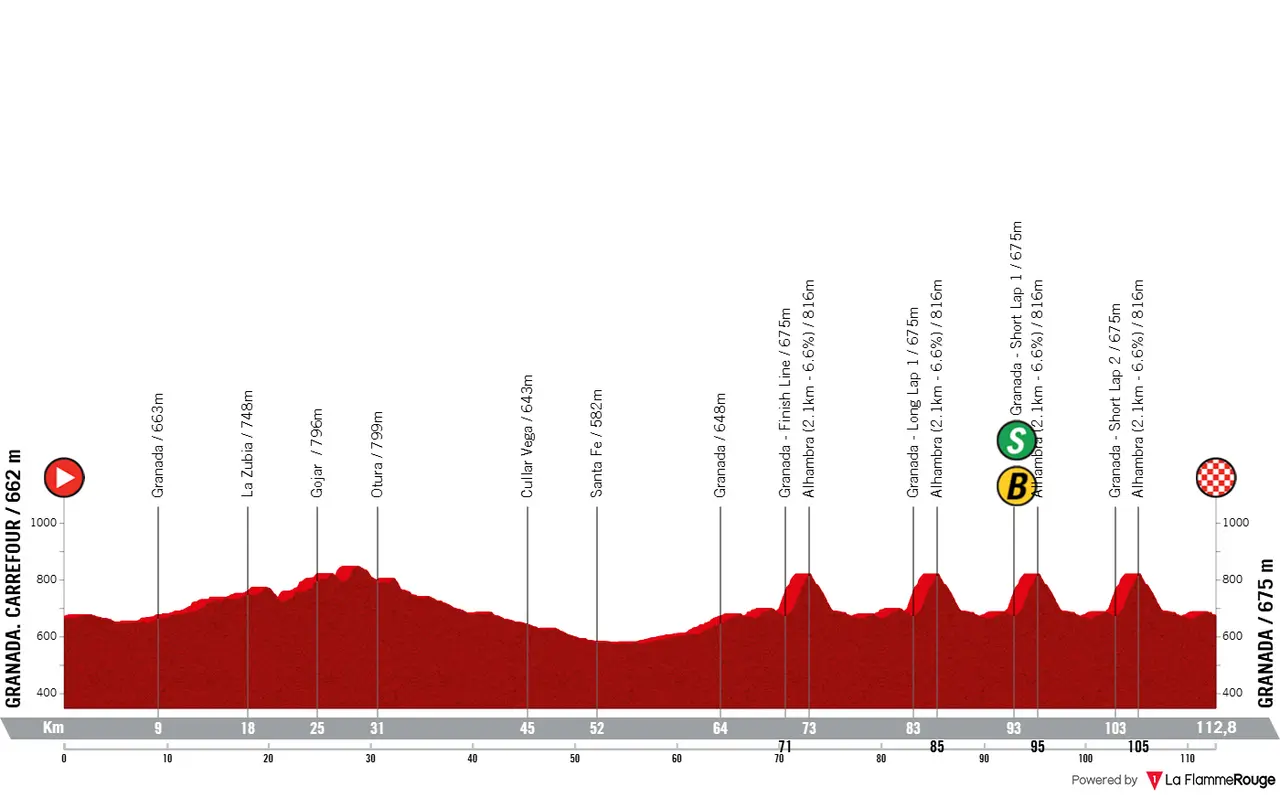
Granada - Granada (Alhambra), 112 kilometers
After the Tour de France's success in implementing a final circuit with a climb on the final stage, the Vuelta a España has headed in the same direction. But with a harder final stage.
The GC contenders cannot rest or celebrate too early on the final day, as the race finishes in Granada with a circuit including four ascents to the famous Alhambra just outside the city center.
Naturally it is a short stage, but a very explosive one towards the end. The climb in the final circuit is 2.1 kilometers long at 6.6%, and its summit will come with 40, 28, 18 and 8 kilometers to go.
The effort suits the classics specialists the best, but GC riders are not excluded in any way from the fight for the win. A reduced bunch sprint could decide the stage, but a small group could go up the road and then battle it out in the streets of Granada.
Previous previews
Preview Vuelta a España 2026 overall classification
Tadej Pogacar - The UAE rider is the obvious favourite to win the overall classification. After the Tour de France, he has taken time off the bike and has also relaxed, taking the mental pressure off of him. He isn't expected to enter the Vuelta with his best legs, but not many should feel that most likely. The Slovenian is, on paper, a level above the competition, and a GC win is very likely if he avoids crashes or illnesses. UAE comes in with João Almeida - although his form is not certain after a very difficult year - and a modest lineup that doesn't match the Tour's but is enough to keep the race under control for him.
Felix Gall - The Decathlon rider was second at the Giro d'Italia, second to Jonas Vingegaard on every single mountain stage. That is the climbing quality and consistency required of a rider that wants to win a Grand Tour. The Austrian is no rookie either, beating Tadej Pogacar is of course not expected, but if the Slovenian suffers a big setback, Gall may be first in line to take advantage of it. He has prepared fully for the Vuelta and won the Vuelta a Burgos. This year's race does feature the mammoth mountain stages in which he usually thrives on, whilst he is backed by a very strong climbing team that should be able to put pressure on his direct podium rivals.
Oscar Onley - The INEOS rider was planned to be the leader at the Tour de France, but crashed ahead of it and couldn't take part. At the Vuelta a Burgos, the Briton's form was where it should be. Explosive, but able to handle the high mountains, the leader of INEOS will be a podium contender - backed up by a team that will also heavily lean into stage wins, which they did not get at the Tour.

Can Oscar Onley put INEOS back in the spotlight at La Vuelta?
Mattias Skjelmose - Lidl-Trek had promised Mattias Skjelmose leadership at the 2026 Giro, and he was removed from it. Then he was supposed to be a co-leader or supporter for Juan Ayuso at the Tour but put in the best Grand Tour of his career to finish sixth. The Dane earned his lead at La Vuelta as the team wanted to reward him, and the form was good. With Mads Pedersen and a quality collective, Lidl is always a threat for the hilly and explosive stages. But it is notable that Carlos Verona, who could be Skjelmose's right-hand man, was removed from the lineup last minute to race elsewhere, which may signal what the team's priorities may be in the race.
Primoz Roglic - The veteran and four-time winner. Roglic summons mixed feelings, as his 2026 season has failed to show him racing at the level required to contest for the podium here - whilst a recent crash jeopardized his form. But at the same time, the Vuelta's stage format has often suited the Red Bull - BORA - hansgrohe leader to perfection, part of why he's won so often here. The podium and a stage win is the best he can achieve, but both are a mammoth task for a rider looking to prove he's still got it. Team support will not be the best in the mountains, he will have to do a lot on his own.
Richard Carapaz - At the Tour, two stage wins in the final week and a KOM jersey. Carapaz fully adapted to the requirements of modern pro cycling and his display in June was incredible, and ending it with great form. This means the EF rider, who is usually very well adapted to the explosive Vuelta, could be in the mix for the podium now that he is fully aiming for GC. EF assembled the best climbers they could around him, but it's still below the Ecuadorian's rival teams.
Visma - A very diverse team, with a strong focus on sprints and stage wins, but with plenty quality climbers. 2023 winner Sepp Kuss takes on his third Grand Tour of the season, but he does so because he is motivated and in form. He ended the Tour with tremendous legs and with that form he is amongst the best in this Vuelta. Simultaneously, the team should provide freedom for both Jorgen Nordhagen but specially Ben Tulett who thrived here last year. The team does not have responsibility to work and may be able to place riders in breakaways to help each others' case.
Movistar - The Spanish team come in with a very strong lineup, prioritizing stage wins but ultimately having great support for their two leaders. Enric Mas is a rider who has not had the level he hoped for this year and at the Giro he struggled. At the Vuelta, he usually performs at his best and recently in Burgos the Spaniard showed good form, so he might be a rider capable of finishing in the Top10. Cian Uijtdebroeks abandoned the Tour de France ill, and will have a second attempt at achieving his goal in the Spanish Grand Tour as well.

After a disapointing Giro d'Italia, Enric Mas will be an outside for La Vuelta
The GC is quite open in this Vuelta. There are several riders mentioned above who may not take part in GC after a few days, as the victory will pretty much be out of reach for everyone and they may instead focus on stage wins. Also, it is the final Grand Tour of the season, the one in which preparation varies the most between riders. Some come from the Tour, some do not; some take on altitude camps, some do not... So there may be a lot more disparity when comparing to the riders' usual level.
Santiago Buitrago, Tobias Johannessen and Valentin Paret-Peintre are the three riders that have the potential of fighting for the Top5 if they have their best form and consistency. All have put in great climbing performances this year and it is a matter of stringing them together throughout the three weeks. All of them, and the one mentioned below, might just aim for stage wins ultimately however.
Quick-Step also have Mikel Landa on board, but after a pelvis fracture in April, his level has not been anywhere near what is required to contest for the GC. Pinarello have in David de la Cruz a contender for the Top10 if he has the same legs he showed at the Giro d'Italia; whilst Astana will prioritize stage wins but has three riders that may aim for GC and at least one of them should be up there: Lorenzo Fortunato, Harold Tejada and Cristián Rodríguez.
Prediction Vuelta a España 2026 overall classification:
*** Tadej Pogacar
** Felix Gall, Oscar Onley, Mattias Skjelmose, Primoz Roglic, Richard Carapaz
* João Almeida, Sepp Kuss, Jorgen Nordhagen, Ben Tulett, Enric Mas, Cian Uijtdebroeks, Santiago Buitrago, Tobias Johannessen, Cristián Rodríguez, Valentin Paret-Peintre
Pick: Tadej Pogacar
Preview Vuelta a España 2026 Stage 10
Essentially, we should see a similar outcome to stage 2. They are sprint stages, but made so complicated that several riders will not have the legs to contest for it. Only this time around, Visma begins the day with two stage wins already. Matthew Brennan is of course the main favourite to win the race, but the Dutch team may look for ways for Wout Van Aert to win a stage as well - and here might be a day. A breakaway would make some sense, but too much of a risk for a team so overwhelmingly the favourite to win the stage.
Don't expect Brennan to be a leadout, but Van Aert might attack again towards the finale, and this time there is no Pogacar to chase him down. A sprint finish is likely, between those who can withstand it, even if a breakaway is possible. Mads Pedersen on paper would be the man to beat, but hasn't carried much form over the past week.
Kaden Groves and Magnus Cort Nielsen would also be great contenders, but they don't seem to be carrying any form. Ben Turner, Axel Laurance, Orluis Aular, Bryan Coquard and Hugo Hofstetter are also sprinters to take into consideration.
Fisher-Black, Miquel, Tronchon, Romele, Albanese, Mulubrhan, Roglic, Widar, Johannessen, Onley
Some puncheurs and GC riders can get in the mix. On stage 2 Felix Gall lost time on the road, and so that's the clear warning that they all must stay in front to avoid time losses, potentially gain time on splits and perhaps even bonifications. A rider like Oscar Onley or Primoz Roglic could go and grab bonus seconds having the explosivity, for sure - if the race is quite hard towards the end.
Meanwhile puncheurs (or climbers) such as Finn Fisher-Black, Pau Miquel, Bastien Tronchon, Alessandro Romele, Vincenzo Albanese, Jarno Widar and Tobias Johannessen will also have the opportunity to strike big.
Prediction Vuelta a España 2026 Stage 10
*** Matthew Brennan, Wout Van Aert
** Orluis Aular, Mads Pedersen, Bryan Coquard
* Ben Turner, Axel Laurance, Kaden Groves, Hugo Hofstetter, Pau Miquel, Finn Fisher-Black, Alessandro Romele, Jarno Widar, Oscar Onley
Pick: Matthew Brennan
How: Reduced bunch sprint.
Profile stage 10: Alcaraz - Elche de la Sierra
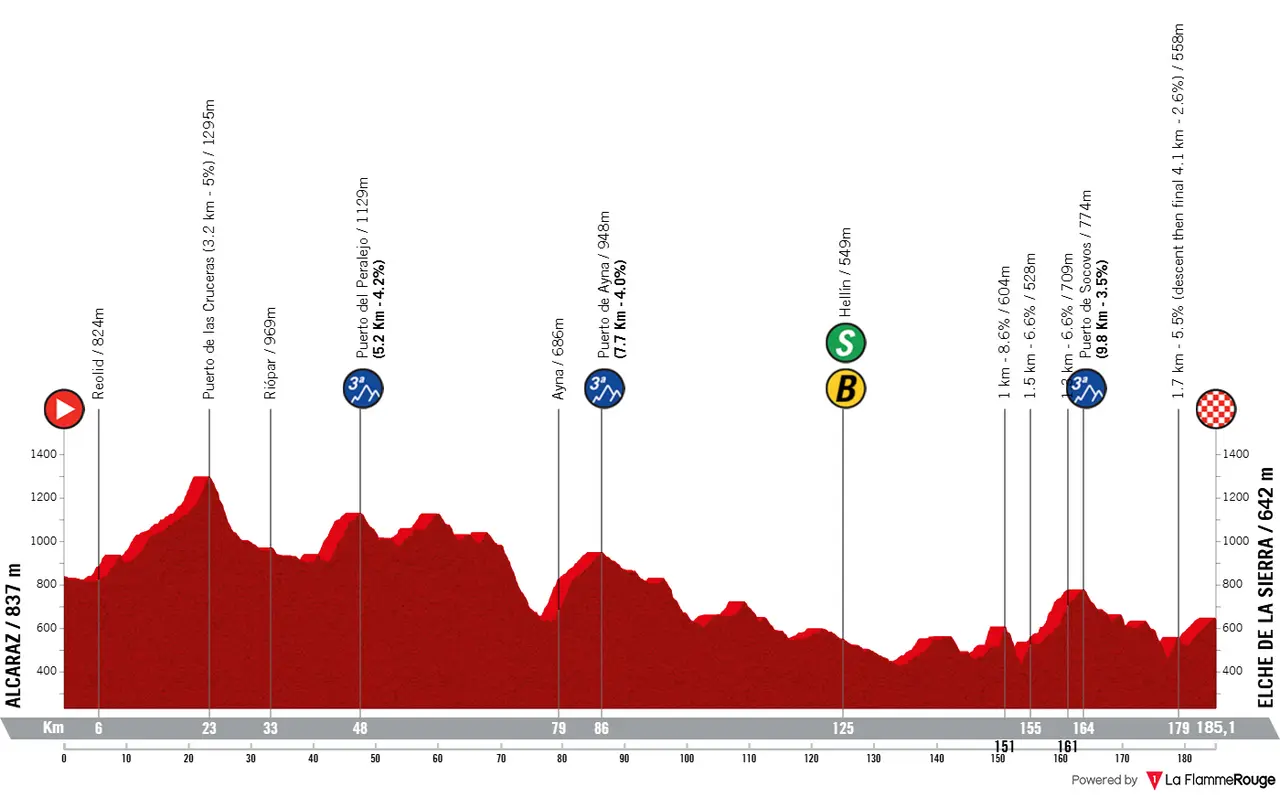
Alcaraz - Elche de la Sierra, 185 kilometers
The second week of the race begins with a hilly stage, one that could end in a reduced peloton sprint or see the breakaway succeed. A 'rompe-piernas' day with 2600 meters of climbing, a tricky start and countless small climbs all throughout the day.
With 21 kilometers to go the riders cross the summit of the Puerto de Socovos, one of the many climbs of the day, with a low average gradient but several tough ramps.
It is not too different from the finale in Elche de la Dierra, which is in sum a combination of small rolling climbs. The final 4 kilometers also pack a gradient, with a false-flat finish likely to see the race ablaze.
Preview Vuelta a España 2026 Stage 11
The question is whether Visma will want to control or not. Matthew Brennan can win the stage if they work for him, but the question is on whether they will opt for that or not. The Dutch team hasn't been challenged in the points classification by anyone and since Tadej Pogacar departed the race, Wout Van Aert's green jersey is virtually won.
But Brennan has won twice, and they want to help Van Aert win a stage. The best way to achieve this, on this stage, is through a breakaway and so I expect him to be present in those first two hilltops to try and do something. Visma would logically control, but in the past two sprint stages they have done so with no reward.
Bryan Coquard has a stage win, and so I would argue that only Red Bull - BORA - hansgrohe for Jordi Meeus could realistically go all-out into a sprint - they do not have a leadout for the Belgian, but the team doesn't pack climbers to support Roglic either and have to put them to use. Orluis Aular and Magnus Cort Nielsen could also do well if it comes back to a sprint; whilst Mads Pedersen is just out of form and we can't be sure of anything.
When it comes to the likes of today's winner Bastien Tronchon, Alessandro Romele, Finn Fisher-Black... These are puncheurs who face a modest sprinter field and effectively have an opportunity to strike big.
The breakaway is the real danger scenario, ideally for riders who can climb relatively well to make it to the front group to begin with, but also not get dropped and be within a chance to win. But having pure watts, good solo attack ability and a strong sprint can go a long way in deciding the outcome of the day if the break makes it.
UAE will want it and I recon Kevin Vermaerke and Ivo Oliveira are danger riders; Walter Calzoni, Xabier Mikel Azparren, Axel Laurance, Pau Miquel, Andreas Leknessund, Andreas Kron, Stefan Küng and Marco Brenner is a good set of breakaway threats with the race kind of skillset to win a day like this.
Prediction Vuelta a España 2026 Stage 11
*** Matthew Brennan
** Wout Van Aert, Xabier Mikel Azparren, Kevin Vermaerke
* Jordi Meeus, Bryan Coquard, Magnus Cort Nielsen, Mads Pedersen, Bastien Tronchon, Alessandro Romele, Ivo Oliveira, Pau Miquel, Andreas Leknessund, Andreas Kron, Stefan Küng
Pick: Wout Van Aert
How: Breakaway win from a small group sprint.
Profile stage 11: Cartagena - Lorca
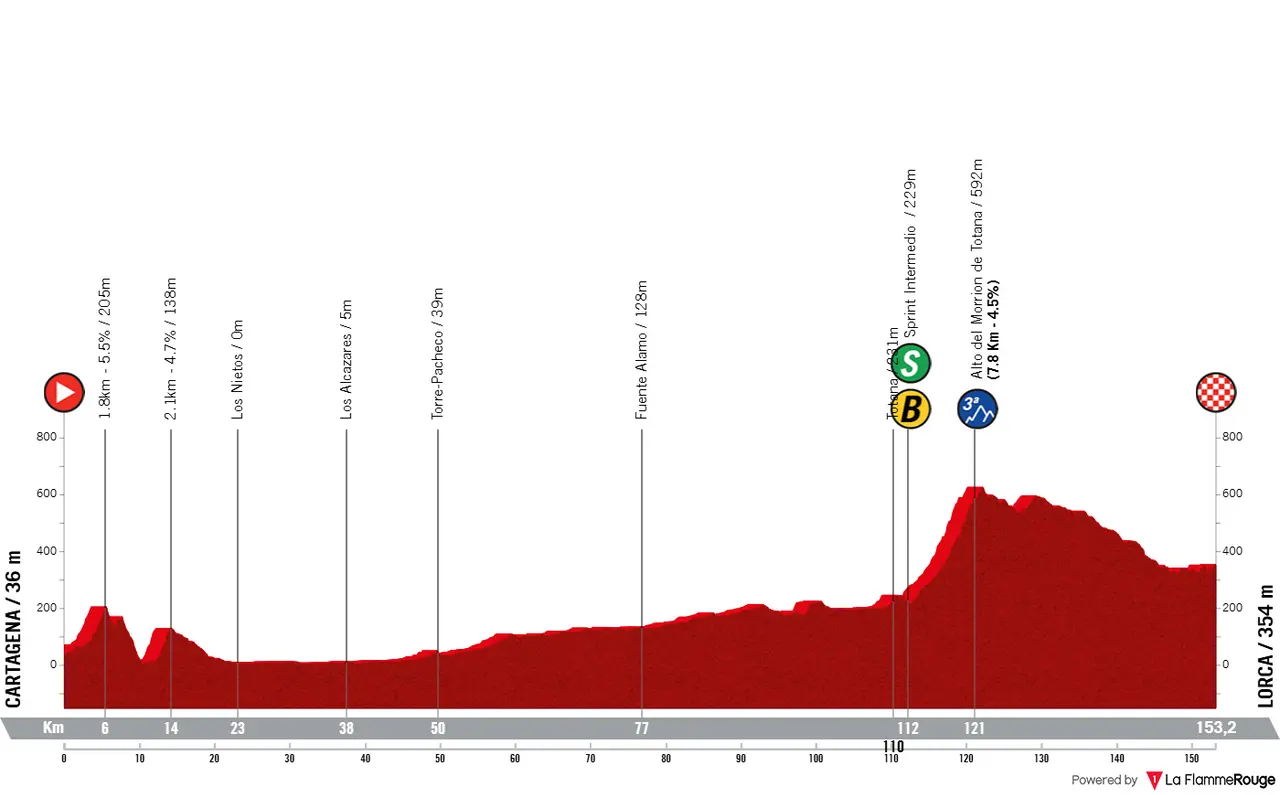
Cartagena - Lorca, 153 kilometers
Stage 11 also begins with two small climbs early in the day. The stage from Cartagena to Lorca is short, with 153 kilometers on the menu, and might be one of the sprinters' best opportunities throughout the opening two weeks of the race.
Most of the stage is flat, without traps to take into consideration. The one true obstacle, that is quite an obvious one, is the Alto del Morrion de Totana. It is 7.8 kilometers at 4.5%, not a climb that ever gets too steep, but it is in comparison like racing the Poggio di Sanremo twice.
At a calm pace, most sprinters will go through comfortably. At a hard pace, some will get dropped. There is not much descending from it, instead a gentle altitude loss until the final kilometers, before the riders enter Lorca for what is expected to be a bunch sprint.
Preview Vuelta a España 2026 Stage 12
Enric Mas will be forced to defend his lead on a day that doesn't favour him. That is because this is a stage where Movistar can be raided. It's been shown they don't have the collective to neutralize their rivals' attacks, but whereas previously Decathlon didn't use their riders to form breakaways and use them tactically, they now know they have to after the stage 9 failure to succeed.
Decathlon are the strongest team in the mountains and they will be tasked with placing riders in the break. On Velefique and the first part of Calar Alto, attacks can be made and differences can be achieved. Mas does not have the team to decimate the peloton, but may be the one attacking early in the final climb, because the final kilometers feature plenty flat sections. And if in Aitana the final ascent was already tactical, here it could be just as bad, but with losses this time as on the flat he can't pace for his rivals.
Teams having men in the breakaway to bridge across to on that finale can be incredibly important and make a world's difference - every GC team should have riders in the move. Mas will be tasked to make the difference beforehand so he does not get attacked there; whilst Felix Gall will be tasked with making the difference beforehand so he then bridges across to teammates.
Primoz Roglic, Oscar Onley, Richard Carapaz, Mattias Skjelmose and Harold Tejada are mostly tasked with following the attacks and then attacking over the rolling part of the climb. They can gain serious time if they time their moves perfectly - whilst other GC outsiders may find themselves in favourable positions as well.
But the stage win might be discussed amongst those part of the breakaway, as it should be a hard day to control and plenty strong climbers will have freedom. Juan Felipe Rodríguez, Ramses Debruyne, Filippo Zana, Finlay Pickering, Tobias Johannessen, Santiago Buitrago, Pavel Sivakov, Valentin Paret-Peintre, Mikel Landa, Eddie Dunbar, Iván Sosa and Marco Brenner are dangerous riders in a day for the climbers.
Prediction Vuelta a España 2026 Stage 12
*** Tobias Johannessen, Santiago Buitrago
** Pavel Sivakov, Eddie Dunbar
* Enric Mas, Felix Gall, Primoz Roglic, Oscar Onley, Richard Caarapaz, Ramses Debruyne, Juan Felipe Rodriguez, Finlay Pickering, Filippo Zana, Valentin Paret-Peintre
Pick: Santiago Buitrago
How: Breakaway victory.
Profile stage 12: Vera - Calar Alto
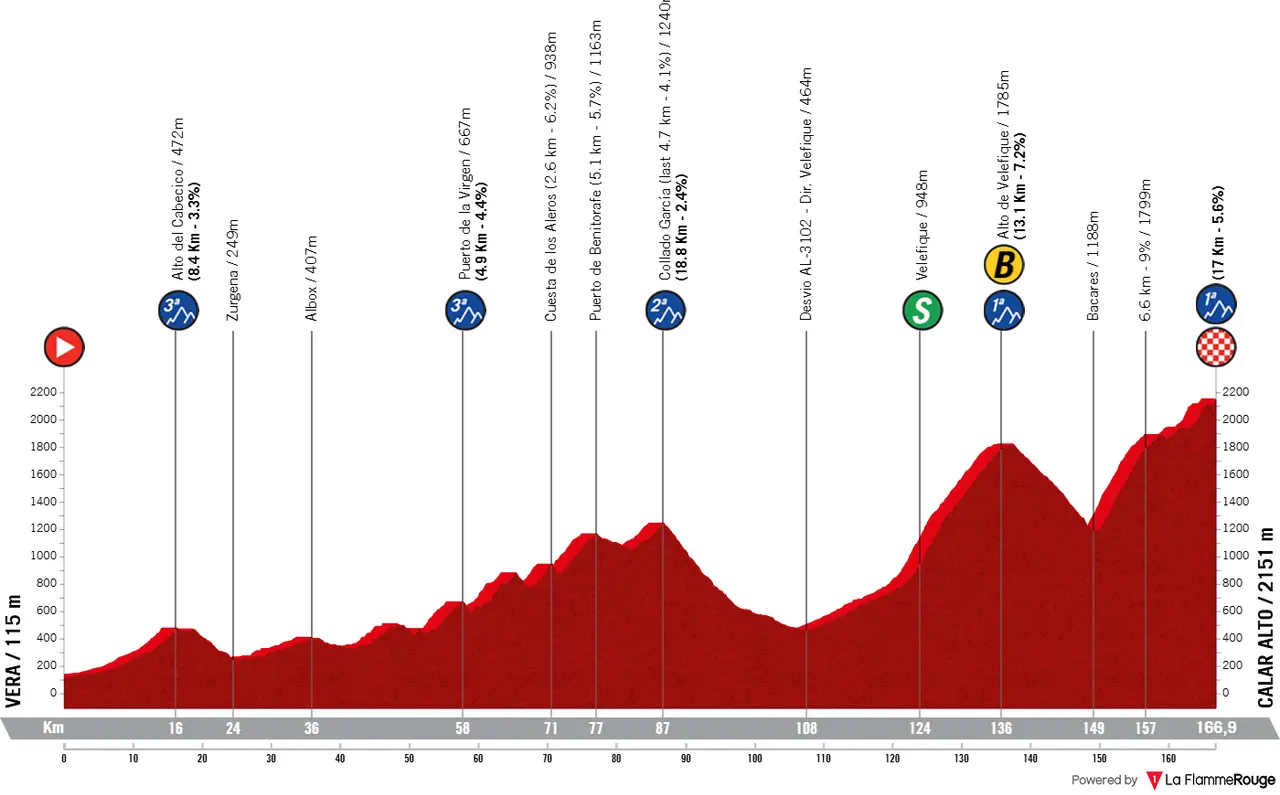
Vera - Calar Alto, 167 kilometers
The peloton heads back into the mountains on the 12th day of racing, featuring 4500 meters of climbing. The stage begins in Ver and throughout the first 120 kilometers there are a lot of rolling roads - small climbs scattered all throughout.
The race turns serious at the Alto del Velefique, 13.1 kilometers at 7.2% with a bonus sprint on top, ending with 31 kilometers to go. Due to the difficulty of the finale, this climb may not see much movement, but its difficulty can't be denied - specially with the countless switchbacks and the early 4 kilometers that average 9%.
The riders descend and then begin the climb to Calar Alto. This is a very difficult one to gauge, and a climb that can be very tactical. Its first 6.6 kilometers average 9%, the toughest part of the stage and where differences are more likely to be made.
The climb in total is 17 kilometers at 5.6%, but after this steep section it becomes a sequence of small ramps and flat sections. Between 3 and 2 kilometers to go the roads ramp up quite a lot once again and differences can still be made in a punchy finale, ending at 2150 meters of altitude.
Preview Vuelta a España 2026 Stage 15
After the general classification battle on La Pandera, the 2026 Vuelta a Espana will conclude its second week on Sunday with Stage 15, a medium-mountain day expected to produce a breakaway battle or reduced sprint.
The stage has been drastically shortened to 110.2km from its original distance of 189.7km because of the extreme temperatures in Andalusia.
Attention inevitably turns towards the star Team Visma | Lease a Bike pairing. Matthew Brennan has already won three stages at this Vuelta a Espana, while Wout van Aert opened his account on Stage 13.
Both will be among the favourites if they enter the breakaway. If neither makes the leading group, Team Visma | Lease a Bike may have to assume responsibility in the peloton, control the escape and attempt to deliver the stage through a sprint.
Kevin Vermaerke, Xabier Mikel Azparren, Magnus Cort, Ivo Oliveira, Pau Miquel, Andreas Leknessund, Andreas Kron, Stefan Kung, Finn Fisher-Black and Jarno Widar are also potential contenders. Movistar Team can once again look towards Orluis Aular.

Stage 15: Palma del Rio - Córdoba, 110 kilometers
Prediction: Stage 15 of the 2026 Vuelta a Espana
*** Wout van Aert, Matthew Brennan
** Kevin Vermaerke, Magnus Cort, Andreas Kron, Stefan Kung
* Orluis Aular, Xabier Mikel Azparren, Ivo Oliveira, Pau Miquel, Andreas Leknessund, Finn Fisher-Black, Jarno Widar
Pick: Wout van Aert
How: A late attack from the breakaway.
Preview Vuelta a España 2026 Stage 14
One of the most eagerly anticipated stages of the 2026 Vuelta a Espana has arrived. Stage 14 brings a brutal day in the high mountains, with all eyes on the legendary final climb to La Pandera (11.8km at 7.5%). That makes it abundantly clear that the general classification is set to explode once again, putting Movistar Team and red jersey Enric Mas firmly in the spotlight.
The Mallorcan faces a huge challenge as he looks to move closer to overall victory. On the previous mountain stage, he gained another 27 seconds on Primoz Roglic and Felix Gall, once again showing stronger legs than both at Calar Alto. Hot weather is expected on Saturday, which should theoretically suit the Movistar leader, although he will know his rivals need to attack and try to take time back.
Felix Gall has also lost his strongest domestique so far, Gregor Muhlberger, following a crash on Stage 13. Decathlon CMA CGM Team still have Matthew Riccitello and others capable of making the race hard, but it will not be quite the same. Primoz Roglic has yet to put his nose in the wind and has been conserving his strength well, but it would be surprising to see him launch a long-range attack given that he has not shown himself to be clearly stronger than the rest either.
One rider who can be expected to try something from distance is Richard Carapaz, as he has so often done throughout his career. Movistar Team cannot afford to panic if that happens, and their strategy should be similar to Stage 12, when Ivan Romeo managed to neutralise the Ecuadorian.
All of this opens the door wider than ever for the stage victory to come from the breakaway. On a day so well suited to pure climbers, the likes of Valentin Paret-Peintre, Santiago Buitrago, Leo Bisiaux, Jarno Widar, Lorenzo Fortunato, Pello Bilbao, Urko Berrade, Eddie Dunbar and Tobias Johannessen are expected to be back in contention for the win. Sepp Kuss and Mattias Skjelmose could also be possibilities, given that they are far enough behind the red jersey that they may be allowed into the breakaway.
Vuelta a Espana 2026 Stage 14 Prediction
*** Sepp Kuss, Valentin Paret-Peintre, Tobias Johannessen
** Enric Mas, Primoz Roglic, Felix Gall, Richard Carapaz, Santiago Buitrago
* Leo Bisiaux, Jarno Widar, Lorenzo Fortunato, Pello Bilbao, Urko Berrade, Eddie Dunbar, Mattias Skjelmose
Pick: Sepp Kuss
How: Victory from the breakaway.
Preview Vuelta a España 2026 Stage 13
A day for the breakaway. You could argue some sprinters could fight for a result on a day like this, but the teams will not be working to bring it back to a bunch sprint - or if they do, they won't likely be successful. The climbs at the start are quite hard and in such terrain it is very difficult to put on an organized chase.
But the formula is quite hard to get right. It will be necessary to be a good climber because the breakaway is likely to be formed in a difficult climb - and there is another decently hard one towards the end of the day.
Second, you need to have some sort of either good sprint or good ability to perform on the flat roads. This is not the case for many pure climbers, which makes it virtually impossible for a few to win even if they could make the difference on paper in the hardest ascents.
Thirdly tactical prowess is necessary. This can be a very tactical finale as some will try to anticipate the final climb; and maybe if a group goes through, there will be attacks before the finale itself. That makes it an interesting day racing wise, but one that should be chaotic.
Those who can sprint - amongst those included in this mix - can do quite well such as Wout Van Aert, Magnus Cort Nielsen, Alessandro Romele... Don't exclude Matthew Brennan even, Visma won't be working, and he might as well join the breakaway if he is able to.
The likes of Bastien Tronchon, Pau Miquel and Finn Fisher-Black can also be very dangerous for such scenarios; whilst the likes of Santiago Buitrago, Eddie Dunbar and Tobias Johannessen are perhaps amongst those who are best able to make the difference on the climbs.
Prediction Vuelta a España 2026 Stage 13
*** Wout Van Aert, Magnus Cort Nielsen, Alessandro Romele
** Kevin Vermaerke, Eddie Dunbar, Santiago Buitrago
* Finn Fisher-Black, Matthew Brennan, Bruno Armirail, Léo Bisiaux, Bastien Tronchon, Pello Bilbao, Ramses Debruyne, Alexey Lutsenko, Pau Miquel, Tobias Johannessen, Andreas Leknessund, Andreas Kron, Stefan Küng, Jarno Widar, Urko Berrade
Pick: Magnus Cort Nielsen
How: Small group sprint.
Profile stage 13: Almuñecar - Loja
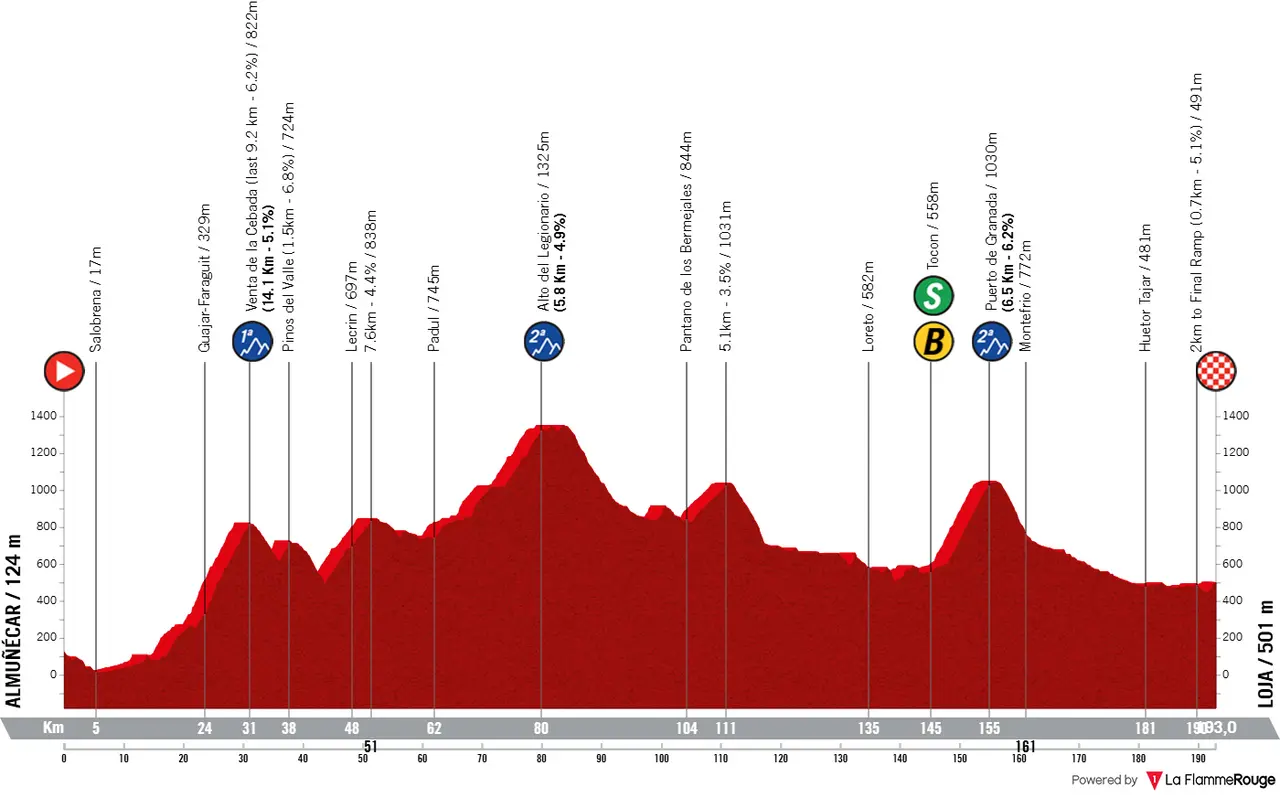
Almuñecar - Loja, 183 kilometers
Stage 13 of the Vuelta is a breakaway day, something that cannot be denied with such a difficult yet difficult to manage profile. The day begins in Almuñecar anf after 15 kiloemters the roads begin to tilt up.
There are around 3300 meters of climbing, a lot for most sprinters. Above all because the first categorized climb of the day is 14 kilometers long at 5%, and it is followed by several other climbs with only descents inbetween.
The first 80 kilometers of the day are simply quite hard and preventing a strong breakaway from going up the road is near impossible. Even if that were to happen, it's not smooth sailing for the final 100 kilometers.
There will only be one meaningful climb then, but it is still not an easy one. The Puerto de Granada is 6.5 kilometers long at 6.2% and ends with 28 kilometers to go. The route to the finish in Loja will be quite fast, with a downhill trend to it.
Still, in town, the riders will not have an easy finale. The final 1.5 kilometers average almost 4%, not a real climb but definitely something that will have an influence in the outcome if there is a sprint finish expected.
Profile stage 14: Jaén - Sierra de la Pandera
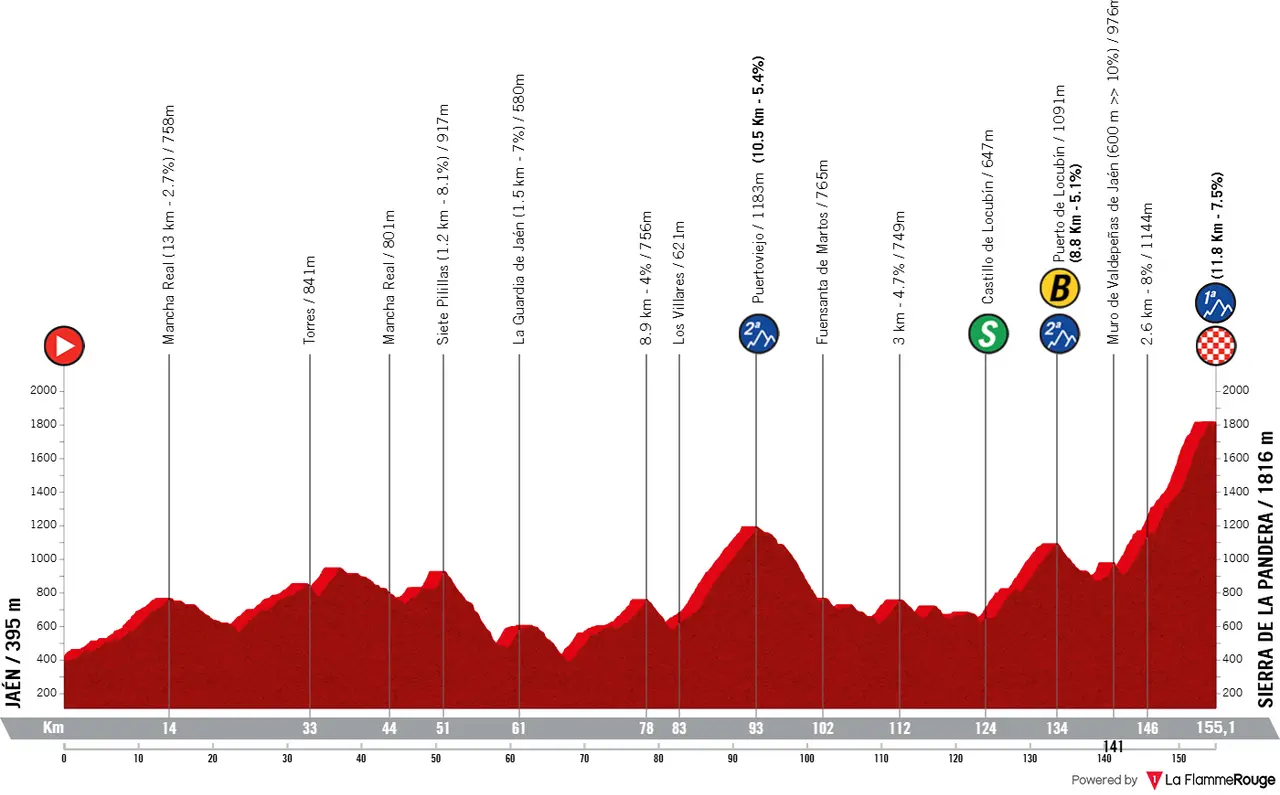
Jaén - Sierra de la Pandera, 155 kilometers
Stage 14 of the Vuelta sees the riders go back into the mountains and with a significant summit finish to be held. Another day with lots of climbing, but one true defining moment in the day.
The riders take off from Jaén and have 155 kilometers on the menu. There are 4100 meters of climbing but only three categorized climbs on the day - two second-category ascents, and then the Sierra de la Pandera.
The final climb is 11.8 kilometers at 7.5%, but the gradient is also slightly misleading as it is an inconsistent climb. The final meters are relatively flat, and there is a lot of fluctuation with the gradients all throughout it.
There will be a whole kilometer as steep as 13%, it is an effort for the pure climbers to make the difference at a time of the race where fatigue also begins to play a meaningful role.
Profile stage 15: Palma del Rio - Córdoba

Palma del Rio - Córdoba, 181 kilometers
The second week of the race ends with another stage designed for the breakaway specialists, those who thrive on the multiple efforts, including uphill and flat roads - as well as good timing and tactical prowess.
The riders begin in Palma del Rio and although the first 25 kilometers are flat, from there on a new race begins. Once again, no key moments on the day where it should absolutely be decided, but a sequence of climbs and rolling roads for hours.
All three categorized climbs should be important moments on the day however: The first is 7.5 kilometers at over 4% and could see the breakaway get formed there; the second is 8.4 kilometers at 3.5% and ends with 54 kilometers to go (leading into a fast section of the stage where rouleurs may give it a go)...
And the final climb is 5.9 kilometers long at 5.6%, potentially hard enough to make some important differences. It ends with only 23 to go, quite close to the finish whilst most of the final kilometers into Córdoba are downhill.
Preview Vuelta a España 2026 Stage 16
*By Javier Rampe
Stage 16 represents one of the final opportunities for the sprinters before the Vuelta enters its decisive closing stretch. The opening half of the route is considerably more demanding than the run to the finish, with rolling roads and repeated changes of rhythm across the Sierra de Aracena. That terrain should encourage attacks and provide a strong breakaway with an opportunity to test the determination of the sprint teams.
Stage 16 represents one of the final opportunities for the sprinters before the Vuelta enters its decisive closing stretch. The opening half of the route is considerably more demanding than the run to the finish, with rolling roads and repeated changes of rhythm across the Sierra de Aracena. That terrain should encourage attacks and provide a strong breakaway with an opportunity to test the determination of the sprint teams.
The route gradually becomes less demanding before a much flatter conclusion near the coast. Those final kilometres should favour the faster riders, although the exposed roads could make the wind an important factor. If a strong crosswind develops, positioning will become essential and the threat of echelons cannot be discounted.
A bunch sprint remains the most likely outcome, but reaching it will require work. The sprint teams must control the attacks across the more difficult opening terrain before keeping their leaders protected as the race approaches Puerto de Palos.
If the peloton can contain the breakaway and negotiate the exposed finale without splitting, the sprinters should contest the victory. With the time trial and further climbing still to come during the final week, opportunities this favourable are beginning to run out.
Vuelta a Espana 2026 Stage 16 prediction
*** Matthew Brennan
** Wout van Aert, Jordi Meeus, Bryan Coquard, Orluis Aular
* Steffen De Schuyteneer, Magnus Cort, Hugo Hofstetter, Bastien Tronchon, Alessandro Romele, Ivo Oliveira, Pau Miquel, Andreas Leknessund, Andreas Kron, Marc Brustenga
Prediction: Wout van Aert
How: Bunch sprint
Profile stage 16: Cortegana - La Rábida
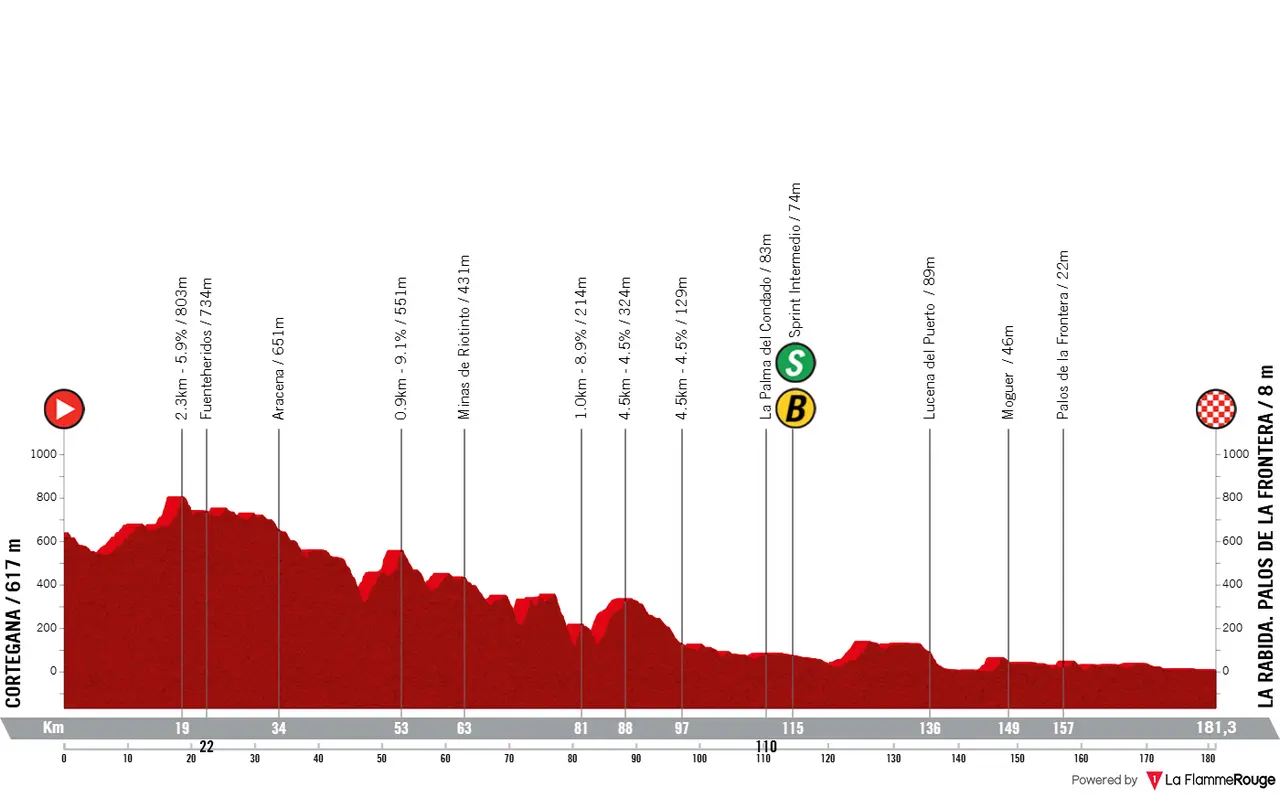
Cortegana - La Rábida, 181 kilometers
The final week of the race begins with a surprisingly flat stage, starting off in Cortegana. The first half of the stage is definitely not easy, packing in plenty small climbs, but none where the sprinters should really be put into difficulty.
The terrain could see a good breakaway manage to escape, but the final 95 kilometers are almost fully flat and in two hours of racing a lot of chasing can be done on favourable roads.
The riders head towards La Rábida for a finale close to the sea, where not only the heat can make a difference but also the wind. The finale takes place just outside of Huelva, with no meaningful technical features.
Preview Vuelta a España 2026 Stage 17
Another hot and flat day, in which not too much action is expected. An easy day for any team to control, whilst Team Visma | Lease a Bike have every reason to do so as Matthew Brennan is by far the main favourite. The Briton simply does not have competition at his level here, and even though his leadout suffered a hit, the presence of Wout Van Aert makes Visma the one team with a quality leadout.
Hence, it's very hard to prevent today's scenario from happening again. Only in a chaotic situation, which has happened in this race already, will the Briton lose it. Bryan Coquard is not a pure sprinter, but somehow has found himself in the best position behind consistently, so may be the best alternative to Brennan.
Jordi Meeus is on paper the other pure sprinter that can thrive in these flat finales, whilst the likes of Hugo Hofstetter, Magnus Cort Nielsen and Vito Braet will be amongst those hoping to challenge Visma and to be in the right place at the right time.
Vuelta a Espana 2026 Stage 17 prediction
*** Matthew Brennan
** Bryan Coquard
* Jordi Meeus, Wout Van Aert, Vito Braet, Magnus Cort Nielsen, Hugo Hofstetter
Pick: Matthew Brennan
How: Regular bunch sprint.
Profile stage 17: Dos Hermanas - Sevilla
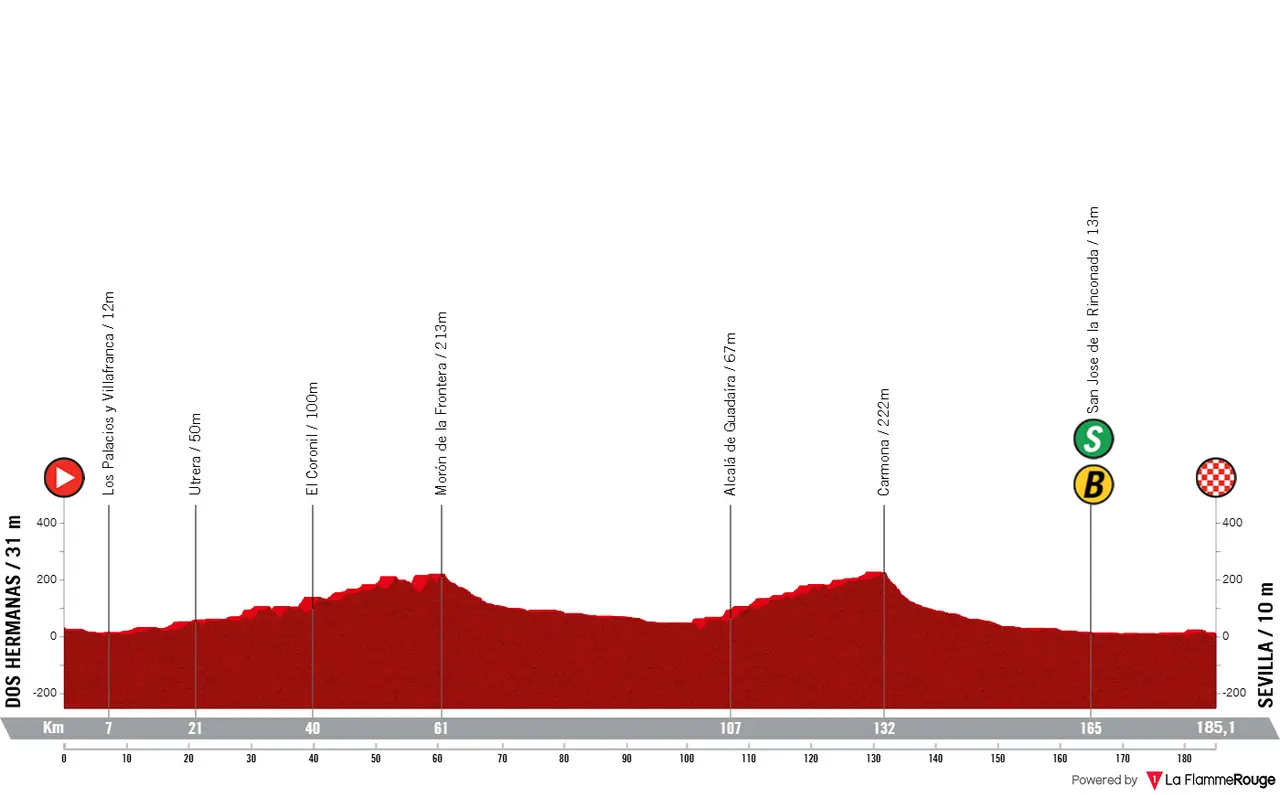
Dos Hermanas - Sevilla, 185 kilometers
Stage 17 takes place within terrain where the heat is usually extreme, specially at this time of year. It is the flattest stage of the race, beginning in Dos Hermanas and taking the riders through 185 kilometers of flatlands around Sevilla.
The riders will finish in Spain's southwestern city, a pan-flat finale within the city center where speeds should be quite high and the fast men that have held up until this point should be rewarded.
Preview Vuelta a España 2026 Stage 18
The stage should be battled between Ethan Hayter - second in the opening time trial - and Stefan Küng, who has been rather absent all throughout the Vuelta but had great form coming up to it. A pure flat time trial, it fits the specialists, and there simply are not many in the race besides the two who get a massive opportunity to take their season to another level.
Wout Van Aert is carrying great form and, although the time trial has long been his priority, he is someone to take into consideration so as to try and take a third stage win. Bruno Armirail, Iván Romeo and Ivo Oliveira are amongst the outsiders for the stage.
In the GC fight, the big question is whether Primoz Roglic can overtake Enric Mas and take the red jersey. The 2:10-minute gap is quite large, and makes it difficult. But in 32 kilometers it is possible to make big differences.
Roglic is likely to recover at least half the time gap he has to Mas, but unlikely to overtake the Spaniard. Felix Gall in the meantime is expected to lose time to both.
The fight for the Top5 positions behind is quite tight, in which we can expect Mattias Skjelmose to be quite above his competitors. But the 5-11th place might see quite a lot of changes in such a long effort - with riders who are often not in the place to fight for a result.
Vuelta a Espana 2026 Stage 18 prediction
*** Ethan Hayter, Stefan Küng
** Iván Romeo, Wout Van Aert
* Primoz Roglic, Mattias Skjelmose, Bruno Armirail, Ivo Oliveira, Oscar Chamberlain, Xabier Mikel Azparren
Pick: Ethan Hayter
Profile stage 18 (ITT): El Puerto de Santa María - Jerez de la Frontera
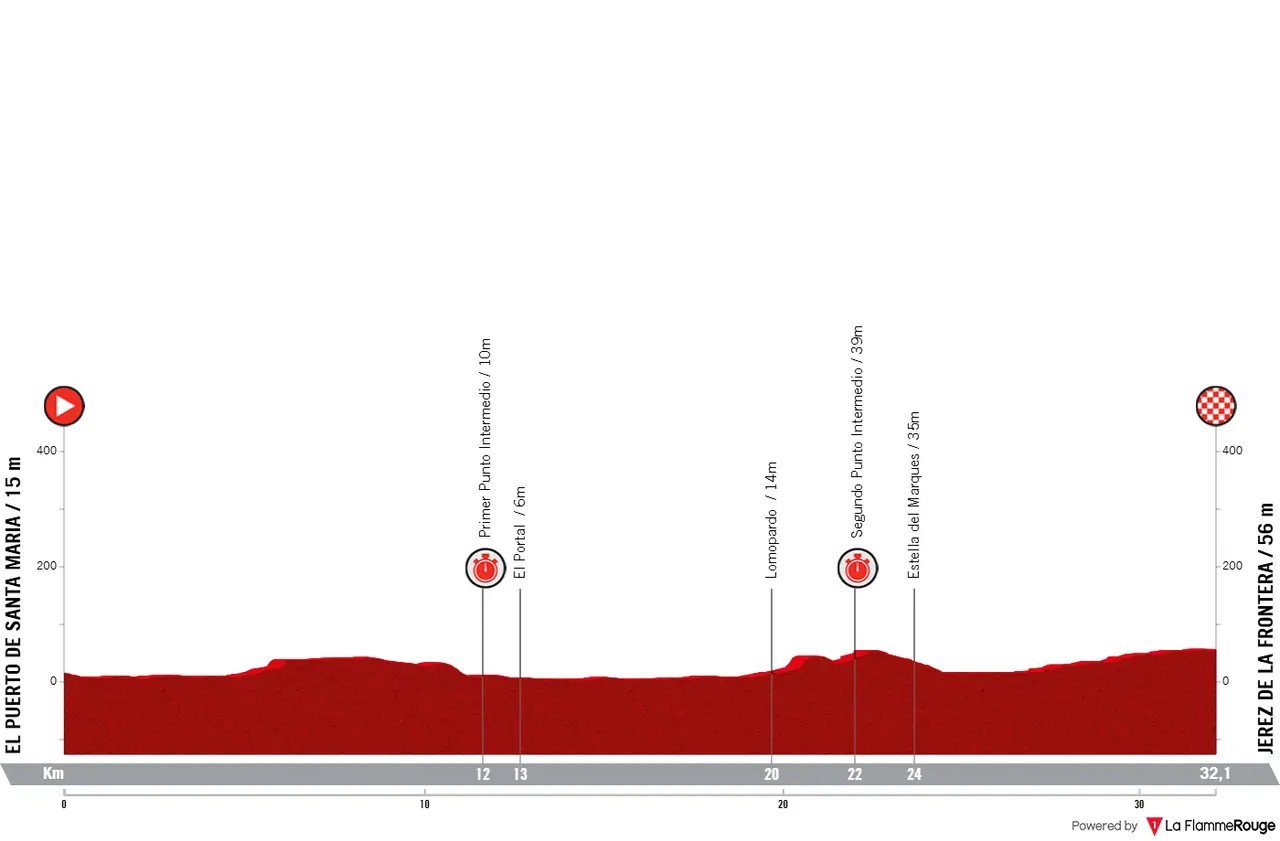
El Puerto de Santa María - Jerez de la Frontera, 32 kilometers
The riders take on their second individual time trial of the race in the final week. It is not extremely long, but is not short either.
It is a flat challenge against the click, going from El Puerto de Santa María to Jerez de la Frontera, featuring 32 kilometers on roads that are not technical and allow the specialists to really make a difference.
An important day for the overall classification, ahead of the final two mountain stages.
Preview of Stage 19 of the 2026 Vuelta a España
*By Jorge Borreguero
Stage 19 of the 2026 Vuelta a España represents one of the final major challenges in the battle for the general classification. Following the time trial, the fight at the top has largely developed into a duel between two riders: Enric Mas and Primoz Roglic. Felix Gall was the biggest loser among the top three and now sits three minutes behind the Spaniard. Everything is still possible for the Austrian, but Mas will primarily have his eyes on Roglic, who trails by just 1:37.
The stage heads into the high mountains and finishes with a summit finish. The final climb to Peñas Blancas (18.8km at 6.5%) will provide a serious test for the contenders for the red jersey. Richard Carapaz, Oscar Onley and Jakob Omrzel are also likely to seize their opportunity and try to put the riders ahead of them under pressure.
In the battle for the podium, Gall is the rider under the most pressure. The Austrian must defend his third place against the aforementioned rivals. Attacks can also be expected from Mattias Skjelmose, Clément Berthet and Cristián Rodríguez. Harold Tejada currently rounds out the top 10 and will have to keep Sepp Kuss behind him.
As for the stage victory, the breakaway could have an excellent chance if Movistar, Red Bull and Decathlon allow it enough freedom. That brings riders such as Valentin Paret-Peintre, Mikel Landa, Urko Berrade, Pello Bilbao, Léo Bisiaux, Matthew Riccitello and Santiago Buitrago into contention. For many of them, opportunities to leave this Vuelta with a stage victory are quickly running out. Even Sepp Kuss could make his way into the breakaway, with his deficit to the red jersey now large enough to give him some freedom.
Prediction for Stage 19 of the 2026 Vuelta a España
*** Valentin Paret-Peintre, Santiago Buitrago, Sepp Kuss
** Enric Mas, Primoz Roglic, Richard Carapaz, Felix Gall
* Oscar Onley, Jakob Omrzel, Mikel Landa, Urko Berrade, Pello Bilbao, Léo Bisiaux, Matthew Riccitello
Pick: Valentin Paret-Peintre
How: Victory from the breakaway
Profile stage 19: Vélez-Málaga - Peñas Blancas, Estepona

Vélez-Málaga - Peñas Blancas, Estepona, 210 kilometers
Stage 19 of the Vuelta features one of the hardest summit finishes. It is a long mountain stage, packing in 210 kilometers and 4000 meters of climbing. But there is no doubt that this is a day where the last climb will be everyone's priority.
The first 50 kilometers are almost fully flat, and then the riders find two categorized climbs, in the middle of several others that will make its effect felt in the legs. The riders descent back to sea level, reaching Estepona before they begin climbing.
The final ascent is no stranger to the Vuelta: The climb to Peñas Blancas. A dramatic change of setting, from sea level to 1274 meters of altitude in one go. The ascent is 18.8 kilometers at 6.5%, quite constant and a climb where serious differences can be created.
Preview of Stage Vuelta a España 2026 stage 20
The breakaway has chances of succeeding but it will require not only a massive effort but also a lot of luck. The final half of this stage is one of the hardest in modern cycling history and it can be said that minutes of difference will be created just about everywhere between those who feel best and those who do not. There is no chance for a non top climber to win such a day.
Santiago Buitrago has virtually sealed the KOM classification which is a big success for him, however the Colombian will want a stage. He can get it, Bahrain is fully focused on that objective, and he has got climbs that suit him. His efforts for the classification may have costed him somewhat but he has been good at entering the right moves and may have the luck on the final mountain stage.
Today's winner Eddie Dunbar will of course be amongst the favourites too, alongside his teammate Tom Gloag; João Almeida who is in rising form, and others such as Sepp Kuss, Urko Berrade and Valentin Paret-Peintre who should all aim for the breakaway.
When it comes to the GC fight: It's not over until it's over. Enric Mas is solid in the race lead, and looked to be riding within his limits this Friday afternoon. The Spaniard mantained his lead in the race, and looked to be saving up for the race's queen stage. As the strongest climber these past few weeks, he looks ready to virtually seal the overall win.
Primoz Roglic is looking good and attacked the race for the first time serious today; Felix Gall continues to be a threat specially in such a brutal stage; And Richard Carapaz is going to try and explode the race from early on most likely to try and capitalize on chaos. But Mas has over 5 minutes on Carapaz so he can afford to let him go; and instead focus on Roglic and Gall whilst trying to feature riders in the breakaway.
Oscar Onley looks to also want to risk it all to jump into the podium, although he would most likely be better at trying to defend his white jersey from Jakob Omrzel whose form has been on the rise throughout the entire Vuelta.
Prediction Vuelta a España 2026 stage 20
*** Enric Mas, Santiago Buitrago
** Felix Gall, Primoz Roglic, João Almeida, Eddie Dunbar
* Richard Carapaz, Oscar Onley, Jakob Omrzel, Clément Berthet, Urko Berrade, Tom Gloag, Tobias Johannessen, Sepp Kuss, Valentin Paret-Peintre, Ramses Debruyne,
Pick: Enric Mas
How: Solo win.
Profile stage 20: La Calahorra - Collado del Alguacil

La Calahorra - Collado del Aguacil, 187 kilometers
The queen stage of the race and also the final day in the mountains. Around Granada, there are plenty mountains and of course, the Sierra Nevada. Whilst the riders don't head towards the ski station, they go up and down the steep roads between Granada and the mythical mountain.
4850 meters of climbing on a day where route changes were forced recently, due to poor road condition on the Alto de Hazallanas. The riders begin the stage in La Calahorra and the first 80 kilometers are in fact not too difficult.
But the final 110 are nightmare fuel. Firstly comes the Alto de El Purche, 8.2 kilometers at 8.1% (with a descent towards the end). This is a brutal climb, often used in the past at the Vuelta and Vuelta a Andalucia - and here it will be climbed twice, ending with 92 and 65 kilometers to go.
The riders will then go up to Guéjar Sierra through it's inconsistent climb and then instead of turning towards the traditional Hazallanas road, they go down to the Rio Genil and cross it at a different point.
The ascent ends up being incredibly similar, and ends in the same location. But instead, the Puerto del Duque is 7.4 kilometers long at 8.2%. The first 2.3 average 10%, and it is another climb with plenty switchbacks.
At this point in the race, the GC fight might have blown up to bits. The climb ends with 31 kilometers to go and the descent is both very technical and steep, providing another major challenge.
The riders then go up to Guejar Sierra once again, before officially beginning the final climb.
The Collado del Alguacil is terrifying, specially at the end of such a day. 8.4 kilometers at 10% makes it just about the steepest mmountain in the race, and an incredibly difficult effort. There is no hiding in a mountain that is unrelenting in its gradients and puts an end to the hardest day of the whole race.
List of winners Vuelta a España
| Year | 1st | 2nd | 3rd |
| 2025 | Jonas Vingegaard | João Almeida | Tom Pidcock |
| 2024 | Primož Roglič | Ben O'Connor | Enric Mas |
| 2023 | Sepp Kuss | Jonas Vingegaard | Primož Roglič |
| 2022 | Remco Evenepoel | Enric Mas | Juan Ayuso |
| 2021 | Primož Roglič | Enric Mas | Jack Haig |
| 2020 | Primož Roglič | Richard Carapaz | Hugh Carthy |
| 2019 | Primož Roglič | Alejandro Valverde | Tadej Pogačar |
| 2018 | Simon Yates | Enric Mas | Miguel Ángel López |
| 2017 | Chris Froome | Vincenzo Nibali | Ilnur Zakarin |
| 2016 | Nairo Quintana | Chris Froome | Esteban Chaves |
| 2015 | Fabio Aru | Joaquim Rodríguez | Rafał Majka |
| 2014 | Alberto Contador | Chris Froome | Alejandro Valverde |
| 2013 | Chris Horner | Vincenzo Nibali | Alejandro Valverde |
| 2012 | Alberto Contador | Alejandro Valverde | Joaquim Rodríguez |
| 2011 | Chris Froome | Bradley Wiggins | Bauke Mollema |
| 2010 | Vincenzo Nibali | Peter Velits | Joaquim Rodríguez |
| 2009 | Alejandro Valverde | Samuel Sánchez | Cadel Evans |
| 2008 | Alberto Contador | Levi Leipheimer | Carlos Sastre |
| 2007 | Denis Menchov | Carlos Sastre | Samuel Sánchez |
| 2006 | Alexandr Vinokourov | Alejandro Valverde | Andrey Kashechkin |
| 2005 | Roberto Heras | Denis Menchov | Carlos Sastre |
| 2004 | Roberto Heras | Santiago Pérez | Francisco Mancebo |
| 2003 | Roberto Heras | Isidro Nozal | Alejandro Valverde |
| 2002 | Aitor González | Roberto Heras | Joseba Beloki |
| 2001 | Ángel Luis Casero | Óscar Sevilla | Levi Leipheimer |
| 2000 | Roberto Heras | Ángel Luis Casero | Pavel Tonkov |
| 1999 | Jan Ullrich | Igor González de Galdeano | Roberto Heras |
| 1998 | Abraham Olano | Fernando Escartín | José María Jiménez |
| 1997 | Alex Zülle | Fernando Escartín | Laurent Dufaux |
| 1996 | Alex Zülle | Laurent Dufaux | Tony Rominger |
| 1995 | Laurent Jalabert | Abraham Olano | Johan Bruyneel |
| 1994 | Tony Rominger | Mikel Zarrabeitia | Pedro Delgado |
| 1993 | Tony Rominger | Alex Zülle | Laudelino Cubino |
| 1992 | Tony Rominger | Jesús Montoya | Pedro Delgado |
| 1991 | Melchor Mauri | Miguel Induráin | Marino Lejarreta |
| 1990 | Marco Giovannetti | Pedro Delgado | Anselmo Fuerte |
| 1989 | Pedro Delgado | Fabio Enrique Parra | Óscar de Jesús Vargas |
| 1988 | Sean Kelly | Reimund Dietzen | Anselmo Fuerte |
| 1987 | Luis Alberto Herrera | Reimund Dietzen | Laurent Fignon |
| 1986 | Álvaro Pino | Robert Millar | Sean Kelly |
| 1985 | Pedro Delgado | Robert Millar | José Francisco Rodríguez |
| 1984 | Éric Caritoux | Alberto Fernández | Reimund Dietzen |
| 1983 | Bernard Hinault | Marino Lejarreta | Alberto Fernández |
| 1982 | Marino Lejarreta | Michel Pollentier | Sven-Åke Nilsson |
| 1981 | Giovanni Battaglin | Pedro Muñoz | Vicente Belda |
| 1980 | Faustino Rupérez | Pedro Torres | Claude Criquielion |
| 1979 | Joop Zoetemelk | Francisco Galdós | Michel Pollentier |
| 1978 | Bernard Hinault | José Pesarrodona | Jean-René Bernaudeau |
| 1977 | Freddy Maertens | Miguel María Lasa | Klaus-Peter Thaler |
| 1976 | José Pesarrodona | Luis Ocaña | José Nazábal |
| 1975 | Agustín Tamames | Domingo Perurena | Miguel María Lasa |
| 1974 | José Manuel Fuente | Joaquim Agostinho | Miguel María Lasa |
| 1973 | Eddy Merckx | Luis Ocaña | Bernard Thévenet |
| 1972 | José Manuel Fuente | Miguel María Lasa | Agustín Tamames |
| 1971 | Ferdinand Bracke | Wilfried David | Luis Ocaña |
| 1970 | Luis Ocaña | Agustín Tamames | Herman Van Springel |
| 1969 | Roger Pingeon | Luis Ocaña | Rini Wagtmans |
| 1968 | Felice Gimondi | José Pérez Francés | Eusebio Vélez |
| 1967 | Jan Janssen | Jean-Pierre Ducasse | Aurelio González |
| 1966 | Francisco Gabica | Eusebio Vélez | Carlos Echeverría |
| 1965 | Rolf Wolfshohl | Raymond Poulidor | Rik Van Looy |
| 1964 | Raymond Poulidor | Luis Otaño | José Pérez Francés |
| 1963 | Jacques Anquetil | José Martín Colmenarejo | Miguel Pacheco |
| 1962 | Rudi Altig | José Pérez Francés | Seamus Elliott |
| 1961 | Angelino Soler | François Mahé | José Pérez Francés |
| 1960 | Frans De Mulder | Armand Desmet | Miguel Pacheco |
| 1959 | Antonio Suárez | José Segú | Rik Van Looy |
| 1958 | Jean Stablinski | Pasquale Fornara | Fernando Manzaneque |
| 1957 | Jesús Loroño | Federico Bahamontes | Bernardo Ruiz |
| 1956 | Angelo Conterno | Jesús Loroño | Raymond Impanis |
| 1955 | Jean Dotto | Antonio Jiménez | Raphaël Géminiani |
| 1950 | Emilio Rodríguez | Manuel Rodríguez | José Serra |
| 1948 | Bernardo Ruiz | Emilio Rodríguez | Bernardo Capó |
| 1947 | Edward Van Dijck | Manuel Costa | Delio Rodríguez |
| 1946 | Dalmacio Langarica | Julián Berrendero | Jan Lambrichs |
| 1945 | Delio Rodríguez | Julián Berrendero | Juan Gimeno |
| 1942 | Julián Berrendero | Diego Cháfer | Francisco Antonio Andrés |
| 1941 | Julián Berrendero | Fermín Trueba | José Jabardo |
| 1936 | Gustaaf Deloor | Alfons Deloor | Antonio Bertola |
| 1935 | Gustaaf Deloor | Mariano Cañardo | Antoon Dignef |
Rúben SilvaEditor-in-Chief
A founding contributor to CyclingUpToDate since its launch in January 2022, Ruben Silva has played a central role in shaping the site’s editorial direction and long-term growth. Before joining the project, he built his experience through independent blogging at Echelons Hub and by producing race previews for Ciclismo Internacional, developing a strong analytical voice rooted in daily engagement with professional cycling.
Beyond editorial work, he has been closely involved in the expansion and coordination of CyclingUpToDate’s wider network, helping establish and support sister platforms across multiple languages. This includes ongoing collaboration with CiclismoAlDia (Spanish), CiclismoAtual (Portuguese), WielrennenUpToDate (Dutch), and RadsportAktuell (German), contributing to a shared editorial vision and consistent international coverage.
He also helps oversee editorial governance across the network, setting standards for accuracy and consistency and coordinating updates or corrections when needed.
Originally from the Porto metropolitan area in Portugal, he holds a bachelor’s degree in Geography. His path into cycling journalism was shaped not through formal media training, but through independent reporting, community engagement, and sustained on-the-ground involvement in the sport.
Over the course of his career, he has conducted approximately 100 interviews across road cycling and cyclocross, ranging from one-to-one conversations and online formats to press conferences and on-site pre- and post-race coverage. His interviews include leading riders, team managers, and prominent figures within cycling media: Tadej Pogacar, Jonas Vingegaard, Mathieu van der Poel, Primoz Roglic, Wout van Aert, Joao Almeida and Tom Pidcock; managers like Patrick Lefevere and Joxean Matxin; and YouTube personality Bryan Kennedy (BKXC)...
Within 18 months of launch, he helped grow CyclingUpToDate’s English-language platform into one of the most-read cycling news websites, built entirely from the ground up. As both a professional journalist and lifelong cycling enthusiast, his focus remains on delivering accurate, timely, and well-contextualized coverage.
claps 11visitors 6
Just in
Popular news
Latest comments
- Maybe Net Company INEOS should be signing Roglic. Feels like they have been mostly irrelevant since G hung up the shoes. At least they would have someone who is there or there abouts on GC.MASnell09-10-2026
- Maybe Net Company INEOS should be signing Roglic. Feels like they have been mostly irrelevant since G hung up the shoes. At least they would have someone who is there or there abouts on GC.MASnell09-10-2026
- i guess there's journalism and then there's journalism. this website simply collects cycling stories and aggregates them in one portal for us fans to access. they aren't really investigative reporters, and their team likely isn't big enough to go into real depth... which is fine by me since i don't expect much more from them. that said, i agree with your view. it would be nice to see a bit more follow-up that pushes the people in charge to actually take a stance.Ketterechts08-10-2026
- UAE was really badly positioned at the last climb, and Ineos did a great job of making that happen at the bottom. That must have affected del Toro and the rest. His attack wasn't spectacular, and they hadn't ripped apart the bunch enough, letting a large group remain in back to reel him in. UAW lost the race on the road to the climb and the bottom third of it, I think.RidesHills08-10-2026
- He won in exactly the same way as others. By being the fastest to complete the stages.mobk08-10-2026
- Very surprised del toro couldn't beat everyone here against lesser competition. He's well on his way to being top 5 in the worldbruins3008-10-2026
- Being the best rider left in the race is pretty much the only way to win in any edition, surely? Seems reductive to say "they only won because the entire peloton wasn't as absolutely stacked as it could've been" - you can only beat who is in front of you.wrsty08-10-2026
- I’m sorry but generally the coverage on your site is first class but this incident highlights something I just don’t get with cycling journalism. This accident should never have been allowed to happen, it comes uncomfortably close to the Finlay Tarling tragedy and two other incidents took place within days of this. I checked all of the cycling websites and you all put out basically the same story. Pidcock gave journalists the perfect opening to blow this sky high, what has the UCI got to say? What is Adam Hansen doing? What do the organisers say? Nothing, you all trot out the same easy quotes taken from Pidcocks interview after the race but do nothing to follow it up. I see it time and time again, journalists taking the easy way out but being outraged when it happens again as it surely will. Riders can’t do this but journalists should be independent and should be able to raise these uncomfortable questions but cyclinguptodate and every other on line publication prefer to take the easy way out. That’s the real tragedy here.Paul53108-10-2026
- Happy to help :-)Mistermaumau08-10-2026
- Well, ok but, it’s also a structural, team, budgeting, direction and all sorts of other issueMistermaumau08-10-2026
Loading
7 Comments