Results Middlekerke - Wevelgem 2026 | Jasper Philipsen wins dramatic In Flanders Fields Van der Poel vs Van Aert rivalry lights up another classic
Cycling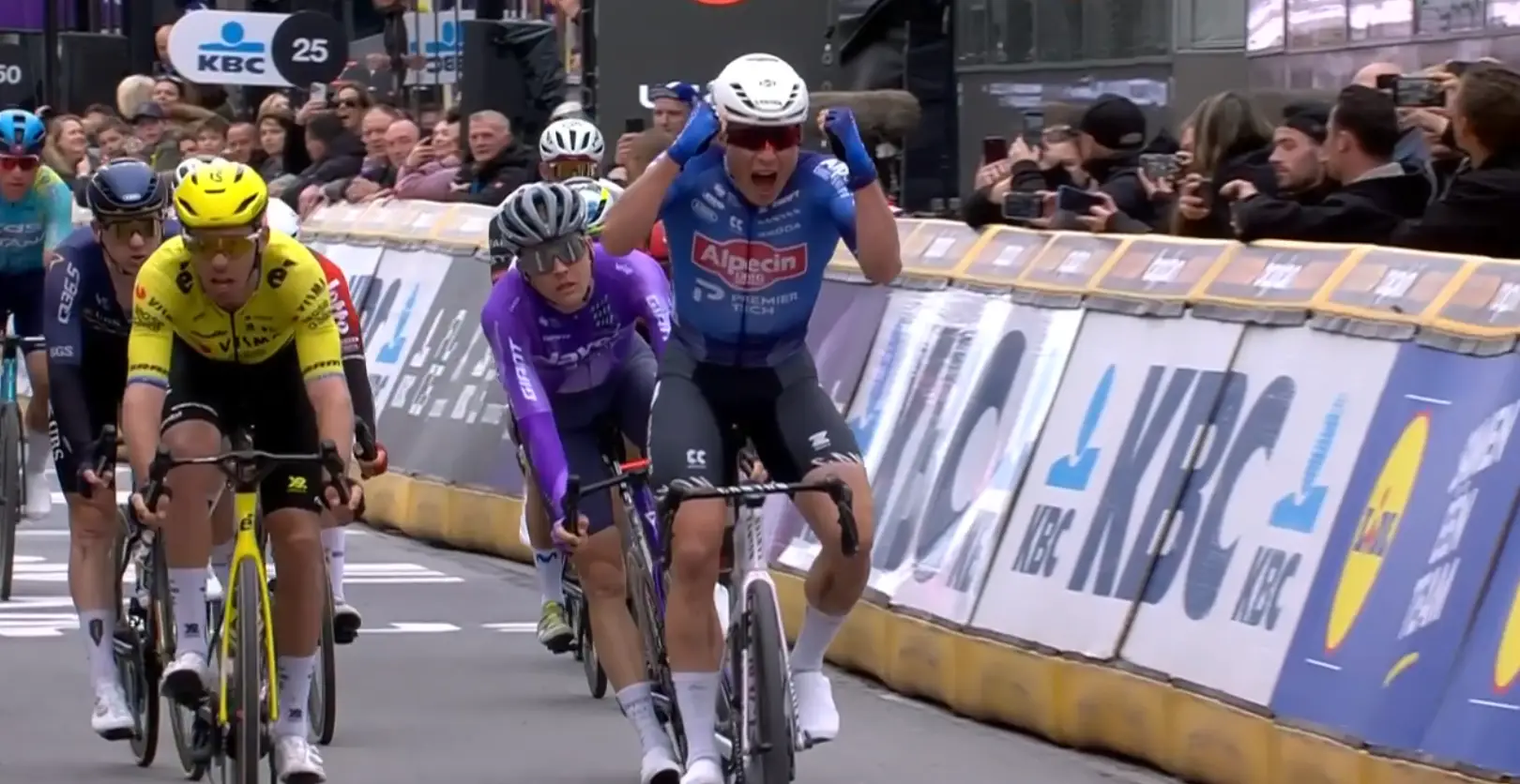
Jasper Philipsen sprinted to victory in the fastest ever edition of In Flanders Fields 2026, but the race will be remembered for another gripping chapter in the rivalry between Mathieu van der Poel and Wout van Aert.
After a long day marked by crosswinds, crashes and constant attacking, the final ascent via the steep Ossuaire side delivered the decisive move, with only Van Aert able to follow Van der Poel’s acceleration as the rest of the race fractured behind them.
An early eight-rider breakaway set the tone from the start in Middelkerke, forming after a series of attacks and quickly building a lead of over five minutes. Dries De Bondt, Jules Hesters and Victor Vercouillie were among those up the road as the peloton allowed the move to establish itself heading towards the exposed coastal roads.
The expected crosswind action in De Moeren increased the pace but did not immediately split the race. While it did not produce a decisive selection, the sustained effort and positioning battle began to wear the peloton down, laying the foundations for the fractures that followed inland.
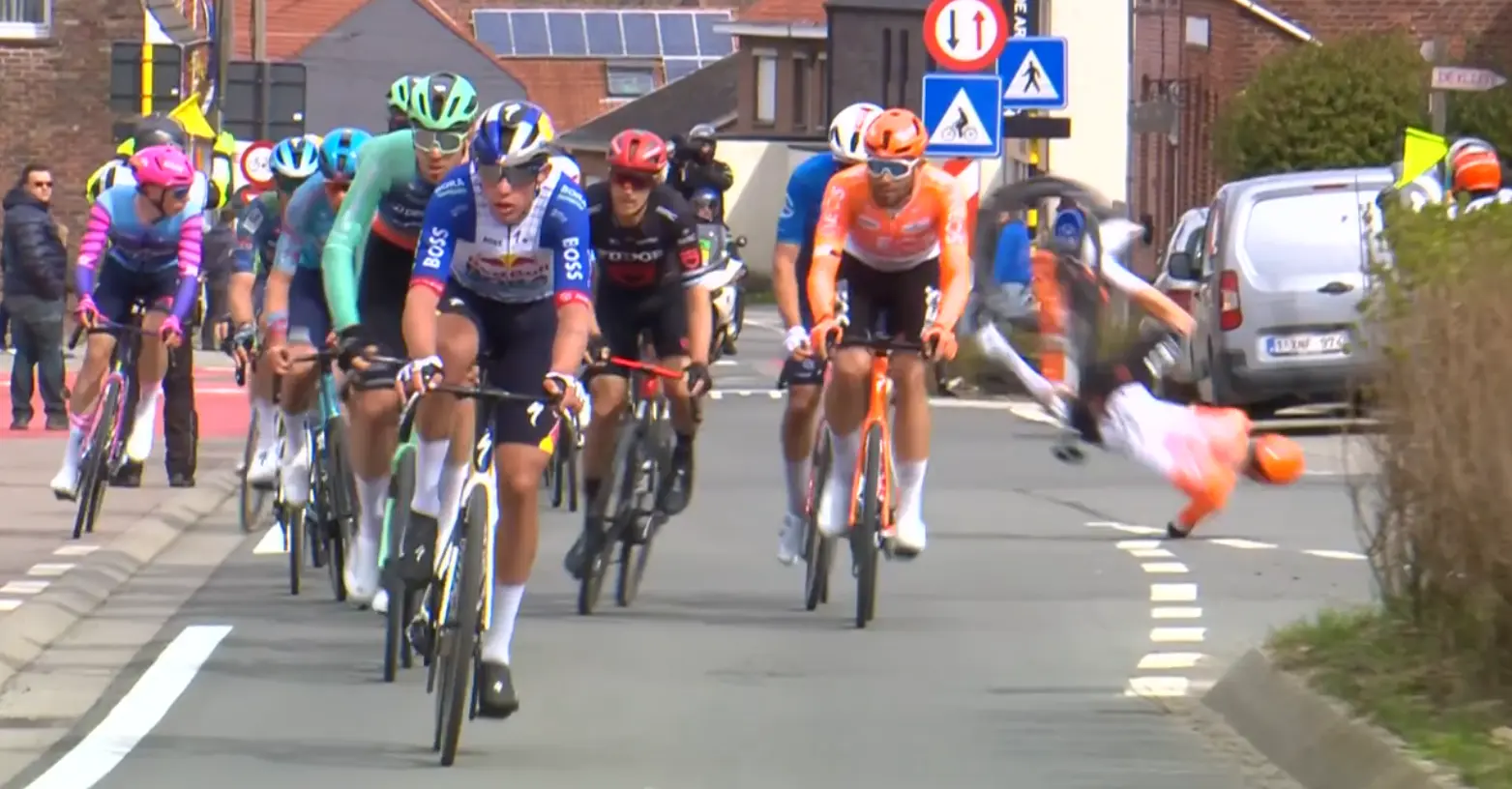
A crash in the feed zone disrupted the rhythm further, leaving several riders on the ground and forcing teams to reorganise before the race had reached the climbs.
Pressure builds before chaotic middle phase
It was only after leaving the coastal roads that the race began to fracture. A front echelon formed on the exposed roads inland, with several riders caught out behind and forced into an early chase, though the move did not fully settle the race.
What followed was a prolonged and aggressive middle phase. Attacks came repeatedly across the hills and plugstreets, with Jasper Stuyven among the most active, forcing the pace on narrow sectors and stretching the peloton into a long line.
The repeated accelerations over the plugstreets further thinned the field and ensured that the decisive climb would be ridden under heavy fatigue. Moves from riders such as Christophe Laporte, Gianni Vermeersch and Ben Turner failed to establish separation, as no group was allowed to gain control.
Mechanical issues and incidents added further disruption. Paul Magnier lost ground after a bike change, while Turner later crashed heavily in a high-speed fall that ended his race. The crash also disrupted INEOS Grenadiers’ chase, removing a key rider at a crucial point in the race.
Meanwhile, the early breakaway began to lose its advantage, but it was Wout van Aert who ultimately brought the race back together. His acceleration on the Kemmelberg split the front of the race and carried himself, Mathieu van der Poel and Florian Vermeersch across to the remnants of the break, reshaping the race around a new leading group.
Kemmelberg delivers decisive split
The race finally broke apart on the final ascent of the Kemmelberg. Van der Poel set a fierce pace on the climb, immediately reducing the leading group. Riders from the early breakaway were the first to crack, and while Vermeersch initially held on as the selection was made, he was eventually distanced. Only Van Aert remained alongside Van der Poel.
The Belgian matched the acceleration on the steep slopes and crested the climb with the Dutchman, leaving the two riders clear at the front as the race split behind them.
Chaotic finale turns race on its head
With 20 kilometres remaining, the race had taken on its final form. Van der Poel and Van Aert led together at the front, working smoothly to extend their advantage. Florian Vermeersch remained in between at around 15 seconds, briefly threatening to close the gap before fading again on the false flats.
Behind them, the peloton had reorganised and was riding at speed, gradually absorbing the remnants of the early breakaway. Several fast finishers remained in contention, increasing the pressure on the leading duo.
That pressure intensified in the final kilometres. Vermeersch was eventually caught after a strong ride, removing the buffer between the leaders and the peloton. At the same time, the sprint threat shifted, with Jonathan Milan delayed by a bike change and losing contact, while Luke Lamperti also dropped out of contention after a puncture.
Despite those setbacks, the chase remained organised. Red Bull-BORA-hansgrohe committed riders to the front in support of Jordi Meeus, helping to bring the gap down rapidly inside the final 15 kilometres.
Inside the final 10 kilometres, the gap collapsed. Van der Poel and Van Aert were caught in the closing kilometres as the peloton finally made contact, bringing the race back together at the front.
However, the moment of regrouping immediately sparked a decisive counter.
Alec Segaert attacked just before the flamme rouge, timing his move perfectly as hesitation rippled through the peloton. The Belgian surged clear, catching the field off guard and quickly opening a gap.
The move proved short-lived. Segaert was reeled in inside the final kilometre as the peloton surged forward once more, setting up a reduced bunch sprint after a day that never settled. Jasper Philipsen emerged fastest in that sprint, taking victory in the fastest ever edition of the race ahead of Tobias Lund Andresen, bringing a breathless and unpredictable edition of In Flanders Fields to a close.

Results powered by FirstCycling.com
Carlos Silva is a writer for CyclingUpToDate.com, where he contributes race reports, interviews, analysis pieces, and live coverage of the international cycling calendar. Holding a degree in Sports from the Jean Piaget Institute, he combines academic knowledge of performance, training, and competition with hands-on journalism experience in professional cycling.
Throughout his career, Carlos has conducted interviews with leading figures in the sport, including Alberto Contador, Joaquim Rodríguez, Óscar Pereiro, João Almeida, Isaac del Toro, Derek Gee, John Degenkolb and Geraint Thomas. These conversations reflect direct engagement with Grand Tour winners, Classics specialists, and emerging talents.
He has provided on-site coverage at major events ranging from the Vuelta a España to the Tour de France, alongside stage races such as Vuelta a Andalucía, Volta ao Algarve, Volta a Portugal and O Gran Camiño. Covering the mythical climbs of the Giro d'Italia remains one of his professional ambitions.
Carlos is responsible for liveblog coverage of all major WorldTour races and beyond, including the Tour de France, Giro d'Italia and Vuelta a España. His reporting integrates verified data from ProCyclingStats to ensure statistical accuracy, contextual depth, and analytical precision.
A lifelong cycling enthusiast, he approaches storytelling across written, photographic, and video formats with a focus on credibility, tactical insight, and informed race interpretation.
claps 3visitors 2
Just in
Popular news
Latest comments
- Ah, finally someone willing to be a bit proactive.Jumpyjohn09-11-2026
- So? Do you understand the way instructions, decisions and authority work? Do you think in a football match if after a match (or even after play has gone on) a player tells the referee he did touch the ball with his hands when the referee didn’t award opponents a penalty that they will revise the score or force a replay? You really don’t get my point, it’s not against the rider but everyone here is so emotional for her they can’t get back to an issue which needs resolving for the future and the first step (or maybe second) is to try to understand how and why it happens, none of you have contributed in the least to that. All everyone is interested in is letting everyone know they agree how unjust it was, not even sure anyone thinks that could affect anything.Jumpyjohn09-11-2026
- Shouldn’t you be in MOUrning?Jumpyjohn09-11-2026
- Maybe you don’t like it and that’s fine, we all have different sensibilities and topics that touch us, but as you try to show me, it doesn’t hurt to reflect and compare ourselves to others behaving similarly. What precisely is the difference between a sports fan interested in every detail of his/her hero’s life and a celeb fan having the same hobby? It’s far more interesting to learn and think about how and why (which) people do things than reading about what they are actually doing. And just to add another level, maybe you’ll agree we don’t use the same value system for everyone, we discriminate in an enormous number of systematic ways. For example, when is the last time you saw a discussion arguing about the achievements of two politicians to compare or for that matter two business leaders apart from the comparison of hypothetical wealth accumulated? Perhaps you misunderstood the intention?Jumpyjohn09-11-2026
- I don’t think I know what’s beneath the surface but I am willing to think about it, discuss it, compare it to a known past, extrapolate to a potential future and ask/try to find out truth or even take action within my powers (boycotting something or someone is within EVERY person’s reach). If you think your attitude has more chance of changing a result, a process, a system or an institution or it just makes you feel good, keep at it but to me it looks like you’ve already given up before trying.Jumpyjohn09-11-2026
- All journalists should start asking the UCI uncomfortable questions, sending inquiries about the interpretation of the rules and the justification of the results. This is the only way to change anything.averagecyclist09-11-2026
- OFF TOPIC: OK, don't get mad with me... I have some very important news, something that can't be overlooked, something that can't be ignored!!! In the new documentary Anatomy of a G.O.A.T. (released in November 2026), legendary Belgian cyclist EDDY MERCKX spoke about TADEJ POGAČAR: Merckx: “He has revived a style of cycling that we had almost forgotten. He is now better than me.” Key statements by Merckx about Pogačar in 2026: - Acknowledging his superiority: This time, Merckx openly admitted, without any subsequent backtracking or reservations, that Pogačar had surpassed him and was now above him. This contrasts with 2024, when he quickly softened his remarks about Pogačar being faster. - The possibility of a historic triple (Giro, Tour and Vuelta): During the July Tour de France (where Pogi claimed his fifth title), Merckx stated that Pogi was the only cyclist in history capable of winning all three Grand Tours (the Giro d'Italia, Tour de France and Vuelta a España) in a single season, provided the conditions were right and he had sufficient team support. - Lack of serious competition: Merckx emphasised that Pogačar has no real rivals in the mountains since 2024, thanks to his extraordinary climbing ability and the fact that he continues to improve despite still being under 28 (he turned 28 in autumn 2026). - Praise for his racing style: Merckx highlighted how Pogačar is bringing back the aggressive, uncompromising spirit of cycling's golden era, when races were not merely about calculated stages and tactical conservatism, but about attacking from long distances. PS: Now, this is real important cycling news. This is not "boring" ... this is called making real history, not BS history. Capish?PogiSloFans09-11-2026
- how else is there to look at things? we are responding to words and pictures, we are not there. your long winded replies make zero sense to anyone. pretty much everyone but you says the same thing. MS was robbed. somehow you think you're so smart to dig beneath the surface and discover something no one else, including the opposing coach and cyclist, saw. lol. you are a tool.mij09-11-2026
- Pidcock finished 9th place, 29 minutes down. he is a helluva rider, so gutsy. and he is amazing at all disciplines. but this headline is . . .mij09-11-2026
- I know, watch the video. and listen to her competitors. it was a tricky tacky call at best. WTF is this guy talking about??? my original comment was from the picture it didn't look like anything.mij09-11-2026
Loading
5 Comments