Francesco Moser and the extraordinary story of 273 victories, bitter rivalries and blood transfusion controversy
Cycling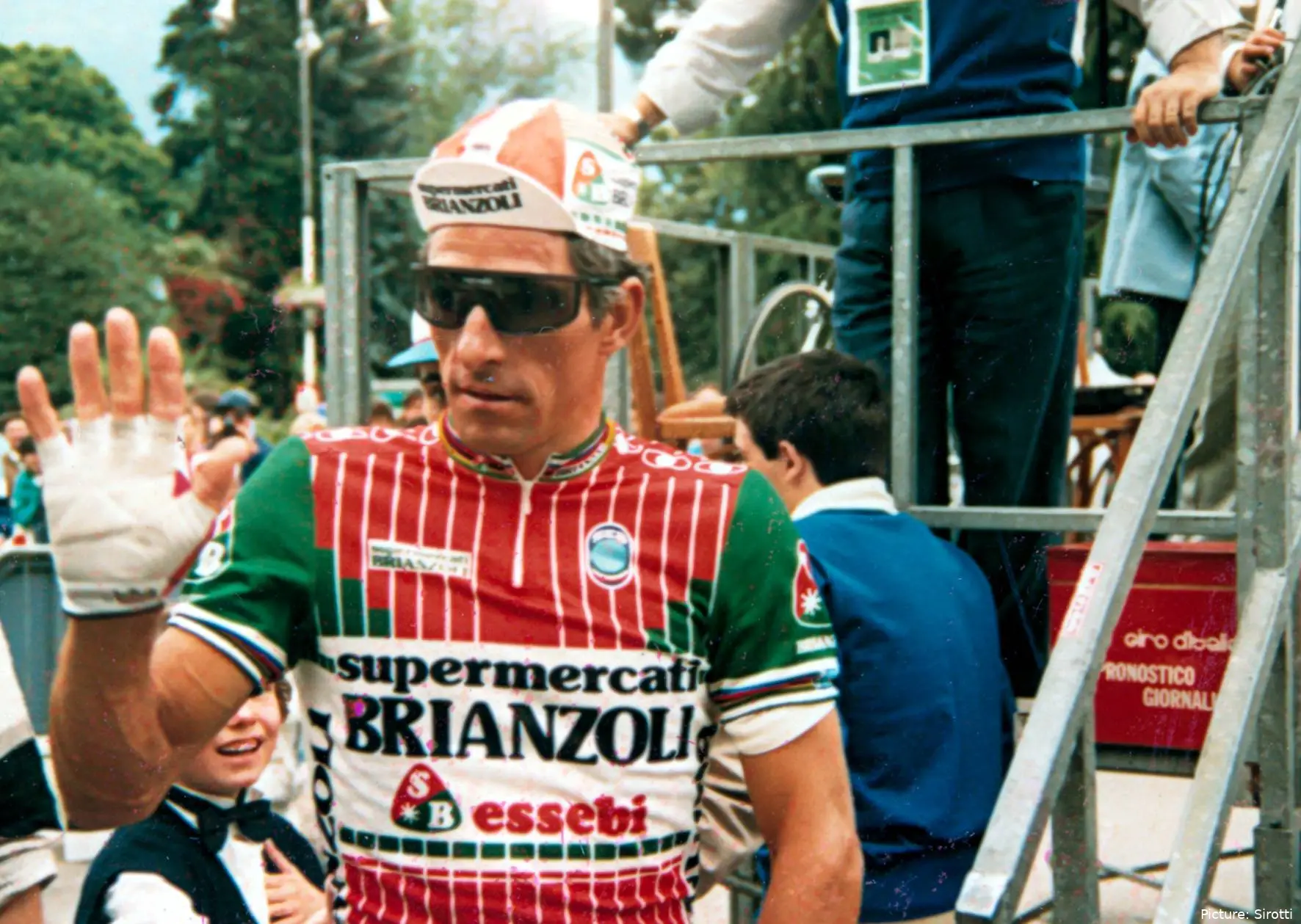
Few riders in the history of professional cycling have combined physical strength, tactical intelligence, technological innovation and an uncompromising personality quite like Francesco Moser. A three-time Paris-Roubaix winner, world champion, Giro d’Italia winner and former Hour Record holder, the Italian was one of the defining figures of his generation.
As part of our new Cycling Legends series, we look back at the extraordinary careers of the riders who shaped the history of the sport, beginning with a man whose achievements were almost as remarkable as the controversies that surrounded him.
Nicknamed Lo Sceriffo (The Sheriff), Moser was a commanding presence in the professional peloton. His rivalry with Giuseppe Saronni divided Italian cycling fans, his battles with Roger De Vlaeminck helped define an era of cobbled Classics racing, and his pursuit of Eddy Merckx’s Hour Record fundamentally changed cycling’s relationship with technology.
Francesco Moser’s beginnings: From the vineyards of Trentino to following his brother Aldo into professional cycling
Born on 19 June 1951 in Palù di Giovo, in the Italian province of Trentino, Francesco Moser grew up in a farming family with strong ties to cycling. His older brothers Aldo, Enzo and Diego all became professional cyclists, although Francesco would eventually surpass their achievements.
One of his earliest memories of professional cycling dates back to the 1957 Giro d’Italia, won by Gastone Nencini. Aged just five, Moser watched the peloton pass through the mountains near his home, where his family worked the land.

Francesco Moser, Bernard Hinault and Lucien Van Impe cross the finish line on stage 20 of the 1985 Giro d’Italia, Saint Vincent – Valnontey di Cogne
Unlike many future champions, however, Moser did not begin racing competitively until his late teens. In 1969, Aldo returned from the Giro d’Italia and gave his younger brother one of his bicycles. “I actually started racing late,” Moser recalled in a 2021 interview with VeloNews.
His progression was remarkably rapid. After representing amateur teams Montecorona Trento and Mobiexport-Bottegone, Moser turned professional with Filotex in 1973, aged 21.
Standing approximately 1.80 metres tall and weighing around 79 kilograms, the Italian possessed the physical attributes of an outstanding Classics specialist. He excelled on flat and rolling terrain, could sustain considerable power over long distances and against the clock, and possessed a sufficiently fast sprint to defeat many of his rivals from reduced groups.
The high mountains remained his greatest weakness, but Moser spent much of his professional career developing ways to compensate for his limitations as a climber.
Yellow jersey glory and the Merckx-Thévenet rivalry at the 1975 Tour de France
Although Moser is primarily associated with the Giro d’Italia and the spring Classics, his record at the Tour de France remains one of the more intriguing aspects of his career. The Italian made just one appearance at the French Grand Tour, in 1975, when Eddy Merckx was pursuing a record sixth overall victory.
Moser immediately made an impression, winning the opening prologue and taking the yellow jersey. He ended the race with two stage victories, seventh place in the general classification and the white jersey as the best young rider. For a Tour debutant competing against established champions such as Merckx, Bernard Thévenet, Lucien Van Impe and Joop Zoetemelk, it was an exceptional performance.
Thévenet ultimately brought Merckx’s dominance of the Tour to an end, while Moser returned to Italy with little intention of building his career around the French Grand Tour. His priorities lay elsewhere, particularly in the Classics and the Giro d’Italia.
Decades later, during his induction into the Giro d’Italia Hall of Fame in 2015, Moser acknowledged that Merckx was the greatest cyclist he had faced. He also revealed that he had helped Thévenet in his efforts to defeat the Belgian during that memorable edition of the Tour.
From heartbreak against Freddy Maertens to World Championship glory against Dietrich Thurau in 1977
Before conquering the cobblestones of northern France, Moser had already established himself among the finest riders in the world. In 1976, he became individual pursuit world champion on the track, demonstrating the sustained power and pacing ability that would later prove instrumental in his Hour Record attempts.
That same year, he came agonisingly close to winning the road race at the World Championships in Ostuni, Italy. However, Belgian sprinter Freddy Maertens proved too strong in the battle for the rainbow jersey, leaving Moser with the silver medal. Twelve months later, the Italian finally secured the title.
On 4 September 1977, at the World Championships in San Cristóbal, Venezuela, Moser defeated West Germany’s Dietrich Thurau to become world champion. Fellow Italian Franco Bitossi completed the podium.
The victory capped an outstanding season in which Moser also won La Flèche Wallonne, the Zürich Championship and the points classification at the Giro d’Italia, where he finished second overall. Moser came close to successfully defending his rainbow jersey in 1978, only to lose out to Dutchman Gerrie Knetemann at the Nurburgring in West Germany.
King of the cobbles: Three consecutive Paris-Roubaix victories from 1978 to 1980
If there was one race perfectly suited to Moser’s characteristics, it was Paris-Roubaix. The Italian’s considerable physical strength, bike-handling skills and ability to maintain speed across the cobblestones made him a natural contender for the Hell of the North.
His association with the race began long before his first victory. In 1974, during only his second season as a professional, Moser finished second behind Roger De Vlaeminck, with Eddy Merckx completing the podium.
Moser later explained that a crash following a bike change had compromised his chances of winning that edition. He finished second again in 1976, but his persistence would eventually be rewarded. In 1978, wearing the rainbow jersey, Moser finally conquered Paris-Roubaix. Interestingly, De Vlaeminck, already a four-time winner of the race, had by then become his teammate at Sanson.
The Italian attacked on the cobblestones and distanced his rivals before entering the Roubaix velodrome alone to claim his first victory. He repeated the achievement in 1979 and again in 1980, winning all three editions with solo attacks.
It was an extraordinary demonstration of superiority in a race where punctures, crashes and mechanical problems can undo months of preparation within seconds. Moser joined Frenchman Octave Lapize, who triumphed between 1909 and 1911, as the only riders to have won three consecutive editions of Paris-Roubaix.
He remained a contender after completing his hat-trick, finishing third in 1981 behind Bernard Hinault and Roger De Vlaeminck. In total, Moser started Paris-Roubaix on 13 occasions and completed every edition he entered.
Despite the significance of his subsequent achievements, Moser believed he had reached his physical peak during those years rather than during his celebrated 1984 campaign. “Many people think 1984 was my best season but I think I was at my best in 1978,” he told Cyclingnews in 2015.

Francesco Moser at the start of 1986 Paris-Roubaix
Beyond Paris-Roubaix: Monument glory and the battle with Bernard Hinault for the Super Prestigeo
Moser’s dominance on the cobblestones sometimes overshadows the extraordinary versatility reflected in the rest of his palmarès. He won Il Lombardia in 1975 and 1978, La Flèche Wallonne in 1977, Gent-Wevelgem in 1979 and Paris-Tours in 1974. Few riders of his physical stature could compete so effectively across such a wide variety of terrain.
His second victory at Il Lombardia carried particular significance, as it secured the 1978 Super Prestige Pernod, the season-long competition that rewarded performances across the most prestigious races on the international calendar.
Moser entered the final Monument of the season trailing Bernard Hinault in the standings. A podium finish would have been sufficient to secure the competition, but the Italian exceeded that requirement by winning the race. “I knew I only needed to come third in that race to take the Super Prestige,” Moser explained in a 2015 interview with Cyclist.
One major Italian Classic, however, continued to elude him. Having finished second at Milan-Sanremo in 1975, Moser had to wait until 1984 to finally conquer La Classicissima. By then, he was 32 years old and enjoying an unexpected resurgence that would produce some of the most celebrated results of his career.
Moser also finished second at the Tour of Flanders in 1976 and 1980, while his only appearance at Liège-Bastogne-Liège, in 1978, resulted in third place. He consequently stood on the podium of all five Monuments during his professional career, winning six editions across three different races.
Breaking Eddy Merckx’s Hour Record and revolutionising cycling technology in 1984
On 25 October 1972, Eddy Merckx established an Hour Record of 49.431 kilometres in Mexico City. For more than a decade, the Belgian’s achievement remained the benchmark in one of cycling’s most physically demanding disciplines.
At the beginning of 1984, Moser appeared to be approaching the final chapter of his professional career. Instead, he embarked on a project that would transform cycling’s approach to aerodynamics, training and equipment.
Working alongside Italian professor Francesco Conconi and a scientific team that included a young Michele Ferrari, Moser adopted a preparation programme that placed considerable emphasis on physiological testing, heart rate monitoring and aerodynamic efficiency.
His bicycle differed radically from the traditional machine Merckx had ridden in 1972. Disc wheels, an aerodynamic frame and a revised riding position helped reduce aerodynamic drag.
On 19 January 1984, in Mexico City, Moser covered 50.808 kilometres, becoming the first cyclist to officially break the 50-kilometre barrier in an Hour Record attempt. Four days later, he returned to the track and improved his own record to 51.151 kilometres.
Moser had extended Merckx’s previous record by 1.720 kilometres, an extraordinary improvement that also highlighted the growing influence of equipment development and scientific preparation on cycling performance.
His achievements encouraged further experimentation within the discipline, eventually leading to the revolutionary Hour Record attempts of Graeme Obree, Chris Boardman, Miguel Indurain and Tony Rominger during the 1990s.
Moser’s fascination with technology extended beyond his competitive career. Speaking to La Repubblica in 2022, he recalled the importance of computer analysis and aerodynamic research in preparing for his attempts in Mexico.

Francesco Moser at the Stuttgart velodrome in Germany, attempting to break the hour record in 1988
Francesco Conconi, Michele Ferrari and the controversy surrounding Moser’s Hour Record
The circumstances surrounding Moser’s Hour Record became increasingly controversial in the years that followed. In 1999, the Italian reportedly acknowledged in an interview with L’Équipe that he had used blood transfusions to enhance his performance.
Blood transfusions were not yet prohibited under the applicable sporting regulations when Moser established his records in January 1984. The International Olympic Committee banned blood doping in 1985. However, Moser subsequently disputed that account of his preparation.
"Conconi was in charge and Ferrari his support, and they exchanged their work. Conconi translated the times and values into performance and prepared the tables. There wasn't any blood transfusions, before the first or second attempt. The benefits of altitude were enough," he said.
The conflicting statements, combined with the subsequent controversies involving Conconi and Ferrari, ensured that the circumstances surrounding Moser’s record would remain a subject of debate.
An important distinction must be made between practices prohibited at the time and those outlawed in subsequent years. Moser’s records received official recognition when they were established, and the controversy does not establish that he used blood transfusions during his subsequent road victories.
Nevertheless, the episode remains a significant chapter in the development of sports science and professional cycling’s complicated relationship with performance enhancement.
Two stage victories and a historic milestone at the 1984 Vuelta a España
Following his successful Hour Record attempts and victory at Milan-San Remo, Moser made his first and only appearance at the Vuelta a España in April 1984. The Italian won the opening prologue to take the leader’s jersey before claiming another stage victory in Santander.
He retained the overall lead for approximately a week before the mountainous terrain began to favour his rivals. Moser eventually finished tenth in the general classification in an edition won by Frenchman Éric Caritoux.
Although he never returned to the Spanish Grand Tour, his two stage victories meant that he had won stages and worn the leader’s jersey in all three Grand Tours, an achievement that reflected his considerable versatility.
The Vuelta also served as preparation for his principal objective of the season: finally securing overall victory at the Giro d’Italia.
Giuseppe Saronni: The rivalry that divided Italian cycling
Italian cycling has a rich history of sporting rivalries. Gino Bartali and Fausto Coppi divided the country in the years surrounding the Second World War, while the following generation witnessed the battles between Felice Gimondi and Eddy Merckx. By the late 1970s, Moser and Giuseppe Saronni had become the central figures in Italian cycling.
The two riders possessed contrasting characteristics. Moser was a powerful rouleur who excelled in time trials and long-range attacks, whereas Saronni possessed greater acceleration and was particularly dangerous in explosive finishes.
Their personalities were equally contrasting, and neither was particularly willing to acknowledge the superiority of the other.
The 1979 Giro d’Italia produced one of the most painful defeats of Moser’s career. Despite his reputation as an outstanding time trial specialist, he was unable to overcome Saronni, who secured his first overall victory at the Italian Grand Tour at just 21 years of age.
Moser later described that defeat as his greatest sporting disappointment. Losing the Giro in a discipline in which he normally held the advantage made the experience particularly difficult to accept. Saronni subsequently won the World Championships in Goodwood in 1982, Milan-Sanremo in 1983 and a second Giro d’Italia that same year.
In a 2023 interview with Corriere della Sera, Saronni questioned the advantages Moser had enjoyed through his association with Conconi and the technological developments of 1984. “I won both Giros with my own strength,” Saronni declared.
He also questioned the organisation of the 1984 Giro and argued that Moser had benefited from equipment that was not equally accessible to his rivals.
A decisive attack on the Poggio seals Milan-Sanremo glory in 1984
On 17 March 1984, Moser arrived at Milan-Sanremo with renewed confidence following his achievements in Mexico. The 294-kilometre race unfolded in difficult weather conditions, with rain and even light snowfall on the Turchino Pass. Australian Phil Anderson was among the riders who attempted to anticipate the favourites, spending a considerable period alone at the head of the race.
The decisive moment, however, came on the Poggio. As the leading riders approached the final kilometres, Moser launched his attack on the descent. Sean Kelly, one of the most dangerous sprinters in the group, was unable to close the gap.
Once Moser had established an advantage, his exceptional time trialling ability made him particularly difficult to bring back on the flat roads towards Sanremo. The Italian reached the Via Roma alone, winning Milan-San Remo by 20 seconds over Kelly, with Belgian Eric Vanderaerden completing the podium.
Nine years after finishing second in the race, Moser had finally secured one of the most prestigious victories in Italian cycling.
The controversial 1984 Giro d’Italia triumph and the bitter rivalry with Laurent Fignon
Despite his extraordinary collection of victories, Moser entered the 1984 Giro d’Italia without having won his home Grand Tour. He had finished second in 1977 and 1979, third in 1978 and fourth in 1976. His failure to secure the Maglia Rosa had become one of the few significant omissions from an otherwise exceptional palmarès.
His principal rival in 1984 was Laurent Fignon, the reigning Tour de France champion and one of the most talented stage racers of his generation.
The Frenchman was a considerably stronger climber, while Moser held the advantage against the clock. The Italian won the opening prologue in Lucca, immediately demonstrating the form that had carried him to his Hour Record and Milan-San Remo victories.
However, as the race entered the mountains, the balance of power began to shift. One of the most controversial decisions of the Giro came when the organisers removed the Passo dello Stelvio from the route, citing adverse weather conditions and safety concerns.
Fignon and his Renault-Elf team were furious. The Frenchman had identified the high mountains as his best opportunity to distance Moser in the general classification, and the removal of one of the race’s most demanding climbs significantly altered the competitive balance.
Further accusations emerged concerning assistance from spectators, race vehicles and the treatment of the Italian favourite. Moser received a five-second time penalty after being repeatedly pushed by spectators during the stage to Arabba.
Nevertheless, Fignon entered the final individual time trial with an advantage of 1:21 over Moser. On 10 June, the riders faced a 42-kilometre individual time trial between Soave and Verona, finishing inside the city’s famous Roman amphitheatre.
Using aerodynamic equipment developed through his Hour Record project, Moser delivered the performance he needed. He defeated Fignon by 2:24, overturning the Frenchman’s advantage and securing overall victory at the Giro by 1:03.
The celebrations inside the Arena di Verona provided one of the defining images of Italian cycling during the 1980s. Fignon, however, never fully accepted the circumstances surrounding his defeat. The Frenchman alleged that a television helicopter had interfered with his performance during the final time trial.
Moser repeatedly rejected those accusations, maintaining that his superiority against the clock was sufficient to explain the outcome. In a 2015 interview with La Gazzetta dello Sport, Moser dismissed the helicopter allegation as a senseless excuse.
There was also an important detail often overlooked in discussions surrounding that edition of the Giro. Fignon had lost more than a minute to Moser on the Blockhaus earlier in the race after suffering a hunger flat. The Frenchman’s defeat could not therefore be attributed exclusively to the events of the final weekend.
Regardless of the differing interpretations of the controversy, the official result remains unchanged. Francesco Moser won the 1984 Giro d’Italia, securing the only Grand Tour overall victory of his professional career.

Francesco Moser, Stephen Roche and Giuseppe Saronni at the 1981 Giro di Lombardia
The pursuit of a second Giro d’Italia title against Hinault and Roberto Visentini
Moser’s victory in 1984 was not the final significant result of his Grand Tour career. In 1985, the Italian returned to defend his title but faced Bernard Hinault, who was pursuing another Giro-Tour double.
The Frenchman ultimately proved too strong, although Moser claimed three stage victories and finished second in the general classification. A year later, Moser returned once again, finishing third behind Roberto Visentini and Giuseppe Saronni. He also claimed another stage victory, taking his career total at the Giro d’Italia to 23.
He finished on the overall podium in six editions of the Italian Grand Tour and won the points classification on four occasions, in 1976, 1977, 1978 and 1982. His record of 23 individual stage victories at the Giro was particularly impressive considering that he also devoted a considerable portion of his career to the spring Classics.
Grand Tour achievements: From the Maglia Rosa to 27 stage victories
| Grand Tour | Best overall result | Stage wins | Classification victories |
| Giro d’Italia | 1st (1984) | 23 | General classification (1984), points classification (1976, 1977, 1978, 1982) |
| Tour de France | 7th (1975) | 2 | Young rider classification (1975) |
| Vuelta a España | 10th (1984) | 2 | - |
| Career total | 1 Grand Tour victory | 27 | 6 classification victories |
A record-breaking palmarès: 273 victories, six Monuments and two Hour Records
According to the official Giro d’Italia Hall of Fame, Moser accumulated 273 race victories during his professional career, making him the most successful Italian cyclist according to its historical victory count.
Different cycling databases apply different criteria when calculating historical victory totals, particularly regarding criteriums, track events and smaller races. ProCyclingStats records 147 victories in its database, while the broader historical tally credited to Moser stands at 273.
Beyond his Grand Tour and Monument victories, Moser won Tirreno-Adriatico twice, the Volta a Catalunya in 1978 and numerous prestigious Italian one-day races.
He was also crowned Italian national road race champion on three occasions and enjoyed considerable success in the Trofeo Baracchi, the prestigious two-man time trial that attracted some of the world’s leading specialists.
Beyond his victories on the road and track, Moser also broke the Hour Record twice in January 1984, establishing distances of 50.808 kilometres and 51.151 kilometres respectively.
The greatest victories of an extraordinary cycling career
| Race | Year(s) | Victories | |
| Giro d’Italia - General classification | 1984 | 1 | |
| World Championships - Road race | 1977 | 1 | |
| World Championships - Individual pursuit | 1976 | 1 | |
| Paris-Roubaix | 1978, 1979, 1980 | 3 | |
| Il Lombardia | 1975, 1978 | 2 | |
| Milan-Sanremo | 1984 | 1 | |
| La Flèche Wallonne | 1977 | 1 | |
| Gent-Wevelgem | 1979 | 1 | |
| Paris-Tours | 1974 | 1 | |
| Zurich Championship | 1977 | 1 | |
| Tirreno-Adriatico | - | 2 | |
| Volta a Catalunya | 1978 | 1 | |
| Italian National Championships – Road race | - | 3 | |
| Super Prestige Pernod | 1978 | 1 | |
| Giro d’Italia - Points classification | 1976, 1977, 1978, 1982 | 4 | |
| Tour de France – Young rider classification | 1975 | 1 | |
| Giro d’Italia - Stage victories | - | 23 | |
| Tour de France - Stage victories | 1975 | 2 | |
| Vuelta a España - Stage victories | 1984 | 2 |
From the early years at Filotex to Gis Gelati
Unlike many modern cyclists who spend their careers moving between multinational teams, Moser raced almost exclusively within the Italian professional cycling structure. He began his professional career with Filotex in 1973 before joining Sanson in 1976, where he enjoyed arguably the most dominant period of his career.
His five seasons with Sanson produced a road world title, three consecutive Paris-Roubaix victories and numerous other major successes. Following two years with Famcucine-Campagnolo, Moser joined Gis Gelati in 1983. It was in the colours of that team that he enjoyed his remarkable resurgence in 1984. He spent the final years of his regular professional career with Supermercati Brianzoli and Château d’Ax.
Retirement and an extraordinary return to the Hour Record at the age of 42
After more than a decade competing at the highest level of professional cycling, Moser’s results gradually began to decline. His third place at the 1986 Giro d’Italia represented his final Grand Tour podium, although he remained competitive in other races. As late as 1987, he finished fifth overall at Tirreno-Adriatico.
Moser brought his regular professional career to an end in 1988, the year he turned 37. However, his fascination with the Hour Record never disappeared.
In 1994, at the age of 42, Moser returned to Mexico City for another attempt against the clock. Inspired by the unconventional riding position popularised by Scottish cyclist Graeme Obree, the Italian covered 51.840 kilometres.
Although the distance was no longer sufficient to establish the outright world record, it exceeded his celebrated performance from ten years earlier by 689 metres.
For a rider who had been away from regular professional competition for several years, it was a remarkable demonstration of his enduring physical condition and continued interest in technological experimentation.
Life after cycling: Vineyards, bicycle business and the emergence of Moreno Moser
Retirement allowed Moser to return to the agricultural environment in which he had grown up. He became increasingly involved in the family wine business in Trentino, developing vineyards and producing wines at the Maso Villa Warth estate near Trento.
One of the most recognisable products associated with the Moser family is its 51.151 sparkling wine, named after the distance he covered during his second successful Hour Record attempt in Mexico. Moser also remained involved in bicycle manufacturing through his own brand, continuing the interest in equipment and technological development that had characterised the latter stages of his racing career.
His activities extended beyond business. Between 1993 and 1998, he served on the Regional Council of Trentino-Alto Adige. He subsequently became the first president of the Cyclistes Professionnels Associés (CPA), the professional riders’ association, holding the position between 1999 and 2007. The Moser family’s association with professional cycling also continued through subsequent generations.
His nephew Moreno Moser emerged as one of Italy’s most promising young riders during the early 2010s, winning the Tour de Pologne in 2012 and Strade Bianche in 2013. Francesco’s son Ignazio also competed in cycling before becoming a television personality in Italy.
In 2015, Francesco received one of the most significant honours of his career when he was inducted into the Giro d’Italia Hall of Fame, joining Eddy Merckx, Felice Gimondi and Stephen Roche among its early inductees.
Modern cycling, Miguel Indurain and Chris Froome
Despite retiring from professional competition in the 1980s, Moser has continued to follow the sport closely, regularly attending the Giro d’Italia and discussing the performances of subsequent generations. Among the riders he particularly admired was Miguel Indurain, whose physical characteristics and approach to Grand Tour racing bore similarities to his own.
Like Moser, Indurain possessed exceptional time trialling ability and had to manage his efforts carefully in the mountains, although the Spaniard developed into a considerably more accomplished Grand Tour specialist. Moser also singled out Chris Froome’s extraordinary long-range attack on the Colle delle Finestre during the 2018 Giro d’Italia.
Speaking to VeloNews in 2021, he described Froome’s performance as “one of the great rides of the Giro ever.” The Italian has also retained his sense of humour when discussing his position in cycling history.
During his 2022 interview with La Repubblica, Moser was asked about historical rankings that placed him behind Eddy Merckx. Rather than comparing himself directly with the Belgian, he joked that he could therefore consider himself the best of the humans, placing Merckx in a category of his own.
It was a rare concession from a man who spent much of his professional career refusing to acknowledge the superiority of his rivals.
The Sheriff’s legacy: A place among cycling’s greatest champions and pioneers
Determining Francesco Moser’s exact position among the greatest cyclists of all time is inevitably subjective. He did not possess the Grand Tour record of Eddy Merckx, Bernard Hinault or Fausto Coppi. Nor did he win as many editions of Paris-Roubaix as Roger De Vlaeminck or, decades later, Tom Boonen.
Yet the breadth of his achievements remains exceptional. He won world titles on both the road and track, conquered six Monuments, claimed stage victories in all three Grand Tours, won the Giro d’Italia and twice broke the Hour Record.
His battles with Giuseppe Saronni became part of Italian sporting culture, while his controversial victory over Laurent Fignon remains one of the most fiercely debated editions of the Giro d’Italia.
His legacy also extends far beyond his results. The aerodynamic bicycles, scientific training methods and technological experimentation associated with his career anticipated developments that would transform professional cycling over the following decades.
Read also
Not every aspect of that transformation was positive, and the controversies surrounding his relationship with Conconi and Ferrari cannot simply be overlooked.
However, reducing Moser’s career to the events of 1984 would overlook the achievements that had already established him among cycling’s greatest champions. His three consecutive Paris-Roubaix victories, his rainbow jersey and his exceptional consistency throughout the 1970s were testament to his qualities as a rider.
The Sheriff did not need the Hour Record or the Maglia Rosa to become a cycling legend. He had earned that status long before arriving in Mexico City.
Carlos Silva is a writer for CyclingUpToDate.com, where he contributes race reports, interviews, analysis pieces, and live coverage of the international cycling calendar. Holding a degree in Sports from the Jean Piaget Institute, he combines academic knowledge of performance, training, and competition with hands-on journalism experience in professional cycling.
Throughout his career, Carlos has conducted interviews with leading figures in the sport, including Alberto Contador, Joaquim Rodríguez, Óscar Pereiro, João Almeida, Isaac del Toro, Derek Gee, John Degenkolb and Geraint Thomas. These conversations reflect direct engagement with Grand Tour winners, Classics specialists, and emerging talents.
He has provided on-site coverage at major events ranging from the Vuelta a España to the Tour de France, alongside stage races such as Vuelta a Andalucía, Volta ao Algarve, Volta a Portugal and O Gran Camiño. Covering the mythical climbs of the Giro d'Italia remains one of his professional ambitions.
Carlos is responsible for liveblog coverage of all major WorldTour races and beyond, including the Tour de France, Giro d'Italia and Vuelta a España. His reporting integrates verified data from ProCyclingStats to ensure statistical accuracy, contextual depth, and analytical precision.
A lifelong cycling enthusiast, he approaches storytelling across written, photographic, and video formats with a focus on credibility, tactical insight, and informed race interpretation.
claps 1visitors 1
Just in
Popular news
Latest comments
- The role I think that Wout played was to prevent IDT from even trying. If it had been just Yates upfront, he could’ve given it a go. But having seen what WVA had done for Jonas in TDF he realized that it was not going to happen.Cbastnagel26-11-2026
- If he wants to be top dog , why is he staying at UAE. Its the worst way to learn how to win the important races which he is starting a a domestique to Pogi. Sexias has a monument he doesnt.abstractengineer26-11-2026
- He had already given the lead up on the mountain itself, and it was lost Wout or no wout because to pull back Yates, he needed carapaz and carapaz absolutely refused to work with him. They have never won a GT outside of Pogi.abstractengineer26-11-2026
- 🤞for NO crashes!!!Lozza26-11-2026
- Ah good, it’s been amended! 👏Lozza26-11-2026
- He will attempt this in 2028 provided in 2027 he wins Roubaix, the Tour and the Vuelta.Renz26-11-2026
- Merckx said that Pogi could race the Giro, Tour and Vuelta in a single season? Pogi said: "I can’t rule that out. In fact, I’ll try it sooner or later, but certainly not in 2027. I'm feeling great at the moment. I'm training and eagerly looking forward to getting back to racing. I'm confident that I can return to the same level, or even a higher one. Life moves fast, very fast. Sometimes you need a break; you need to stop for a while. That's what I needed. If I hadn't taken a break, my body would simply have forced me to.”PogiSloFans26-11-2026
- The only 4 things Pogi needs to win next year are: 1) Paris Roubaix 2) Tour de France 3) World Championships 4) La Vuelta There is no cyclist at this moment that is capable of winning these four races in the same year. NOBODY except Pogi. Of course that doesn't mean he's gonna win them all, but he's the only one that can do it. I think his "biggest problem" will be Paris Roubaix (MVDP and WVA)... or a bad crash in any of the four races.PogiSloFans26-11-2026
- yeer lozz i get that but Trek went all in for Ayuso when they maybe could have went all in for el toro loco. then the bought the derek now Felix ..Only results will tell and imo they need to win one of the big 3week races nex year.
 Davide26-11-2026
- But Ayuso was the one who was unhappy and wanted to leave. Del Toro happy at UAE.Lozza26-11-2026
Loading
Write a comment