INEOS set to totally disappear from the peloton? British WorldTour team confirm “we’re going back to market” after Netcompany investment
Cycling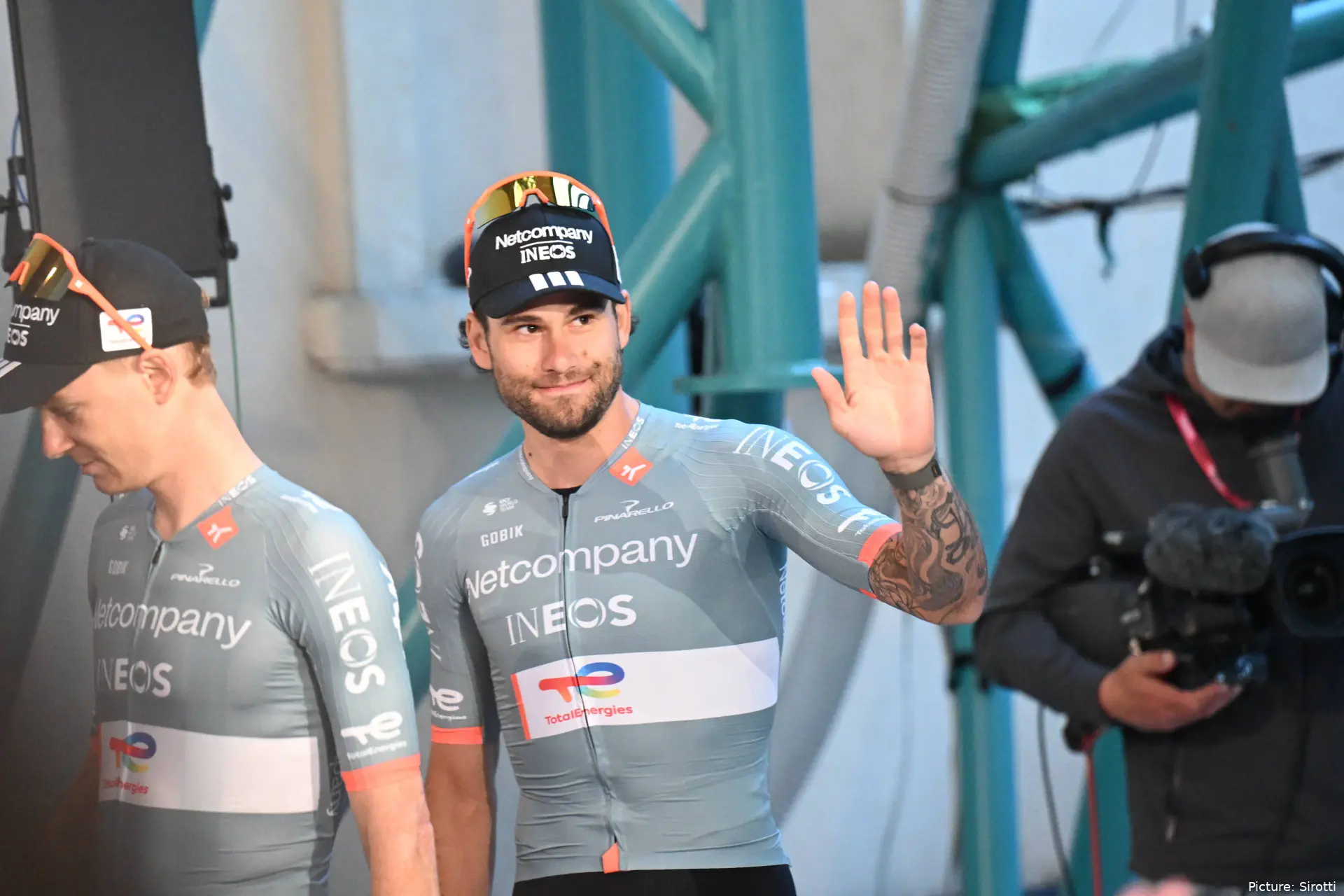
One of the most recognisable names in modern cycling could be set to disappear from the peloton altogether after senior figures within the newly rebranded Netcompany INEOS Cycling Team confirmed they are already searching for another major title sponsor.
The British WorldTour squad only debuted their new green and grey colours at the Giro d’Italia this week following the arrival of Danish software and AI company Netcompany, but the latest comments from the team suggest the rebrand may not be the final stage of the project’s transformation.
Speaking to the Leaders Worth Knowing podcast, the team’s Chief Commercial Officer Tom Hill revealed that the squad is already looking for an additional co-title partner beyond Netcompany. “We have Netcompany as our first name-co title partner, but we're going back to market looking for a second co-title partner,” Hill explained.
That immediately raises the prospect of the INEOS name eventually disappearing entirely from the team title despite owner Sir Jim Ratcliffe remaining involved behind the scenes. When discussing the possibility of a future naming structure, Hill referenced the idea of “Netcompany-X”, with the “X” representing another incoming sponsor. For cycling fans, it would mark another major identity shift for one of the sport’s defining teams of the modern era.
From Team Sky dominance to another rebrand
The squad first entered the WorldTour in 2010 as Team Sky, built around the ambition of delivering a British Tour de France winner. Within two years, Bradley Wiggins achieved exactly that before Chris Froome turned the team into cycling’s dominant Grand Tour force.
Between 2012 and 2019, the organisation won seven Tours de France through Wiggins, Froome, Geraint Thomas and Egan Bernal. Marginal gains, control riding and overwhelming financial strength became synonymous with the Sky project during one of the most successful periods any team has enjoyed in the modern sport. The transition to Team INEOS came in 2019 following the end of Sky’s sponsorship agreement, before the team became INEOS Grenadiers a year later.
Now, however, another evolution appears to be underway. While Hill stressed that Ratcliffe’s company remains committed to the project long term, the comments also reflected the growing financial arms race at the top of men’s cycling.
“Ineos will absolutely remain involved as a long-term backer, with a massive interest in cycling. That has never waned,” Hill said. “Sir Jim has a very passionate interest in cycling and has been a very fantastic supporter and backer.”
The modern WorldTour superteam battle
The wider backdrop is a rapidly changing WorldTour landscape. Over recent seasons, UAE Team Emirates - XRG and Team Visma | Lease a Bike have become the sport’s dominant Grand Tour teams around Tadej Pogacar and Jonas Vingegaard respectively, while the likes of Red Bull - BORA - hansgrohe, Lidl-Trek and Decathlon CMA CGM Team have also significantly increased investment.
INEOS, by contrast, have spent recent years trying to rediscover the dominance they once enjoyed during the Team Sky era.
The team have still collected major wins through riders such as Filippo Ganna, Carlos Rodriguez and Egan Bernal, but they have not won a Grand Tour since Bernal’s Giro d’Italia triumph in 2021.
Why the search for another sponsor matters
Hill openly linked additional sponsorship to the team’s long-term sporting ambitions. “Ultimately, if we can broaden the financial base by having other partners in to help put investment into the team, create that virtuous circle of more investment, better riders, win more races, more sponsors. That is the next step for us, as of now.”
For a team once defined by stability and complete control at the top of the sport, the next chapter may now depend on how successfully it can reinvent both its identity and its financial model in cycling’s rapidly escalating superteam era.
Kieran WoodDeputy Editor-in-Chief
Kieran Wood is a sports journalist based in Wales and has been active in journalism since 2022. He regularly contributes to DartsNews.com and CyclingUpToDate.com, where he covers professional cycling and darts. In cycling, his work includes liveblogs from major races, including the Tour de France, the Giro d’Italia, and La Vuelta a España, alongside race reports and analysis. He has also conducted interviews with professional riders.
His reporting spans the full racing calendar, from one-day classics to stage races, with a focus on accurate, real-time coverage and clear contextual analysis. For statistics, results, and historical context, he regularly uses resources such as ProCyclingStats. To support reporting on rider activity and training context where relevant, he also references Strava.
In his work, Kieran places strong emphasis on careful sourcing, editorial accuracy, and updating articles as new, verified information becomes available.
claps 6visitors 5
Just in
Popular news
Latest comments
- What a cheater Jay Vine is. Remco gained on everyone else pretty much evenly. But Vine? After he was caught, the gap grew at a suspiciously slow rate. Typical UAE
 Rafionain-Glas18-10-2026
 - Strade? Never saw him as a gravel rider that can handle it.mij18-10-2026
- It surprises me that anyone still believes any professional (or amateur!) sport is clean--much less wants it to be. The best you can hope for is a reasonably level playing field that doesn't expose young, ambitious athletes to health risks they don't understand. In that regard, World Tour cycling appears to do a better job than almost any sport with independent, random testing. There are certainly fewer mysterious midnight "heart attacks" these days. If you want to see what an uneven playing field looks like, show up to masters nationals. It is also certainly the case that no major pharmaceutical corporation has developed a multi-billion dollar miracle drug just to give it only to one or two anointed ectomorphs in a minor non-revenue sport. If you don't like that all sports run on PEDs these days and you can't be bothered to contribute as a tester, a federation official, or pharmaceutical representative, then just turn off the TV and play outside.
 MarkFour18-10-2026
 - Good grief, who proofreads this stuff? Errors abound.wrsty18-10-2026
- You can add weight to a bike and limit gears or make it single speed if you like. I doubt that would reduce crashes. It would just add another dymanique. All good and well, but It wont stop cars getting on to the course.Cyclingsbestfan18-10-2026
- Seixas is probably second best in the World on short climbs. But that hasn't translated as well to long climbsRafionain-Glas18-10-2026
- Idiotic fellaRafionain-Glas18-10-2026
- Nothing. Against Pogi nothingabstractengineer18-10-2026
- He didn't even try to sprint all outvappaxbipmv18-10-2026
- Campenaerts looked like a rolling pumpkin with that all orange leaders skinsuit !frieders318-10-2026
Loading
3 Comments