"I finally decided to tell the truth” - Floyd Landis recalls Armstrong years and Tour de France doping scandal
CyclingMonday, 31 August 2026 at 16:01
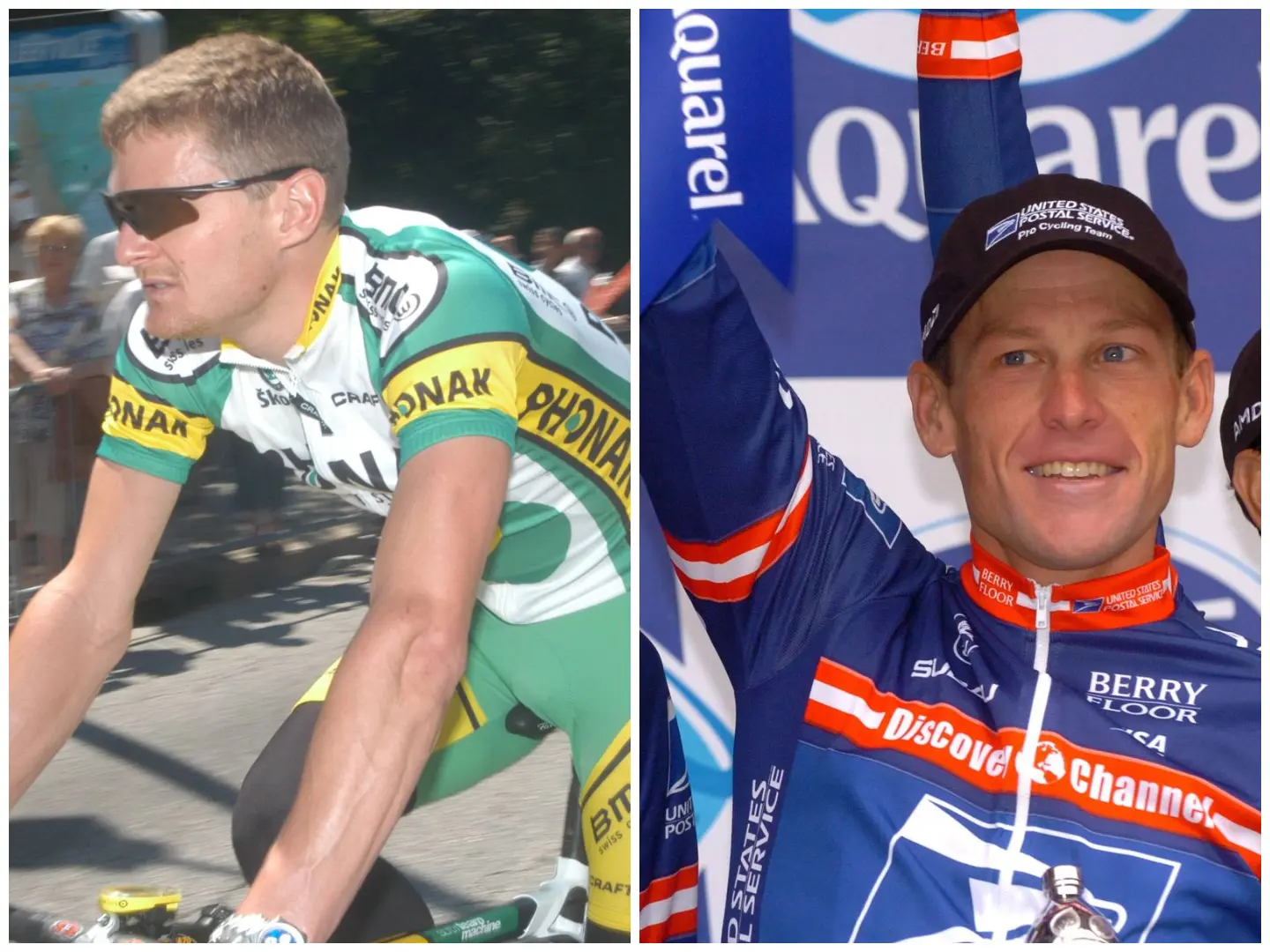
Floyd Landis is once again looking his past in the eye. The former American cyclist, winner of the 2006 Tour de France before being stripped of the title for doping, is one of the central figures in a documentary by Irish Independent and Indo Sport.
In it he retraces his childhood, his departure from the Mennonite community, and the road that took him to the elite of cycling. A story marked by contradiction, guilt, and a constant search for answers.
Landis grew up in Lancaster, Pennsylvania, in a deeply religious Mennonite family. Separation from the outside world, discipline, and the Bible shaped his early years. Yet that upbringing also sparked in him a permanent need to question his surroundings. “It wasn’t a rebellion. I never had anything but love and respect for my parents,” he explains.
The bike became his escape. First it was a mountain bike that let him discover an unknown freedom and, later, a tool to think and confront his doubts. “I spent much of my twenties riding my bike alone and thinking. The bike was a reason to leave and also a kind of therapy for me,” he recalls in the interview.
His talent surfaced almost from the start. Mike, one of his first cycling mentors, remembers a teenager able to race against far more experienced riders with barely any specific training. “He didn’t have any learned talent. It was pure natural power,” he says. That physical capacity, paired with an extraordinary will to suffer, would turn him professional.
The talent that needed no explanation
At barely 15, Landis already stood out for his endurance. While other youngsters looked for excuses to skip training, he could spend hours on the bike. “He would get on his bike in Farmersville and ride 160 kilometers on a mountain bike on the road, hunting down every big climb he could find,” Mike says.
That obsession soon shifted to road racing. Landis started in local events and quickly left behind rivals with far more experience. “When he showed up, everyone thought: you don’t have a pro license. And he’d say: if you let me race with the others, this is going to be a joke. And it was,” his mentor recalls.
What impressed most, however, wasn’t only his physical ability. It was his tolerance for suffering. “For a kid his age, his capacity to suffer, something you usually learn when you’re older, was astonishing,” Mike explains. That trait would become one of Landis’s hallmarks as a pro.
The documentary reconstructs the rise of an extraordinary cyclist from a setting far removed from professional sport. The bike first offered him freedom, then an identity, and finally a profession. “I just wanted to see what was out there,” Landis sums up. What he found was a world completely different from the one he had known as a child.

Floyd Landis was stripped of his 2006 Tour de France title for doping
From prodigy to the Tour de France
The progression was meteoric. Landis moved to California to build his career and ended up in professional road cycling. His physical strength made him one of the peloton’s most valuable domestiques and, later, a rider capable of fighting for Grand Tours.
In 2006 came the defining moment. Landis won the Tour de France after one of the most memorable performances in the race’s recent history, especially on the Morzine stage, where he launched a spectacular comeback. Three days after celebrating on the Champs-Élysées, everything changed: a positive anti-doping test led to his disqualification and opened a battle that would last for years.
For four years he maintained his innocence and spent practically everything he had on lawyers. Finally, in 2010 he admitted he had doped and also accused members of the system surrounding Lance Armstrong’s team. “I finally decided to tell the truth,” he recalls in the documentary. That confession played a decisive role in triggering the investigation that eventually dismantled the narrative built around Armstrong.
Landis’s story thus takes on a scope far wider than a single positive test. His trajectory connects two seemingly incompatible worlds: the strict morality of his upbringing and the sophisticated doping system he found in professional cycling. “I wanted to understand it,” he says, recalling the questions that had followed him since childhood.
The contradiction of professional cycling
Landis explains that he never stopped carrying his family’s teachings. Even when he left his community at 20, the feeling that he was doing something wrong remained. “Even when I left, I still had those feelings of guilt and felt like I was doing something wrong,” he acknowledges.
That need to understand also explains, in his telling, his relationship with the bike. Long solo days became a way to organize his thoughts. “It’s like a meditation. You’re moving, but you’re thinking and you can let your mind drift,” he notes.
The problem emerged when the sport that had let him escape became shaped by a culture that seemed to demand ever more. Landis went from being the teenager who simply wanted to discover how far he could go on a bike to becoming a cog in a professional machine where the lines between preparation, competitiveness, and doping blurred.
Mike, however, insists Landis’s talent existed long before any outside help. “I’m convinced he could have chosen any endurance sport and been a champion,” he says. “Running, cycling, swimming, it didn’t matter. It just so happened Floyd loved bikes.”
The price of telling the truth
Landis’ confession had devastating consequences for his career and personal life. He lost the Tour, faced years of litigation, and was publicly marked as one of the faces of doping in an especially dark era for cycling. But his decision to speak had a far greater impact than he likely imagined.
Lance Armstrong’s subsequent downfall made Landis a key figure in understanding how that system worked. His testimony helped reveal a structure where doping could not be seen solely as an individual choice by riders, but as part of a much deeper competitive culture.
And, paradoxically, the rider raised on the idea of staying “separate from the world” ended up exposing some of professional sport’s most uncomfortable secrets. His story is not only that of a champion stripped of his title. It is also that of a young man who spent his life searching for answers and found them in the least expected place.
“There was never a lack of love and respect for my parents,” Landis insists. “I just wanted to understand it.” That line captures much of his trajectory: the need to question, first his upbringing and then the world of cycling, until he accepted that the truth had a price he was finally willing to pay.
Javier RampeCycling Journalist
Javier Rampe is a sports analyst with more than 15 years of experience. He holds a degree in Economics from the University of Rome and a Diploma in Business Studies from the University of Cádiz. Despite coming from an academic background not particularly associated with cycling, his passion for both cycling and journalism was instilled in him from an early age. He grew up following Miguel Indurain and José María “El Chava” Jiménez. An admirer of Michael Robinson’s communication style and journalistic approach, he was inspired to pursue a degree in Journalism at the University of Buenos Aires, which he is currently completing.
He has always maintained close ties with the worlds of sport and culture, contributing from a young age to sports blogs and film and music review websites. His work has appeared in media outlets such as Cope, RAI, and Radio Con Vos. He is also the founder of the cycling-focused podcast El Contraanálisis and the football interview channel Días De Fútbol, dedicated to conversations with professional footballers.
In addition to his work at Ciclismoaldia, Javier has interviewed some of the most influential figures in modern cycling, including Alejandro Valverde and Tadej Pogačar, as well as key voices in anti-doping policy such as Alberto Yelmo, David Varillas, and Marcelo Milano. Marcos Maynar, in relation to the ‘Operación Ílex’ case, is also among the personalities he has interviewed. He enjoys conducting in-depth analysis of the cycling ecosystem and has attended major events such as Strade Bianche, the Vuelta a Andalucía, and Itzulia, as well as numerous national cyclo-cross races.
His background in economics, combined with extensive experience in marketing and corporate communications, drives his continuous study of positioning strategies and ensures that he always keeps his focus on crafting compelling and evocative headlines.
claps 0visitors 0
Just in
Popular news
Latest comments
- Who cares? He chose it to win. That’s not on anyone but Floyd.Guavaking31-08-2026
- It's a sad story. Lying and not facing the truth is like having an anvil chained to your neck. I wish him well. By coincidence I watched "The Programme." recently. Jesse Plemons play a great Landis in the film.Cyclingsbestfan31-08-2026
- It would be a powerfull team if he did sign up with Ineos. Onley's future is looking good. Carapaz and Onley would make a great climbing double act. Would it be enough though to topple Pogacar the GT king?Cyclingsbestfan31-08-2026
- Good onTom MVDP needs more time on MB to get up to his level on cyclo cross. Such a pity all the hype about VDP losing rather than Tom winning ans thrashing the fieldpaultryan200231-08-2026
- Getting your finger to click on the link is the point. Just like me you were drawn to the headline. It's more commonly called clickbait. I'm surprised you have to ask, as you do similar with all that faff about Pogicar that you post.Cyclingsbestfan31-08-2026
- You've lost me there? You would need to explain your thinking on that comment.Cyclingsbestfan31-08-2026
- Maybe if fans would crowdfund Alpacin’s losses that might happen. The Tour is the reason cycling exists commercially at all and riders no longer have to work for peanuts.Mistermaumau31-08-2026
- Yeah but you can’t suppose there was NOBODY who saw anything. Someone didn’t do what any leading rider should. Not saying there needs to be blame but the lack of focus was more likely elsewhere.Mistermaumau31-08-2026
- It doesn’t even pay the paper it’s sent on.Mistermaumau31-08-2026
- I suspect nothing has actually changed to the previous truth, just adding froth?Mistermaumau31-08-2026
Loading
4 Comments