Jacques Anquetil: Five Tour wins, a bitter rivalry with Poulidor and a world record lost to doping controversy
Cycling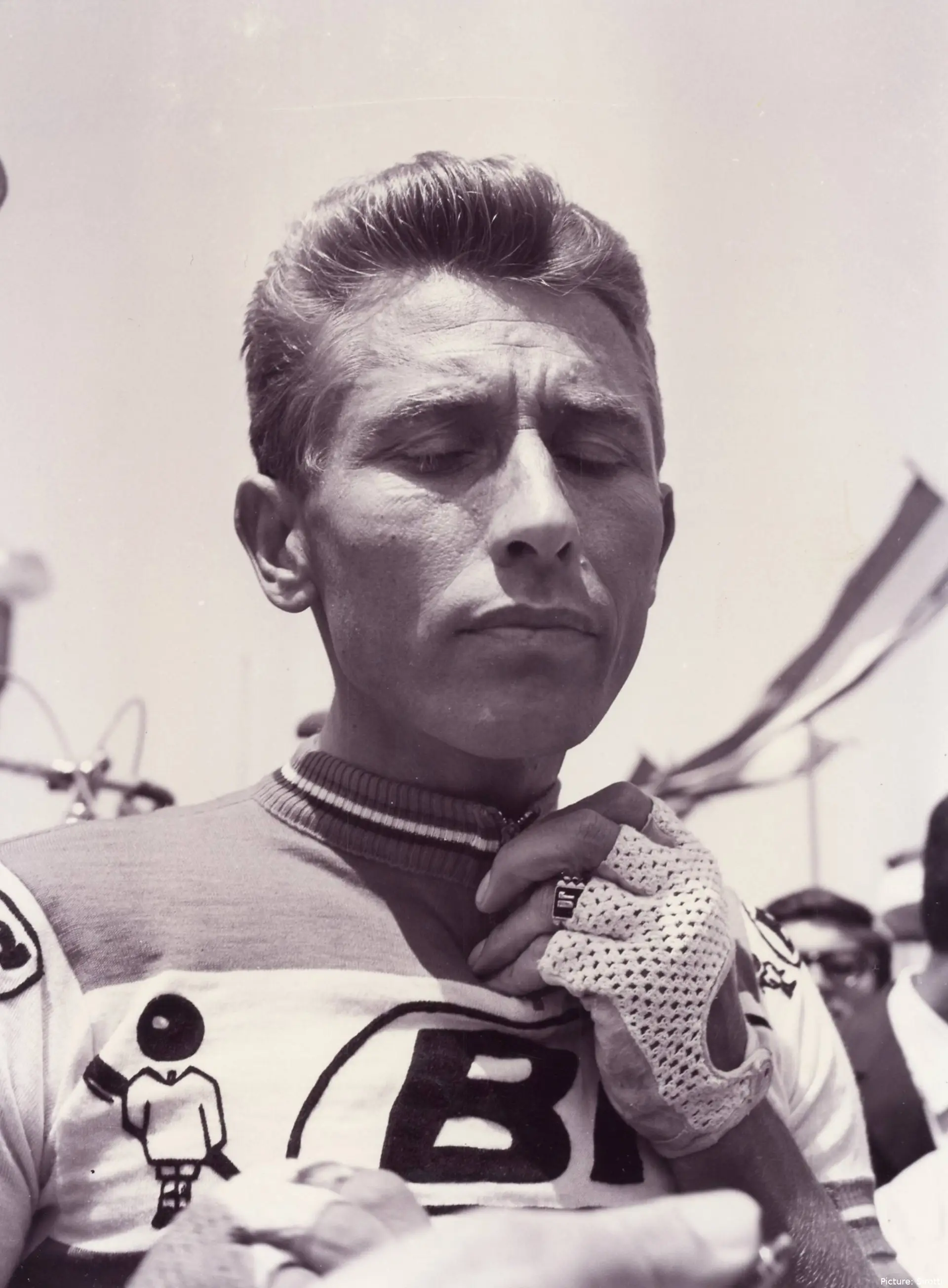
Jacques Anquetil won the Tour de France five times. Raymond Poulidor never won it, or even wore the yellow jersey. Yet in the contest for the affection of French cycling fans, the rider who kept losing often seemed to have the advantage.
It remains one of cycling's great paradoxes. Anquetil made winning look almost clinical: he measured his effort, controlled races and rarely attacked simply to entertain. Poulidor's defeats, by contrast, helped turn him into a national hero. Their rivalry raised a question that still resonates: is a champion judged only by results, or also by the way those results are achieved?
In the seventh installment of our Cycling Legends series, we explore the victories, rivalries and uncomfortable contradictions of Monsieur Chrono: a champion who conquered cycling's biggest races without ever fully conquering the French public. His story stretches from record-breaking time trials and Grand Tour dominance to open disputes about doping and an unlikely friendship with the man who became his most famous opponent.
From Normandy to the professional peloton: The making of Jacques Anquetil
Jacques Eugène Ernest Anquetil was born on 8 January 1934 in Mont-Saint-Aignan, near Rouen, in Normandy. His early life was far removed from the wealth and international recognition that would eventually accompany his sporting achievements.
His family had agricultural roots, and Anquetil spent part of his childhood working on his father's land. The experience introduced him to physical labour long before he discovered the demands of professional cycling.

Parc des Princes, Paris, 1959. Anquetil and Rivière congratulate Frederico Bahamontes on his victory in the Tour de France
His involvement in the sport began to develop seriously in 1950, when a school friend encouraged him to join AC Sottevillais, a local cycling club. There, he encountered André Boucher, the coach who would become one of the most important influences on his career.
Boucher recognised his potential and encouraged a disciplined approach built around endurance, pacing and the distribution of effort. Training behind motor-paced vehicles helped the young rider practise sustaining high speeds. Those lessons would become hallmarks of Anquetil's racing, especially in individual time trials.
Anquetil's progress was remarkable. In 1952, aged just 18, he represented France at the Helsinki Olympic Games. He finished 12th in the individual road race and contributed to France's bronze medal in the team classification.
His performances attracted the attention of Francis Pélissier, a former professional cyclist who managed the La Perle team. Pélissier recognized the teenager's potential and offered him the opportunity to turn professional in 1953. Within months, Anquetil would demonstrate that the confidence placed in him was justified.
The 1953 Grand Prix des Nations: A teenage sensation announces himself
On 27 September 1953, the 19-year-old Anquetil competed in the Grand Prix des Nations, one of the most prestigious individual time trials in professional cycling.
The race was widely regarded as the unofficial world championship of time trialling. Previous winners included Fausto Coppi, Hugo Koblet and Louison Bobet, placing Anquetil among some of the sport's most celebrated names.
Despite his inexperience, the Frenchman delivered an extraordinary performance. Over the 140.3-kilometer course, Anquetil finished six minutes and 41 seconds ahead of Roger Creton. Italian rider Agostino Coletto completed the podium, more than seven minutes behind the winner.
The scale of his victory immediately established him as one of Europe's most exciting young talents. More importantly, it revealed a quality that would define his career: an extraordinary ability to maintain speed and regulate effort over long distances.
The Grand Prix des Nations became one of Anquetil's signature events. Between 1953 and 1966, he won the competition nine times, an achievement that helped establish his nickname as 'Monsieur Chrono'.
His dominance against the clock extended beyond road racing. On his third attempt, in 1956, at Milan's Vigorelli velodrome, Anquetil established a new UCI Hour Record of 45.159 kilometers, surpassing the mark set by Fausto Coppi in 1942.
At just 22 years old, he had already beaten one of cycling's most prestigious records. The next challenge would be considerably greater: winning the Tour de France.
1957: A Tour de France debut that stunned the peloton
Anquetil's first Tour victory was emphatic. The 23-year-old won four individual stages and finished 14 minutes and 56 seconds ahead of Belgian Marcel Janssens. Austria's Adolf Christian completed the podium.
His stage victories included the journey from Caen to Rouen, the mountainous route between Besançon and Thonon-les-Bains, a short time trial in Barcelona and the 66-kilometer individual time trial from Bordeaux to Libourne.
Although his ability against the clock attracted considerable attention, Anquetil also demonstrated that he possessed the climbing ability and consistency necessary to survive the demands of the Tour.
The victory showed that his talents extended beyond a single discipline: he could also survive the mountains and manage the demands of three weeks. But the four-year gap before his next Tour triumph showed that early success did not guarantee an uninterrupted reign.
1961: Taking yellow on the opening day and keeping it until Paris
Anquetil returned to the Tour in 1961 determined to reclaim the title he had won four years earlier.
The Frenchman took the yellow jersey on the opening day and retained it all the way to Paris, producing one of the most commanding general classification performances of his career.
His two individual stage victories came in time trials: a 28.5-kilometer test around Versailles and a 74.5-kilometer effort between Bergerac and Périgueux.
Italian Guido Carlesi finished second overall, 12 minutes and 14 seconds behind, while Luxembourg's Charly Gaul completed the podium just two seconds further back.
Gaul, the 1958 Tour champion, was among the finest climbers of his generation. Yet even his exceptional mountain abilities were insufficient to challenge Anquetil's dominance.
The Frenchman's victory reinforced his reputation as a rider capable of imposing his preferred rhythm on an entire Grand Tour. It also marked the beginning of four consecutive victories that would transform cycling history.
1962: A third title and the arrival of Raymond Poulidor
The 1962 Tour introduced an important organizational change, with commercial trade teams returning after years of competition between national and regional selections.
Anquetil rode for Saint-Raphael-Helyett-Hutchinson, supported by a strong team that included German rider Rudi Altig. Belgian Jef Planckaert emerged as his principal opponent in the general classification. Once again, however, Anquetil's performances against the clock proved decisive.
He won the 43-kilometer time trial between Luçon and La Rochelle before delivering another outstanding performance over 68 kilometers from Bourgoin to Lyon. In the latter event, he defeated Italian Ercole Baldini by two minutes and 59 seconds and Raymond Poulidor by five minutes and one second.
Anquetil eventually won the Tour by four minutes and 59 seconds over Planckaert. Poulidor, meanwhile, finished third on his debut. At the time, few could have predicted just how significant the relationship between the two Frenchmen would become.
Anquetil represented established superiority, tactical precision and a certain emotional distance. Poulidor would increasingly embody perseverance, humility and the appeal of the underdog. Their rivalry was beginning to take shape.
1963: Beating the climbers on their own terrain
The 1963 Grand Boucle provided perhaps the clearest demonstration that Anquetil was far more than an exceptional time triallist.
Federico Bahamontes, winner of the 1959 Tour, was one of the greatest climbers of his generation. His compatriot José Pérez Francés also emerged as a serious contender. Anquetil responded by combining his established strength against the clock with outstanding performances in the mountains.
He won four individual stage wins included the mountainous finishes in Bagnères-de-Bigorre and Chamonix, as well as the time trials around Angers and between Arbois and Besançon. The mountain victories complicated the familiar picture of Anquetil as a time-trial specialist. He could also beat the best climbers on their own terrain.
He finished three minutes and 35 seconds ahead of Bahamontes, with Pérez Francés taking third. The victory made Anquetil the first cyclist to win the Tour de France four times. It also completed a historic season in which he became the first rider to win the Vuelta a España and Tour de France in the same year.

Tour de France, 1963. Anquetil (on the left), joined by Bahamontes and Poulidor, climbing the Col du Tourmalet.
1964: The unforgettable battle with Poulidor on the Puy de Dôme
The 1964 Tour de France became the defining chapter of Anquetil's rivalry with Raymond Poulidor.
Anquetil arrived having already won the Giro d'Italia, hoping to become only the second rider after Fausto Coppi to complete the Giro-Tour double. Poulidor, however, was determined to prevent his rival from securing a fifth yellow jersey. Their confrontation reached its most dramatic moment on stage 20, during the ascent of the Puy de Dôme.
The two Frenchmen rode shoulder to shoulder on the steep slopes, neither willing to concede the slightest psychological advantage. The images became part of cycling folklore. As the climb continued, both riders visibly struggled. Eventually, Poulidor accelerated and distanced Anquetil, gaining valuable time on the defending champion. For a moment, the prospect of a dramatic reversal seemed possible.
Yet Poulidor's effort was not enough to overturn the general classification. Anquetil recovered and won the final individual time trial between Versailles and Paris, securing his fifth Tour de France victory by just 55 seconds. It was the smallest winning margin of his five triumphs.
His four stage victories that year included the Briançon-Monaco stage and three individual time trials. For Anquetil, the result represented a historic achievement. For Poulidor, it was another painful disappointment.
For French cycling, the Puy de Dôme became the enduring symbol of a rivalry that transcended sporting results.
Giro d'Italia: Two victories and a historic double
Although Anquetil's international reputation was built primarily around the Tour de France, his achievements in Italy were equally important to his legacy. He won the Giro d'Italia twice, in 1960 and 1964, becoming the first French rider to win the Italian Grand Tour.
His first victory came in 1960, when he defeated Gastone Nencini, the Italian who would subsequently win that year's Tour de France. Anquetil's success was built around his ability to perform consistently throughout the race and deliver decisive performances against the clock.
He won two individual time trials, including the demanding 68-kilometre test between Seregno and Lecco.
Four years later, he returned to Italy and claimed a second overall victory. His principal opponents included Italo Zilioli and Franco Balmamion, but Anquetil established an important advantage by winning the fifth-stage individual time trial from Parma Baganzola to Busseto.
He then successfully defended his position through the remaining stages. Across his appearances in Italy, he recorded six individual stage victories, all in time trials: two in 1959, two in 1960, one in 1961 and another in 1964.
Yet his achievements in Italy also required the ability to negotiate difficult mountain stages, unpredictable weather and aggressive opposition.
The 1963 Vuelta a España: The first rider to win all three Grand Tours
Anquetil's victory at the 1963 Vuelta a España occupies a special place in cycling history.
Having already conquered the Tour de France and Giro d'Italia, he travelled to Spain with the opportunity to complete an unprecedented collection. No cyclist had previously won all three Grand Tours.
Anquetil immediately demonstrated his intentions by winning the opening individual time trial, designated stage 1b. He subsequently maintained control of the general classification and finished ahead of Spaniards José Martín Colmenarejo and Miguel Pacheco.
The victory made him the first cyclist in history to win the Tour de France, Giro d'Italia and Vuelta a España. It was a milestone that extended his legacy beyond French cycling.
Beyond the Grand Tours: An extraordinary collection of victories
Anquetil's achievements were not limited to three-week stage races.
Throughout his professional career, he collected victories in prestigious shorter stage races, major one-day events and individual time trials.
His five Paris-Nice titles demonstrated his ability to perform consistently in demanding early-season conditions, while his victories at the Critérium du Dauphiné Libéré reinforced his reputation as one of the finest stage racers of his generation.
He also won Gent-Wevelgem in 1964, Bordeaux-Paris in 1965 and Liège-Bastogne-Liège in 1966. Taken together, those results make it difficult to reduce his career to performances against the clock.
| Competition | Victories | Years |
| Tour de France | 5 | 1957, 1961, 1962, 1963, 1964 |
| Giro d'Italia | 2 | 1960, 1964 |
| Vuelta a España | 1 | 1963 |
| Grand Prix des Nations | 9 | 1953–1958, 1961, 1965, 1966 |
| Paris–Nice | 5 | 1957, 1961, 1963, 1965, 1966 |
| Critérium du Dauphiné Libéré | 2 | 1963, 1965 |
| Gent–Wevelgem | 1 | 1964 |
| Bordeaux–Paris | 1 | 1965 |
| Liège–Bastogne–Liège | 1 | 1966 |
| Itzulia Basque Country | 1 | 1969 |
The remarkable 1965 Dauphiné-Bordeaux-Paris double
In 1965, Anquetil's sporting director Raphaël Géminiani persuaded him to attempt one of the most demanding challenges of his career.
The objective was to win the Critérium du Dauphiné Libéré and then immediately compete in Bordeaux-Paris, an endurance race of approximately 600 kilometres. The schedule appeared almost impossible. Bordeaux-Paris began during the night, only hours after the Dauphiné had concluded in Avignon.
Anquetil won the Dauphiné before travelling rapidly to Bordeaux to begin the second event, with virtually no opportunity for meaningful recovery.
Despite the accumulated fatigue of the preceding days, he won Bordeaux-Paris as well. The achievement became one of the most remarkable demonstrations of endurance in his career. It also challenged the public perception that Anquetil was unwilling to suffer physically.
His preference for calculated racing had never meant that he lacked resilience. When an exceptional sporting objective justified the effort, he was capable of pushing himself to extraordinary limits.
Liège-Bastogne-Liège 1966: A Monument for Monsieur Chrono
Anquetil's victory at Liège-Bastogne-Liège in 1966 further demonstrated the breadth of his abilities.
The Belgian Monument was associated with demanding climbs, aggressive racing and unpredictable tactical situations. It was not an event in which Anquetil could rely on a conventional individual time trial to establish an advantage.
Nevertheless, he produced a commanding performance to win one of cycling's most prestigious one-day races. Combined with his earlier Gent-Wevelgem victory, the result demonstrated that his talents extended well beyond controlling Grand Tour classifications.
His palmarès also included victories in major one-day races, even if Grand Tours remained his defining stage.
The World Championship title that escaped him
Despite his extraordinary collection of victories, Anquetil never won the professional road race World Championship.
His best opportunity came in 1966, when the event was held at the Nurburgring in West Germany. The race produced a podium involving three riders whose careers were closely connected.
Rudi Altig, the German who had previously been Anquetil's teammate, won the rainbow jersey. Anquetil finished second, while Raymond Poulidor claimed the bronze medal.
| Position | Rider | Country |
| 1 | Rudi Altig | West Germany |
| 2 | Jacques Anquetil | France |
| 3 | Raymond Poulidor | France |
| 4 | Gianni Motta | Italy |
| 5 | Jean Stablinski | France |
The first three riders were credited with the same finishing time, while Gianni Motta arrived eight seconds later and Jean Stablinski finished ten seconds behind the winner.
The outcome was particularly frustrating for Anquetil. Although he was among the greatest time trialists in cycling history, his sprinting ability was comparatively limited. Altig was a much more accomplished finisher and made that advantage count.
The rainbow jersey remained one of the few major honours missing from Anquetil's collection.
He also never won the French national professional road race championship, although he had been French national pursuit champion on the track between 1955 and 1957.
Anquetil versus Poulidor: The rivalry that divided France
The rivalry with Raymond Poulidor was about more than race results. It became a contest between two competing images of sporting greatness, and between the qualities that spectators admired in their champions. The two Frenchmen represented contrasting personalities and different ideas about what a sporting champion should embody.
Anquetil was elegant, sophisticated and often perceived as emotionally distant. He enjoyed luxury, good food and the financial rewards of professional cycling. Poulidor, by contrast, was portrayed as modest, approachable and hardworking. His repeated disappointments only increased his popularity. The contrast was extraordinary.
The numbers were brutally one-sided: five Tour victories for Anquetil, none for Poulidor, who never even wore yellow. Yet Poulidor often inspired warmer public affection. The man who lost could appear more relatable than the man who almost always found a way to win.
For many spectators, Anquetil represented superiority and calculation, while Poulidor embodied perseverance in the face of disappointment. The rivalry also contained genuine hostility. Their sporting relationship became particularly tense when either rider believed the other had benefited from questionable tactical decisions or assistance from teammates.
Following the 1966 Paris-Nice, Poulidor publicly criticized the conduct of Anquetil's teammates. Anquetil responded angrily, questioning his rival's complaints.
The dispute illustrated how personal their competition had become. For supporters, taking sides could amount to choosing a sporting philosophy. Anquetil offered precision and results; Poulidor offered vulnerability, attacks and the possibility of heartbreak. Neither image tells the whole story of either rider, but together they explain why the rivalry endured beyond the finish line.
From bitter rivals to genuine friends
Time eventually transformed their relationship. After retirement, the two Frenchmen developed a genuine friendship, and the hostility that had once defined their competition gradually gave way to mutual understanding.
Anquetil came to recognize how much their rivalry had cost them personally, while Poulidor spoke warmly about the generosity and character of the man who had repeatedly defeated him.
Their reconciliation revealed a side of Anquetil that many supporters had rarely witnessed during his racing career. Behind the public image of a cold, calculating champion was a man capable of affection, humour and loyalty.
Beyond Poulidor: Rivals who challenged Anquetil
Although Poulidor became Anquetil's most famous opponent, several other exceptional riders challenged his dominance.
Roger Rivière was considered one of his most dangerous potential rivals during the earlier stages of his career. An outstanding time triallist and track cyclist, Rivière possessed qualities that made him a natural competitor to Monsieur Chrono.
Their rivalry might have become one of the defining contests of the 1960s, but Rivière's career was effectively ended by a devastating crash during the 1960 Tour de France. Raphael Géminiani later argued that Rivière had been Anquetil's true sporting counterpart, with Poulidor emerging as his principal rival only after Rivière's accident.
It was a judgement shaped by Géminiani's close relationship with Anquetil, rather than an undisputed historical conclusion. Federico Bahamontes presented a very different challenge. The Spaniard was an exceptional climber, capable of producing devastating attacks on long mountain passes.
He won the 1959 Tour de France, when Anquetil finished third, before taking second place behind the Frenchman in 1963. Charly Gaul was another formidable opponent. The Luxembourger excelled in the mountains and in difficult weather conditions, winning the 1958 Tour and the Giro d'Italia in 1956 and 1959.
Professional teams and the business of being a champion
Anquetil's professional career lasted from 1953 until 1969, a period during which the commercial structure of cycling underwent considerable change.
He competed for several major French teams, with his progression reflecting both his sporting achievements and his increasing commercial value.
| Years | Team |
| 1953–1955 | La Perle–Hutchinson |
| 1956–1961 | Helyett (with changing co-sponsors) |
| 1962–1964 | Saint-Raphaël (with Helyett and later Gitane) |
| 1965–1966 | Ford France |
| 1967–1969 | Bic |
Anquetil was also an important figure in the growing professionalisation of cycling. He understood his commercial value and negotiated accordingly, treating sporting success as both a personal ambition and a means of achieving financial security.
His enjoyment of wealth and luxury sometimes contributed to his reputation for arrogance, particularly among supporters who expected champions to demonstrate greater humility. However, his approach also anticipated the increasingly professional attitudes adopted by later generations of leading riders.
Doping and the limits of Anquetil’s sporting legacy
Any serious assessment of Anquetil's legacy must also confront the doping culture of professional cycling in the 1950s and 1960s. Sporting greatness and historical controversy coexist in his story; one cannot simply erase the other.
Unlike many riders who preferred to avoid discussing the subject publicly, the Frenchman was remarkably outspoken. He acknowledged using performance-enhancing substances and defended their use in a sport characterized by extreme physical demands.
Anquetil argued that professional cyclists should be allowed to reduce the suffering associated with their work, drawing comparisons between medication in cycling and the treatment of pain in other occupations.
His arguments belonged to an era in which anti-doping rules were still developing. That context helps explain his stance, but it does not remove the ethical and medical questions raised by performance-enhancing substances.
The death of British rider Tom Simpson during the 1967 Tour de France, in which amphetamines were implicated, contributed to increasing scrutiny of doping and its consequences.
Anquetil's public stance demonstrated the extent to which some leading riders resisted restrictions they regarded as incompatible with the physical realities of their profession.
He was not an anti-doping reformer. His public resistance to restrictions reflected a view of professional cycling in which managing pain and fatigue was part of the job. That makes his legacy more difficult to celebrate uncritically, and more important to examine carefully.
The 1967 Hour Record that was never recognised
Anquetil's relationship with anti-doping regulations also affected one of his most remarkable late-career performances.
In September 1967, he returned to Milan's Vigorelli velodrome and covered 47.493 kilometers in one hour. The distance exceeded the existing official Hour Record.
However, the performance was not ratified because Anquetil did not complete the required anti-doping procedure. He refused to take the newly introduced post-race doping test.
Accounts of the incident describe Anquetil objecting to the conditions of the test and proposing that it be conducted later at his hotel. The officials did not accept that alternative. The precise details of the confrontation, including reports of a scuffle, should be verified against contemporary reporting before publication.
1969 Itzulia Basque Country: The final victory
By the late 1960s, Anquetil's dominance of the Grand Tours had ended. A new generation was emerging, including Felice Gimondi and Eddy Merckx, while the Frenchman was approaching the conclusion of a professional career that had lasted more than 15 years.
His final victory came at the 1969 Itzulia Basque Country. The race had returned to the calendar after a long absence, having last been held in 1935.
Anquetil seized the opportunity to add another prestigious stage-race victory to his record. The competition was closely contested. A decisive breakaway on the second stage reduced the general classification battle to a small group of contenders.
Anquetil subsequently took the race lead during the fourth day's morning half-stage to Gernika, won by Raymond Riotte. He defended his advantage in the afternoon's 43-kilometer individual time trial to Bilbao, finishing third behind Raymond Poulidor and Luis Ocaña.
On the final stage to Eibar, Anquetil finished seventh in the group of favourites, protecting his overall lead. He won the general classification by 32 seconds over Francisco Gabica, with Mariano Díaz third at 40 seconds.
Ocaña finished sixth at 3:59, while Poulidor took seventh at 4:08. Remarkably, Anquetil secured the overall victory without winning an individual stage. It was a fitting final success for a rider whose career had been defined by his ability to manage the general classification.
An understated farewell in Antwerp
Although the Itzulia Basque Country provided his final victory, it was not Anquetil's last competitive appearance. His final race took place on 27 December 1969 in Antwerp, Belgium.
For a rider who had dominated an entire era, the occasion attracted surprisingly little attention. As the UCI later recalled, citing contemporary reporting from L'Équipe, his final appearance passed with remarkable indifference from the media.
It was an understated conclusion to one of cycling's most distinguished careers. Anquetil retired from professional competition at the end of 1969, aged 35.
He left the sport with five Tour de France victories, two Giro d'Italia titles, one Vuelta a España, nine Grand Prix des Nations victories and an officially recognized Hour Record.
Life after cycling: Journalism, television and the Normandy countryside
Retirement did not mean that Anquetil disappeared from professional cycling. He remained involved through journalism, broadcasting, race organization, and administrative responsibilities. He worked as a correspondent for L'Équipe and contributed to radio and television coverage, including assignments associated with Europe 1 and Antenne 2.
His experience as a professional cyclist gave him a valuable perspective on a sport undergoing significant change. Anquetil had spent his career studying opponents, regulating effort and understanding the tactical demands of stage racing.
Those qualities also informed his work as a commentator and observer. He assumed organizational responsibilities connected with Paris-Nice and the Tour Méditerranéen. Later, he became involved with the Fédération Française de Cyclisme, serving on its management committee and working as sporting director of French national teams at the World Championships.
Away from the sport, Anquetil devoted considerable attention to his property in Normandy, the Domaine des Elfes, near La Neuville-Chant-d'Oisel. He enjoyed the countryside, agricultural activities and the comfortable lifestyle that his professional success had allowed him to establish.
Remarkably, he showed little interest in recreational cycling after retirement. According to the UCI's account of his later years, Anquetil rode a bicycle on only three further occasions after his final race: during the Grand Prix des Gentlemen in Nice, with friends in Normandy and with his daughter on her birthday.
Anquetil's legacy: A champion who made winning look complicated
Anquetil's record leaves little room for argument about his sporting stature. Five Tour de France titles, victories in all three Grand Tours, major one-day successes and repeated domination of the time trial place him among cycling's defining figures. Yet statistics alone do not explain why his name still provokes debate.
His career exposed a tension at the heart of professional sport. Spectators want champions to win, but they also want them to suffer visibly, take risks and offer something of themselves. Anquetil was often most effective when he refused to do those things on demand. He treated races as problems to solve, not performances to stage for the crowd.
Read also
That approach made him formidable. It also helped make Poulidor, the rival who repeatedly fell short, so beloved. Their eventual friendship added a final human dimension to a rivalry once framed as an irreconcilable clash of personalities.
Nor can Anquetil's achievements be separated from his outspoken defense of doping practices in his era. A credible historical portrait must hold the victories and the controversy together, rather than use one to dismiss the other.
Perhaps that is why Monsieur Chrono remains such a compelling figure. He conquered the Tour de France five times, but the more difficult question - what makes a champion worthy of admiration - was never settled by the stopwatch
Carlos Silva is a writer for CyclingUpToDate.com, where he contributes race reports, interviews, analysis pieces, and live coverage of the international cycling calendar. Holding a degree in Sports from the Jean Piaget Institute, he combines academic knowledge of performance, training, and competition with hands-on journalism experience in professional cycling.
Throughout his career, Carlos has conducted interviews with leading figures in the sport, including Alberto Contador, Joaquim Rodríguez, Óscar Pereiro, João Almeida, Isaac del Toro, Derek Gee, John Degenkolb and Geraint Thomas. These conversations reflect direct engagement with Grand Tour winners, Classics specialists, and emerging talents.
He has provided on-site coverage at major events ranging from the Vuelta a España to the Tour de France, alongside stage races such as Vuelta a Andalucía, Volta ao Algarve, Volta a Portugal and O Gran Camiño. Covering the mythical climbs of the Giro d'Italia remains one of his professional ambitions.
Carlos is responsible for liveblog coverage of all major WorldTour races and beyond, including the Tour de France, Giro d'Italia and Vuelta a España. His reporting integrates verified data from ProCyclingStats to ensure statistical accuracy, contextual depth, and analytical precision.
A lifelong cycling enthusiast, he approaches storytelling across written, photographic, and video formats with a focus on credibility, tactical insight, and informed race interpretation.
claps 3visitors 3
Just in


Popular news
Latest comments
- Well, he did come close, especially on stage 18. And Pogačar certainly would have heard of him at least. And no-one ever said that Pogačar being BFFs with Callum was a condition for Callum challenging him
 Rafionain-Glas22-11-2026
- she should go for it!mij22-11-2026
- literally one of the dumbest of all dumb headlines used here. Challenging Tadej??? I doubt Tadej even knows this rider exists.mij22-11-2026
- but they are aware of sock height, riding in the super tuck, mismatched uniforms, and handle bar width.mij22-11-2026
- yes Merlier missed the early races in the middle east where he traditionally takes a lot of wins. I’ll give stuyven his dues as a domestique. that isn’t what he was signed for, and with no personal wins it was a failure. he was signed to win races.mij22-11-2026
- You haven't proven a single thing, with every post you are losing credibility.awp22-11-2026
- Yes, may God bless him and you too, would you like me to say a prayer for you? 😂awp22-11-2026
- He is one rider who isn't afraid of taking on Pogi unlike no balls Remcoabstractengineer22-11-2026
- No no my friend, I have proven all my arguments. But you saying that "God" exists is your problem, not mine. Under common logic and debate principles, whoever asserts that something exists ("God exists") carries the burden of proving it. In other words, the burden of proof is the obligation to provide evidence or logical justification for a claim. Ad acta!!!PogiSloFans22-11-2026
- pure class!Ketterechts22-11-2026
Loading
Write a comment