Five Grand Tours, two Merckx doping scandals and a complicated relationship with Pantani - The remarkable story of Felice Gimondi
Cycling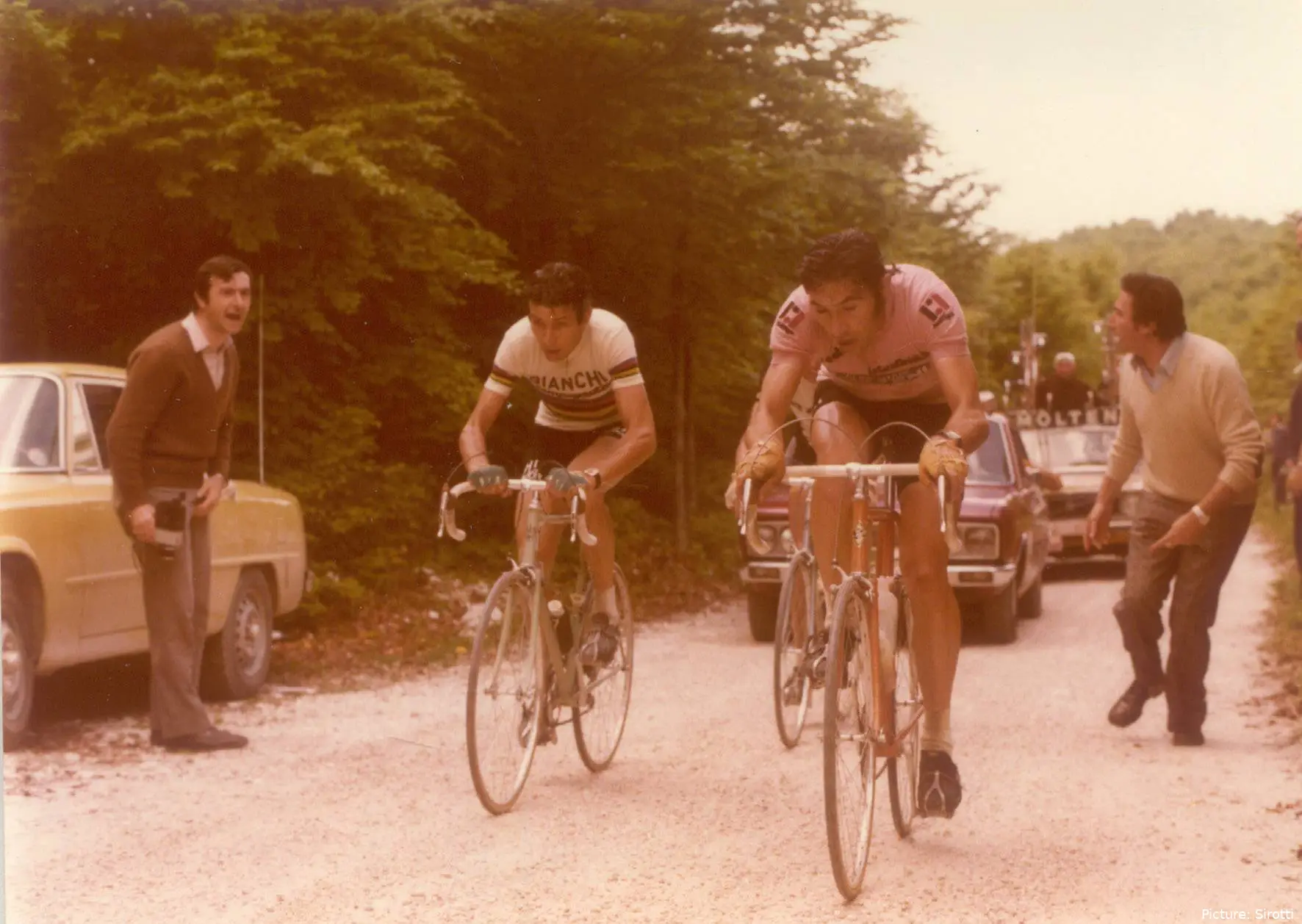
Few riders in cycling history have compiled a palmarès as complete as Felice Gimondi's. The Italian won all three Grand Tours, became world road race champion and conquered some of cycling's most prestigious Classics. Yet his extraordinary career is often remembered through the shadow of Eddy Merckx.
The Belgian's dominance undoubtedly cost Gimondi opportunities, but it never prevented him from building a remarkable legacy of his own. From his unexpected Tour de France victory in 1965 to his final Giro d'Italia triumph eleven years later, Gimondi repeatedly found ways to succeed against the strongest opposition.
In this edition of our Cycling Legends series, we revisit the victories, controversies and personal relationships that shaped the career of one of Italian cycling's greatest champions.
From delivering letters to becoming a professional cyclist
Felice Gimondi was born on 29 September 1942 in Sedrina, a village in the province of Bergamo in northern Italy. His father, Mosè, worked as a lorry driver, while his mother, Angela Salvi, delivered mail around the village.
His first experiences on a bicycle came through helping his mother deliver letters across the steep roads of the Brembana Valley. His father later encouraged his interest in competitive cycling, although the family's limited finances made purchasing a racing bicycle difficult.
In a 2017 interview with La Stampa, Gimondi recalled how his father promised to buy him a bicycle once a customer settled an outstanding payment for a delivery of sand. When the money finally arrived, the family purchased a second-hand racing bike for approximately 30,000 lire. Gimondi was so excited that he rode it home barefoot.
He began competing with the Sedrinese cycling club, gradually establishing himself in regional amateur races. His breakthrough arrived in 1964 when he won the Tour de l'Avenir, an amateur ride viewed as a testing ground for future Tour de France champions.
That year, he also represented Italy at the Tokyo Olympic Games, finishing 33rd in the road race. His performances earned him a professional contract with Salvarani for the following season.
1965 Tour de France: The unexpected champion
When Gimondi arrived at the 1965 Tour de France, he was not supposed to be Salvarani's leader. The 22-year-old had already finished third at the Giro d'Italia during his first professional season, but his participation in France came about under unusual circumstances.
Vittorio Adorni, who had won the Giro earlier that year, was the team's established leader. Gimondi had not originally expected to participate, having already fulfilled his contractual obligation to race one Grand Tour.
In a 2015 interview with Cyclist, he recalled enthusiastically accepting the opportunity when Salvarani's sponsors asked whether he wanted to compete. The initial intention was for him to ride only the opening part of the race. Instead, he would reach Paris wearing the yellow jersey.
Gimondi won stage three from Roubaix to Rouen and took the overall lead. Although he subsequently lost the jersey, he remained among the leading contenders. Adorni's withdrawal through illness then changed the team's strategy, allowing Gimondi to pursue his own ambitions.
His principal opponents included Raymond Poulidor, runner-up to Jacques Anquetil at the previous year's Tour, and fellow Italian Gianni Motta.
Gimondi combined consistency in the mountains with exceptional time-trialling performances. He won the mountain time trial to Le Revard before delivering another decisive victory in the final time trial from Versailles to Paris.
He secured the general classification by 2 minutes and 40 seconds over Poulidor, with Motta completing the podium. Having entered the race as a late addition to the team, Gimondi had won the Tour de France on his debut, during his first professional season.
The victory also produced an emotional family moment. In one of his final interviews with Corriere della Sera, Gimondi recalled discovering that his father had travelled to see him during the Tour but remained outside the team hotel, unwilling to disturb him.
When he found his father sitting quietly on a veranda, the two embraced without speaking. Gimondi remembered it as the only occasion during that Tour when he became genuinely emotional. After returning to Sedrina as a national hero, he resigned from his job with the postal service. Cycling had become his profession.

Felice Gimondi on the Passo Stelvio stage of the 1972 Giro d’Italia
Three Giro d'Italia victories across three different eras
If the Tour made Gimondi internationally famous, the Giro d'Italia established his place in Italian cycling history.
He won his home Grand Tour three times, in 1967, 1969 and 1976, and finished on the overall podium on nine occasions, a record recognised by the Giro's official Hall of Fame.
His first victory came in 1967 against formidable opposition, including Jacques Anquetil, Franco Balmamion and several of Italy's leading stage racers.
Gimondi secured the maglia rosa ahead of Balmamion, with Anquetil completing the podium. The result confirmed that his unexpected Tour triumph had been no accident.
The controversial 1969 Giro
His second Giro victory came in circumstances that remain among the most disputed in the race's history. Eddy Merckx had dominated much of the 1969 edition and appeared to be heading towards overall victory when he was excluded following a positive doping control in Savona.
The Belgian disputed the result and maintained his innocence. Gimondi inherited the race lead and ultimately won ahead of Claudio Michelotto and Italo Zilioli. The incident remains particularly controversial because Gimondi himself had been involved in an anti-doping dispute the previous year.
During the 1968 Giro, he was initially reported positive following a control involving Reactivan. However, subsequent proceedings resulted in his exoneration. The Giro d'Italia's historical archive confirms that Gimondi and Franco Balmamion were initially implicated but later acquitted because of procedural irregularities.
In a detailed 2012 interview with Linkiesta, Gimondi provided his own explanation. He maintained that he had taken substances that were not prohibited under the regulations then in force. Salvarani arranged for two scientific experts, professors Genovese and Lodi, to assist his defence. Additional testing was conducted after he repeated the physical exertion and substance intake associated with the original result.
Gimondi argued that these tests demonstrated how permitted substances could produce misleading findings under the testing procedures of the period. The controversy highlighted the difficulties facing professional cycling as anti-doping regulations and scientific methods were still developing.
The following year's Merckx exclusion added another dimension to the debate. In a 2025 interview with Corriere della Sera, the Belgian again disputed the circumstances of his positive test and alleged that he had previously been offered money to lose the Giro. Those allegations remain Merckx's account rather than established findings. Gimondi's 1969 victory nevertheless stands in the official record.

Felice Gimondi in the time trial on stage 15 of the 1969 Giro d’Italia, from Cesenatico to the Repubblica San Marino
1976: The veteran's final triumph
Seven years later, Gimondi returned to the top of the Giro podium in one of the most dramatic victories of his career. Approaching his 34th birthday, he faced a new generation of challengers, including Francesco Moser and Johan De Muynck.
Gimondi remained competitive throughout the final week but lost the overall lead to De Muynck in the Dolomites. On the penultimate road stage, finishing in Bergamo, he won in front of his home supporters, beating Eddy Merckx and Gianbattista Baronchelli in the sprint. The following day, he recovered enough time in the Arcore time trial to reclaim the maglia rosa. He won the Giro by just 19 seconds over De Muynck.
Reflecting on the victory to the Cyclist, Gimondi acknowledged how much his approach had changed: "I wasn't the same rider so I needed real race management. I finally saw it through when I beat De Muynck in the last time-trial [on Stage 22 ed.] so it was a special win." His third Giro title demonstrated the importance of experience and tactical judgement in extending a champion's career.
The 1968 Vuelta: Joining an exclusive club
In 1968, Gimondi completed one of cycling's greatest achievements by winning the Vuelta a España. Having already conquered the Tour de France in 1965 and the Giro d'Italia in 1967, he became only the second rider in history to win all three Grand Tours, following Jacques Anquetil.
He defeated José Pérez Francés and Eusebio Vélez to secure the general classification. Remarkably, Gimondi achieved the victory in his only appearance at the Spanish Grand Tour.
| Grand Tour | Overall wins | Winning years |
| Tour de France | 1 | 1965 |
| Giro d'Italia | 3 | 1967, 1969, 1976 |
| Vuelta a España | 1 | 1968 |
| Total | 5 |
Barcelona 1973: The day Gimondi defeated Merckx for the rainbow jersey
On 2 September 1973, Gimondi secured one of his most celebrated victories at the World Road Race Championships in Barcelona. The demanding Montjuïc circuit produced a decisive selection containing four outstanding riders: Gimondi, Eddy Merckx, Freddy Maertens and Luis Ocaña.
Merckx was already the dominant figure of his generation, while Ocaña had won the Tour de France earlier that summer. The closing kilometres developed into a tactical contest as Gimondi and Ocaña attempted to break up the leading group. Merckx responded to their attacks, leaving the outcome to be decided in the sprint.
Maertens accelerated in the finale, but Gimondi timed his effort perfectly and overtook the Belgian to claim the rainbow jersey. Maertens finished second, Ocaña third and Merckx fourth. The result intensified tensions within the Belgian team, with Merckx and Maertens subsequently disagreeing over their tactics.
For Gimondi, the victory was particularly significant. After winning bronze at the 1970 World Championships and silver in 1971, he had finally secured gold. In a later retrospective, Gimondi discussed the tactical battle and acknowledged how important it had been to position himself correctly behind Merckx during the closing kilometres.
The world title completed an extraordinary collection of achievements that already included victories in all three Grand Tours.
Paris-Roubaix, Il Lombardia and Milan-Sanremo: A champion of the Classics
On 17 April 1966, he won Paris-Roubaix in punishing conditions. Cold rain made the cobbled roads particularly difficult, but the young Italian attacked approximately 35 kilometres from the finish and rode clear. He entered the Roubaix velodrome alone, more than four minutes ahead of Jan Janssen, with Gustaaf De Smet finishing third.
Later that year, Gimondi added his first Giro di Lombardia victory. He won the race again in 1973, shortly after becoming world champion, although that edition also ended in controversy. Merckx crossed the finish line first but was subsequently disqualified following a positive doping test, leaving Gimondi as the official winner.
On 18 March 1974, Gimondi added Milan-Sanremo to his palmarès while wearing the rainbow jersey. These victories placed him among the rare champions capable of succeeding in Grand Tours, cobbled Classics and the longest one-day races.
Eddy Merckx: The rival who changed Gimondi's career
No account of Gimondi's career would be complete without Eddy Merckx. The Belgian won five Tours de France, five Giros d'Italia, three World Championships and nineteen Monument titles, dominating professional cycling throughout much of the period in which Gimondi was at his strongest.
Their rivalry extended across almost every major type of race. Gimondi frequently had to accept defeat, but he also produced some of his finest performances against Merckx. In a 2015 Cyclist interview, Gimondi reflected on how many additional Grand Tours he might have won without the Belgian. "I could have won five Giros and two Tours de France like Fausto Coppi."
The psychological challenge was considerable. In a 2012 interview with Linkiesta, Gimondi recalled losing 33 seconds to Merckx in a time trial at the Volta a Catalunya. The defeat shattered his confidence, and he admitted that it took him two years to accept the Belgian's superiority.
Eventually, that recognition developed into respect. Their relationship became a close friendship after their racing careers ended. When Gimondi died in August 2019, Merckx expressed his grief in an interview with ANSA. "This time I lose. First of all, I lose a friend, and then the rival of a lifetime."
The Belgian revealed that they had remained in contact and had spoken only two weeks before Gimondi's death. In a June 2025 interview with Tuttobiciweb, Merckx again described Gimondi as his principal opponent, praising his consistency, loyalty and character.
He also rejected suggestions that he had deliberately allowed Gimondi to win races. "I never left anything to him, because I never gave gifts to anyone. What Felice took home, he did with his strength and intelligence. And Felice was strong and intelligent", Merckx insisted.
The relationship between the two champions became one of cycling's most enduring examples of fierce competition developing into genuine friendship.
Beyond Merckx: The champions who shaped his career
Although Merckx was his most famous opponent, Gimondi competed against several generations of exceptional riders. Vittorio Adorni played an important role in his early development at Salvarani. The experienced Italian was the team's established leader when Gimondi turned professional, combining mentorship with an increasingly competitive relationship.
Gianni Motta was another major Italian contemporary. Their rivalry extended beyond racing results, with both competing for victories and national prestige. Jacques Anquetil represented the established generation of Grand Tour champions, making Gimondi's victory over him at the 1967 Giro particularly significant.
Luis Ocaña became another formidable opponent, while Francesco Moser, Gianbattista Baronchelli and Johan De Muynck emerged as major challengers during Gimondi's later years. Luciano Pezzi, meanwhile, was among the most influential figures behind his success.
A former professional who had raced alongside Fausto Coppi, Pezzi became an important team director at Salvarani. A 1998 article published by L'Unità following Pezzi's death recalled him disputing the popular account that Gimondi had been selected for the 1965 Tour simply because another rider was unavailable.
According to Pezzi, he had already intended to include the youngster after his impressive third-place finish at the Giro. The account offers an important qualification to the familiar story of Gimondi's unexpected Tour debut: his opportunity may have arrived under unusual circumstances, but his potential had already been recognised.

Felice Gimondi and Eddy Merckx on the climb to the Passo Fedaia during the 1970 Giro d’Italia
Salvarani, Bianchi and the final years of his career
Gimondi spent his professional career with two major Italian cycling organisations. He raced for Salvarani from 1965 until 1972 before joining Bianchi in 1973. His association with Bianchi became particularly important, extending beyond his competitive career and continuing for decades after his retirement.
By the late 1970s, Gimondi was approaching the end of his career. His final Giro d'Italia came in 1978, when Johan De Muynck, the Belgian he had defeated by just 19 seconds two years earlier, was now his teammate.
Rather than pursuing another personal triumph, Gimondi accepted a supporting role and helped De Muynck win the general classification. He finished 11th overall. His final full road season was 1978, although historical team records list him with Bianchi-Faema until February 1979.
| Period | Team | |
| 1965–1972 | Salvarani | |
| 1973–1977 | Bianchi-Campagnolo | |
| 1978–early 1979 | Bianchi-Faema |
Marco Pantani: A complicated relationship beyond retirement
Retirement did not mean leaving professional cycling behind. Gimondi established an insurance business, maintained close ties with Bianchi and became involved in team management.
His most prominent management position came with Mercatone Uno, the Italian team associated with Marco Pantani. Pantani had become a national hero after winning both the Giro d'Italia and Tour de France in 1998. His Tour victory was particularly significant because he became the first Italian to win the race since Gimondi in 1965.
Gimondi served as president of Mercatone Uno from January 2000 until the conclusion of the 2001 Giro d'Italia. Their relationship, however, was difficult. Gimondi recalled that Pantani frequently insisted on making his own decisions, even when others attempted to offer guidance.
The former champion eventually stepped away from his management position. Despite their differences, Pantani's death in February 2004 deeply affected him. In 2012, Gimondi identified Pantani's death as one of the saddest moments of his life.
He continued to defend the younger rider's sporting achievements, particularly when retrospective anti-doping investigations raised questions about historical results.
The controversy over Pantani's 1998 Tour victory
In 2013, reports suggested that Pantani's 1998 Tour de France victory could face renewed scrutiny following retrospective testing. Gimondi strongly opposed the possibility of stripping riders of victories many years after the events.
In a July 2013 interview, he argued that anti-doping controls should not be applied retrospectively in a manner he considered unfair. He expressed the same principle in relation to Lance Armstrong, although the American's case involved substantially different evidence and disciplinary proceedings.
Gimondi also criticised the UCI's handling of historical doping controversies. These statements represented his personal views on retrospective investigations, rather than conclusions about the validity of the evidence concerning Pantani or Armstrong.
His admiration for Pantani's talent nevertheless remained unwavering. He described Pantani as one of the greatest climbers in cycling history. He singled out the Italian's victory at Oropa during the 1999 Giro d'Italia as an extraordinary performance.
After suffering a mechanical problem on the final climb, Pantani recovered, overtook numerous opponents and won the stage. Gimondi recalled being astonished by the comeback, regarding it as one of the most remarkable climbing performances he had witnessed.
His relationship with Pantani reflected both the difficulties of managing an exceptional athlete and the enduring admiration that champions can retain for one another despite personal disagreements.
Vincenzo Nibali and Gimondi's lasting influence
Gimondi remained closely involved in cycling throughout his later years, regularly commenting on the sport and the development of Italian riders. Vincenzo Nibali was among those he admired most.
The Sicilian's victories in all three Grand Tours invited comparisons with Gimondi, who had achieved the same feat decades earlier. In a retrospective published by Corriere della Sera, Gimondi acknowledged their similarities while suggesting that Nibali might have been the stronger climber.
His own achievements received formal recognition in 2013 when he was inducted into the Giro d'Italia Hall of Fame. He became only the second rider to receive the honour, following Eddy Merckx.
The Giro celebrated his three overall victories and nine podium finishes, recognising his exceptional record in the Italian Grand Tour. Gimondi also served on the UCI ProTour Council during the late 2000s, maintaining an institutional connection with professional cycling.
The death of an Italian cycling legend
On 16 August 2019, Gimondi died at the age of 76 after suffering a medical emergency while swimming during a holiday in Sicily. His death prompted tributes from across the cycling world.
Eddy Merckx mourned the loss of his former rival and friend, while Vincenzo Nibali remembered his humility. Davide Cassani, the former professional rider and Italian national team coach, recalled Gimondi as his childhood idol.
The tributes reflected the respect Gimondi had earned not only through his victories but also through his character and conduct throughout a long career. In 2020, the Italian National Olympic Committee honoured him posthumously with the Gold Collar for Sporting Merit.
Felice Gimondi's legacy: Far more than Eddy Merckx's greatest rival
Felice Gimondi's career presents an extraordinary historical paradox. He won five Grand Tours, became world champion, claimed four Monument victories across three different Classics and remained competitive for more than a decade. Yet his achievements are frequently discussed in terms of what he might have won without Eddy Merckx.
Gimondi emerged from modest beginnings in Sedrina to win the Tour de France during his first professional season. He completed the collection of all three Grand Tours by the age of 25, became world champion in Barcelona and reclaimed the Giro d'Italia when many believed his best years were behind him.
His career spanned the final years of Jacques Anquetil's dominance, the extraordinary rise of Merckx and the emergence of a new generation led by riders such as Francesco Moser. After retirement, he remained part of Italian cycling through his involvement with Bianchi, his relationship with Marco Pantani and his support for later champions.
Read also
Merckx may have prevented him from winning additional races, but their rivalry also became central to Gimondi's story. Above all, Gimondi demonstrated that greatness cannot be measured solely by the number of victories. It also depends on the strength of the opposition, the determination to keep competing and the respect earned along the way.
He was the boy who delivered letters on his mother's bicycle, the unexpected winner of the 1965 Tour de France, the champion of all three Grand Tours and the man who defeated Eddy Merckx for the rainbow jersey. Felice Gimondi was never simply the rider who finished behind Eddy Merckx. He was one of cycling's greatest champions in his own right.
Carlos Silva is a writer for CyclingUpToDate.com, where he contributes race reports, interviews, analysis pieces, and live coverage of the international cycling calendar. Holding a degree in Sports from the Jean Piaget Institute, he combines academic knowledge of performance, training, and competition with hands-on journalism experience in professional cycling.
Throughout his career, Carlos has conducted interviews with leading figures in the sport, including Alberto Contador, Joaquim Rodríguez, Óscar Pereiro, João Almeida, Isaac del Toro, Derek Gee, John Degenkolb and Geraint Thomas. These conversations reflect direct engagement with Grand Tour winners, Classics specialists, and emerging talents.
He has provided on-site coverage at major events ranging from the Vuelta a España to the Tour de France, alongside stage races such as Vuelta a Andalucía, Volta ao Algarve, Volta a Portugal and O Gran Camiño. Covering the mythical climbs of the Giro d'Italia remains one of his professional ambitions.
Carlos is responsible for liveblog coverage of all major WorldTour races and beyond, including the Tour de France, Giro d'Italia and Vuelta a España. His reporting integrates verified data from ProCyclingStats to ensure statistical accuracy, contextual depth, and analytical precision.
A lifelong cycling enthusiast, he approaches storytelling across written, photographic, and video formats with a focus on credibility, tactical insight, and informed race interpretation.
claps 0visitors 0
Just in
Popular news

Latest comments
- It's not a comment on the article but the state of affairs for many. And you don't have look hard to find them.flyer24-11-2026
- 🐐❤️Lozza24-11-2026
- ????Lozza24-11-2026
- Rather sad . Maybe a top 5 or reality check which may give him a top 10. Their are to many good riders above him now and also his age. In football he would be 2nd division not premier league. Great rider however has passed his peak.paultryan200224-11-2026
- the rumored salary is 3 mil- not cheap but again they paid a pack fodder froome 5 mill for 5 years so...abstractengineer24-11-2026
- They can set off Roglic's salary against their PR budget, which can be almost zero due to all the free publicity they're getting.Hills3324-11-2026
- They didn't win it 7 years in a row. They cheated. They didn't win jack shit. Cheating isn't a strategy, it's just cheating.wrsty24-11-2026
- POGI=BABY HULK=SMASH !!! ... The madder Hulk gets, the stronger Hulk gets. The same goes for Pogi. The physical pain, emotional distress, and rage act as catalysts that flood Pogi's and Hulk's body with adrenaline and gamma energy, pushing their strength, durability to virtually limitless levels. Why do you all think Pogi has a sticker of Baby Hulk on his handle bar? Pogi and Baby Hulk are one. Capish Pogi haters?PogiSloFans24-11-2026
- No, Primož will never win the Tour. His obstacles to overcome are: First row- Pogi, Jonas, Seixas, Remco.... AND... Second row- Del Toro, Lipowitz, Pellizzari, Ayuso, Enric Mass ... Can't see it happening.PogiSloFans24-11-2026
- Rationalizing bad behavior, character, may be at an all-time high (which is low) as we've seen in the polls which reveal the acceptance of murder.flyer24-11-2026
Loading
Write a comment