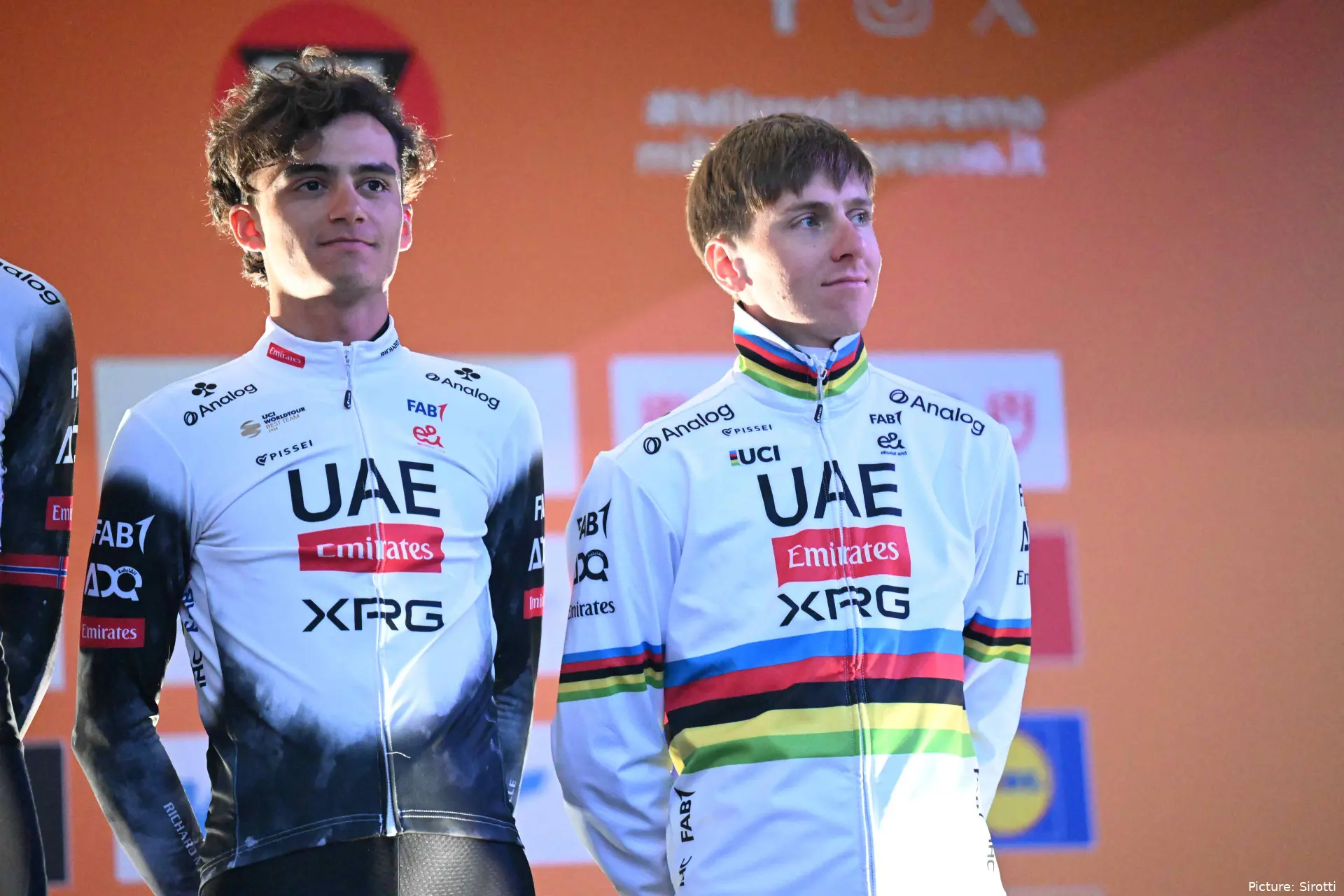
Once again, Tadej Pogacar will attempt to win one of the two cycling Monuments still missing from his palmares: Milano-Sanremo. It is also the Monument that has resisted him the most so far.
The unique nature of the Classicissima explains why. Unlike races such as the Tour of Flanders, Liege-Bastogne-Liege or Il Lombardia, Milano-Sanremo does not feature the extreme climbs that usually make Pogacar’s attacks so devastating. That is why Isaac del Toro could prove crucial if the Slovenian is finally to conquer the race.
This year’s confirmed route once again starts with a change at the beginning. The race will start in Pavia and, after a marathon day of racing, will finish on the iconic Via Roma in San Remo. The decisive phase, however, remains the same: the Cipressa followed by the Poggio.
The Cipressa arrives at kilometre 276, just 22 kilometres from the finish. The climb is 5.6 kilometres long with an average gradient of 4.1 per cent. No individual kilometre reaches six per cent. The first 3.8 kilometres average around five per cent, with one ramp touching nine per cent.
For the past two years, UAE Team Emirates - XRG have pursued a clear strategy here. The team aim to set the fastest possible pace on the Cipressa to allow Pogacar to open a gap, ideally distancing Mathieu van der Poel. The Dutchman remains his biggest rival and the rider who has repeatedly prevented Pogacar from winning this race.
UAE have never hidden their plan. Their goal is to ride the Cipressa at an infernal tempo, targeting a time of around nine minutes. However, that plan has already taken a blow before the race has even begun. Two riders who were expected to play key roles, Tim Wellens and Jhonatan Narvaez, are injured and will not take part. That makes Isaac del Toro’s role even more important.
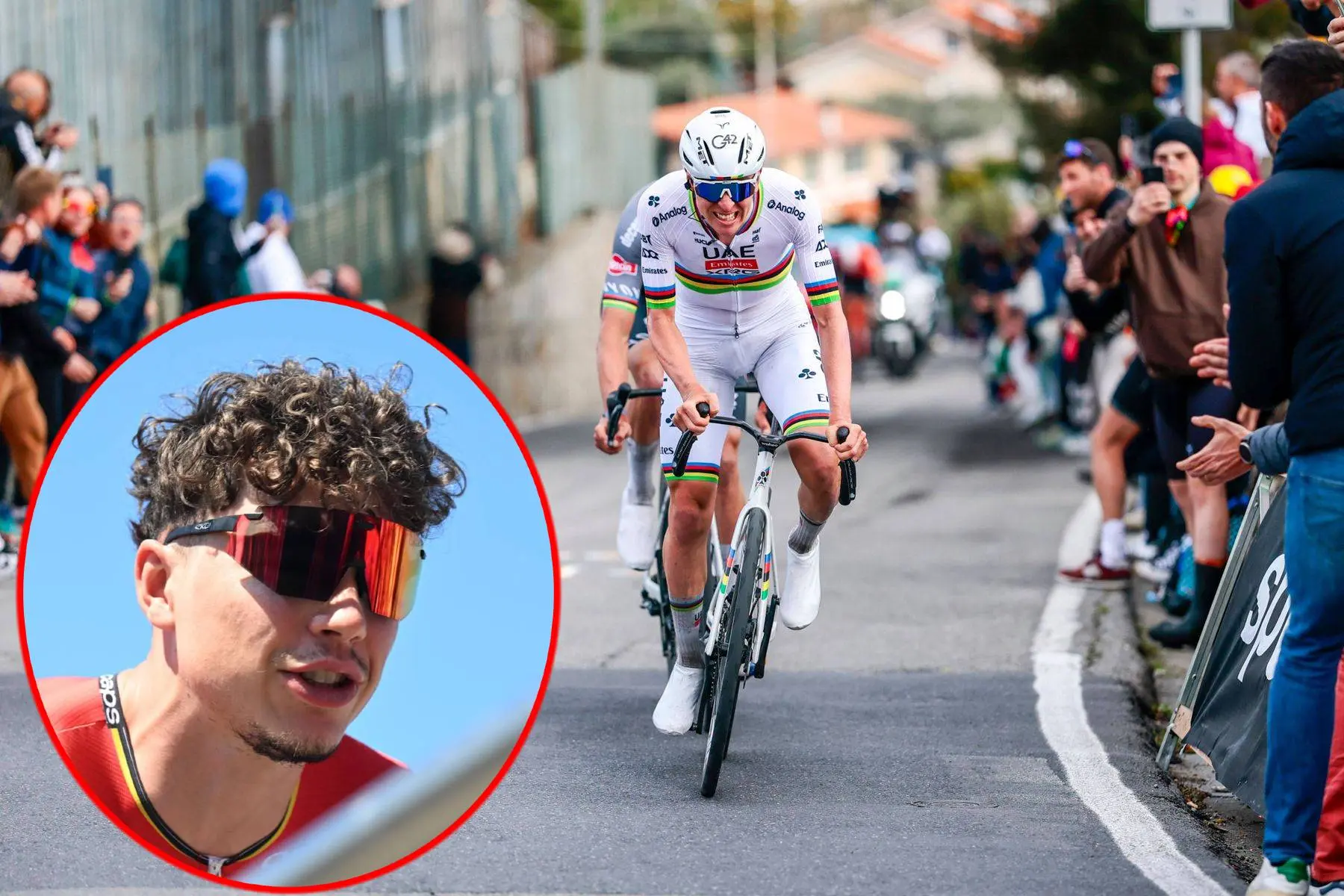
Del Toro’s growing importance in Pogacar’s Sanremo strategy
The Mexican was already given responsibility last year as one of the riders tasked with setting a brutal tempo on the Cipressa, but he did not meet expectations. Twelve months later, however, Del Toro appears to be a different rider.
He has taken a major step forward, supported by a series of impressive results. His growing list of victories in different types of classics, as well as the support he gave Pogacar at last year’s World Championships in Kigali when the pair escaped on the hardest part of the course, shows how much he has developed.
It is also widely accepted that dropping a rider like Mathieu van der Poel on the Poggio is extremely difficult. The climb is only 3.7 kilometres long with an average gradient of 3.7 per cent. The steepest sections reach around five per cent, with only one short ramp touching eight per cent.
That means everything may once again depend on the work done on the Cipressa.
Pogacar’s attack will almost certainly be explosive, but without the proper launch, there simply is not enough difficulty to distance Van der Poel. Recent editions of the race have repeatedly shown that.
A perfect example of the type of lead-out required came in last year’s Tour de France, when Jhonatan Narvaez launched Pogacar on stage seven at the Mur de Bretagne, a climb that is significantly steeper than the Cipressa.
With Wellens and Narvaez both absent, Del Toro arriving in peak form could therefore be essential if Pogacar is finally to achieve his goal of winning a Milano-Sanremo that has so far eluded him.
Milano-Sanremo 2026 route and profile explained
According to the official profile, Milano-Sanremo 2026 will cover 289 kilometres from Pavia to the Ligurian coast in San Remo. The race keeps the traditional structure that has defined the Classicissima for decades: a long and relatively flat opening section, a transitional middle phase featuring the Passo del Turchino, and an explosive finale built around the Capi, the Cipressa and the Poggio.
The start in Pavia leads into a largely flat opening stretch of more than 100 kilometres. The peloton will pass through towns including Casteggio, Voghera, Rivanazzano Terme and Tortona before heading towards Novi Ligure and Ovada. This section contains no major climbs and is usually where the day’s breakaway forms.
The difficulty here is mostly cumulative rather than selective. The distance and possible crosswinds can influence the race, although the sprinters’ teams typically control the tempo.
The first notable climb is the Passo del Turchino (532 metres), which comes around kilometre 148.3. It is a long but gentle ascent that rarely decides the race. However, it marks an important geographical turning point. After the summit, the race descends towards Voltri and reaches the Mediterranean coast, where the route becomes more exposed to the wind along the Riviera.
The traditional Capi follow in the later stages of the race. First comes Capo Mele (around kilometre 240), then Capo Cervo (kilometre 251) and Capo Berta (kilometre 259). These climbs are short with moderate gradients. While they rarely split the race on their own, they raise the intensity and help position the favourites before the decisive moment.
The Cipressa (239 metres) is crested at approximately kilometre 276.3. With more than five kilometres of climbing, it is the first point where teams with attacking ambitions can launch serious moves. If the pace is high enough, weaker sprinters can be dropped here.
The decisive moment usually arrives on the Poggio di San Remo (160 metres). Its summit comes at kilometre 292.4, just 5.6 kilometres from the finish after a technical descent.
Although short, the Poggio is explosive. Puncheurs and classics specialists often try their luck here. The combination of gradient, accumulated fatigue and the fast descent into San Remo frequently makes it the defining moment of the race.
Juan LarraCycling Journalist
Juan Larra is a writer for Cyclinguptodate and editor-in-chief of Ciclismoaldia, where he has played a central role since its inception. Under his leadership, the website has become a trusted source for professional cycling coverage, offering in-depth analysis, news, and feature stories.
A sports journalist with over 20 years of experience, Juan earned his degree in Journalism from the University of Seville in 2007. He began his career covering a wide range of sports—including football, basketball, Formula 1, MotoGP, tennis, and cycling—for platforms such as the official La Liga app, Vodafone and Movistar websites, NBA Blogdebasket, and Cadena Cope, honing his skills in writing and editorial management.
In addition to his work at Ciclismoaldia, Juan contributes to Cyclinguptodate and serves as editor-in-chief for the tennis-focused site Tenisaldia. Throughout his career, he has conducted exclusive interviews with cyclists and sports figures, provided detailed analysis of competitions ranging from local Spanish races to major international events, and acted as a special correspondent at prestigious races including Paris-Roubaix, the Tour de France, and the Vuelta a España.
Juan’s combination of experience, expertise, and direct access to athletes has established him—and the platforms he leads—as authoritative voices in professional cycling.
claps 3visitors 1
Just in

Popular news
Latest comments
- Nothing. Against Pogi nothingabstractengineer18-10-2026
- He didn't even try to sprint all outvappaxbipmv18-10-2026
- Campenaerts looked like a rolling pumpkin with that all orange leaders skinsuit !frieders318-10-2026
- He can take his dumb a$$ politics somehwere else !frieders318-10-2026
- good to have her back. fingers crossed she‘ll be able to stay!Ketterechts17-10-2026
- A tenner and he wins the Tour next year, too 😂anonymouscyclist17-10-2026
- the answer is either stick to classics or GTs but not bothabstractengineer17-10-2026
- the exodus already stared with Ciccone. Already they were struggling with two sprinters, now there are three. Also Ganna will demand leadership. Gall is the most proven GC, Ayuso has the most potential. GC leadership for everybody will be impossible. Literally a UAE style mess without pogi.abstractengineer17-10-2026
- I raced as an amateur for 12 years, including six years on my country’s national road cycling team. I secured two national titles and competed in three World Championships plus more than 15 international stage races. At 23, we travelled to Italy for a training camp—or so I assumed. On a rest day, we watched a presentation about adopting a more “professional” training approach. It was crystal clear what “professional” meant. That moment first exposed me to this dilemma. After returning from Italy, I left cycling—at least at the competitive level I had known. Over the following two years, the whole team was caught doping. I hold that everyone is innocent until proven guilty. In my view, current stakeholders operate on a different scale, and the sums involved are vast. I am unsure whether any doping would ever be revealed. I try to stay positive and enjoy the show. My 2c.
 vannpelt17-10-2026
 - Fiver he wins 🤣
 leedorney17-10-2026
Loading
Write a comment