Netflix’s The Truth and Tragedy of Moriah Wilson directed by Katie Walsh reached the number one spot in the U.S. shortly after its April 3, 2026 release and climbed to number two in the UK. That alone is remarkable for a film so deeply rooted in cycling culture.
Moriah Wilson was a cyclist first, not just a victim
For cycling fans, the documentary stands out for one key reason: it treats Moriah “Mo” Wilson as an athlete first. The film highlights her rapid rise in gravel racing, her discipline, and her growing reputation as one of the sport’s most exciting talents.
Rather than reducing her story to the crime, it captures the mindset of a dedicated rider. Training routines, race footage, and insights from those close to her reflect the culture and intensity of elite cycling.
The documentary succeeds in portraying the gravel racing world with accuracy. It shows the tight-knit nature of the community, the competitive dynamics, and the blend of freedom and ambition that defines the discipline.
For viewers familiar with the sport, these details feel genuine. The film avoids clichés and instead presents cycling as it is lived: demanding, personal, and deeply social. It also shows how, despite her exceptional talent, Moriah Wilson often had to navigate the sport largely on her own, driven from within.

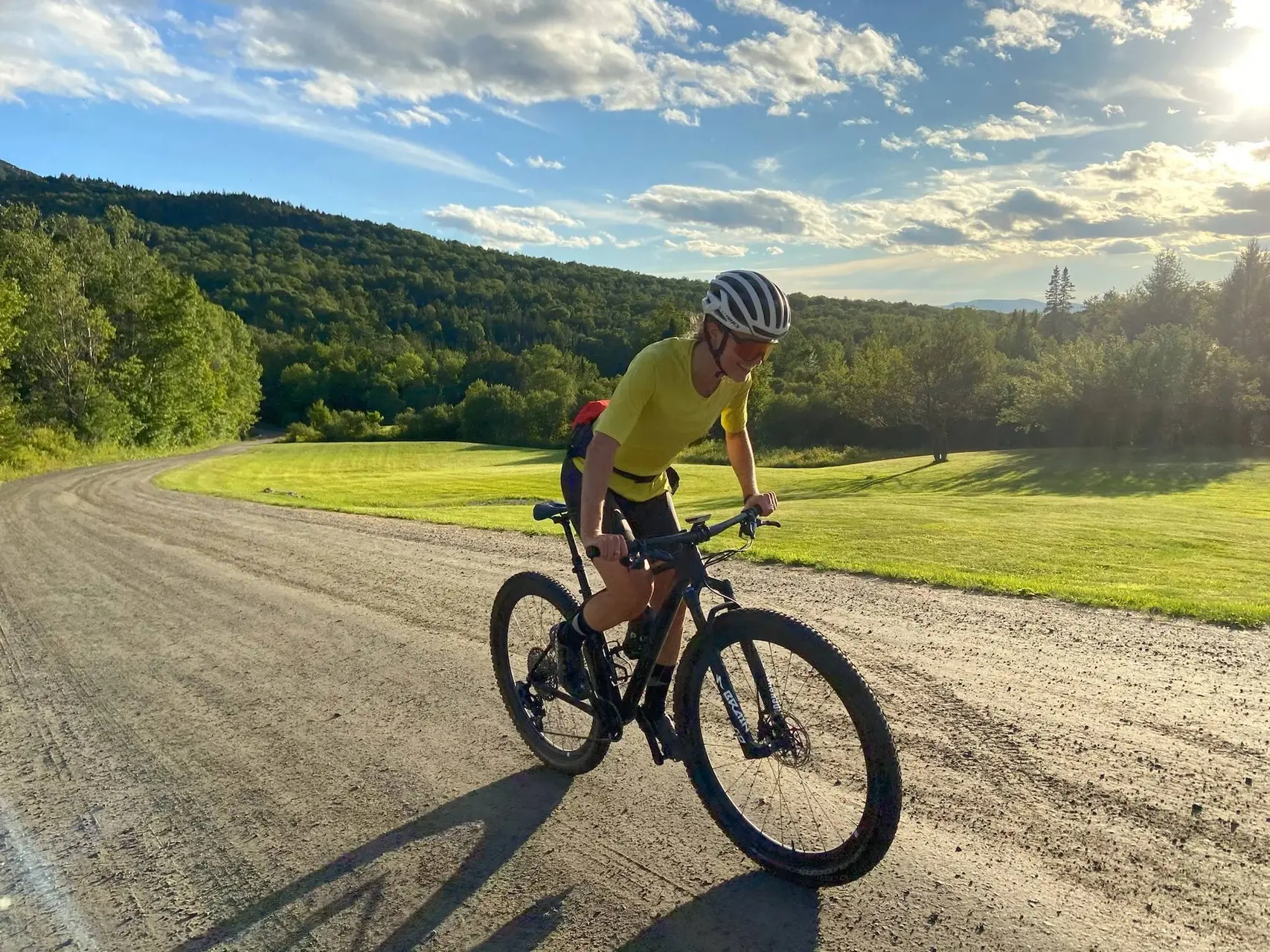
Artistic impression of Moriah Wilson biking on a gravel road in Vermont
Where true crime meets cycling fans
Structurally, the film follows a classic true-crime format. It reconstructs the timeline leading up to Wilson’s death and examines the relationships involved.
Yet from a cycling perspective, it goes further. The emotional weight comes not just from the crime, but from the loss of a rider at the peak of her potential. That dual focus gives the story added depth.
The documentary makes clear how deeply the case affected the cycling world, and beyond. Teammates, friends, and fellow competitors reflect on the shock and grief that followed. Also striking is the fact that, from a perhaps European perspective, a cyclist in the United States seems to have to do it all on her own, with the support of family and just a handful of friends.
For fans, this is where the film hits hardest. It captures the sense of that lonely feeling that top cyclists sometimes have to live through, as they put in all the hard work and the miles. Seeing the loss of one of their own goes much deeper than just reading about Moriah Wilson as a headline-making case.
Final take
While The Truth and Tragedy of Moriah Wilson follows a familiar true-crime structure, it succeeds where it matters most for cycling fans. It understands the sport, respects its culture, and presents Wilson as the athlete she was. The inclusion of passages from a book she had underlined adds a deeply personal layer, making the story resonate even more.
That perspective elevates the documentary beyond standard genre fare, making it a meaningful watch for anyone connected to cycling.
Her impact on the sport continues through the work of the Moriah Wilson Foundation, which supports the next generation of athletes and riders.

Kieran WoodDeputy Editor-in-Chief
Kieran Wood is a sports journalist based in Wales and has been active in journalism since 2022. He regularly contributes to DartsNews.com and CyclingUpToDate.com, where he covers professional cycling and darts. In cycling, his work includes liveblogs from major races, including the Tour de France, the Giro d’Italia, and La Vuelta a España, alongside race reports and analysis. He has also conducted interviews with professional riders.
His reporting spans the full racing calendar, from one-day classics to stage races, with a focus on accurate, real-time coverage and clear contextual analysis. For statistics, results, and historical context, he regularly uses resources such as ProCyclingStats. To support reporting on rider activity and training context where relevant, he also references Strava.
In his work, Kieran places strong emphasis on careful sourcing, editorial accuracy, and updating articles as new, verified information becomes available.
claps 23visitors 7
Just in
Popular news
Latest comments
- yes for sure, there will be more chances for him at Euro than Lombardia. I wonder if that emotion wasn't also because he knows he has now been eclipsed by a younger rider w/o his goals being checked off. At least when Seixas over takes Tadej someday, Tadej will have accomplished his major goals. He still has Roubaix left, but Seixas isn't a threat there. And he should find a year to get Vuelta. Remco now is behind at least 2 riders w/o ever having won a Tour, one monument to his name, and the next few World Championships are not Remco friendly. I would still take Remco's wins though!!!mij12-10-2026
- Remco was at 100%. He raced as expected: 15th best on the climbs and then best in the sprint of the chasing group. Exactly what he did at Liège-Bastogne-Liège, where he was on similar form. His win in Amstel was comparable to Quebec or the Euros
 Rafionain-Glas12-10-2026
 - "inside the tent pissing out" is an idiom based on a quote from President Lyndon Johnson. Not sure if you're saying you don't understand the term. The full phrase is "it's probably better to have him inside the tent pissing out, than outside the tent pissing in."wrsty12-10-2026
- Pissing out?? Who is forcing them? They can follow Ayuso's example. And they can be leaders on another team. Ayuso's example again. :)MajorPayne12-10-2026
- Hmm it's an interesting take with certain disclaimers e.g. comparing them at the same age (Pogi wasn't given chances so early in his career so we will never know), the level of the competitors in the race or tour (really hard to compare, as you would be looking at multiple competitors, let alone comparing just Seixas vs Pogi). In any case, Seixas' future certainly looks very bright, especially as he has the advantage of youth, access to new scientific knowledge/methods that weren't around when Pogi started, and most importantly has Pogi as an extremely good example to aspire to (e.g. copying training methods, nutrition, tactics, race craft, etc., to list just a few...).Pogboom12-10-2026
- > He’s so much better than Pogacar was at 20 years old It does not mean NOTHING. What is important how long you can be at the top. Most of the best riders are (really) good for 4-5 years (Alaphilippe, Sagan), of course outside this window you can win stages etc. but forget about GC winner in main tours. Talents like Pogacar (in case of GC) or MvdP (monuments or CX - 15 years being on top!!!) are rarity. It might be that if you start being good fast, you end up being good still young.averagecyclist12-10-2026
- Winning Il Lombardia would surely mean much more to Remco than to Seixas, after his crash there and then second places where he was far ahead of the rest but still far behind Pog, and had to blink away tears at the finish. Wonder if he will ever have such a good chance again.Hills3312-10-2026
- Yeah him, Del Toro for sure - not that they all pan out, but then how can you tell what someone was going to be capable of if they never got to be an out-and-out leader? Either way, their squad has a lot of riders who could be leaders at other teams but they are safely inside the tent now, pissing out.wrsty12-10-2026
- "removing any barriers to their golden goose" What barriers? Ayuso maybe? :) :) :)MajorPayne12-10-2026
- And let's not forget, Tadej Pogačar won his first Tour de France eating pizza, drinking beer and playing Playstation. This kept goinig on for another two years and when he lost the Tour 2X to Jonas, things dramaticaly changed. Today Pogi is a "killing machine." In 2024, in the Tours rest day, Pogi said: "If I compare the year 2019 to what we're doing today, we were real amatuers." ... That is the difference between Pogi and Seixas. Seixas immediately got professional help and advice, he knows exactly what he wants and is already at a very high level. So, the paths of Pogi and Seixas weren't the same.PogiSloFans12-10-2026
Loading
Write a comment