"You put two steep walls in the final kilometres and it is great" - TDFF director declines calls for even more challenging parcours
Cycling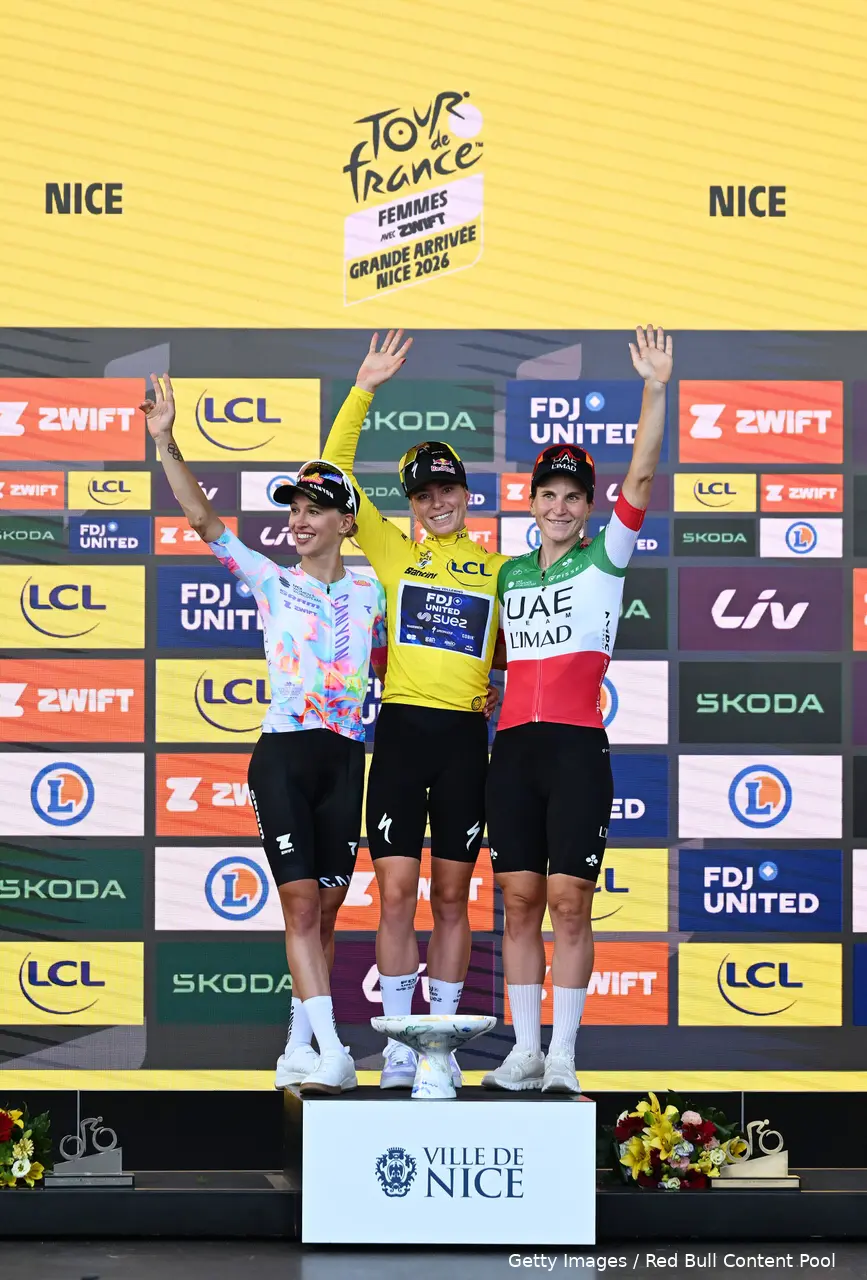
The Tour de France Femmes successfully concluded yet another action-packed edition which did not lack epic performances, fascinating stories, nor unexpected twists. Ultimately, it was Demi Vollering who stood on top of the standings at the end of ninth stage, but fans already wonder whether the race could expand both in length and difficulty.
This year, riders had to complete 1,170 kilometers and overcome 18,800 altitude meters spread across nine stages in order to complete the 2026 edition and participate in the battle for overall title. These numbers are quite comparable to 2025, although there was time trial on the course year prior.
And yet, despite all the spectacle, voices have emerged across the peloton for even tougher routes, including multiple mountain top finishes and queen stages which would feature multiple high-altitude mountain passes.
"We could make it harder, and the competitors would be completely capable of doing it, but I am not looking to over-escalate the difficulty," Tour de France Femmes director Marion Rousse told RMC Sport. "That is my personal point of view, informed by my experience as a broadcaster."
Read also
One of the directors serious concerns is something she has witnessed at the men's Tour in the past; that favourites tend to approach the stages much more defensively, perhaps in respect of the obstacles yet to overcome, and would still wait to open the battle in the final parts of the stage where not much damage can be done.
"Sometimes, when you make stages too difficult, it actually kills the suspense because everyone just watches each other," she added, citing Saturday's stage as a preferred blueprint. "A stage like Saturday is magnificent to watch, you put two steep walls in the final kilometres and it is great. We don't necessarily want to make it harder."
No big changes planned
The 2026 edition was in any case a massive success commercially. Moving the race start after the men's race finale proved an effective step with France 2 recording an average audience of 3.1 million and a peak of 5.1 million viewers on the queen stage featuring Mont Ventoux summit.
"We feel like we take a step forward every year," Rousse said. "It was only our fifth edition, but what I have seen since the start in Switzerland is genuinely the Tour de France. It is exceptional because we started from very far behind."
"There was a small challenge with five days between the finish of the men's race and our own start, and we wondered if it would work as well," Rousse acknowledged. "It worked even better, so it's brilliant."
Ondrej ZhasilCycling Journalist
Ondřej Zhasil is a cycling journalist at CyclingUpToDate and has been part of the team since 2023. He is based in Ostrava, the third-largest city in the Czech Republic, and covers professional cycling across the main UCI competitions, including the Tour de France, the Giro d’Italia, and La Vuelta a España. A key focus of his work is startlist analysis and pre-race coverage, where he examines team selections, rider line-ups, and tactical scenarios ahead of major events.
Alongside WorldTour coverage, Ondřej has developed specific expertise in junior cycling and in racing across East Asia, including competitions in China and Japan. He also maintains a broad working knowledge of other disciplines and levels, including cyclocross, while continuing to expand his understanding of mountain bike racing.
Ondřej holds a bachelor’s degree in Mathematics and Physics, which supports his analytical, data-driven approach to performance and race analysis. In his reporting, he regularly uses ProCyclingStats for results, statistics, and historical context. He places strong emphasis on careful sourcing, editorial accuracy, and updating articles promptly when new, verified information becomes available.
claps 0visitors 0
Just in
Popular news
Latest comments
- Maybe Net Company INEOS should be signing Roglic. Feels like they have been mostly irrelevant since G hung up the shoes. At least they would have someone who is there or there abouts on GC.MASnell09-10-2026
- Maybe Net Company INEOS should be signing Roglic. Feels like they have been mostly irrelevant since G hung up the shoes. At least they would have someone who is there or there abouts on GC.MASnell09-10-2026
- i guess there's journalism and then there's journalism. this website simply collects cycling stories and aggregates them in one portal for us fans to access. they aren't really investigative reporters, and their team likely isn't big enough to go into real depth... which is fine by me since i don't expect much more from them. that said, i agree with your view. it would be nice to see a bit more follow-up that pushes the people in charge to actually take a stance.Ketterechts08-10-2026
- UAE was really badly positioned at the last climb, and Ineos did a great job of making that happen at the bottom. That must have affected del Toro and the rest. His attack wasn't spectacular, and they hadn't ripped apart the bunch enough, letting a large group remain in back to reel him in. UAW lost the race on the road to the climb and the bottom third of it, I think.RidesHills08-10-2026
- He won in exactly the same way as others. By being the fastest to complete the stages.mobk08-10-2026
- Very surprised del toro couldn't beat everyone here against lesser competition. He's well on his way to being top 5 in the worldbruins3008-10-2026
- Being the best rider left in the race is pretty much the only way to win in any edition, surely? Seems reductive to say "they only won because the entire peloton wasn't as absolutely stacked as it could've been" - you can only beat who is in front of you.wrsty08-10-2026
- I’m sorry but generally the coverage on your site is first class but this incident highlights something I just don’t get with cycling journalism. This accident should never have been allowed to happen, it comes uncomfortably close to the Finlay Tarling tragedy and two other incidents took place within days of this. I checked all of the cycling websites and you all put out basically the same story. Pidcock gave journalists the perfect opening to blow this sky high, what has the UCI got to say? What is Adam Hansen doing? What do the organisers say? Nothing, you all trot out the same easy quotes taken from Pidcocks interview after the race but do nothing to follow it up. I see it time and time again, journalists taking the easy way out but being outraged when it happens again as it surely will. Riders can’t do this but journalists should be independent and should be able to raise these uncomfortable questions but cyclinguptodate and every other on line publication prefer to take the easy way out. That’s the real tragedy here.Paul53108-10-2026
- Happy to help :-)Mistermaumau08-10-2026
- Well, ok but, it’s also a structural, team, budgeting, direction and all sorts of other issueMistermaumau08-10-2026
Loading
Write a comment