"We are a tool to bring people together, not a tool for sanctions": UCI President addresses the growing politicisation of professional cycling
Cycling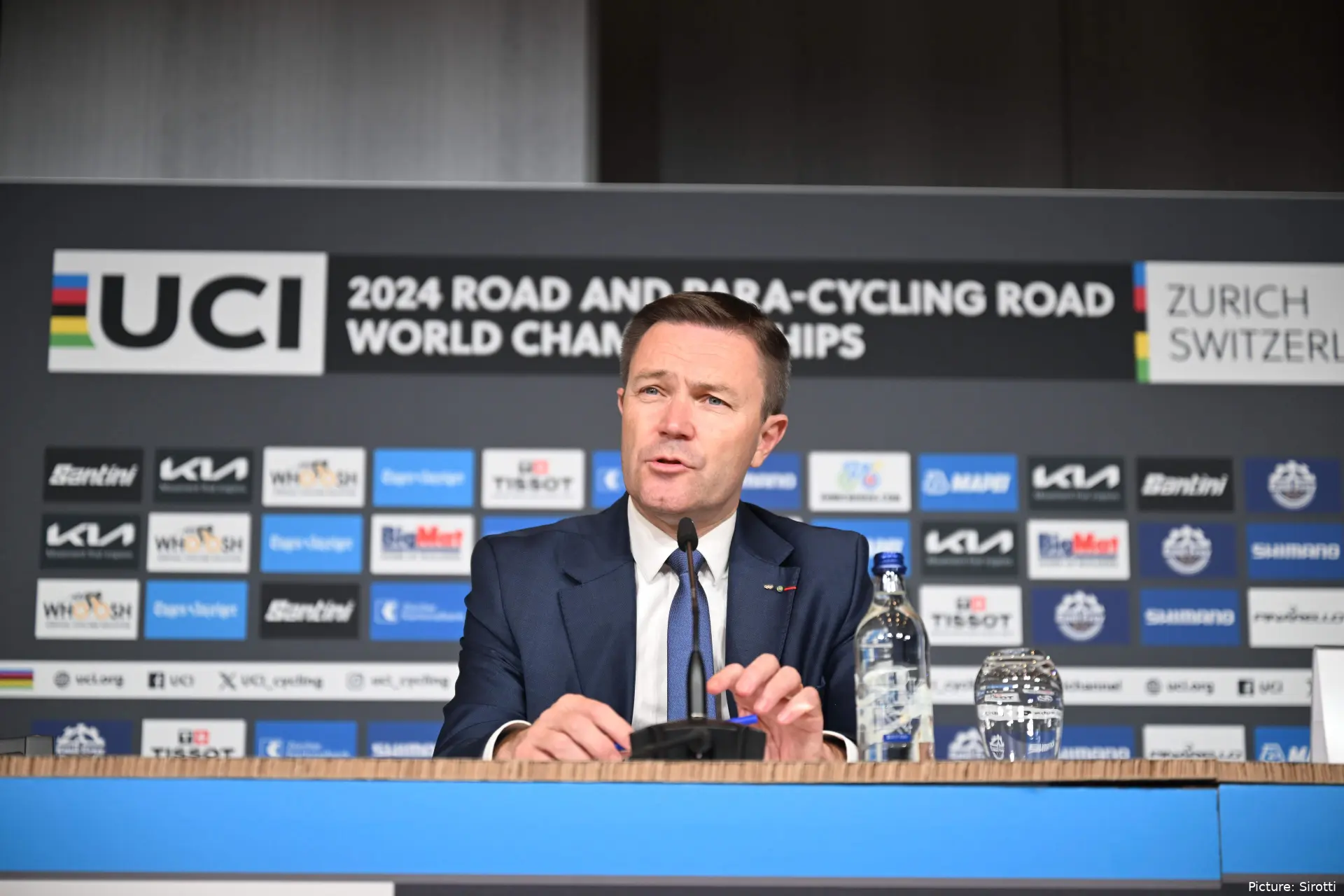
The Union Cycliste Internationale held its annual WorldTour and Women’s WorldTour seminar on 10 and 11 December in Geneva. As usual, discussions centered around the main challenges professional cycling faces and potential solutions to fix them.
“The WorldTour seminar has existed for a very long time, almost since the beginning of the WorldTour,” UCI President David Lappartient said in quotes gathered by Cyclism Actu. “All organisers, all teams, men and women, rider representatives and champions like Mark Cavendish are present. It is really a moment where a lot happens indoors: presentations and debates.”
Is cycling politicized?
One theme stood out in particular. “A topic imposed itself: the politicisation of sport and the impact of geopolitics on our discipline, as we saw with the Vuelta,” he explained. “Our message is clear: we are politically neutral. We are a tool to bring people together, not a tool for sanctions.”
Some people might not agree with that, given that Russian teams were banned entirely by the UCI in 2022 following the Ukraine invasion, and Russian riders must compete under a neutral flag. An unusual step to take by a self-proclaimed politically neutral organization that claims not to be a tool for sanctions.

Safety remained a central concern, as it has been the case the past years. Lappartient pointed to several measures already implemented. “A lot has been done: yellow cards have been introduced, barriers have evolved, standards have changed, obstacles are much better protected, and we are communicating more,” he said.
However, he acknowledged resistance to certain innovations. “Some things work less well, especially when it comes to testing developments like maximum gear ratios or GPS trackers, which still generate a lot of reluctance.”
That reluctance is related to the Tour de Romandie Féminin chaos, in which six teams (Team Visma | Lease a Bike, AG Insurance-Soudal, EF-Oatly-Cannondale, Canyon//SRAM, Team Picnic PostNL, and Lidl-Trek) were disqualified before even starting the first stage.
Teams were told they would have to fit the devices to their bikes themselves and accept liability for any loss or damage during crashes or other race incidents. Those six teams refused to comply, arguing that the measure was imposed without sufficient consultation, clarity on liability, or agreement on how the test would be implemented.

Russian riders like Vlasov have been competing under a neutral flag
Zero tolerance with doping
Other topics of discussion were health and anti-doping efforts. “Athletes, men and women, have sometimes tended to lose a lot of weight to climb better and be more efficient. That raises important questions,” Lappartient noted.
He reaffirmed the obvious UCI’s stance on clean sport. “We have reaffirmed the UCI’s unwavering commitment to fighting doping, staying permanently connected, and reanalysing samples for up to ten years. This year, 300 samples were reanalysed. For us, there is no plan B: we must fight doping as effectively as possible.”
Despite economic fragility among teams, Lappartient highlighted cycling’s growing popularity, which might sound like contradicition. “Sport has never been so popular, which is very positive,” he said. “Budgets are increasing significantly, and riders’ salaries too. In women’s cycling, salaries have been rising by 30 percent per year for the past three years. However, the disappearance of two men’s WorldTour teams shows that team economics remain complex.”

Félix SernaCycling Journalist
Félix Serna is a writer at CyclingUpToDate and has been part of the team since 2025. He covers professional cycling across both the men’s and women’s calendars, with a focus on UCI rankings, race developments, and rider performance. His work includes interview-based reports, liveblogs, and tournament coverage designed to provide clear, accurate context throughout the season.
In his reporting, Félix regularly uses ProCyclingStats for results, statistics, and historical reference. He places strong emphasis on careful sourcing, editorial accuracy, and updating articles promptly when new, verified information becomes available. He holds a bachelor’s degree in International Studies.
claps 10visitors 1
Just in

Popular news
Latest comments
- A shame to see him retire, I really liked him as a rider. His dignified tribute along with Matej Mohorovic to Gino Mader after his death was class and will always live in my memory. Enjoy your retirement.GregT11-10-2026
- A shame to see him retire, I really liked him as a rider. His dignified tribute along with Matej Mohorovic to Gino Mader after his death was class and will always live in my memory. Enjoy your retirement.GregT11-10-2026
- I thought Seixas had hit the end of the road from a fatigue standpoint, after the WC meltdown - and he still finished ok. This was impressive and an amazing return.mij11-10-2026
- totally, eating crow for breakfast this morning. after the world championships I thought we were looking at a late season fade from fatigue. way to go Paul!mij11-10-2026
- Well if UAE the best team in history comes knocking their the only team in the world who can get Seixas. Seixas will become unbeatable and incredible there. Lets see if he stays at decathlon or goes to UAE.miguel11-10-2026
- Pogi would have won the Vuelta at around 10 min. But it would have been boring for fools like you. Capish?PogiSloFans11-10-2026
- Rather than me describing the technology at length on here, If you google. Line-scan cameras. They are also sometimes called Slit-Scan cameras. Either search will fill you in. You can read all about how they. work. Enjoy! Just to be clear the cyclist is saying he wants to see exactly where the digital finish line is in relation to the actual physical finish. At this point we only have the word of the authority that the digital line corresponds to the exact starting edge of the physical finish line. That seems like a reasonable request to me.Prorodsandstuff11-10-2026
- 100% @Jumpyjohn, good point well raised.anonymouscyclist11-10-2026
- The media keep stirring the soup.. or spitting in it
 leedorney11-10-2026
 - Yes, he has won many races... second class races. He isn't the real deal... Seixas is the real deal. Capish?PogiSloFans11-10-2026
Loading
Write a comment