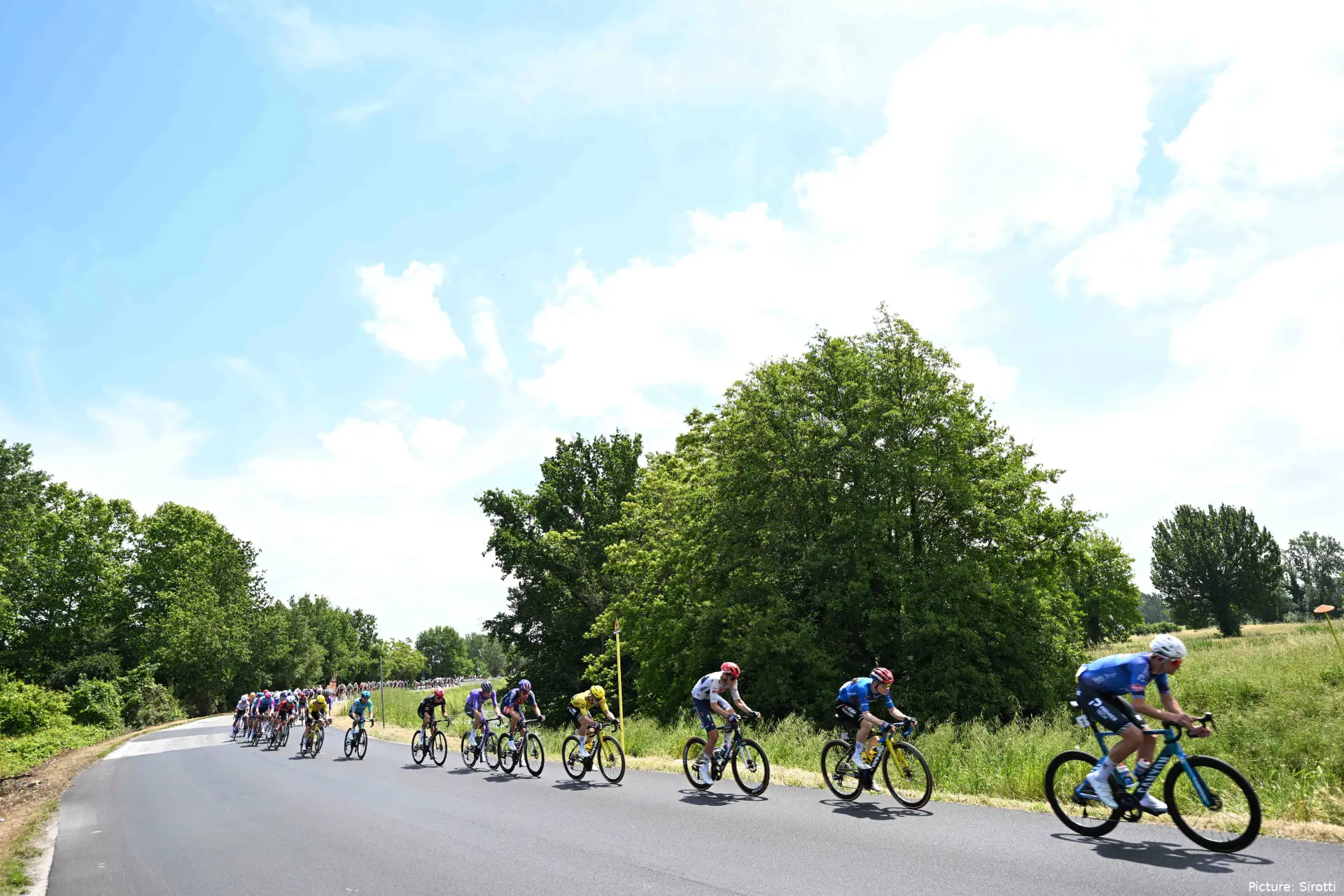
The full route of the 2026 Tour de France was unveiled months ago, marking the official start of preparations for next season. La Grande Boucle will begin on July 4th with a Grand Départ in Barcelona, featuring a team time trial, and finish on July 26th. There will be 21 demanding stages, with a design that offers opportunities for everyone.
Tadej Pogačar and Jonas Vingegaard start, once again, as the leading favourites, but they face two formidable contenders: Remco Evenepoel and Paul Seixas. The Belgian is already established, a former world champion and reigning double Olympic gold medallist; on the other hand, stands the young French prodigy, who is sweeping all before him this season.
The course features enough high-mountain days to make a difference, seven in total, as well as a double, unprecedented finale on Alpe d’Huez on stages 19 and 20. However, the route will not limit the high mountains to the Alpine colossus alone, with other decisive days for the general classification contenders.
Below, we analyse in detail the most important days of the French summer; the stages the peloton’s leaders have ringed in red on their calendars.
Les Angles
Granollers, a handball stronghold in Spain and a short hop from the Barcelona-Catalunya circuit, a regular Formula 1 and MotoGP venue, is a city of around 65,000 on Barcelona’s outskirts. Proud of its Porxada, a 16th-century market hall that today hosts the municipal market, it will serve as the start of this stage heading north to the French border.
On day three, Catalan fans will have a final chance to see the peloton in action over a route of more than 100 kilometres. Despite 3,950 metres of climbing and the ascent of the Col de Toses before leaving Spain, the traverse across the plateaus near Font-Romeu and the climb to Les Angles (1.7 km at 7% average) could prove perfect terrain for the ambush of a fast-climbing surprise.

Granollers - Les Angles
Gavarnie-Gèdre
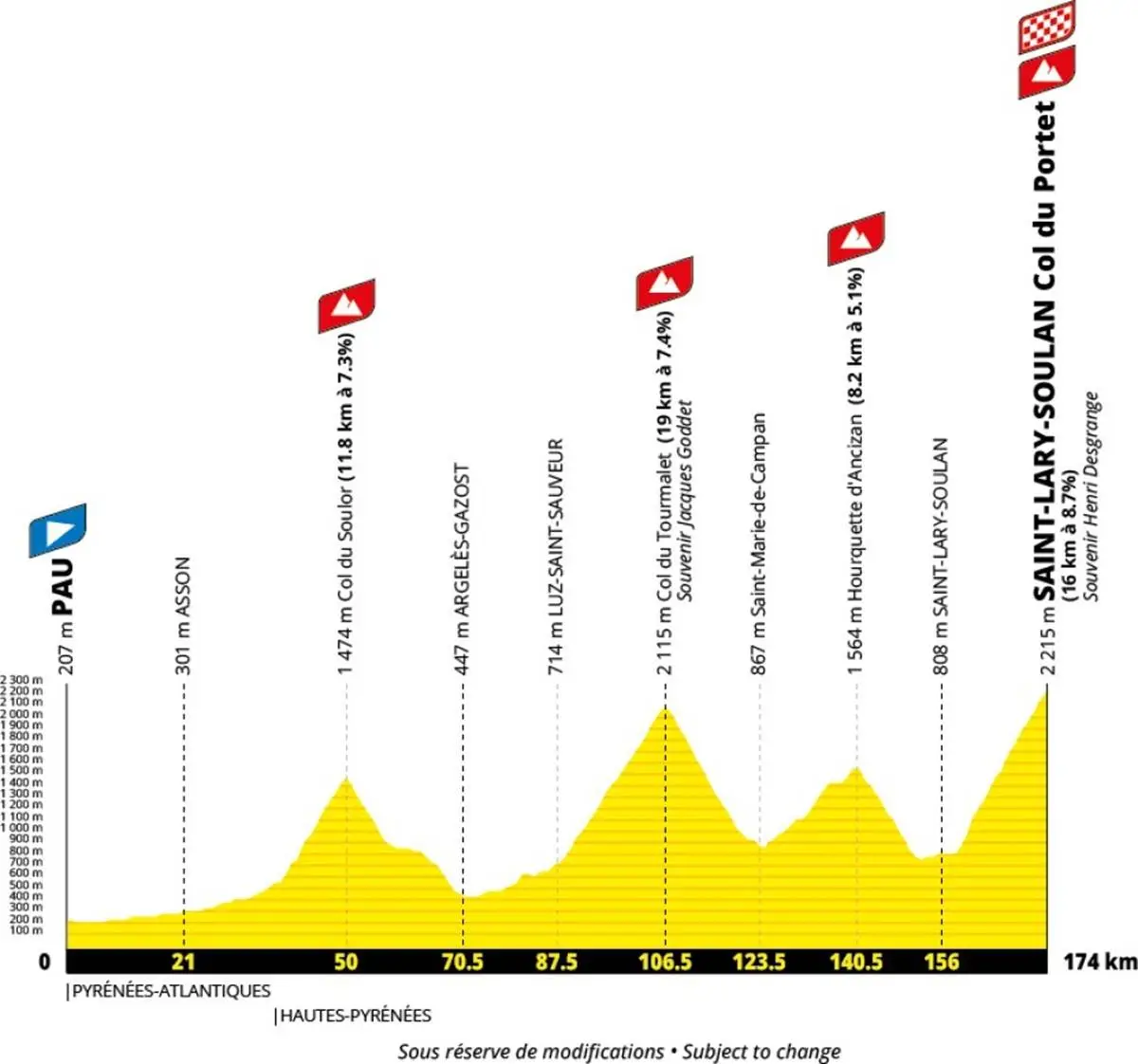
Stage six of the Tour de France will be the most selective Pyrenean day on the route, blending the classic with the new. The Tour’s big favourites are likely to test one another on the ascents of the Col d’Aspin and, later, the Col du Tourmalet, provided they choose to open the race before the final 40 kilometres.
If not, the outcome could fall to the best climbers from a breakaway, in the spectacular setting of the Gavarnie cirque, reached via a long but gentle climb: 18.7 kilometres at 4% average gradient.

Pau - Gavarnie-Gedre
Le Markstein
As we complete exactly two weeks of racing, the action will kick off out of Mulhouse with the ascent of the Grand Ballon and a first pass over the finish line, a mere prelude to the selection on the final climb, which will start to take shape on the Ballon d’Alsace.
This long route hides one of the gems of the 2026 route: the ascent to La Haya, a forest path converted into a cycle lane, with 11.2 kilometres of bends at 7.3% average and an especially irregular profile. Six kilometres will still remain to reach Markstein, on a stretch where fatigue and surges can prove decisive.

Mulhouse - Le Markstein
Plateau de Solaison
Perfectly placed before the second rest day, the 15th day of racing profiles as a big mountain stage that could be decisive in the fight for yellow and seal the fate of the GC hopefuls. Even more so if Le Markstein is gifted to the break.
The battle will almost certainly open on the ascent of the Salève via the Col de la Croisette, a no-mercy climb of almost 5 kilometres at 11.2% average gradient. A first filter of maximum severity.
In the finale, the route heads to the Plateau de Solaison via a narrow road that snakes through the villages of the Bornes massif. It’s 11.3 kilometres at 9.1% average on relentlessly steep terrain. An explosive ramp that should suit Tadej Pogačar down to the ground.

Champagnole - Plateau de Solaison
5. Alpe d'Huez
The second day on Alpe d’Huez promises the queen mountain stage of the Tour, with 5,600 metres of total elevation gain. It arrives for the first time on the eve of the finale, pushing the demands to an extreme level.
The sequence of climbs is simply colossal: after cresting the Col de la Croix de Fer, the climbers must link the Col du Télégraphe and the roof of the race, the mythical Col du Galibier. It is tailor-made for a diesel like Jonas Vingegaard to gain time on the UAE Team Emirates leader.
From there, the final ascent to the Alpe d’Huez ski station comes on stage 20 but, unlike the previous day, it will be tackled via a virtually unused racing side, over the Col de Sarenne, only previously used in descent in 2013. Almost virgin territory, where history is still to be written.

Le Bourg d'Oisans - Alpe d'Huez
High-mountain stages Tour 2026
| Stage | Date | Route | Kilometres |
| 2 | 05.07 | Tarragona - Barcelona | 182 km |
| 6 | 09.07 | Pau - Gavarnie-Gèdre | 186 km |
| 14 | 18.07 | Mulhouse - Le Markstein | 155 km |
| 15 | 19.07 | Champagnole - Plateau de Solaison | 184 km |
| 18 | 23.07 | Voiron - Orcières Merlette | 185 km |
| 19 | 24.07 | Gap - Alpe d'Huez | 128 km |
| 20 | 25.07 | Le Bourg d'Oisans - Alpe d'Huez | 171 km |
Rúben SilvaEditor-in-Chief
A founding contributor to CyclingUpToDate since its launch in January 2022, Ruben Silva has played a central role in shaping the site’s editorial direction and long-term growth. Before joining the project, he built his experience through independent blogging at Echelons Hub and by producing race previews for Ciclismo Internacional, developing a strong analytical voice rooted in daily engagement with professional cycling.
Beyond editorial work, he has been closely involved in the expansion and coordination of CyclingUpToDate’s wider network, helping establish and support sister platforms across multiple languages. This includes ongoing collaboration with CiclismoAlDia (Spanish), CiclismoAtual (Portuguese), WielrennenUpToDate (Dutch), and RadsportAktuell (German), contributing to a shared editorial vision and consistent international coverage.
He also helps oversee editorial governance across the network, setting standards for accuracy and consistency and coordinating updates or corrections when needed.
Originally from the Porto metropolitan area in Portugal, he holds a bachelor’s degree in Geography. His path into cycling journalism was shaped not through formal media training, but through independent reporting, community engagement, and sustained on-the-ground involvement in the sport.
Over the course of his career, he has conducted approximately 100 interviews across road cycling and cyclocross, ranging from one-to-one conversations and online formats to press conferences and on-site pre- and post-race coverage. His interviews include leading riders, team managers, and prominent figures within cycling media: Tadej Pogacar, Jonas Vingegaard, Mathieu van der Poel, Primoz Roglic, Wout van Aert, Joao Almeida and Tom Pidcock; managers like Patrick Lefevere and Joxean Matxin; and YouTube personality Bryan Kennedy (BKXC)...
Within 18 months of launch, he helped grow CyclingUpToDate’s English-language platform into one of the most-read cycling news websites, built entirely from the ground up. As both a professional journalist and lifelong cycling enthusiast, his focus remains on delivering accurate, timely, and well-contextualized coverage.
claps 0visitors 0
Just in

Popular news
Latest comments
- Individual Gautherat is the most exciting given his age too I agree. But Frigo and Balderstone for uae will be super valuable as doms areound those leaders. UAE just quitly uppgrade w/stronger and younger guys. Sivakov was on the down and Frigo replace all that with bigger engine. Balderstone seems like another brilliant under the radar pickup UAE is masters off....so exhausting they never missmiguel25-10-2026
- Surprised it’s that inexpensive!Lozza25-10-2026
- Nah, I like it here. I like a challenge, against the people who hate me here. Jumping John, you ain't getting rid of me :))PogiSloFans25-10-2026
- Pogi deserves every penny he gets paid... and he's the only cyclist that should be paid more. If he's two classes above everyone else, his salary should also be. Ad acta.PogiSloFans25-10-2026
- It’s not only that, it’s this obsession with running after money, whether it be teams, riders, sponsors, broadcasters. As soon as one player gets ahead, others feel obliged to match their moves with increases for fear of losing out and for fear of someone else following in your place instead without looking at the long-term consequences of blindly following. Other sports ahead (or behind depending on how you look at it) in such matters should serve as a warning but humanity has a habit of heading straight into walls even when the writing is on it. When financial objectives and limits aren’t clear, it’s impossible to manage any organisation, you can’t even recruit the right riders or tell them what is needed to make sure they’re a good fit because you can’t clearly explain what they can expect. Not all riders are motivated by money alone and some of the teams are proof of that.Jumpyjohn25-10-2026
- To be honest, their signings weren't actually too bad. Oscar and Kevin had great 2025 seasons. Most of the top leaders were signed. But Red Bull, Lidl-Trek and Pinarello showed that that's not actually the coast. So team culture is probably the foremost reason. Whether there's a bad sporting culture now is debatable, but certainly there's the past. 2024 was the end of the old Ineos (it was not actually transition, it was slow decline)
 Rafionain-Glas25-10-2026
 - FYI. Pogi made his World Tour debut at the TDU in 2019. I remember it well because someone said watch out for Pogi as he did a good time up Corkscrew during training. Who would have thought he'd end up as the GOAT.Santiago25-10-2026
- FYI. Pogi's first World Tour race was at the TDU in 2019. I remember it well because someone said watch out for Pogi as he did a good time up Corkscrew during training. Who would have thought he end up as the GOAT.Santiago25-10-2026
- 50 million isnt low. But if you hire super domestiques for a million and 3rd rung leaders for 3-5 million, natural you dont have money left not the results expected. Most monuments and TDF are out of reach due to Pogi. But there were a promising 2nd rung leaders on the market and they went for broke to get Onley and Kevin. I put their entire troubles due to mismanagementabstractengineer25-10-2026
- I think it’s becoming clear that cycling got way ahead of itself for a few reasons and is now coming to the realisation that some rider salaries just exploded without justification and it snowballed until sponsors started pulling money out because THEY did not see any return on increased costs. Cycling is still a dying sport (that never moved out of the niche family) and will remain so if it doesn’t embrace and promote new ventures or manage to attract new markets. Even within cycling, fans are basically compartimentalised, (almost nobody here follows track for example), and the multiplication of possibilities hasn’t grown the sport, it has just split it into a larger number of smaller branches. If it weren’t for nation state sponsors (far too numerous already) other teams would never have (had to resort to) raised bigger budgets that are now leading to sponsor abandonment. That’s the difference between long-term steady growth and financial doping, the latter can also just blow up in your face. I will venture to wager that apart from one or two exceptional cases, rider salaries will no longer go up and are quite likely to actually drop over the next decade.Jumpyjohn25-10-2026
Loading
Write a comment