Remco Evenepoel opens a debate that once seemed impossible: Is he the greatest time trialist in history?
CyclingMonday, 21 September 2026 at 14:48
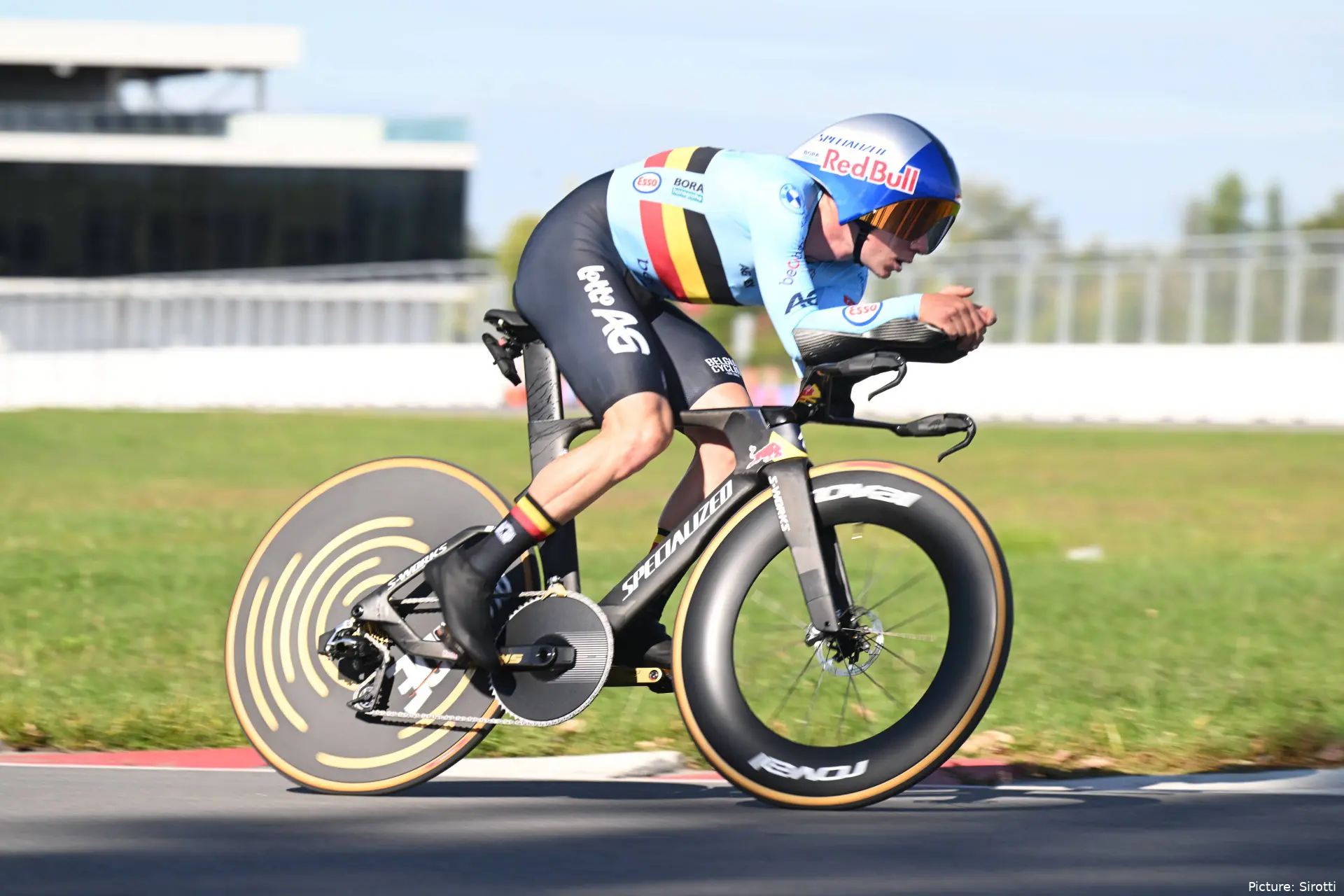
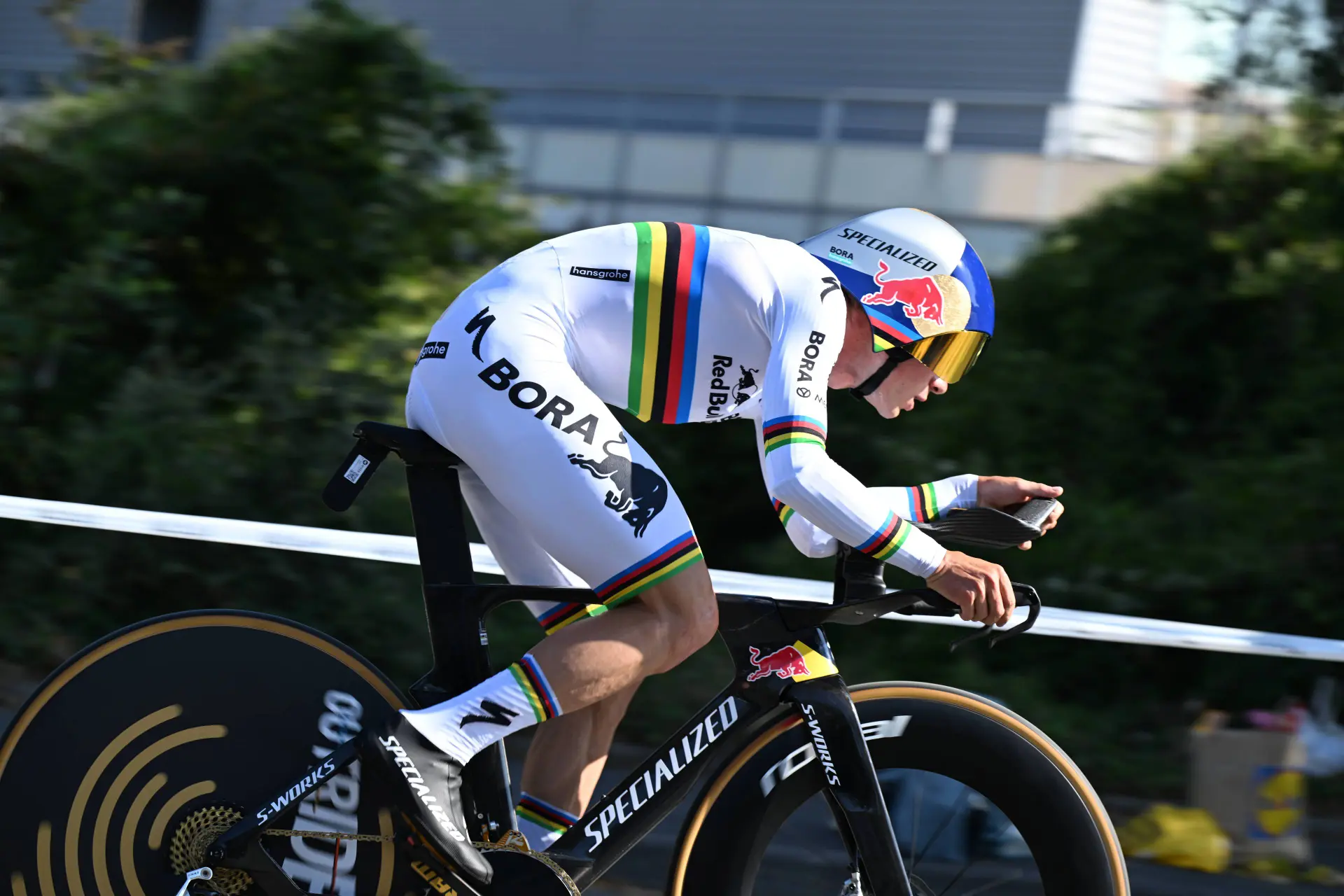
Remco Evenepoel once again showed at the Montréal 2026 World Championships why he remains the dominant force in global time trialling. The Belgian claimed a fourth straight world title against the clock after covering the 39.2 kilometres in 44:53.13, finishing 57 seconds ahead of Filippo Ganna and 1:13 clear of a sensational Paul Seixas, who, at just 19, took the bronze medal.
The result not only confirmed a supremacy that has become routine in recent years, it also revived a bigger question: are we witnessing the greatest time trialist in history? As Juan Larra and Jorge P. Borreguero discussed in a new episode of El Espresso de CiclismoAlDía, the answer requires context for Evenepoel’s current numbers and those of some of the sport’s great legends.
With four consecutive world titles, the Belgian has drawn level with Fabian Cancellara and Tony Martin for the most rainbow jerseys in the discipline. However, he has set a benchmark neither of them reached: he is the first rider to win four Time Trial World Championships in a row.
For Juan Larra, the win in Montréal almost rubber-stamped what has long been evident: Evenepoel is, by some distance, the finest time trial specialist in the current peloton. He imposed himself with huge authority on a course that mixed long power sections with a highly technical urban layout.
Jorge P. Borreguero agrees and highlights the sheer scale of the gap to his rivals. Evenepoel finished almost a minute ahead of Ganna and even had time to celebrate before the line, a striking sight in a discipline where every second counts to the final metre.
The comparison used in the discussion helps explain this aura of dominance: just as Tadej Pogačar is perceived to be capable of opening massive gaps on a mountain stage, Evenepoel has reached a level against the clock where the question is often by how much he will win, not whether he can win.
And that leads to one of the key arguments. Pogačar, Jonas Vingegaard, and other top riders have evolved into all-round contenders across almost any terrain. Yet when a pure time trial arrives, the gap between Evenepoel and the rest remains extraordinary.

Remco Evenepoel won the time trial world championships for a fourth time
Is Evenepoel the greatest time trialist in history
Here Juan Larra draws an important line between two ideas: being the best time trialist right now and being the best of all time.
The first is hard to dispute. The second still needs perspective. The modern Time Trial World Championships began in the mid-1990s, so a comparison based solely on world titles does not capture the full history of the discipline.
There are also great champions from earlier eras with outstanding time trial records. Eddy Merckx, Bernard Hinault, Jacques Anquetil, and Miguel Indurain built part of their Grand Tour dominance through this discipline.
The numbers frame the complexity of the debate. Merckx won 69 time trials, Hinault took 20 Tour de France time trial victories, and Indurain made the discipline one of his main weapons in the Grande Boucle. Evenepoel, at just 26, is still building his palmarès. So, while his current level looks extraordinary, it is still premature to close a historical comparison of this magnitude.
There is another point both journalists consider crucial: cycling has changed. Today’s Grand Tours offer fewer time trial kilometers than in some past eras, and the best riders are far more complete.
One of the most interesting angles in El Espresso de CiclismoAlDía’s analysis is precisely that evolution.
Juan Larra recalls how in other periods a top time trial specialist could carve out huge gaps in the races against the clock and then defend them in the mountains. The example of riders like Miguel Indurain shows how decisively a time trial could shape a general classification.
Today the landscape is different. The main GC favourites can perform in time trials, in the mountains, in classics, and even on terrains once reserved for far more specific profiles.
Jorge P. Borreguero compares this evolution to other sports, where athletes have also trended toward broader skill sets. In cycling, that shift has enabled riders like Pogačar, Vingegaard, Evenepoel, and the younger talents coming through to compete at the highest level across multiple specialties.
That is where Paul Seixas appears as one of the standout examples of this new generation.
Paul Seixas, the major breakthrough in the Montréal time trial
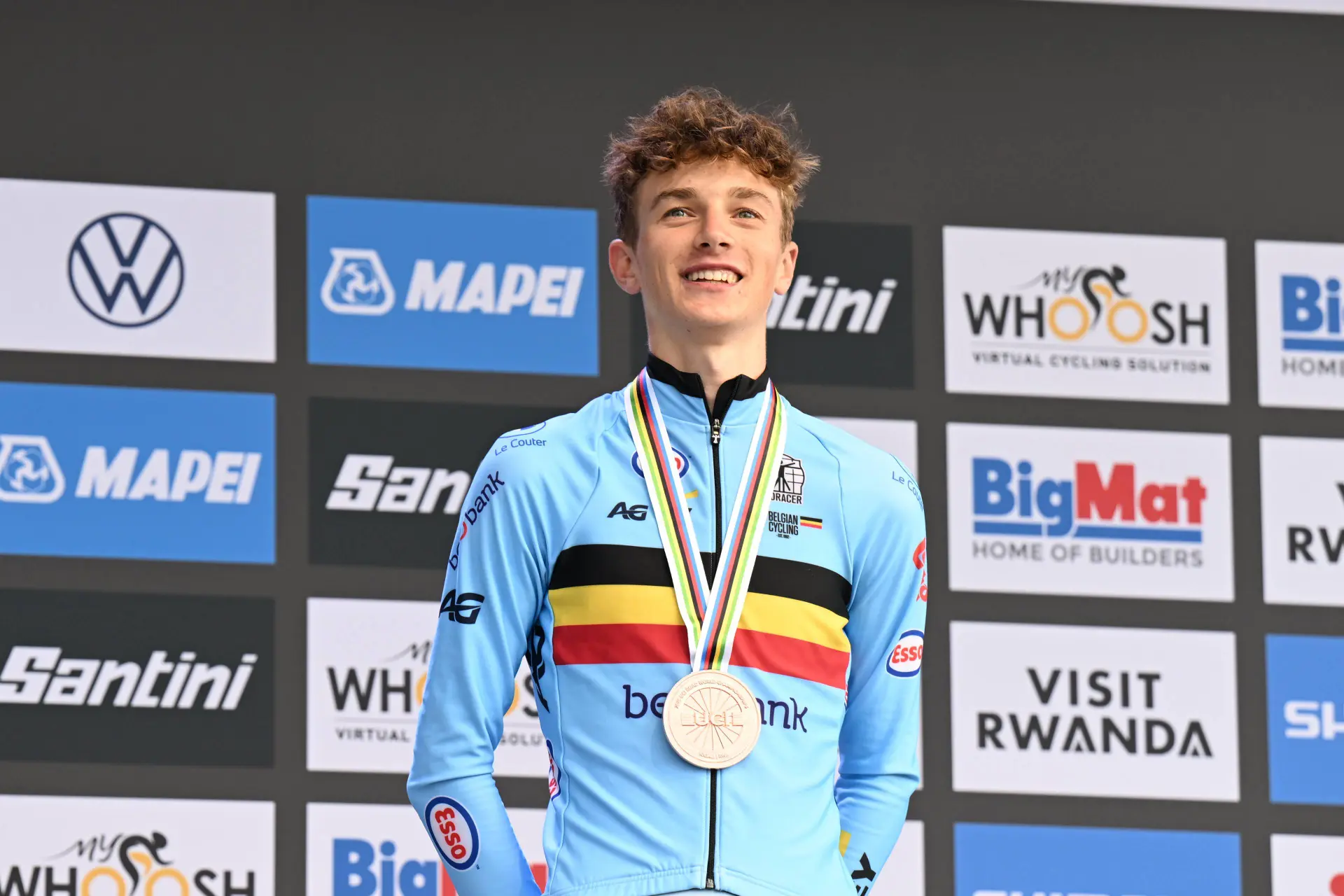
Paul Seixas’s bronze was another headline from the Montreal Worlds. The Frenchman, just 19, finished third over 39.2 kilometers, 1:13 minutes behind the world champion.
For Jorge P. Borreguero, the result stands out because Seixas did not arrive with the time trial specialist tag that others on the start list carried. Yet he finished ahead of numerous riders whose primary strength is precisely this discipline.
Juan Larra adds an important nuance. The Frenchman had already shown the attributes of a complete rider and an ability to perform in time trials. So Montreal’s bronze does not come out of nowhere, but confirms the enormous potential of a cyclist who is still only 19.
His result gains even more weight in a generational context. Evenepoel, Pogačar, and Vingegaard are still in their athletic prime, so Seixas will share the stage for years with some of the era’s best. But his ability to already approach them in such a specific discipline opens a particularly intriguing scenario for the future.

The podium of the 2026 World Championships time trial: Remco Evenepoel, Filippo Ganna and Paul Seixas
Isaac del Toro also takes a step forward
Another name in the analysis is Isaac del Toro. The Mexican finished sixth in Montreal, 1:38 behind the world champion, a striking result given that the time trial has not historically been one of his strongest terrains.
Juan Larra reads his ride as a positive signal ahead of the road race. Del Toro also arrived buoyed by his recent win at the Grand Prix Cycliste de Montréal, ahead of Evenepoel and Seixas, and his performance against the clock confirms he keeps improving in a discipline where he still has room to grow.
For Jorge, the evolution is especially interesting because it reflects a trend among young talents: riders who did not initially stand out in time trials are improving progressively thanks to targeted work with their teams.
A world championship sixth place does not make Del Toro a time trial specialist, but it is further evidence of his shift toward an increasingly complete profile.
Evenepoel and the future of the time trial
The big debate, however, circles back to the same question: how far can Remco Evenepoel go?
With four consecutive World titles, the Belgian has matched Fabian Cancellara and Tony Martin in total crowns. The difference is that neither of them strung together four wins in a row.
That is why Juan Larra believes the historical debate still needs time, especially because top specialists from other generations accumulated many more victories across all types of time trials.
But one factor plays in Evenepoel’s favor: his age. At 26, he still has a wealth of opportunities to expand his palmarès. If he maintains the level shown in Montreal over the coming years, the historical discussion will move beyond his four Worlds and increasingly focus on the length of his dominance in the discipline.
Jorge P. Borreguero also puts another issue on the table: the potential future importance of time trials at the Tour de France. Evenepoel’s superiority over Pogačar in this discipline is one of the few areas where there is currently such a clear gap between them.
More kilometers against the clock could shift the balance of a Grand Tour and offer the Belgian a tool to offset the differences he may currently face against Pogačar in high mountains.
Read also
A debate that has only just begun
The Montreal World Time Trial left one certainty and several questions. The certainty is that Remco Evenepoel remains on another level against the clock. The Belgian has won four straight World titles, becoming the first man to stitch together such a streak in the history of the competition.
The questions concern what comes next. Whether Paul Seixas can become one of his great rivals over the next decade, whether Isaac del Toro will keep closing the gap in a discipline where he is still developing, and above all, whether Evenepoel can turn his current dominance into a historical legacy comparable to the great specialists of all eras.

Jorge BorregueroWriter
Jorge Borreguero is a journalist with a degree from the Complutense University of Madrid and has been a writer for Cyclinguptodate and Ciclismoaldia since early 2023. In this role, he has played a key part in the evolution of the website, particularly as a specialist covering Movistar Team. He regularly writes race reports, analytical pieces, and in-depth features about the team, and has conducted exclusive interviews and attended multiple team presentations, providing readers with firsthand insights into one of the leading professional cycling squads.
Throughout his career, Jorge has maintained a strong focus on sports journalism, gaining experience across a variety of disciplines, including basketball and football. However, his current work is almost entirely dedicated to cycling, contributing extensively to Ciclismoaldia and its sister website Cyclinguptodate. For these platforms, he combines thorough research with detailed reporting to deliver high-quality content, ranging from race previews and results to expert analysis of teams and riders.
Jorge’s reporting is marked by accuracy, depth, and a commitment to providing readers with reliable and authoritative information. His direct engagement with teams, athletes, and events ensures that his coverage reflects firsthand knowledge and professional insight. Through his work, he has established himself as a trusted voice in professional cycling journalism, bridging the gap between the sport and its global audience while maintaining rigorous editorial standards.
claps 0visitors 0
Just in
Popular news
Latest comments
- Sagan was long part of the discussion as one of greats, what with three RR world championships in a row. Fabian Cancellara had the monument wins to go with the TTs, while Tony Martin was simply amazing in his own way. Ganna, between his wins and seconds, is the one who suffers from living in the wrong era. Evenepoel has plenty of time to win a 5th, 6th, and 7th time. He's won the European and the Olympics TTs, he's won at the grand tours, he's just an incredible time trials. In my mind, his career may not be done (may not even be at a half way point!), but quite clearly, he's the greatest time trialist we've seen. Time to attack the hour record, sir - both on a bike Merckx's and on a modern bike. Just because.RidesHills21-09-2026
- One of a long line of amazing Slovenian riders. My family is from right across the border to his hometown of Kranj, via the backroads to Eisenkappel, and I suspect he may end up biking those (amazing) roads in his retirement. Enjoy!!RidesHills21-09-2026
- I think it is pretty obvious that he is in the discussion, and with 4 in a row likely is. I don't know who would be considered better.mij21-09-2026
- Pogi, the best of everything else... The G.O.A.T. of over all cycling!!!PogiSloFans21-09-2026
- How is it that these two journalists don't make any mention of the Swede who also had a fantastic ride and most likely would have bumped Seixas off tge podium if he hadn't hit the deck....I guess they're just too start struck to be a bit more objective.Zone0Rider21-09-2026
- Hey Jumpin Johnny, do you really know who Mou is? Oh please, be so good and tell me.PogiSloFans21-09-2026
- Pogi hater... shush. Capish?PogiSloFans21-09-2026
- Battling it out with Longo stillJumpyjohn21-09-2026
- Remco has already set a record, only person ever to win 4 consecutives, as Longo had to skip a year during her streak. If he wins the road race he’ll be level at the road cycling top with 5, others having more have been in other disciplines or across several disciplines. How many has your man collected in all his years of domination, doesn’t seem to be his strong point, especially when you consider how often he’s avoided the Vuelta. You should know better now than to continue hyping him up. Pray he doesn’t have a change of heart and buy himself out of his contract to start a family.Jumpyjohn21-09-2026
- Funny how this guy doesn’t ask who Mou is when his thumb score shoots its load. Obviously doesn’t know too much about darts though.Jumpyjohn21-09-2026
Loading
3 Comments