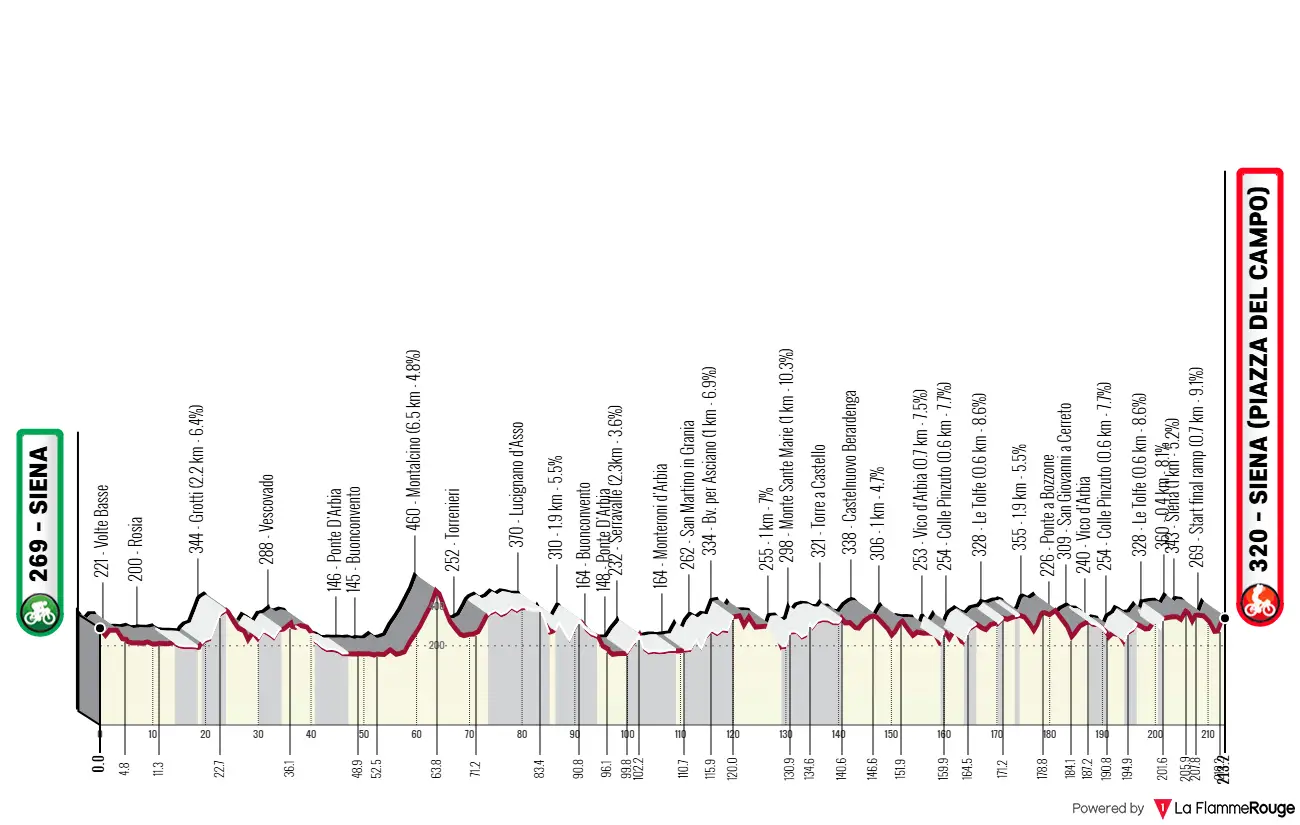
On the 8th of March the World Tour peloton will tackle one of the biggest and most spectacular races of the year. Strade Bianche will be on the road, with it's iconic gravel roads, steep climbs and beautiful sceneries. We take a look at it's profile.
After having changed it in 2024, the 2025 course remains just as hard and with the same large distance. 213 kilometers on the menu, with 3700 meters of climbing - although the race does not have a single mountain to tackle.
Read also
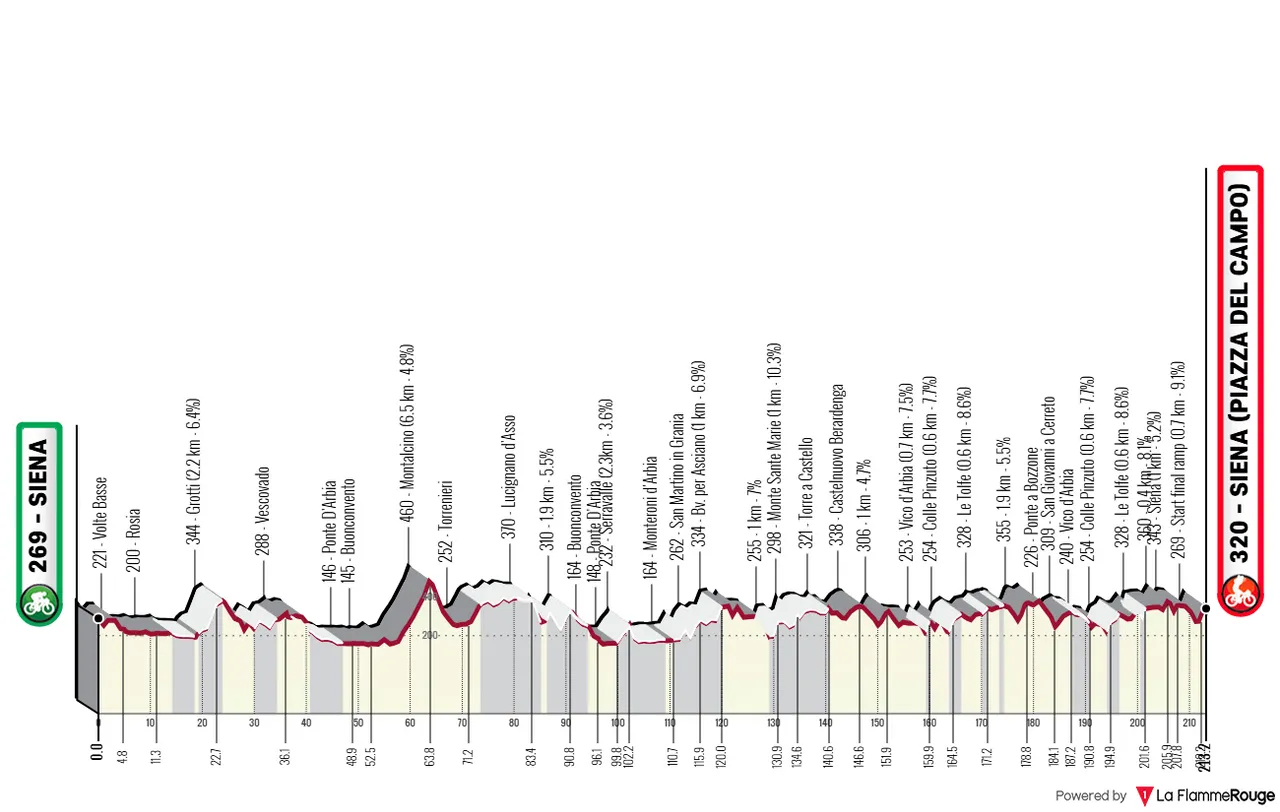
Siena - Siena (Piazza Del Campo), 213,2 kilometers
There are 81Km of gravel divided into 16 sectors, as short as 600 meters long and as big as 11.9Km in length, and they aren’t concentrated in any specific area of the route but rather spread evenly throughout the entire race, it’s one of attrition, where tactics, positioning and let’s admit, a tad bit of luck all have to be ticked off the box. The route starts off in some rolling roads and just a bit before the halfway point of the race the first major challenge comes.

Monte Sante Marie
Lucignano d’Asso sector, the 5th and biggest of the race and finishes with 127Km to go, it’s a fairly hard sector that has a lot of room for crashes, punctures, splits, etc… Every sector (and well every Kilometer) is a chance for something to go wrong, and like in the cobbles it’s a matter of having the least possible energy spent unnecessary, this is where the real race starts!
Monte Sante Marie is perhaps the first crucial sector of the race, ending with just over 72 kilometers to go and featuring a whole kilometer at 10%. However the sheer size and diversity of gradients found throughout the sector makes it a brutal one that will inevitably explode the race.
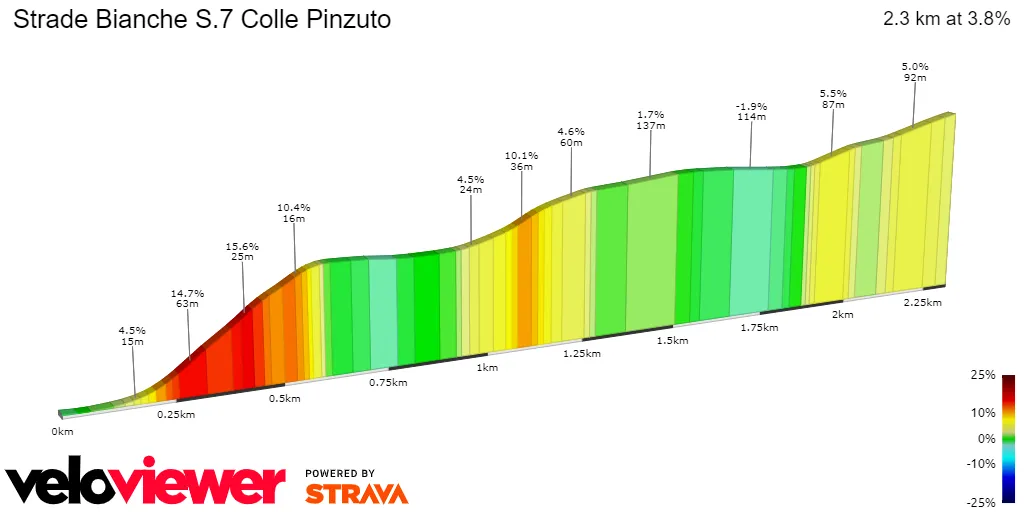
Colle Pinzuto
Colle Pinzuto finishes with 53Km to go and is one of the last pieces of brutal roads where gaps can be made out of power and not opportunity, it’s one that doesn’t include descents so it’s quite a brute.
Le Tolfe follows, it summits with 42Km to go and is a U shaped sector, you enter it full speed in a descent and then have a nasty ramp in the gravel, the last white road of the race and for sure at this race we can have the rider, or the group of riders who will fight for the win.
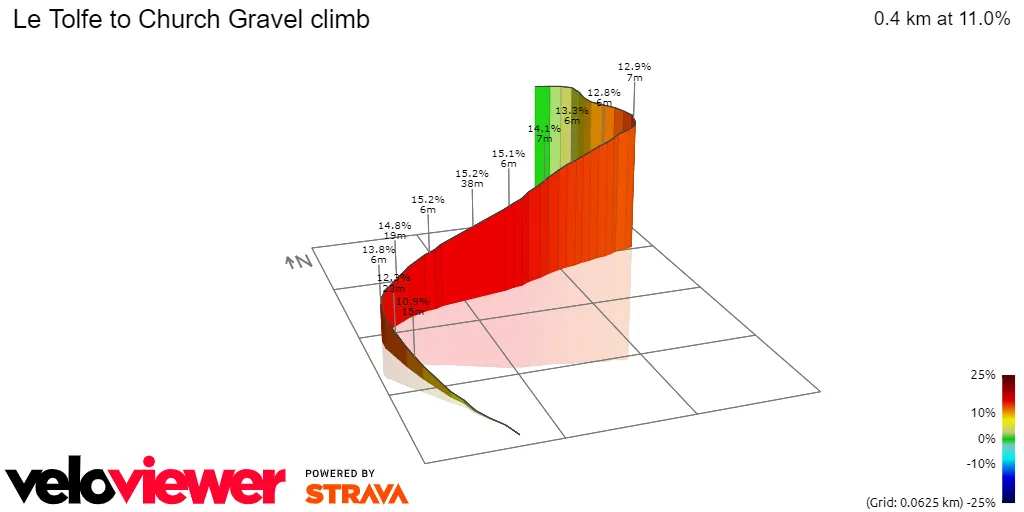
Le Tolfe
Traditionally, the riders would then have a few hills and ride into Siena just a few kilometers away. In 2024 an extra loop was added and this year it stays. This will feature the 1.3-kilometer long Strada del Castagno which finishes with 39 kilometers to go, and then the 3.3-kilometer long downhill San Giovanni a Cerreto which ends with 22.5 kilometers to go.
In antecedes Colle Pinzuto and Le Tolfe which will be climbed for a second time. These will end with 17 and 12 kilometers to go, by this point the race may already be decided, but if not certainly these pinch points can be the end of many riders' ambitions.
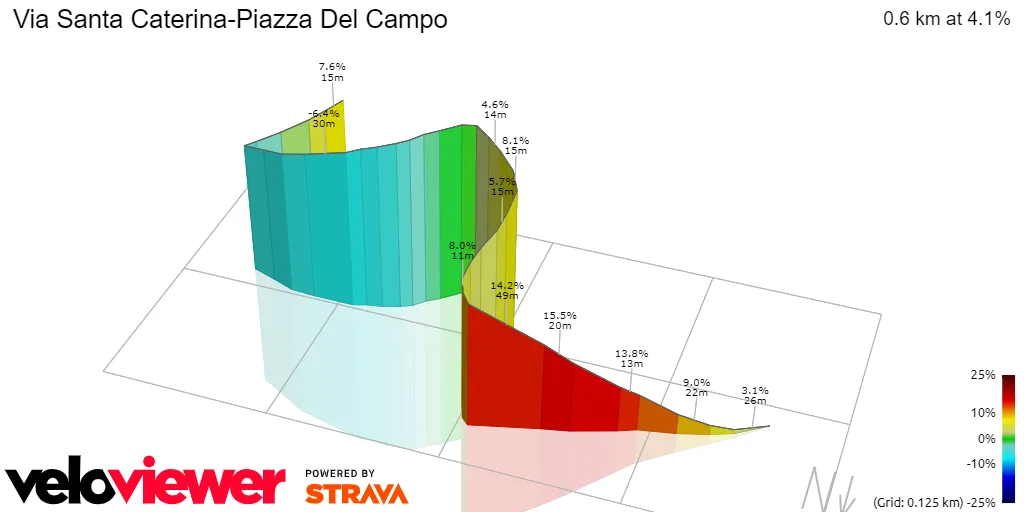
Via Santa Caterina & Finale
From there on there are 12 kilometers into the finish line. They will by no means be easy as the road keeps tilting either up or down, however it does give some opportunity to reconsolidate the race and possible form alliances ahead of the final ascent.
If a group, it will all be decided in the narrow streets of Siena, Via Santa Caterina is one of the most iconic places in cycling and you’re sure to get some awesome images. The decisive ramp will go up to 16% in it's steepest section (700 meters, 9% average gradient) and the final corners into the heart of Siena will be a final opportunity to overtake other riders.
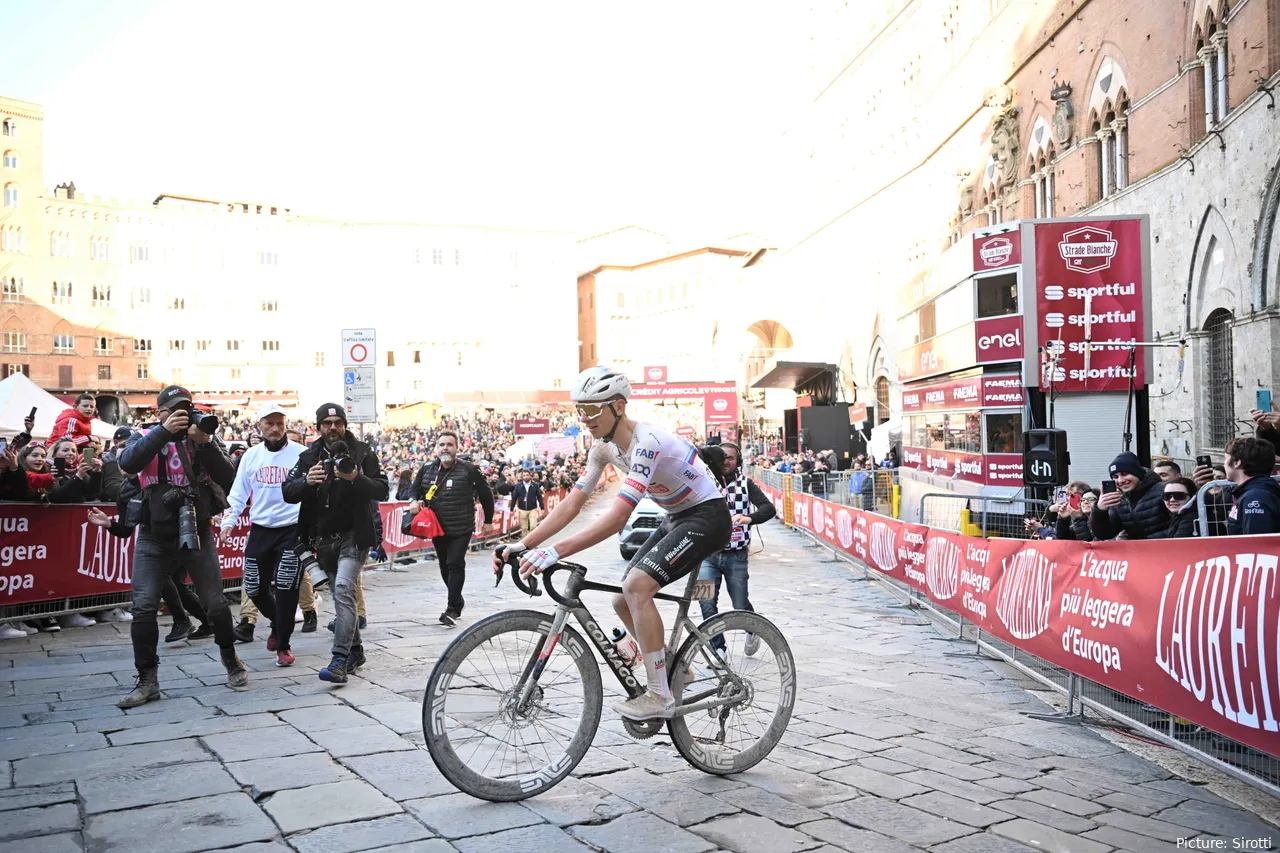
The race ends at the iconic Piazza del Campo. @Sirotti
The race where nothing can be taken for granted: 81 km of gravel sectors, 100% excitement. Here is the route of the #StradeBianche @CA_Ita 2025👇
— Strade Bianche (@StradeBianche) January 24, 2025
.
La gara dove non c'è mai niente di scontato: 81 km di sterrato, 100% emozione. Ecco il percorso della #StradeBianche @CA_Ita 2025👇 pic.twitter.com/Snpq5LSoYC
Rúben SilvaEditor-in-Chief
A founding contributor to CyclingUpToDate since its launch in January 2022, Ruben Silva has played a central role in shaping the site’s editorial direction and long-term growth. Before joining the project, he built his experience through independent blogging at Echelons Hub and by producing race previews for Ciclismo Internacional, developing a strong analytical voice rooted in daily engagement with professional cycling.
Beyond editorial work, he has been closely involved in the expansion and coordination of CyclingUpToDate’s wider network, helping establish and support sister platforms across multiple languages. This includes ongoing collaboration with CiclismoAlDia (Spanish), CiclismoAtual (Portuguese), WielrennenUpToDate (Dutch), and RadsportAktuell (German), contributing to a shared editorial vision and consistent international coverage.
He also helps oversee editorial governance across the network, setting standards for accuracy and consistency and coordinating updates or corrections when needed.
Originally from the Porto metropolitan area in Portugal, he holds a bachelor’s degree in Geography. His path into cycling journalism was shaped not through formal media training, but through independent reporting, community engagement, and sustained on-the-ground involvement in the sport.
Over the course of his career, he has conducted approximately 100 interviews across road cycling and cyclocross, ranging from one-to-one conversations and online formats to press conferences and on-site pre- and post-race coverage. His interviews include leading riders, team managers, and prominent figures within cycling media: Tadej Pogacar, Jonas Vingegaard, Mathieu van der Poel, Primoz Roglic, Wout van Aert, Joao Almeida and Tom Pidcock; managers like Patrick Lefevere and Joxean Matxin; and YouTube personality Bryan Kennedy (BKXC)...
Within 18 months of launch, he helped grow CyclingUpToDate’s English-language platform into one of the most-read cycling news websites, built entirely from the ground up. As both a professional journalist and lifelong cycling enthusiast, his focus remains on delivering accurate, timely, and well-contextualized coverage.
claps 0visitors 0
Just in
Popular news
Latest comments
- he lost his factory ride as Cannondale Factory Racing ended their MTB team. probably looking for more opportunities.mij27-11-2026
- hello he aint a domestic or super domestic , he is a genuine 3 week GC rider capable of winning. I wouldnt be surprised with his stance that he never wins a TDF just settles for runner up. . must be a well paid lackie.go figure
 Davide26-11-2026
- AI tends to lag behind …Ketterechts26-11-2026
- yes, but he never competes against the best because he chooses to work for him. seixas is different, he faces the competition and wants to beat the best while he (pogi) is at his prime. that is something idt will never even try to achieve. to use metaphors … when seixas is a conquerer, idt chooses to be a heir.Ketterechts26-11-2026
- "and Wout van Aert sprinting to victory in Paris in the final stage of last year’s Tour de France." Which race did the fellow watch?
 Rafionain-Glas26-11-2026
- The role I think that Wout played was to prevent IDT from even trying. If it had been just Yates upfront, he could’ve given it a go. But having seen what WVA had done for Jonas in TDF he realized that it was not going to happen.Cbastnagel26-11-2026
- If he wants to be top dog , why is he staying at UAE. Its the worst way to learn how to win the important races which he is starting a a domestique to Pogi. Sexias has a monument he doesnt.abstractengineer26-11-2026
- He had already given the lead up on the mountain itself, and it was lost Wout or no wout because to pull back Yates, he needed carapaz and carapaz absolutely refused to work with him. They have never won a GT outside of Pogi.abstractengineer26-11-2026
- 🤞for NO crashes!!!Lozza26-11-2026
- Ah good, it’s been amended! 👏Lozza26-11-2026
Loading
Write a comment