“No WorldTour race went as planned, but then everything improved in May”: Juan Ayuso proves he is back to his best form after a disrupted spring
CyclingSunday, 21 June 2026 at 09:00
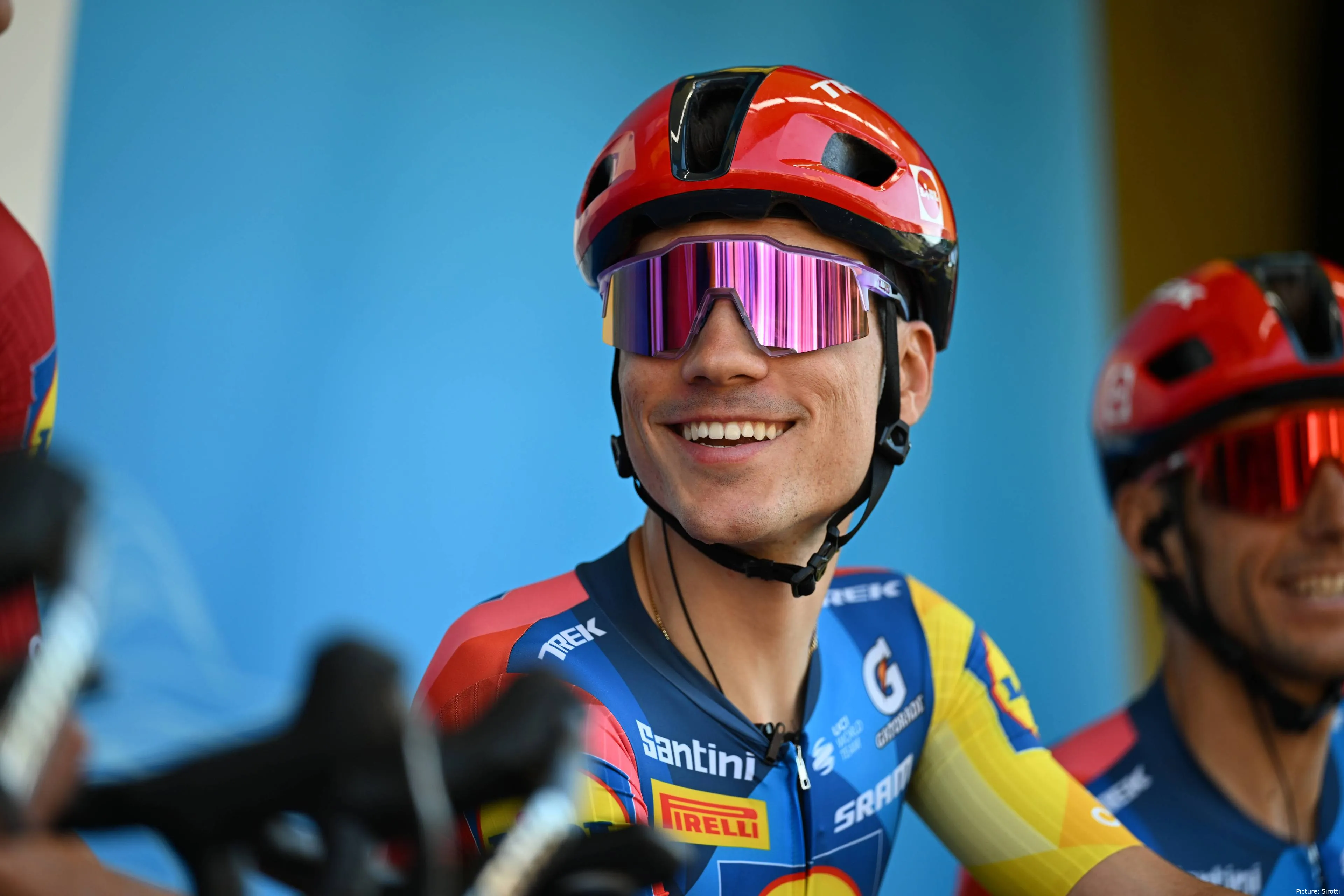
Juan Ayuso’s strong showing at the Tour Auvergne-Rhône-Alpes confirmed both his return to form and his growing importance within Lidl-Trek’s general classification plans ahead of the Tour de France. The Spaniard finished third overall behind Isaac del Toro and Luke Tuckwell after an aggressive and consistent week in the mountains, underlining a season that had previously been disrupted by crashes and illness but now appears to be stabilising at a high level. According to Lidl-Trek head coach Josu Larrazabal, the performance also reflects a broader progression that goes beyond results alone, even if tactical decisions on the Grand Colombier may have cost Ayuso a better outcome.
Recovery after a disrupted spring
For Lidl-Trek, the race represented a confirmation of Ayuso’s trajectory after a difficult first part of the season. “Absolutely yes. For me it went well,” Larrazabal said in words to bici.pro. “After everything that happened to Juan in the first part of the season, we are happy. He started very strongly in Algarve, then there was a crash when he was leader at Paris-Nice. After that he was sick again and had to go home from the Basque Country. No WorldTour race went as planned. It was not a positive moment. But then everything improved in May.”
The coach explained that the turnaround began after a structured altitude block in Sierra Nevada. “After recovery, we went with Juan and the team to altitude in Sierra Nevada. We did a lot of testing there, from materials to the team time trial, and the results were very positive. At Auvergne-Rhône-Alpes we finished fourth in the team time trial and we were strong in the mountain stages. One of them we won with Simons. And we also had two second places, which confirms Juan’s progression. Even in the final stage, although Del Toro was the strongest, we controlled the race.”
Read also
The approach, Larrazabal said, was also designed as preparation for the Tour de France rather than purely for immediate results. “We were also there to prepare the team for situations that could happen in the Tour. That is also a test.”
Ayuso’s attacking style remains central to his racing identity, even if it sometimes leads to tactical overreach. Larrazabal acknowledged that on the Grand Colombier the Spaniard may have misjudged his effort. “He was annoyed,” the coach said when describing Ayuso’s reaction to being distanced by Del Toro. “We focus on the process of development. The data shows everything is going well, but it does not guarantee results. Riders think mainly about winning.”
He added that ambition remains both a strength and a challenge. “Of course on Saturday he probably regretted his move. He should have waited a bit longer because Visma | Lease a Bike was still pacing. Del Toro took advantage. He did not play his cards in the best way, but he raced to win, and that is important for him.”
Final preparation for the Tour de France
The final weeks before the Tour will now focus on refining form, with a structured altitude block planned before the start in Barcelona. “We will do another 11–12 days of altitude training,” Larrazabal explained. “The riders went to Andorra after the race, and then we will arrive in Barcelona. We will do two training days on the Montmeló circuit before the Tour.”
Physically, Ayuso is already operating at a very high level, according to his coach. “The numbers were already very high at the Dauphiné. What improves now is durability, the ability to sustain high efforts over more days. At the Tour you need that over blocks of two or three days in the second and third week.”
Larrazabal added that marginal physical gains are now small, but still possible in specific areas such as weight management and heat adaptation. “He can maybe lose half a kilo, at most one, without losing power. That improves fatigue resistance. And adaptation to the heat in Barcelona will also be important.”
Larrazabal also offered a final remark on his rider’s personality. “He is exactly like that,” he said. “A rider we sometimes have to hold back. He pays attention to every detail. We have to tell him: you are already very good, don’t tighten the screw too much or you might break it.”
claps 1visitors 1
Just in
Popular news
Latest comments
- It needs a big name like VDP and their team to stand up to the UCI and say I'm not paying these ridiculous fines - and to do it during a grand tourCyclingsbestfan21-06-2026
- I wonder what to watch today? Tour of Slovenia? Baloise Belgium tour? Or enjoying Tadej's three-time ascent of the Col de la Croix? Tough decision! ;)MajorPayne21-06-2026
- mus-musculuspeedypogigonzales: meaning 1) mus-musculus = common house MOUse 🐭 2)speedy gonzales = the fastest mouse of Mexico... arriba arriba andale... 🌵 3)pogi = the fastest cyclist of Slovenia and the world... gremo gremo hitreje... 🚴🏻mus-musculuspeedypogigonzales21-06-2026
- if he dont get a podium at the TDF it will be a failure for both Juan and Lidl-Trek. His team might not be in the top three but they need to aim up...Davide21-06-2026
- Ne, ne, ne razumeš. Ta tip MOU, o katerem govoriš, je iz Hrvaške, jaz pa sem iz Slovenije.mus-musculuspeedypogigonzales21-06-2026
- I don't like Dominique Serieys much (they way he got rid of Vincent Lavenu was cruel) but he wants to win at the Tour and I don't see any reason why he'd not take Olav. On a different note, Kooij's rivalry with Merlier is great, especially as they are both riders who sprint skillfully, relying on positioning, drafting and timing. Jonothan Milan just mashes those pedals, and while you don't get to be one of the best I the world with pure power, he's often been disappointed by Merlier coming out of the wheel just at the right time. And Paul Magnier is successfully learning the dark arts which have made Merlier so successful.
 Rafionain-Glas21-06-2026
 - It was downright hilarious when he dropped his head in disappointment and then looked up again just for that small chance that he'd seen it wrong. But I think that UCI only give the fines (which matter little for the riders) so they can say that they are doing something if they are criticised. There isn't anything wrong at all with him sitting shirtless in the hotseat, and especially after an effort as hard as that. His look of utter disbelief was "He beat me in Sanremo, in Flanders, Roubaix was cruel and now here..."Rafionain-Glas21-06-2026
- I doubt that is relevant in context, without him the viewing proportions would be pretty similar. Also, is he searching out the competition that’s trying to avoid him or will they follow him where he races, try to answer it. Would he attract others if he showed some interest in his home Tour? Personally I think everyone would just stick to their own programs, very few pick races according to his.Jumpyjohn21-06-2026
- Would be cool if he did the research to answer his own questions, less time left for spending hereJumpyjohn21-06-2026
- It does help to feel mortals more equal. Us ordinary citizens are also often fined for such exhibitions. Personally I have little against it especially if it results in women fighting for equality with men ;-) BUT from experience, the vast majority of those testing the rules fall into 2 categories that put me off allowing this in general, the really vain look at my super sculpting work like look at the flash car I have to drive to feel worthy and the really ugly, often worse than what you try to ignore on nudist beaches. At least MVDP doesn’t fit into either. And that’s the thing with rules, individually we’d all prefer to be without but collectively you need them to stop standards dropping ever lower and anyone of a certain age will probably agree that generally over time as we get more freedom and individual, standards drop. MY 2 Sunday centsJumpyjohn21-06-2026
Loading
1 Comments