"He was in intensive care for 12 days and was ready to finish second at the Tour" - Tiesj Benoot uses Jonas Vingegaard as comeback inspiration
Cycling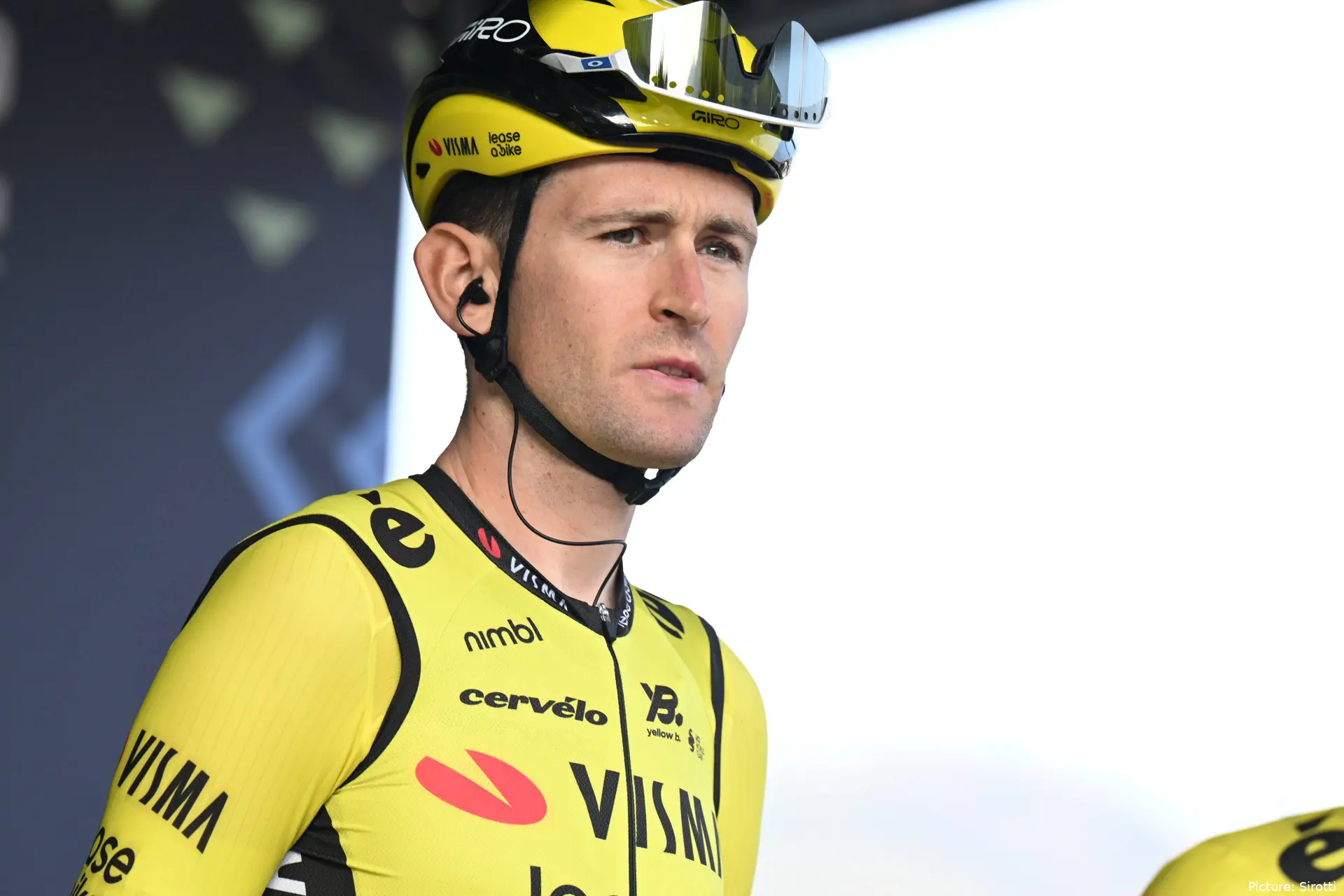
For more than a decade, Tiesj Benoot measured his seasons in cobbles, punchy climbs and white gravel roads. This year, for the first time in his professional career, the Spring will unfold without him.
Benoot, who was one of Decathlon AG2R La Mondiale Team’s major signings for 2026 after four years with Team Visma - Lease a Bike, was seen as one of the French squad’s key hopes for the Classics campaign that begins this weekend.
16 weeks ahead to recover his smille
The defining moment of his career remains his victory at Strade Bianche in 2018, when he conquered brutal conditions to claim a triumph that shaped his trajectory on the roads of Tuscany. Since then, he has been a constant presence in the biggest one-day races, repeatedly making it into the decisive phases of the Tour of Flanders and the Amstel Gold Race.
The Belgian rider will be sidelined for a long period, estimated at 16 weeks, after undergoing surgery for an inguinal hernia. “I was in a lot of pain, so I’m happy they removed it,” Benoot told Sporza. “It’s good that a cause has been found for my issues. Now a long rehabilitation awaits me.”
Benoot hopes to receive the green light later this month as he works toward one of the objectives he set with the team for his season, the Tour de France. “Originally it was in my program and I would love to be there as well. But it’s still too early to say that it will be a target.”
For now, he is limited to 300 metres of walking per hour. “If I get the green light on Tuesday, I can start rehabilitation with the physiotherapist. Normally, I should be able to train properly again in a few weeks.”

Tiesj Benoot, here still in Visma colours, at the 2025 Tour de France
An inspiration called Jonas Vingegaard
Wout van Aert, his former teammate and close friend, sent him a gift to lift his spirits as he goes through this difficult period away from the bike. “I’ve already eaten quite a bit of chocolate,” Benoot laughs. “That’s a little less ideal for me as a rider. I’m going to spend the longest period of my career without a bike.”
Yet there is both disappointment and hope in the words of the 31-year-old rider. “I’ve already swallowed the disappointment of having to miss the Spring. But I’m motivated to come back at least at the same level.”
Classics are out, but the Tour de France remains possible. He believes everything is still within reach and points to Jonas Vingegaard as an example, after the Dane crashed at Itzulia Basque Country, recovered and made it to the start of the Grand Boucle. “He was in intensive care for 12 days and was ready to finish second at the Tour about eight weeks later. I don’t compare myself to that, but I hope to be there.”
“If I can ride for two or three weeks without problems, we’ll be able to better estimate where I stand. I’ve ridden the Tour nine times, so I know it’s no gift if you’re only at 80 per cent.”
For now, Tiesj Benoot knows he will have to watch his favourite races from the sofa at home, the events where he feels most at ease. “Although that might be even harder in the Spring, because those are the races I train for all winter and where my heart truly lies.”

Carlos Silva is a writer for CyclingUpToDate.com, where he contributes race reports, interviews, analysis pieces, and live coverage of the international cycling calendar. Holding a degree in Sports from the Jean Piaget Institute, he combines academic knowledge of performance, training, and competition with hands-on journalism experience in professional cycling.
Throughout his career, Carlos has conducted interviews with leading figures in the sport, including Alberto Contador, Joaquim Rodríguez, Óscar Pereiro, João Almeida, Isaac del Toro, Derek Gee, John Degenkolb and Geraint Thomas. These conversations reflect direct engagement with Grand Tour winners, Classics specialists, and emerging talents.
He has provided on-site coverage at major events ranging from the Vuelta a España to the Tour de France, alongside stage races such as Vuelta a Andalucía, Volta ao Algarve, Volta a Portugal and O Gran Camiño. Covering the mythical climbs of the Giro d'Italia remains one of his professional ambitions.
Carlos is responsible for liveblog coverage of all major WorldTour races and beyond, including the Tour de France, Giro d'Italia and Vuelta a España. His reporting integrates verified data from ProCyclingStats to ensure statistical accuracy, contextual depth, and analytical precision.
A lifelong cycling enthusiast, he approaches storytelling across written, photographic, and video formats with a focus on credibility, tactical insight, and informed race interpretation.
claps 0visitors 0
Just in

Popular news
Latest comments
- writing about yourself in third person ... please, at least have someone else from your staff author these self-coverage articles!Ketterechts25-11-2026
- Don’t forget Yates’s podium at 2023 TdF!Lozza25-11-2026
- It was stage 14 to Morzine that Carlos Rodriguez won in 2023, not Puy de Dome. And Kwiato actually won the previous stage himself to Grand Colombier!Lozza25-11-2026
- Go Pogi!! 🐐❤️Lozza25-11-2026
- They didn’t have or need “extraordinary information”. All they needed was for a French judge to sign off on the night-time testing for it to go ahead.Lozza25-11-2026
- If the sponsors voted for Primoz then you get him, otherwise not.flyer25-11-2026
- It sure can feel or seem that way but I wonder if the same amount of prodigious performances (compared to the others) would occur if no one was ever doping at all.flyer25-11-2026
- Given the similarity of two articles (published on I think the same date), I'm reusing (copy-n-pasting) my post from the twin: I've always thought the last day of each of the grand tours was problematic mostly in that the GC is considered completed before the race starts when that is not really true. There is some tension, but not desirable tension. What saves the awkward practice is the race finish is legit for those who participate - so it's not wholly different from the other stages. That neutralizations usually make good sense demonstrates their necessity so if that has to be the way to go I agree that the design plan for the neutralization should be completed before the race starts. This years end stage in the Vuelta had one of the best first half's I've seen in that many of the riders looked to be thoroughly enjoying themselves making it a joy to watch. But I think it was slightly closer to the exception rather than the rule.flyer25-11-2026
- Even I often win without being there at all, not even breaking a sweat. Beat that!flyer25-11-2026
- It is not about rest and peaking again - 5 weeks is not enough for that. It is about recovery while maintaining form. 4 weeks is easier for that. With a Giro-Vuelta, the 12 week break is enough to rest and then peak again. Not for the Tour
 Rafionain-Glas25-11-2026
Loading
Write a comment