Volta a Catalunya 2027 route reveals return of historic summit finish after 39 years as two mountain stages confirmed
Cycling
The 2027 Volta a Catalunya is beginning to reveal its main attractions, with two summit finishes already confirmed that could play an important role in the battle for the general classification. The 106th edition of the race, scheduled for 22–28 March, will return to the Espot ski resort for the first time in almost four decades, while La Molina, one of the most familiar climbs on the Catalan race, will also feature again.
Both ski resorts are operated by Ferrocarrils de la Generalitat de Catalunya (FGC), but they offer two very different climbing challenges. Espot saves much of its difficulty for the final kilometres, while La Molina features its steepest gradients towards the beginning of the ascent. The contrasting profiles could encourage different approaches from the general classification contenders, although further details of next year's route have yet to be announced.
Espot returns to the Volta a Catalunya after 39 years
The biggest announcement is the return of Espot, which will host the Volta a Catalunya in 2027 for the first time in 39 years. The ski resort has featured on the route just twice before: in 1979, when Switzerland's Josef Fuchs won a stage from Àger to Espot, and in 1988, when Arsenio González took victory on a stage that had started in Bagà.
Next year's finish will be situated at an altitude of 1,530 metres, with riders tackling a 9.8-kilometre climb averaging 5.8%. The ascent begins relatively gently before becoming more demanding towards the summit, where gradients reach 10%.
With the toughest sections concentrated towards the top, Espot could provide an opportunity for gaps to open up as the climb progresses. The closing kilometres will pose the greatest challenge, making positioning and the ability to sustain a strong pace potentially decisive.
Its return also brings back a finish with a place in the race's history, restoring a climb that has been absent from the Volta a Catalunya for almost four decades.

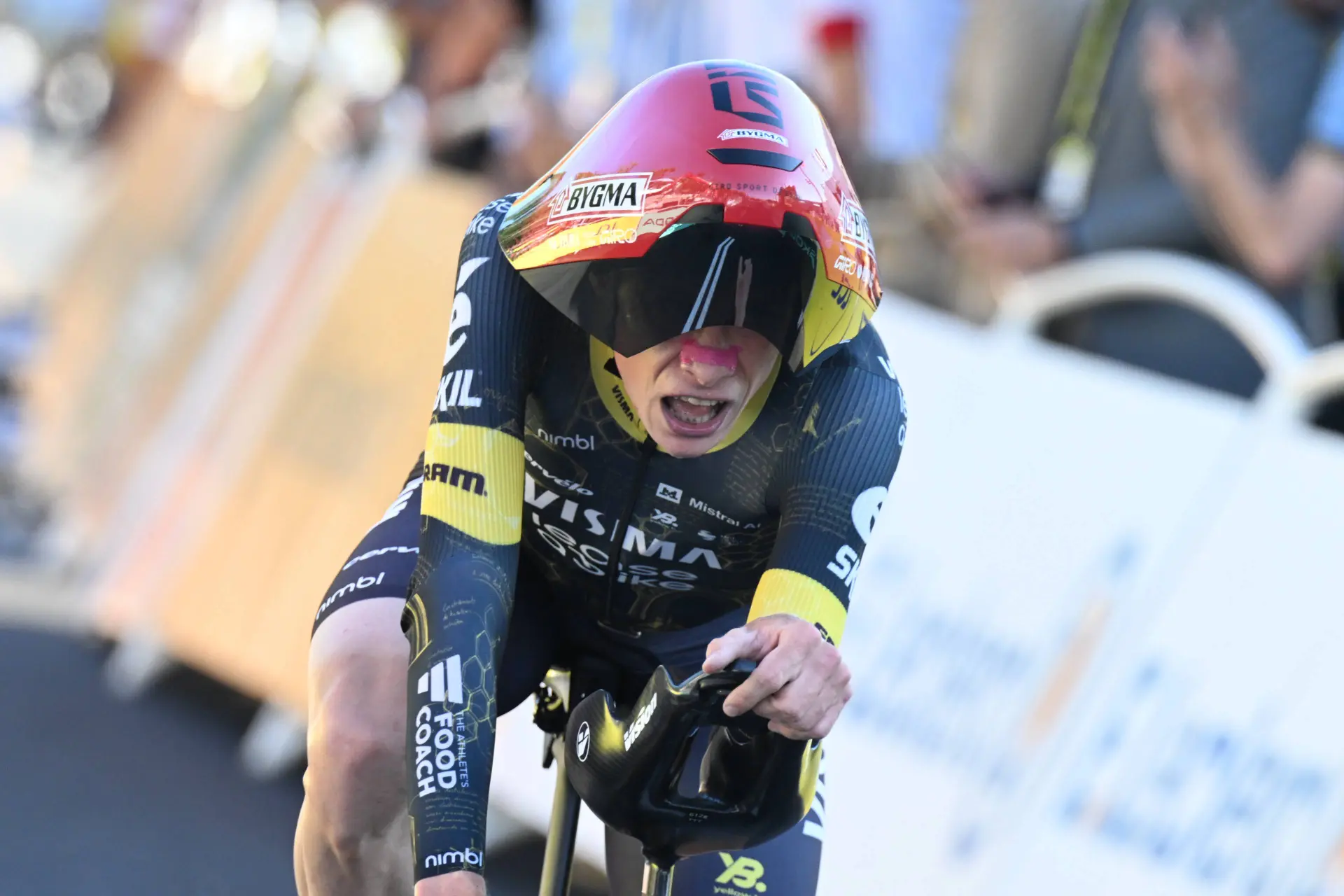
Jonas Vingegaard won the 2026 Volta a Catalunya from Lenny Martinez and Florian Lipowitz
La Molina set for its tenth Volta a Catalunya summit finish
The second confirmed ski resort is La Molina, which will host a Volta a Catalunya stage finish for the tenth time in 2027. Located in the municipality of Alp, in the Cerdanya region, it has become a regular fixture since making its debut in 2014, when Joaquim Rodríguez claimed victory.
The most recent finish came in 2025 and produced a fiercely contested battle between Juan Ayuso, then riding for UAE Team Emirates, and Primoz Roglic. The Spaniard narrowly won the stage, although the Slovenian responded the following day with victory at Montserrat, a result that also secured him the overall title.
La Molina's roll of honour features some of the biggest names in professional cycling. Remco Evenepoel won there in 2023, following Ben O'Connor's success in 2022. Previous winners also include Miguel Ángel López in 2019, Alejandro Valverde in both 2017 and 2018, Dan Martin in 2016 and Tejay van Garderen in 2015.
The return of La Molina gives the general classification contenders another familiar opportunity to gain time in the mountains. Its characteristics, however, are quite different from those of Espot, adding variety to the two summit finishes confirmed so far.
Read also
Two contrasting climbing challenges for the 2027 Volta
La Molina is a 10.8-kilometre ascent with an average gradient of 4.5% and ramps reaching 14%. Although its average gradient is lower than Espot's, the steepest sections come early in the climb, potentially forcing riders to respond to attacks almost immediately.
It is a relatively fast ascent, but its demanding opening kilometres can quickly whittle down the group of favourites. That contrasts with Espot, where the difficulty builds towards the summit.
The combination of these two ski resorts provides one of the first indications of what riders can expect from the 2027 Volta a Catalunya. Scheduled for 22–28 March, the race has so far confirmed two summit finishes at FGC-operated ski resorts, each presenting a different climbing challenge.
With the full route still to be unveiled, Espot's return after 39 years and La Molina's tenth appearance as a stage finish are among the first major features of an edition that is gradually taking shape.

Javier RampeCycling Journalist
Javier Rampe is a sports analyst with more than 15 years of experience. He holds a degree in Economics from the University of Rome and a Diploma in Business Studies from the University of Cádiz. Despite coming from an academic background not particularly associated with cycling, his passion for both cycling and journalism was instilled in him from an early age. He grew up following Miguel Indurain and José María “El Chava” Jiménez. An admirer of Michael Robinson’s communication style and journalistic approach, he was inspired to pursue a degree in Journalism at the University of Buenos Aires, which he is currently completing.
He has always maintained close ties with the worlds of sport and culture, contributing from a young age to sports blogs and film and music review websites. His work has appeared in media outlets such as Cope, RAI, and Radio Con Vos. He is also the founder of the cycling-focused podcast El Contraanálisis and the football interview channel Días De Fútbol, dedicated to conversations with professional footballers.
In addition to his work at Ciclismoaldia, Javier has interviewed some of the most influential figures in modern cycling, including Alejandro Valverde and Tadej Pogačar, as well as key voices in anti-doping policy such as Alberto Yelmo, David Varillas, and Marcelo Milano. Marcos Maynar, in relation to the ‘Operación Ílex’ case, is also among the personalities he has interviewed. He enjoys conducting in-depth analysis of the cycling ecosystem and has attended major events such as Strade Bianche, the Vuelta a Andalucía, and Itzulia, as well as numerous national cyclo-cross races.
His background in economics, combined with extensive experience in marketing and corporate communications, drives his continuous study of positioning strategies and ensures that he always keeps his focus on crafting compelling and evocative headlines.
claps 0visitors 0
Just in

Popular news
Latest comments
- The US has gone through a long convoluted process of defining how athletes can make money off their "Name, Image, and Likeness," and I see the point that Pederson and the other athletes are making here. Also, how very Mads Pederson to say, "Everyone has seen the somewhat tacky advertisements." You can almost see that sly smile on his face when he says it.RidesHills27-10-2026
- Vine coming from his background and then succeeding on a team full of superstars, so great. He's got solid wins (GC and TT), would be even more successful in the TT if he didn't live in the era of Ganna and Evenepoel, and seems to have a thing for the Vuelta. Aren't something like 1/3 of his wins there? (Checks procyclingstats - yes, 5 of the 14) Great guy, and I wish him all the success he can find!RidesHills27-10-2026
- Such a soft spot for Vine. To watch him come from the Zwift Academy to the levels he is at, now, is incredible. Always rooting for a Vine win.anonymouscyclist27-10-2026
- glad you're still making it happen!mij27-10-2026
- With the exception of Axel Laurence, the rest are in their 30's. My opinion is I think, perhaps, we're beginning to see the effects of younger riders coming into the pro ranks. I believe we're going to see those effects in the coming years. All teams are looking for the next Pogi, Jonas & Seixas. Of course, Seixas hasn't proved himself yet. He's just a kid. I believe he will though. Remco is a strange case. I believe if he can overcome being erratic, he should wn a few Tours, What do you guys think?Paggss27-10-2026
- And, at 2% he'll still destroy the competition...Paggss27-10-2026
- I agree.Paggss27-10-2026
- I hear you, I'm 73 with C5 & C6 fused. Also, I'm two aortic valve replacements and three pacemakers down. Yea, Father time is catching up. I'm just glad I can ride at a good level. Uphills are not my favorite however, I love those downhills! I guess I give us 'old guys' some inspiration. :~ )Paggss27-10-2026
- Prove otherwise... I'm sure there's thousands of Glaswegians will be happy to tell you their version of it!slappers6627-10-2026
- they should allow teams to add to the roster limit if they are adding riders in other disciplines. for example, you can have 30 road riders, 3 gravel, 3 mountain bike, 3 cyclocross. that way a team isn't penalized by losing road riders by expanding into other disciplines. of course it needs to be policed as does a team classify Pidcock, MVDP or WVA as cross, mountain, or what? But that is workable.mij27-10-2026
Loading
Write a comment