Two cars invade professional cycling race in the space of 1 minute and reignite safety discussion
Cycling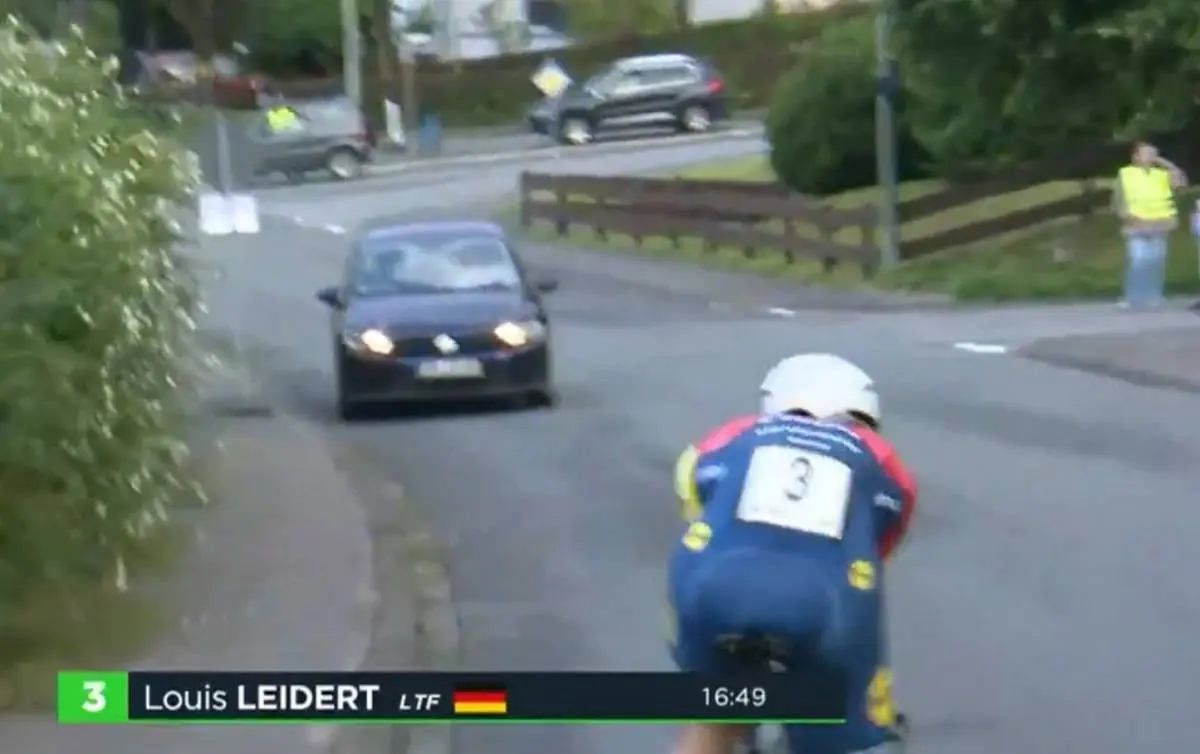
Safety is back at the heart of the debate in cycling after a new incident involving a non-race vehicle at the Sauerlandrundfahrt. Just weeks after the tragic death of Finlay Tarling at the Volta a Portugal, caused by a car entering the course, a similar situation again endangered a rider. This time, fortunately, the outcome was very different.
The rider involved was Louis Leidert, a 21-year-old from Lidl-Trek Future Racing, who encountered two vehicles on the route during the opening time trial of the new German race. The most dangerous moment came in the final stretch of the 13.7-kilometre chrono, when one car appeared unexpectedly after a corner, heading straight towards the rider.
Leidert had to react instantly to swerve around the vehicle and avoid a collision that could have had serious consequences. The relatively low speed of that section proved decisive, giving him the split second needed to anticipate and pass without crashing. Just moments later, he encountered another car turning left to join a narrow side road.
Although neither episode left the rider with physical consequences, the footage again highlights a recurring issue in cycling: course control and safety, especially in lower-ranked races. Vehicles entering an active race route pose one of the greatest risks to riders who often travel at over 50 km/h and have minimal time to react to any unexpected obstacle.
Less than a month since Tarling was struck
The context makes this incident even more concerning. It has been less than a month since the death of Finlay Tarling, which was directly linked to the presence of a vehicle on a race course. That tragedy reopened debate on safety protocols and access control at cycling events.
#SauerlandRundfahrt: A menos de un mes de la muerte de Finlay Tarling, seguimiento presenciando coches en circulación: ¡EN CARRERA! pic.twitter.com/N9oMMloamt
— Javier Ramírez (@javier_rampe) September 4, 2026
At the Sauerlandrundfahrt, the incident occurred in a time trial of just 13.7 kilometres, a format that in theory allows tighter course control given the shorter route and riders racing individually. The fact that two vehicles could enter the course under those conditions heightens concern ahead of the race’s remaining three stages.
Leidert’s episode ended without harm, but it leaves a clear warning: in cycling, a lapse of only a few seconds can be the difference between a scare and a tragedy.
Javier RampeCycling Journalist
Javier Rampe is a sports analyst with more than 15 years of experience. He holds a degree in Economics from the University of Rome and a Diploma in Business Studies from the University of Cádiz. Despite coming from an academic background not particularly associated with cycling, his passion for both cycling and journalism was instilled in him from an early age. He grew up following Miguel Indurain and José María “El Chava” Jiménez. An admirer of Michael Robinson’s communication style and journalistic approach, he was inspired to pursue a degree in Journalism at the University of Buenos Aires, which he is currently completing.
He has always maintained close ties with the worlds of sport and culture, contributing from a young age to sports blogs and film and music review websites. His work has appeared in media outlets such as Cope, RAI, and Radio Con Vos. He is also the founder of the cycling-focused podcast El Contraanálisis and the football interview channel Días De Fútbol, dedicated to conversations with professional footballers.
In addition to his work at Ciclismoaldia, Javier has interviewed some of the most influential figures in modern cycling, including Alejandro Valverde and Tadej Pogačar, as well as key voices in anti-doping policy such as Alberto Yelmo, David Varillas, and Marcelo Milano. Marcos Maynar, in relation to the ‘Operación Ílex’ case, is also among the personalities he has interviewed. He enjoys conducting in-depth analysis of the cycling ecosystem and has attended major events such as Strade Bianche, the Vuelta a Andalucía, and Itzulia, as well as numerous national cyclo-cross races.
His background in economics, combined with extensive experience in marketing and corporate communications, drives his continuous study of positioning strategies and ensures that he always keeps his focus on crafting compelling and evocative headlines.
claps 4visitors 4
Just in


Popular news
Latest comments
- I see I missed a lot during my boycott.Jumpyjohn05-11-2026
- What kind of sauce is on that rice? Ketchup?Kbd05-11-2026
- 18 broken bones. 78 crashes, among 30 rider per year is a lot. so for a rider over 15 seasons, they will break their bones 7-8 times and crash 38 times.abstractengineer04-11-2026
- i dont think he is ready ot win against the top 2 or the 2nd rung of evenepoel, del toro , Almeida. In the third week in the TDF he was very very defensive, no attacks. i think he was exhausted. right now he needs time not the brutal Giro or the intense TDF.abstractengineer04-11-2026
- Rota is an excellent rider to get in a break with because he always does his turnchapmanesque04-11-2026
- That 3000 extra that the Tour de France is built up in the flat stages
 Rafionain-Glas04-11-2026
- maybe this is something else they can protest in the streets of France.mij04-11-2026
- his Roubaix win was amazing. not to take anything away from him - arguably one of MVDP's wins was at the expense of a WVA flat - but so many things need to line up to get one of these. He had a perfect race with fewer bike issues on an attritional course. And crazy strong as usual. Glad he got this done.mij04-11-2026
- Orts was a super smart signing with the new rules regarding cross and UCI pointsmij04-11-2026
- Podcast sounds great. Two so called experts stating the f*cking obvious.wrsty04-11-2026
Loading
10 Comments