"That's just not how the human body works" - American rider Keegan Swirbul denounces omnipresent doping in Portuguese cycling
Cycling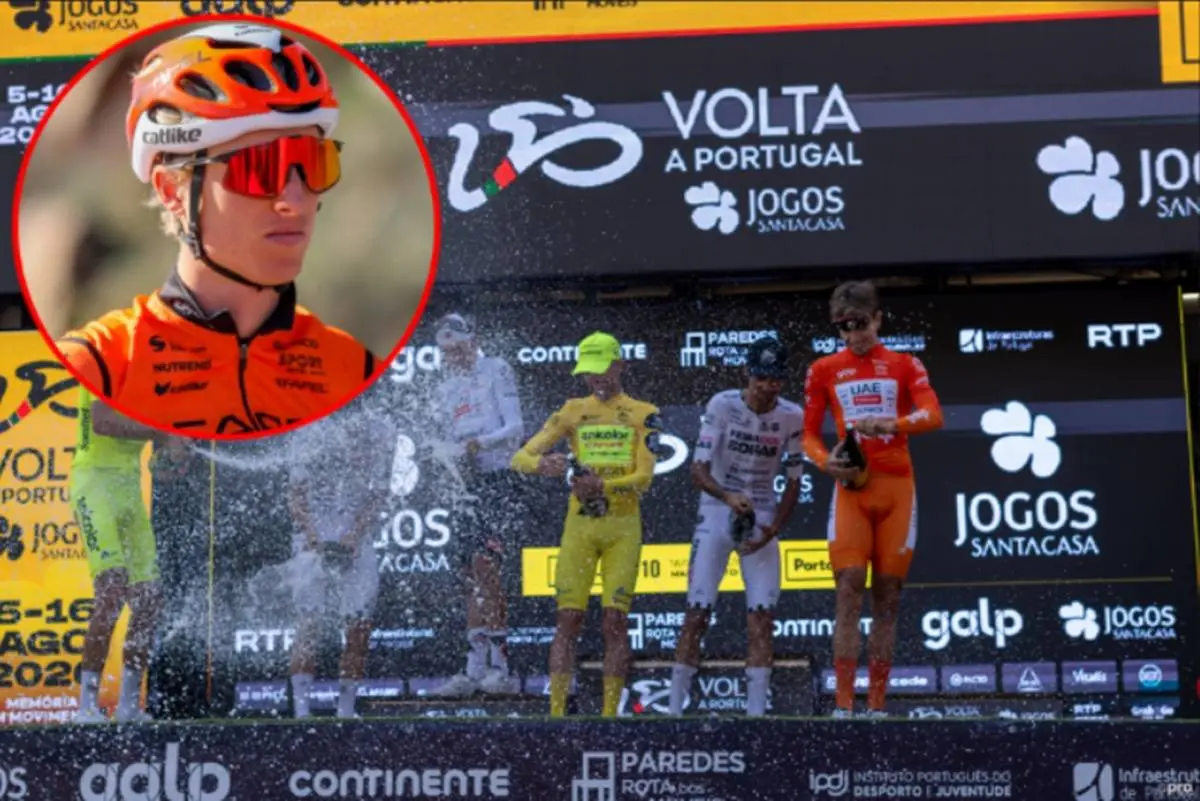
Doping is one of pro cycling's most controversial topics. Often, pro riders hesitate to approach the topic publicly, fearing repercussions. CyclingUpToDate has talked to Keegan Swirbul, an American rider who's spent several years in the Portuguese peloton, and has openly spoken about some of his rivals and the widespread doping abuse that has surrounded him.
Swirbul, 30, has just completed the final road race of his career: the GP Douro Internacional. Born in Basalt, Colorado; he is one of the few American riders who found their way into the Portuguese peloton. After several years in the American Continental scene, he found himself racing for Rally Cycling - which would later change names towards to Human Powered Health.
From 2020 to 2022, every year he took part in the Volta a Portugal. The 'Grandíssima', as popularly known in the small Iberic nation, is host to some of the most ferocious competition in professional cycling. Formerly known locally as the 'fourth Grand Tour', the race featured 18 stages in its very first edition all the way back in 1927. The event has maintained a high status throughout many decades, although this century, the race has been reduced to 11 stages.
In Portugal there is a thriving continental scene, with 10 professional teams - only topped, in Europe, by Italy and France, arguably the two countries with the most tradition in Grand Tour racing. These ten teams compete in a calendar that is largely of lower-level UCI and non-UCI events, which has created its own sub-culture in the sport. For Portuguese cycling aficionados, the Volta a Portugal is compared to the Tour de France.
Although it's half the length, the race features daily TV broadcasting, a large amount of home teams with their own separate goals and ambitions; and unmatched in coverage that turns this race into the ultimate goal for the 'national' teams - well above races such as even the Volta ao Algarve and Figueira Champions Classic, who host a set of World Tour teams and international stars on a yearly basis.
In 2023, after his departure from Human Powered Health, Swirbul briefly joined the Spanish Vigo - Rias Baixas team. Looking to remain a professional, he joined Efapel Cycling in April of that year. He has spent the final three and a half seasons of his career in the Portuguese team, which he represented all the way until this past Sunday on the road.
"It's crazy that I had this chance, to be one of the few people that has raced [here]. I got to learn the culture, I got to more or less learn the language. I've got a bunch of friends now in Portugal that are going to be there forever. It's super cool, not many Americans are going to have that chance that's for sure," he said in conversation with CyclingUpToDate.
The conversation would turn out to be one of the sincere accounts from an active professional cyclist in recent years.
'The video'
But why Keegan Swirbul? There are approximately 3500 professional male road racers in the 2026 season. The answer is a Youtube video posted on the 29th of August termed 'THERE IS DOPING IN PRO CYCLING'. The title in itself is enough to persuade fans of the sport into watching, but above all it comes from a reputable source. Since 2014, Swirbul has been a professional rider, and races in a country that has grown a negative reputation over the doping cases that have cast a dark cloud over the country for decades now.
In 2009 Nuno Ribeiro was stripped of his victory at the Volta a Portugal. The same faith followed in 2017 and 2018 as Raúl Alarcon was stripped of his two titles. Amaro Antunes was awarded the victory after Alarcón's suspension in 2017, but he himself was later also stripped of that very same title - as well as the 2021 victory - due to another doping ban.
Several titles over the past decade remain awarded to riders who have been suspended later on. That is the case with Ricardo Mestre, Rui Vinhas and João Rodrigues - whilst Jóni Brandão, having been awarded one title after Alarcón's suspension, was also stripped of it.
All the riders above had one thing in common: They were part of the W52 - FC Porto team. Led by former convicted doper Nuno Ribeiro, the team was part of a widespread doping scheme that saw 11 out of its 12 riders - with the exception of Guilherme Mota - be part of the 'Prova Limpa' operation. Jorge Magalhães was part of it, but not punished, having retired at that time.
The bans ranged from three to ten years, most of them due to the possession of forbidden substances in a the process known as 'Prova Limpa'. Amongst those who received suspensions were former World Tour riders Amaro Antunes and José Gonçalves.
Team manager and CEO, Nuno Ribeiro and Adriano Quintanilha respectively, were both found guilty and sentenced over charges of traffic of prohibited substances and [doping] methods. A doping scandal comparable only to the Festina raid at the 1998 Tour de France.

The podium of the 2026 Volta a Portugal
But the widespread doping convictions were not restricted to the now disbanded team, which saw its end in July of 2022. Frederico Figueiredo, Domingos Gonçalves, Rinaldo Nocentini, Edgar Pinto, João Benta, Daniel Silva, Rafael Silva, Venceslau Fernandes and António Carvalho are just some of the other riders who were suspended throughout the past years in the Portuguese peloton, razing its depth - and credibility - to the ground.
CyclingUpToDate can confirm that despite not having been suspended, former winner Maurício Moreira was also notified of biological passport abnormalities in 2024.
Swirbul moved into the peloton in the year following the W52 - FC Porto scandal. He believes that at first, the peloton he faced appeared more credible: "I'll be honest. So there were a few years where I would say last year (2025, ed.) and the year before in 2024, I didn't quite feel the same. It's not that they're going faster because I know that in sport in general, like the race is getting faster. The times are getting faster, it's just the natural progression of sports".
In 2026, this has changed. "I will say something changed this year, a little bit for me as a rider in the peloton. It just felt like there were more people that were kind of triggering this like spider sense in my brain. They rode really well in these big races after kind of not really doing anything the whole year, which is the classic thing that I always am suspicious about really".
Swirbul raced the Volta a Portugal and believed he would end his career in Porto. He did, but not on that day. "Yeah to be honest, before that race, I felt physically really poorly. Like very, very poorly. The last 10 days I felt very just terrible, honestly. So I kind of told my team and the boss like: 'Guys, don't count on me for this race. I feel terrible'."
But ultimately, he was selected to race the GP Douro Internacional, and won the race. The day prior to achieving his biggest win in the Portuguese peloton, he uploaded 'the video'. He did so actually in the minutes leading up to the very start of the stage. "Totally a coincidence [...] I just ended up uploading it literally five minutes before I left the bus to go and do the race," he revealed.
"On the first stage, no one was aware. It's funny, I always get quite a few riders to come up to me and be like: 'Hey dude, I watch your videos' and stuff like that. And I told a few guys when we were in the neutral zone like: 'I just uploaded a new one, like you're going to like it'."
Swirbul's unusual final day as a professional road rider
After winning Saturday's stage, Swirbul began the final day in the yellow jersey. The American was left, right and center in the peloton on that day, but not only because of his achievement.
"The second stage, when I was in the yellow jersey, a lot of riders had seen the video and I'm pretty sure even one of the riders that I mentioned... I mean, his name is José Neves, for sure seen it because he was like just attacking me (figuratively, ed.).
In the video, Swirbul talked openly about António Carvalho - whom he described as literally 'looking like a cadaver' and 'so sickly terrifying'; Frederico Figueiredo - whom he stated had been notified a year before his suspension and continued to race and win; and José Neves.
Swirbul also displayed a graphic comparing W/Kg estimates which gained traction on social media, often displaying performances that are highly comparable between the riders at the Volta a Portugal and the Tour de France.
Neves was one of the riders who was suspended in the W52 - FC Porto scandal, and the only one who returned to the peloton since, in 2025. This year, he battled for the Grandíssima's podium, ultimately finishing fourth only seconds behind the best Portuguese rider in the overall classification, Pedro Silva.
Neves' suspension was due to possession of human growth hormone, although he did not test positive for it. Neves was also only racing the Volta a Portugal for the second time in his career, despite having turned pro in 2018 - and it was not for a Portuguese team, but with Spanish Burgos - BH team back in 2020. At age 30, the GI Group Holding - Simoldes UDO rider was in the battle for the podium and finished second to Alexis Guerin on the final mountain stage to Senhora da Graça.
The duo have had contact following Swirbul's controversial assessment of his rival. "... He did actually send me a message after the race. I understand that he's mad and he was kind of saying like: 'do you have any proof?' And I was like: 'what do you mean proof?' Like, you were banned, that's all I said in the video [...] We don't know if he was doing drugs or not, but like he was banned for four years (correction: three years, ed.) and that's a fact. So that's what I said in the video, he can't get mad with that honestly".

Alexis Guerin won the final mountain stage of the Volta a Portugal atop the mythical Senhora da Graça climb. Behind him, José Neves
Portugal's image of doping?
During the Volta a Portugal itself, Neves' team manager in the Portuguese 'Oliveirense' team Manuel Correia defended his rider when asked about the matter: "I don't want to get into that, but he has never tested positive in a drug test in his life. That's not the point; sometimes unfair things happen in our lives," he said in an interview with Rádio Renascença.
Swirbul doubts the credibility in Neves' performance - whom he stressed multiple times is a talented rider, aside from all else. "I mean, even Pogacar, if he sits out for four years he's not going to come back and start smashing people right away".
"And I'm not saying that Neves was either, it's just the doubt that we have. And then kind of what I was saying in the video a bit, like, it's just not a good, it's not a good image for the sport in Portugal. Like it's already been so damaged by these doping scandals and it's just a little comedy, honestly," the American argued.
"Like how can a director want to just hire... you don't put as your security guard a guy that's coming out of jail for robbing stores, you know? You don't put that type of person as your head of security [...] If you're trying to improve the image of cycling in Portugal, which to me means that they don't really care about the image of cycling in Portugal, which is sad".
How can one prove innocence?
Does Swirbul himself doubt the riders that have raced in the same peloton as him? "Yeah, I do. But they're just suspicions and I can't really say names. Because you know, I'm sure this is the reality, there are definitely going to be people that are suspicious of me. There's going to be riders that think: 'Oh my God, this freaking American comes up and all of a sudden he wins, like there aren't many people that have won one of these races that aren't these Portuguese guys'."
A point that would have to come across is how would Swirbul himself, the winner of the most recent Portuguese stage-race, assure his own innocence in a field that is ravaged by the use of prohibited substances?
"I mean, there's no way to prove it. I could be doping too. I mean, anyone can and that's the reality of cycling and any sport," he responded frankly, before making a clear argument on what makes a riders' overall performance more credible. "My level - I say my level, and I also see the same with my own teammates at Efapel Cycling - is very consistent throughout the entire year".
"You should really be quite consistent throughout the year. And I see that with myself, I definitely had some health problems earlier this season. You know, I had to take a couple of two, three weeks off the bike in the middle of the season. But still I'm like within two or 3% of my top level at all times, and the same with my teammates".
He does not see the same trend within some of the riders who take part in the Portuguese racing scene. "It's like, we're always very similar. And then you see these, some of these guys that are doing these swings that just to me that, that's just not how the human body works". Swirbul, a professional coach currently - a position that he will maintain following his retirement from road cycling - staunchly argues.
"And I'm someone that knows physiology, how to train properly quite well. Like, that's something that I study and I pride myself in knowing a lot about that. And that's just not how the human body works. You don't just suddenly gain 10% of your physical level over the course of a month, and there's too many guys that I see doing that in Portugal. And that's why I feel like they're up to something".
Swirbul, speaking from his home in the northeast of Catalunya - a world-renowned cycling hub - revealed that one of the athletes he coaches has, coincidentally, been involved in a shocking situation in the exact same morning in which the interview took place.
"Literally I just found this out this morning... I have a guy that I work with as his coach and he has raced in the Spanish amateur scene. To be honest, he's like not even a very high level rider at this point, but he did race there for many years and he told me this morning that he was offered EPO from some of the teams on the Spanish amateur scene. And to me, that's just shocking".
Swirbul mentioned EPO micro-dosing in his video, as something which is commonly used in the Portuguese peloton. The worries that this method, only detectable for a few hours, is the reason why riders such as Tadej Pogacar and Jonas Vingegaard were tested halfway through the night at the Tour de France, outside of the regularly legal time period in which doping authorities can test riders.
"From what I've heard, it's quite an innocuous way to dope and it's quite easy to do without many worries of your health," he believes. "And I think it would be probably, if you wanted to go and search for it, I bet you could find a way to get it, honestly. There's got to be people doing that, honestly, not just in Portugal, obviously - all over the place".

Volta a Portugal peloton during this year's final stage, in the city of Porto
Former Contador domestique André Cardoso under fire
Swirbul has raced the final years of his career with Efapel, currently managed by José Azevedo. Azevedo was, from 2004 and 2006, part of the US Postal Service team. The 52-year old manager has never been convicted for the use or possession of forbidden substances, but speculation has surrounded his career mostly due to the 2004 Tour de France, where he was fifth in the overall classification as the right-hand man of Lance Armstrong.
"I don't think my boss, José Azevedo would be mad that I say this, but he is kind of the only one within this Portugal cycling scene that actually wants to change the game," Swirbul argues. In 2025, Azevedo had an explosive interview with A Bola in which he called for the '100% rigor' use of the biological passport in the Portuguese peloton, and has argued the team would follow a more international program.
But like Nuno Ribeiro in the W52 - FC Porto team, Swirbul criticizes the repeated hiring of previously convicted riders. A new name has been called out:
"I have no fear to say this: It's André Cardoso. Like this guy was an EPO positive, massive EPO positive, and he is the boss of Boavista. And like, if you're a brand wanting to have a good image as sponsoring a cycling team, why in the world would you ever want to have someone that is literally..."
André Cardoso was one of the Portuguese peloton's success stories, having spent the first years of his career in the continental scene, before moving up the ranks and into the World Tour in 2014. In 2017, he joined Alberto Contador at Trek - Segafredo and was a domestique for 'El Pistolero' in several races, before an abrupt end to his racing schedule in June at the Criterium du Dauphiné. In November 2018, a four-year ban for the use of EPO was made official by the UCI. Cardoso returned to racing in the Portuguese peloton in 2021, before hanging up his wheels in 2023 and taking up a leading role at the Feira dos Sofás - Boavista team, where he remains until today.
"Like I say with José Neves we don't know if that guy actually doped, they never found anything in his blood. It very well could be that he actually did nothing. To be honest, I would actually probably say he did nothing, but he was on that team (W52, ed.). So he was sanctioned. André Cardoso is like, they caught this guy with his hands in the fucking fire".
"And he's the boss of one of these teams of whom I personally have, you know, a couple of riders on that team that I definitely have some doubts about for sure, very much so. And I'm not afraid to say that - I'm never going back to Portugal again in my life (to race, ed.)".

André Cardoso racing the 2017 Criterium du Dauphiné, his final race before a four-year doping ban
Swirbul believes that within the Portuguese teams, there is a lack of general understanding on how the sport is seen internationally. "That to me is just a terrible image for the sport from the outside. And maybe if you're a team in Portugal, you don't really understand how Portuguese cycling is viewed from outside of Portugal. I do".
"I know what people think of cycling in Portugal and that it's that literally everyone is doping there. Even me, they think that it's inevitable. And so first step would be to really consider who you're hiring, who you're getting in the game".
"We don't need these guys with a past with doping running teams, racing for teams... That's just a no brainer to me, but maybe they see it in a different way [...] That would be the first step for me, honestly, getting some of those guys out".
In the end, the American agrees with the fact that the country's reputation ultimately continues to harm its own upcoming generations, who are often unable to be signed by teams outside of the Portuguese scene due to the lack of credibility.
"That's the thing that's the saddest for me, these young guys that I see. And there are many, I could name you ten guys there that I'm like: 'Wow, this guy, he's a talent. He's clean, he's talented, he should absolutely have a chance to race big races outside of Portugal'. And he's just never going to get a chance ever because of that..."
Rúben SilvaEditor-in-Chief
A founding contributor to CyclingUpToDate since its launch in January 2022, Ruben Silva has played a central role in shaping the site’s editorial direction and long-term growth. Before joining the project, he built his experience through independent blogging at Echelons Hub and by producing race previews for Ciclismo Internacional, developing a strong analytical voice rooted in daily engagement with professional cycling.
Beyond editorial work, he has been closely involved in the expansion and coordination of CyclingUpToDate’s wider network, helping establish and support sister platforms across multiple languages. This includes ongoing collaboration with CiclismoAlDia (Spanish), CiclismoAtual (Portuguese), WielrennenUpToDate (Dutch), and RadsportAktuell (German), contributing to a shared editorial vision and consistent international coverage.
He also helps oversee editorial governance across the network, setting standards for accuracy and consistency and coordinating updates or corrections when needed.
Originally from the Porto metropolitan area in Portugal, he holds a bachelor’s degree in Geography. His path into cycling journalism was shaped not through formal media training, but through independent reporting, community engagement, and sustained on-the-ground involvement in the sport.
Over the course of his career, he has conducted approximately 100 interviews across road cycling and cyclocross, ranging from one-to-one conversations and online formats to press conferences and on-site pre- and post-race coverage. His interviews include leading riders, team managers, and prominent figures within cycling media: Tadej Pogacar, Jonas Vingegaard, Mathieu van der Poel, Primoz Roglic, Wout van Aert, Joao Almeida and Tom Pidcock; managers like Patrick Lefevere and Joxean Matxin; and YouTube personality Bryan Kennedy (BKXC)...
Within 18 months of launch, he helped grow CyclingUpToDate’s English-language platform into one of the most-read cycling news websites, built entirely from the ground up. As both a professional journalist and lifelong cycling enthusiast, his focus remains on delivering accurate, timely, and well-contextualized coverage.
claps 8visitors 8
Just in
Popular news
Latest comments
- Could we give Seixas time to be Seixas and not make comparisons too soon? Maybe it’s my age speaking, but he’s a mere 20, barely started. Sure, a phenom, but so young. Will he win 8 Monuments like van der Poel so far, will he win 4 grand tours like Vingegaard? Those have been the two seconds to Pogačar’s first, since covid. Yes, there’s an eventual changing of the guard, but Seixas will need time to build the palmares to make his case. Might we please give him that time (while we enjoy the hell out of his riding)?RidesHills15-10-2026
- You've been dropped multiuple times from this site LOL !frieders315-10-2026
- 'Seixas will never each Pogi's level?' WTF...you have a crystal ball or you just blowing more smoke here !frieders315-10-2026
- lol great point, but the riders have to do something. I know these are open roads, lots of cars, but these is not good for the riders of course.mij15-10-2026
- its kind of hard to believe that standing at the starting line in protest, at a race that didn't have a saftey issue, hasn't fixed the problem......jad2914-10-2026
- Comparing young riders to greats leaves them open for failure and disappointment. At one time, Moscon was compared to Boonen by his team and it turned out nothing like that. Currently its a very crowded space especially with Pogi wining everything.abstractengineer14-10-2026
- This is crazymij14-10-2026
- This is crazymij14-10-2026
- This is crazymij14-10-2026
- problem is they are not stacked at all with most of their stars declining. Behind jonas they basically have zero climbers of top tier quality its insanely bad.miguel14-10-2026
Loading
Write a comment