“It all started with a wrong decision by Jasper Philipsen... Tadej Pogacar's comments were unfair” - Paris-Roubaix specialist offers unique insight into chaos of 2026
Cycling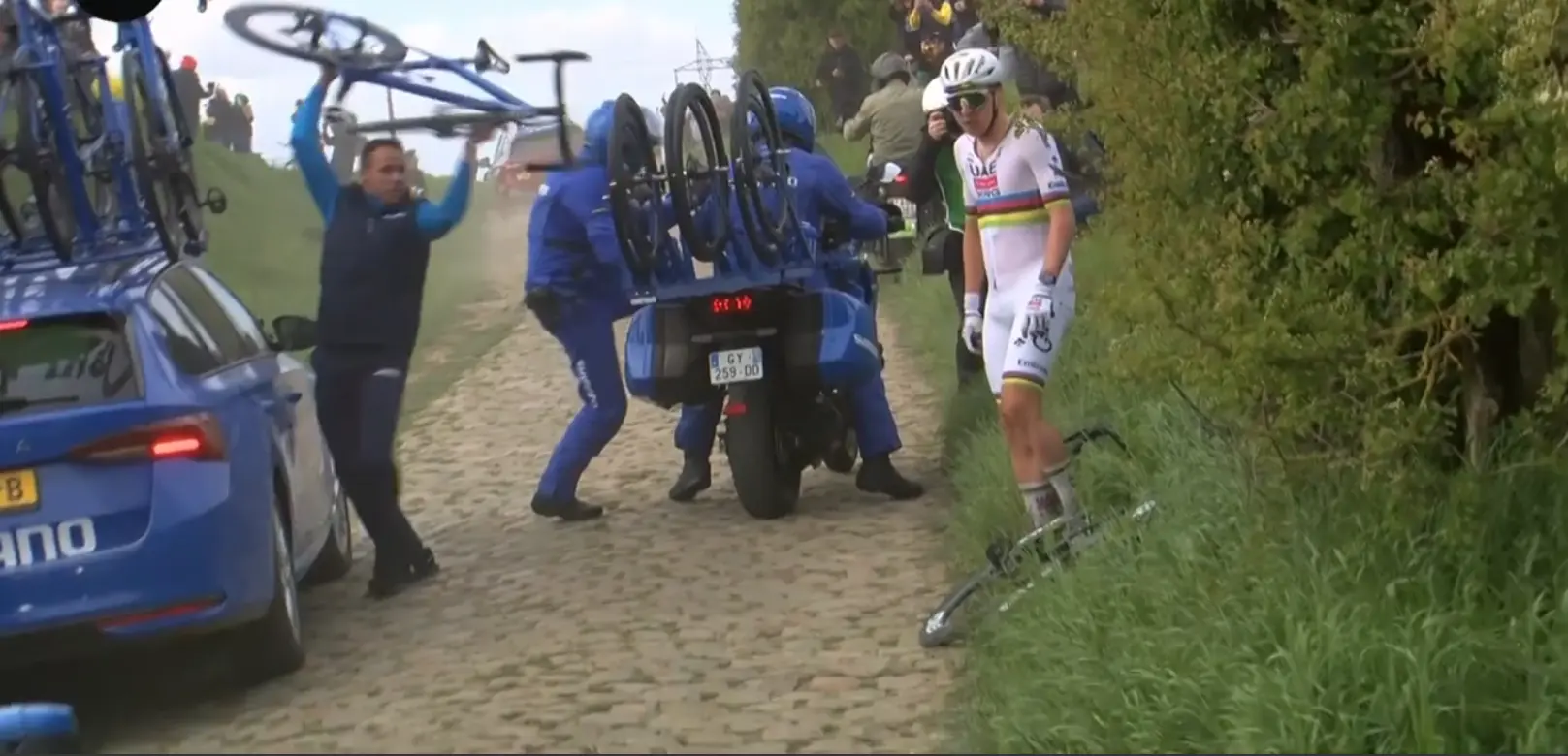
The 2026 edition of Paris-Roubaix delivered one of the most chaotic and unpredictable races in recent memory, with repeated mechanical issues affecting every major contender.
From Tadej Pogacar’s triple puncture to repeated problems for Wout van Aert and Mathieu van der Poel, the race was shaped as much by equipment and decision-making as by legs. For Alan Marangoni, a six-time Roubaix rider and former Classics domestique, the defining moment came inside the Forest of Arenberg.
Confusion inside Arenberg
Van der Poel’s double puncture in quick succession triggered one of the most talked-about sequences of the race, as confusion over a bike change cost significant time. “In my opinion, it all started with a wrong decision by Jasper Philipsen, which then created confusion,” Marangoni explained to Bici.Pro. “He didn’t think it through. He immediately wanted to give his bike to Van der Poel without considering that he is shorter, so the bike is smaller and especially that he had different pedals. That’s where the disaster came from.”
In practical terms, the solution could have been far simpler. “When it would have been enough to give him the wheel and they would have lost half the time,” he added, underlining how quickly a small decision became decisive.
Decision-making under pressure
For Marangoni, the issue was not just the mistake itself, but the lack of preparation for such scenarios. He felt that even Van der Poel “wasn’t completely clear-headed,” despite how it may have appeared from the outside.
“In those situations it’s not always easy to make the right decisions,” he said. “That’s why I think they should train this as well, managing unexpected situations, especially in a race like Roubaix.”
That perspective points to a wider gap in modern race preparation. “I don’t think they have meetings about this, which is strange if you think about how every other detail is studied,” Marangoni continued. “It would be enough to decide in advance what to do if something happens. Make a list of possible problems. For example, when it’s better to give the bike to the leader, when it’s better to wait for the team car, and when to just change the wheel.”

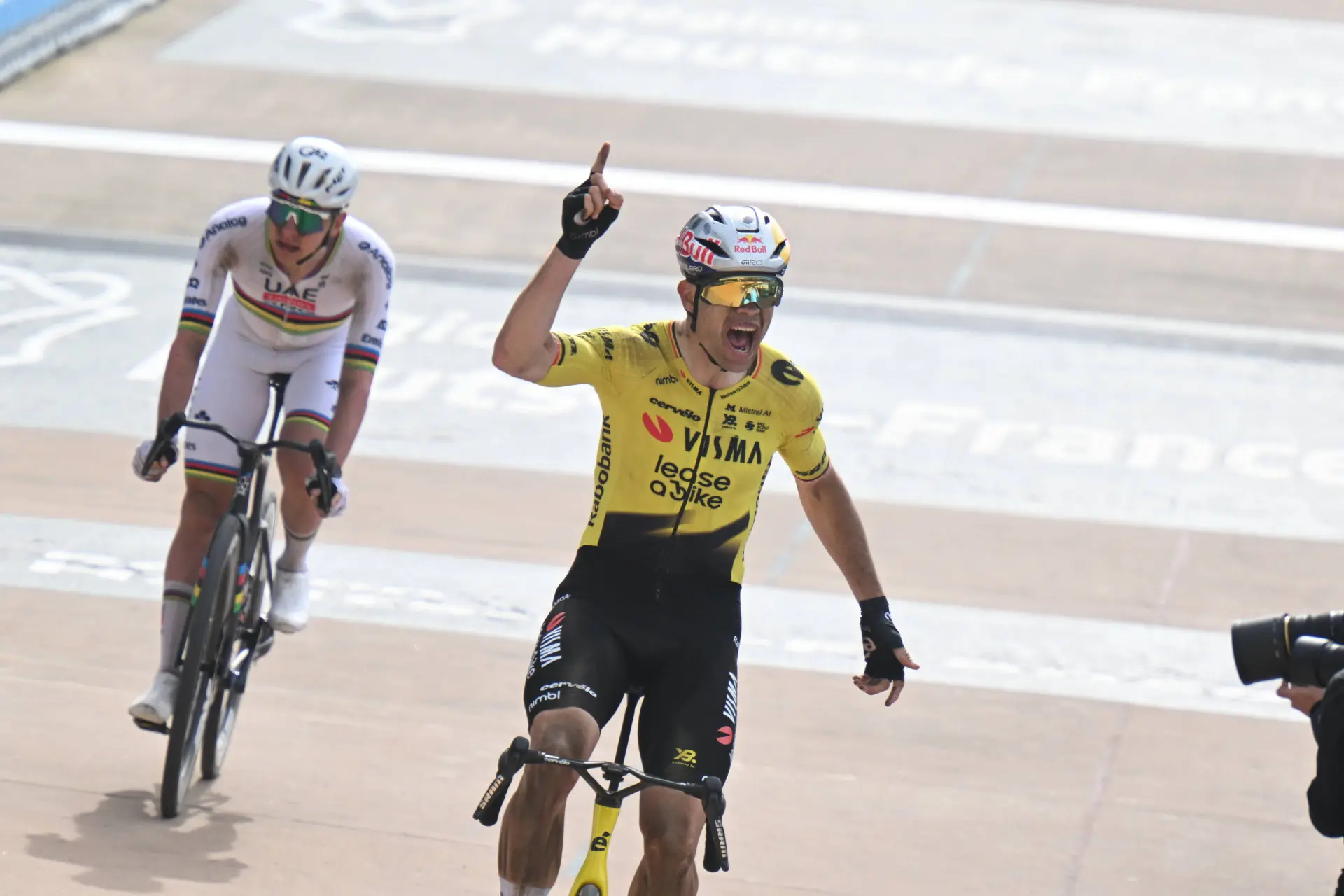
Tadej Pogacar eventually finished 2nd at Paris-Roubaix 2026
Bike vs wheel: a key mistake
The Arenberg incident also highlighted what Marangoni sees as a growing trend in the peloton. “Sometimes it seems like riders are so used to changing bikes for every problem that they don’t even consider that sometimes it’s better to just change the wheel,” he said.
That distinction, he argues, can be decisive. “Of course, maybe by changing the wheel you lose a few seconds immediately, but then you have your own bike,” Marangoni explained. “If instead you find yourself on a bike that isn’t yours and you have to ride it for 10 or 20 kilometres, you obviously can’t push in the same way.”
Pogacar and neutral service
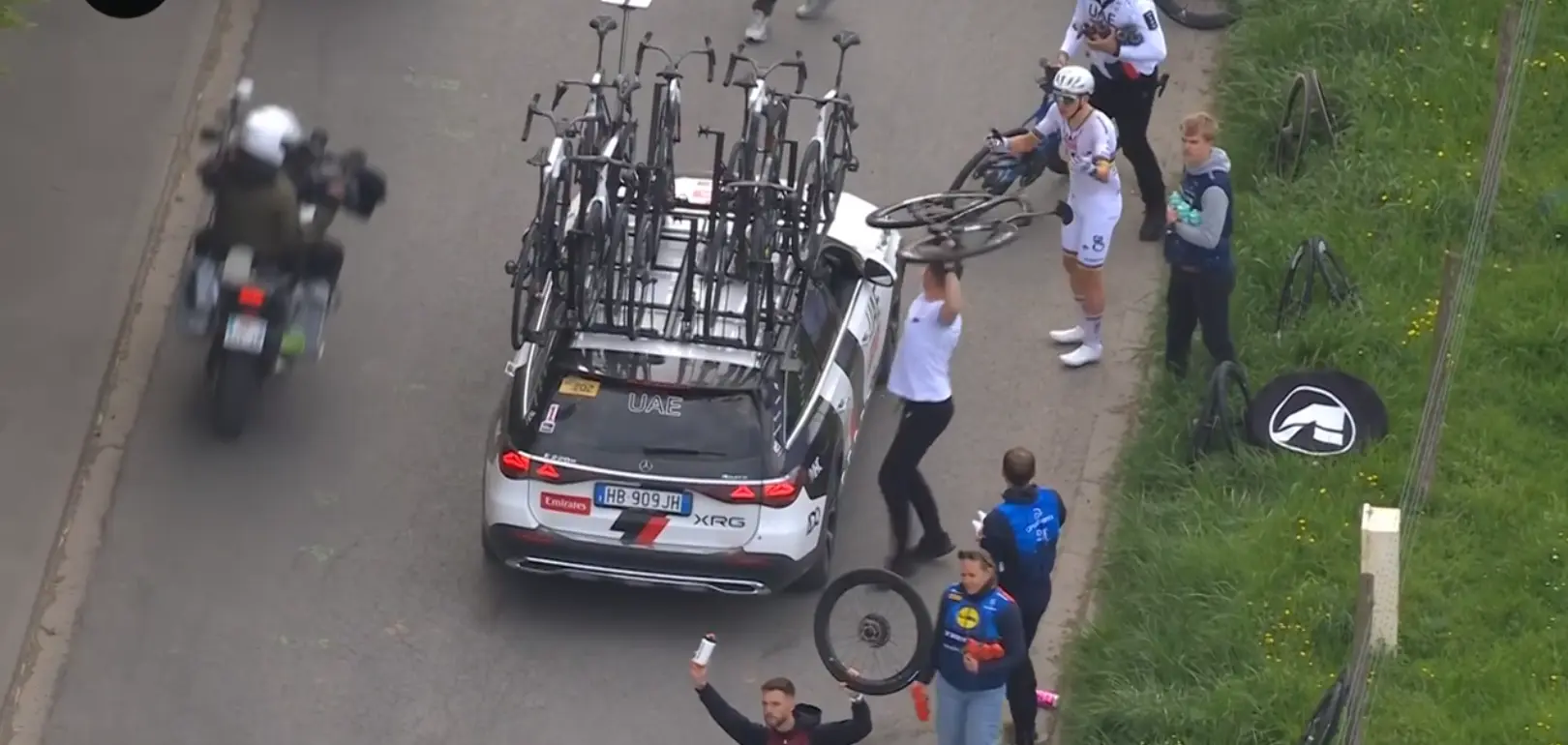
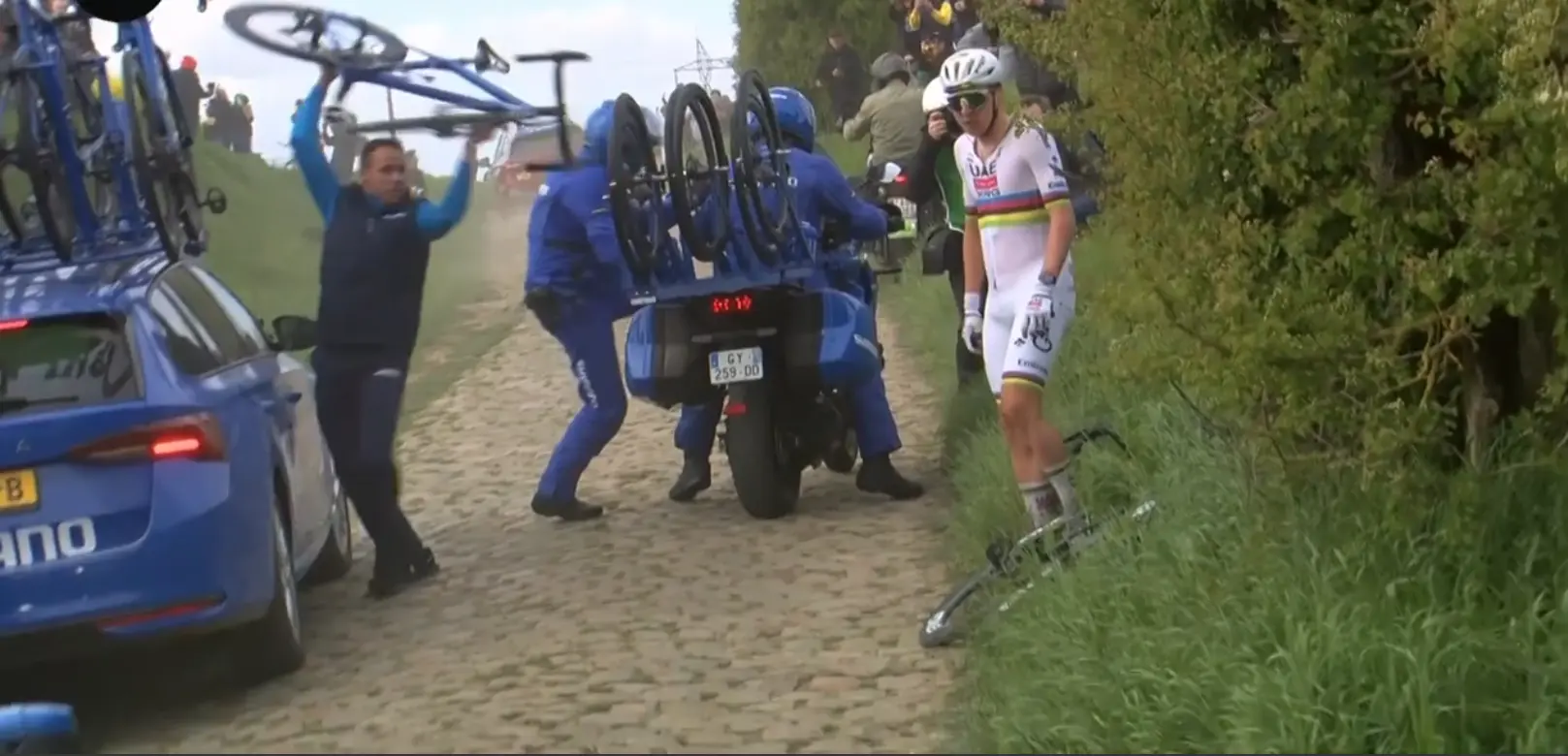
The Slovenian’s own misfortune added another layer to the race’s mechanical chaos, particularly his use of a neutral service bike. “I spoke to a Shimano mechanic and he told me they have five bikes with the measurements of the five favourites, plus a telescopic seatpost to deal with any situation,” Marangoni said.
“Maybe Pogacar didn’t know that or didn’t realise in the moment, but it would have only taken a second to adjust the saddle,” he continued. “From the images, it looked too high and he wasn’t pedalling well. So I think his comments were a bit unfair.”
Communication breakdowns
Marangoni also pointed to situational factors that compounded the problem. “In that moment he was at the back of the group and I think they simply didn’t see him.”
“Also, the radio didn’t have signal in that sector, so there were communication problems,” he added. “But that’s another thing you have to anticipate, because in that race anything can happen.”
Chaos as part of Roubaix
Ultimately, the 2026 edition reinforced the unpredictable nature of Paris-Roubaix, where preparation and instinct must constantly adapt to circumstances. “I would tell the riders that problems will happen, but they can almost always be managed with the help of teammates,” Marangoni said.
“Of course, if you break your bike in two you have to wait for the team car, but that doesn’t happen in every race,” he continued. “I would spend half an hour the day before, or the morning of the race, listing ten possible problems and ten quick solutions to handle them in the best way.”
In a race defined by chaos, those decisions can be the difference between staying in contention and watching it ride away.

Kieran WoodDeputy Editor-in-Chief
Kieran Wood is a sports journalist based in Wales and has been active in journalism since 2022. He regularly contributes to DartsNews.com and CyclingUpToDate.com, where he covers professional cycling and darts. In cycling, his work includes liveblogs from major races, including the Tour de France, the Giro d’Italia, and La Vuelta a España, alongside race reports and analysis. He has also conducted interviews with professional riders.
His reporting spans the full racing calendar, from one-day classics to stage races, with a focus on accurate, real-time coverage and clear contextual analysis. For statistics, results, and historical context, he regularly uses resources such as ProCyclingStats. To support reporting on rider activity and training context where relevant, he also references Strava.
In his work, Kieran places strong emphasis on careful sourcing, editorial accuracy, and updating articles as new, verified information becomes available.
claps 0visitors 0
Just in
Popular news
Latest comments
- Rather than me describing the technology at length on here, If you google. Line-scan cameras. They are also sometimes called Slit-Scan cameras. Either search will fill you in. You can read all about how they. work. Enjoy! Just to be clear the cyclist is saying he wants to see exactly where the digital finish line is in relation to the actual physical finish. At this point we only have the word of the authority that the digital line corresponds to the exact starting edge of the physical finish line. That seems like a reasonable request to me.Prorodsandstuff11-10-2026
- 100% @Jumpyjohn, good point well raised.anonymouscyclist11-10-2026
- The media keep stirring the soup.. or spitting in it
 leedorney11-10-2026
 - Yes, he has won many races... second class races. He isn't the real deal... Seixas is the real deal. Capish?PogiSloFans11-10-2026
- What are you talking about? I'm not the one you guys are spitting on. I'm a Slovenian Pogi fan, that's all... the guy you're talking about is a Croation Ustasha. Capish?PogiSloFans11-10-2026
- It would be epic if Seixas came to UAE. 3/4 of the commentators on this site would stop watching cycling... ha ha ha ha ha ha...PogiSloFans11-10-2026
- UAE's problem is Seixas wants to beat Tadej.Renz11-10-2026
- You are blinded by your infatuation with Pogi. IdT has done crazy good stuff. One of the strongest ever first three years in the peloton. poor showing in his last couple of races btu I don't think he is quite washed up yetmobk11-10-2026
- Absolutely not. The guy has finished so many races 2nd to Pogi so absolutely not a shocker that when Pogi isn't there he wins a fewmobk11-10-2026
- GOATmij11-10-2026
Loading
1 Comments