The 2025 is now just around the corner, 10 days away to be
precise. And now we can’t help but getting carried away, as we could have an
all time great Tour de France ahead. Will Jonas Vingegaard or Remco Evenepoel
be able to do anything about Tadej Pogacar? Who will be the king of the
sprinters? And is this the year we see Mathieu van der Poel at his very best in
July?
So much to talk about, and so little time to wait. Over the
next 10 days, we are going to talk about 10 of the best moments, rivalries, and
stories in Tour de France history. From Chris Froome on Mont Ventoux, to Greg
LeMond’s dramatic victory, and also Primoz Roglic’s heartbreak in 2020, there’s
so many moments to look back on that defy mere sporting stories.
Read also

The Tour de France goes beyond sport, it is one of the
biggest global events held annually. We won’t be able to cover every moment,
but you can let us know in the comments any of your personal favourites.
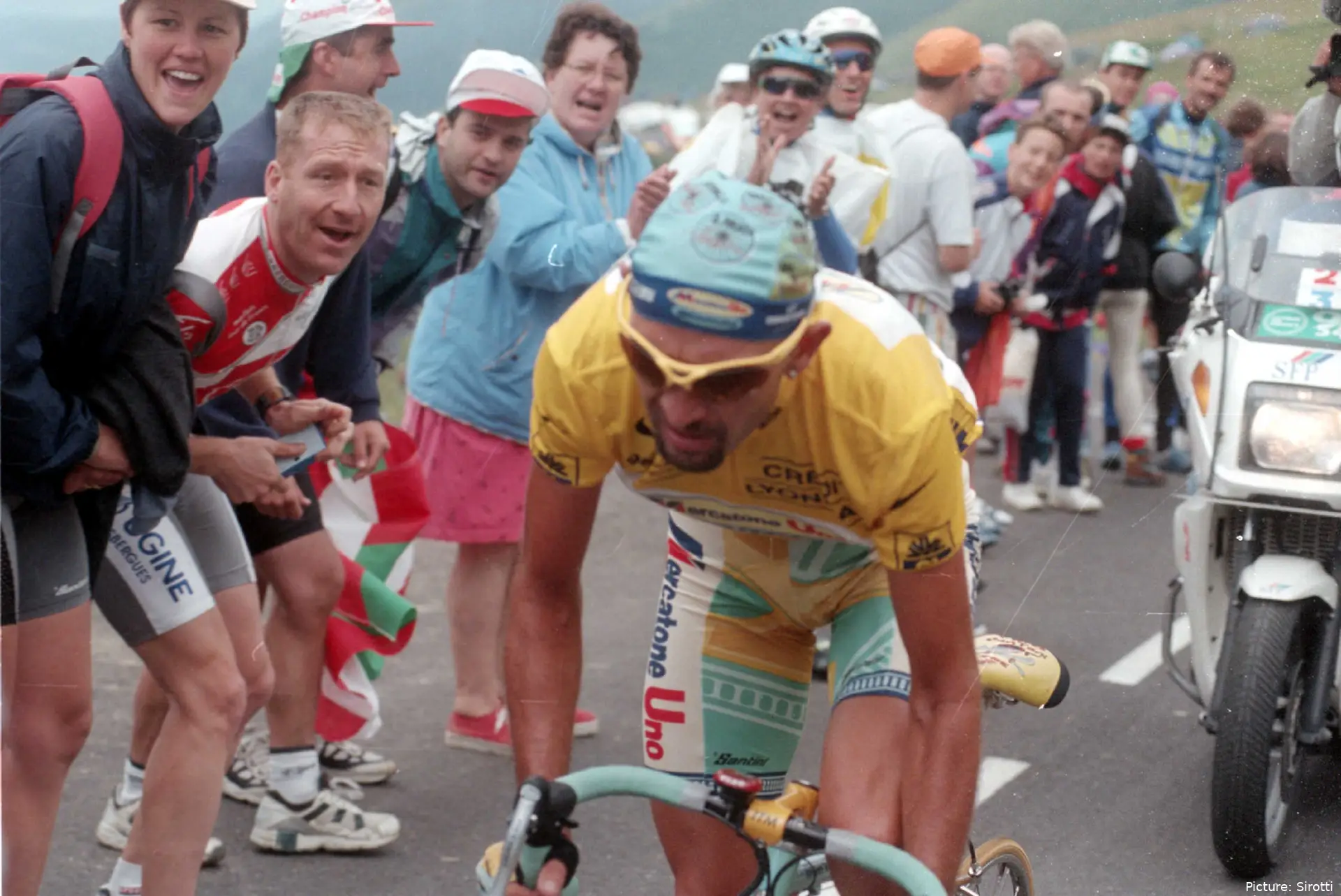
Today, we’re going to look at Marco Pantani’s record
breaking climb of Alpe d’Huez back in 1997, which remains arguably the greatest
climbing performance in cycling history. The diminutive Italian climber, known
as “Il Pirata” (The Pirate), delivered a record shattering ascent that day, one
which would cement his legend still to this day. That ride is remembered with
equal parts awe and ambivalence, symbolising both Pantani’s genius and the
sport’s troubled 1990s.
1997 Tour de France Stage 13
It was Stage 13 of the 1997 Tour, deep in the Alps and deep
into the race, when Pantani chose to make his move. From the base of Alpe
d’Huez, he sprang from the pack with explosive acceleration, instantly
distancing the elite field. The fans lining the 21 hairpin bends witnessed a
masterclass in climbing as Pantani danced on the pedals, out of the saddle,
steadily increasing his lead with every switchback.

Jan Ullrich, the Tour’s young leader in the yellow jersey,
tried to respond but soon found himself at his limit, unable to reel Pantani
back. Richard Virenque of France, another renowned climber, also cracked in
Pantani’s wake, as did every other contender on that ascent. By the midpoint of
the climb, it was clear that Pantani was on a special ride, chasing not just a
stage win but cycling history.
Pantani reached the summit finish alone, securing a dominant
stage victory and stopping the clock at 37 minutes and 35 seconds for the
climb. That astonishing time set a new record for the Alpe d’Huez ascent, one
that still stands all these decades later. In terms of sheer speed, he had
flown up the 13.8 km mountain at an average of just over 23 km/h on gradients
averaging 8%, a feat that defied what many thought humanly possible on such a
brutal climb.
Pantani’s blistering ascent instantly entered cycling lore.
Not even Lance Armstrong, at the peak of his (ultimately tainted) Tour de
France reign, ever surpassed Pantani’s benchmark on Alpe d’Huez. That day,
Pantani made a compelling case for the title of cycling’s greatest climber,
combining tactical daring with an almost inhuman capacity to sustain speed on
steep grades.

Pantani's ascent of Alpe d'Huez remains the record
What makes Pantani’s victory on stage 13 even more
impressive was how good Jan Ullrich was that year. The young German won the
Tour by 9 minutes to Virenque, one of the biggest ever margins, and Pantani was
third over 14 minutes back. Clearly, Ullrich was in a league of his own, but on
Alpe d’Huez he had absolutely no answer for Pantani.
Triumph and tragedy
Pantani’s performance in 1997 did more than earn him a
prestigious stage win; it signaled the makings of a champion. After finishing
third overall in that Tour behind Ullrich and Virenque, Pantani returned in
1998 even stronger. In 1998 he achieved a historic Giro d’Italia and Tour de
France double, becoming the first Italian to win the Tour in decades and
solidifying his status as the sport’s dominant climber of the era.
It wasn’t until just last year, and a certain Tadej Pogacar,
that another man completed the Giro-Tour double. So, for over 25 years, Pantani
had achieved a feat the rest of the peloton could only dream of.
Pantani’s 1998 Tour victory, achieved in a race marred by
the infamous Festina doping scandal, elevated his mystique even further. He
conquered the mountain stages in dramatic fashion that year, including a
memorable solo attack in the freezing rain over multiple Alpine passes to seize
the yellow jersey. In those triumphs, Pantani seemed to confirm what his Alpe
d’Huez record had suggested: when the road went uphill, he was in a league of
his own.
That fact is emphasised more by the fact that in the
prologue of the 1998 Tour, Pantani lost over 4 minutes to Ullrich in an
individual time trial. He finished 181st out of 189 riders, but
still went on to win the yellow jersey, simply through his incredible climbing,
and he actually won the Tour by six minutes.
However, Pantani’s greatness was tragically intertwined with
cycling’s darkest chapters. In 1999, while leading the Giro d’Italia, Pantani
was expelled from the race after a test revealed an abnormally high hematocrit
level, a result widely seen as evidence of EPO use. It was a crushing blow
virtually overnight, the hero of the mountains was implicated in scandal, and
Pantani’s soaring career suddenly plummeted.

In the years that followed, Pantani struggled with injuries,
suspensions, and a deep depression, and he never returned to his winning ways.
The late ’90s and early 2000s brought a reckoning for the entire sport as
doping revelations emerged, and Pantani became one of that era’s most tragic
figures. He died on February 14th 2004 at just 34 years old, alone
in a hotel room, his life cut short by a cocaine overdose. a heartbreaking end
that underscored the toll of fame, pressure, and scandal on the fallen champion.
A complex legacy
The legacy of Pantani’s 1997 Alpe d’Huez ride is
double-edged, like much of cycling’s best moments from the 90s and early 2000s.
On one hand, there is enduring awe at an athletic achievement that borders on
the unbelievable, a mountain climb so fast and furious that it remains
unmatched in the Tour’s long history. On the other hand, there is the knowledge
that many extraordinary performances of that era were fuelled by rampant
doping, which forces fans and historians to view Pantani’s records, and in fact
any new records, with a measure of scepticism and sorrow.

Since the 1990s, cycling has changed significantly, stricter
anti-doping measures have led to slower, more human-scaled times on the big
climbs, and even the strongest modern riders cannot approach Pantani’s Alpe
d’Huez mark. Thibaut Pinot’s gritty stage win on the climb in 2015, for
instance, took over 41 minutes, and the duel between Tadej Pogacar and Jonas
Vingegaard in 2022 likewise fell well short of Pantani’s pace. In a sense, the
very fact that his record still stands is a reminder of how extraordinary (and
how tainted) the EPO-fueled era was, even as it immortalises Patani as one of
the most gifted climbers ever to grace the Tour.
For dedicated Tour enthusiasts, Marco Pantani’s day of
supremacy on Alpe d’Huez remains unforgettable. It encapsulates everything that
made fans revere Pantani: the fearless attacking spirit, the drama in the
mountains, and the almost poetic way he could destroy the best riders in the
world when the road tilted upward. At the same time, it stands as a cautionary
tale from a complicated period in cycling, ensuring that Pantani’s story, and
that 37-minute ascent into the clouds, will always be remembered with both
reverence and regret.

Fin MajorCycling Journalist
Fin Major is a UK-based writer at CyclingUpToDate and has been part of the team since 2024. He is the site’s main writer for FAQs and evergreen explainers and has written around 2,000 pieces for the platform. Alongside this work, he focuses on in-depth analysis and covers the biggest races on the calendar, including the Tour de France, the Giro d’Italia, and La Vuelta a España, providing clear context around performance trends, tactics, and key storylines.
In his reporting, Fin uses reputable data sources such as ProCyclingStats for results, statistics, and historical context. He places strong emphasis on careful sourcing, editorial accuracy, and updating articles promptly when new, verified information becomes available. Outside of writing, Fin is an active cyclist, which supports his practical understanding of the sport and its demands.
claps 0visitors 0
Just in

Popular news

Latest comments
- many people advise him to grow slowly and rather do giro and/or vuelta instead of tdf. but i can totally understand that he is not satisfied with taking over once pogi declines, but instead beat him in his prime. so if he goes for tdf again, i‘m all for it. let‘s hope that pogi recovers soon!Ketterechts07-11-2026
- So gracious to offer something no-one would be prepared to pay for. The Giro is not the Tour and doesn’t command the same interest or attract the same “elite” (those willing to pay to be a part of something they consider has ego boosting potential). Roadside viewing will always largely remain free for everyone outside circuits. Introduction of a symbolic entrance to mountain climbs is worthy of exploration. Asking 1-2€ isn’t going to repulse real fans (most will spend 50-100€ on their outing that day all things included) but will prevent a portion of the total knobhead thrillseekers who will join in any large gathering as long as it’s free, just because they’re attracted to crowds, without which it it difficult for them to work up their anti-social behaviour.Jumpyjohn07-11-2026
- How is radio going to help when someone went over a cliff or bridge or off the roadside into a forest unnoticed and is laying there unconscious?Jumpyjohn07-11-2026
- Yep, next we’ll be accusing F1 drivers of avoiding Le Mans.Jumpyjohn07-11-2026
- But on what is that opinion based? Are you holding him to a different standard than others? Are you saying he should do learn to like something he doesn’t Are you saying he hasn’t achieved enough Are you saying he pretends to be better than his results? It’s actually a really strange opinion to oust if you consider it objectively or rationally. Try applying it to others or yourself by asking if not EVERYONE should then be doing more? Nobody in athletics or swimming gets criticism for not expanding their repertoire when a rival or someone else does. In fact, most who move to another event get accused of running from their rival. Opinions are boring, the reasons behind them are what count.Jumpyjohn07-11-2026
- for a medical chief to throw things like is just bad. There are already radios which were banned for spectacle. allow radios. Gps trackers are not a complete solutionabstractengineer07-11-2026
- Yeah man...PogiSloFans07-11-2026
- any rider less than 25 whether they are really ready for the position of leadership of GT is probably not the case. I think Pogi himself suffered when he was defeated by Jonas in the TDF twice. But that would be the team's job to ensure support so that they can bounce back. It requires a team and time to get back up and win after getting knocked down.abstractengineer07-11-2026
- I'm very glad he got the big late Quickstep Vuelta win and I hope he has a few left for Euskaltel-Euskadi.flyer07-11-2026
- My memories of Ivan Basso aren't good but I liked his sister Elisa ok.flyer07-11-2026
Loading
4 Comments