“Trying to understand him is fascinating”: Groupama's director breaks down the numbers behind Pogacar's extraordinary performances
Cycling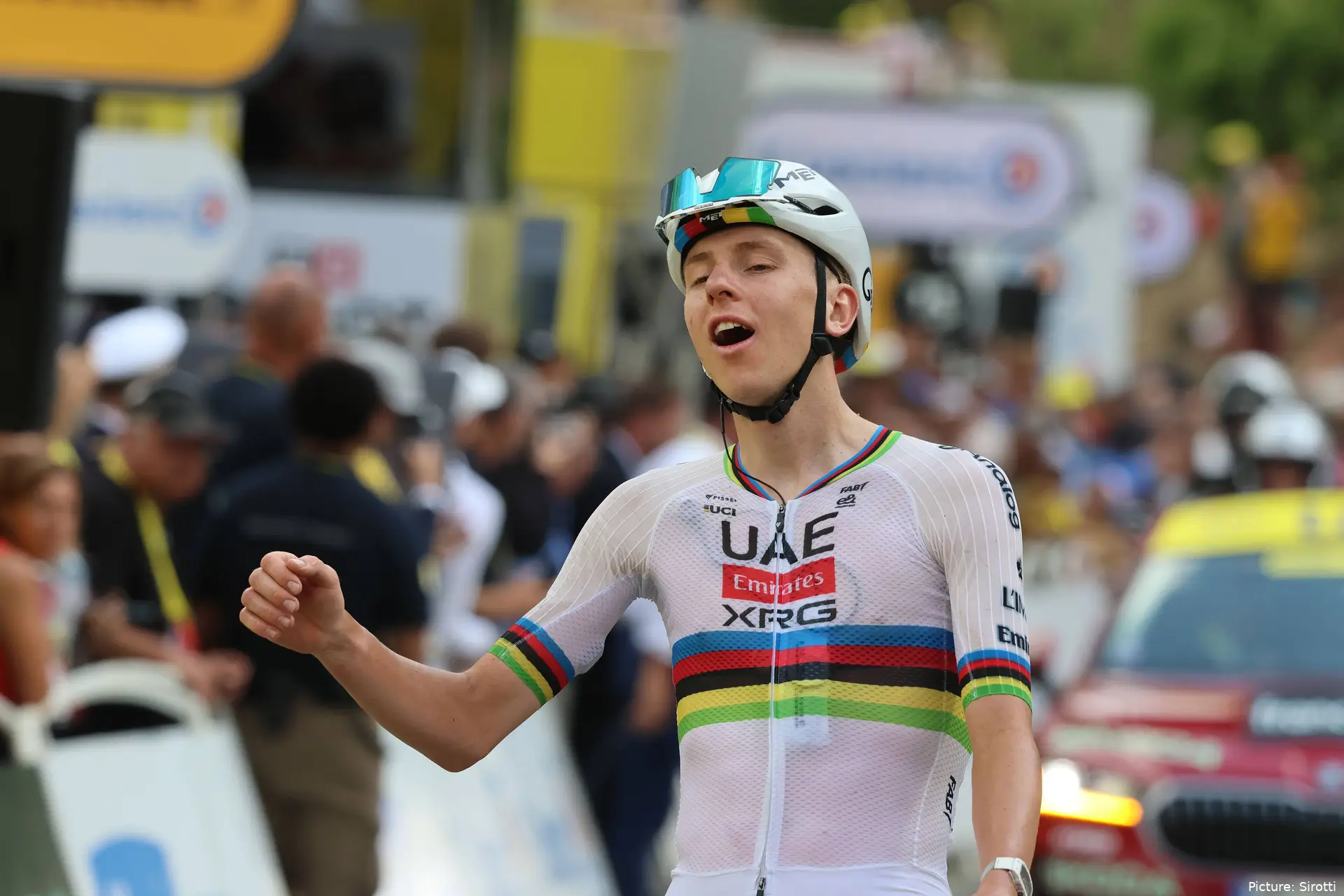
Tadej Pogacar's dominance has become a subject of fascination for sports scientists as well as cycling fans, with Fred Grappe among those attempting to understand what makes the Slovenian so effective. The performance director of Groupama - FDJ United has compiled a database of Pogacar's most significant climbing performances since 2019 and believes his combination of physical ability, efficiency and race intelligence sets him apart.
Speaking in Anatomy of a G.O.A.T., a documentary produced by Eurosport and HBO Max examining Pogacar's physiology, metabolism and recovery, Grappe described the UAE Team Emirates-XRG leader as a unique athlete.
“Understanding Tadej Pogacar is fascinating. We're dealing with a legend. He produces the best performances in almost all the races,” Grappe said.
The French scientist revealed that he had tracked 73 major climbing performances by Pogacar between the 2019 Vuelta a España and 2026. His analysis includes some of the Slovenian's most impressive displays in Grand Tours and one-day races, offering a statistical perspective on a career that has increasingly defied conventional expectations.
“I've made a list of Pogacar's key performances since the 2019 Vuelta. That's 73 climbs between 2019 and 2026. Trying to understand him is fascinating.”
Plateau de Beille performance illustrates Pogacar's climbing advantage
One of the performances Grappe examined in detail was Pogacar's victory on stage 15 of the 2024 Tour de France, which finished at Plateau de Beille. The Slovenian attacked Jonas Vingegaard and crossed the finish line 1 minute and 8 seconds ahead of his Danish rival.
His climbing time also surpassed Marco Pantani's benchmark from the 1998 Tour de France. Pantani had completed the ascent in 43 minutes and 28 seconds, while Pogacar was almost four minutes faster.
“If we consider Tadej's weight of 65kg, we get a power of around 460 watts. Vingegaard produces 444, Evenepoel 422, the tenth rider produces 380 watts. He's simply the best,” Grappe said.
The scientist also highlighted the improvements Pogacar made following his defeat to Vingegaard at the 2023 Tour. “When he rides, nothing moves. When I watch him ride, he stays in the saddle. Lots of other riders move, they don't stay in the saddle. He sticks firmly in the saddle. He's a pedalling machine.
“If he needs to open a gap, he'll stand on the pedals but then sit down again. It's fascinating to watch him, his shoulders, hips and feet are in line, he's like a 100m track sprinter, he has the same physiology. You can see that when he opens a gap on the climbs.”
Read also
UAE's teamwork helps Pogacar conserve energy before attacking
Grappe used Il Lombardia as an example of how the team's control of a race can contribute to the Slovenian's advantage.
“Il Lombardia highlights the perfect strength of the UAE and of Pogacar. He spends three quarters of the race behind his teammates like being behind a scooter. The drafting effect saves him 30-40%. The others are also in the slipstream but they have to fight each other for position. When the peloton is slimmed down and speeds up, he has an advantage of half a zone, about a 20-30 watt difference.
“His zones are very high, so he is less tired. If we add it all up, we get to a point that when he decides to attack, he can use his full potential. The team exerts its influence for most of the race and then he finishes off the job.”

Félix SernaCycling Journalist
Félix Serna is a writer at CyclingUpToDate and has been part of the team since 2025. He covers professional cycling across both the men’s and women’s calendars, with a focus on UCI rankings, race developments, and rider performance. His work includes interview-based reports, liveblogs, and tournament coverage designed to provide clear, accurate context throughout the season.
In his reporting, Félix regularly uses ProCyclingStats for results, statistics, and historical reference. He places strong emphasis on careful sourcing, editorial accuracy, and updating articles promptly when new, verified information becomes available. He holds a bachelor’s degree in International Studies.
claps 0visitors 0
Just in

Popular news
Latest comments
- 🐐❤️Lozza09-11-2026
- This is such a black eye to women's professional cyclocross if this result remains. Marie Schreiber won this race fairly. This finish is not unlike others in cyclocross. Lots of moving around to get to the finish not to cut anyone off , but to generate a sprint on soft wide tires caked with mud and sand. This is not nearly the same as a road race between two riders sprinting to the finish on faster bikes and thinner firmer tires. The powers in charge need to use some common sense, reverse this result and remember this is Cyclocross not Road racing. Unbelievable. . .Zencycle09-11-2026
- Tis beyond your comprehension fine sir so best not to look on with blind eyes to THE GOATS greatness.
 Brucegel09-11-2026
- McNulty winning was beneficial in ensuring the rainbow jersey would not remain winless
 Front24209-11-2026
- Eccelente! That's 7 riders in total in Red Bull who come from the devo team, 8 if you include Lipo
 Rafionain-Glas09-11-2026
- again, nothing is going to be resolved. it is a discussion board. I simply said I didn't see how MS impeded LBs sprint. the UCI doesn't care about my thoughts, and I am really not that emotionally invested in it.mij09-11-2026
- provoke change, lol. this is a discussion board. nothing is going to change by what I say here. just commenting that it didn't look like MS impeded Brand. beyond that not trying to go too deep.mij09-11-2026
- as excellent as maga rednecks chloe dygert (and quinn simmons)?Ketterechts09-11-2026
- so what i understand is: i left a comment calling out the endless author CVs for being an unnecessary flex of expertise, and you responded by lecturing me (and others) on discrimination and value systems. hats off to you. you definitely lost me!Ketterechts09-11-2026
- I just love the flood of Americans into the top ranks of world cycling. In addition to being studs on the bike, they all seem to be excellent emissaries for our country.Occam09-11-2026
Loading
1 Comments