The Russian who devoured legendary Miguel Induráin and held off Marco Pantani at the Giro d’Italia - “I beat a monster”
Cycling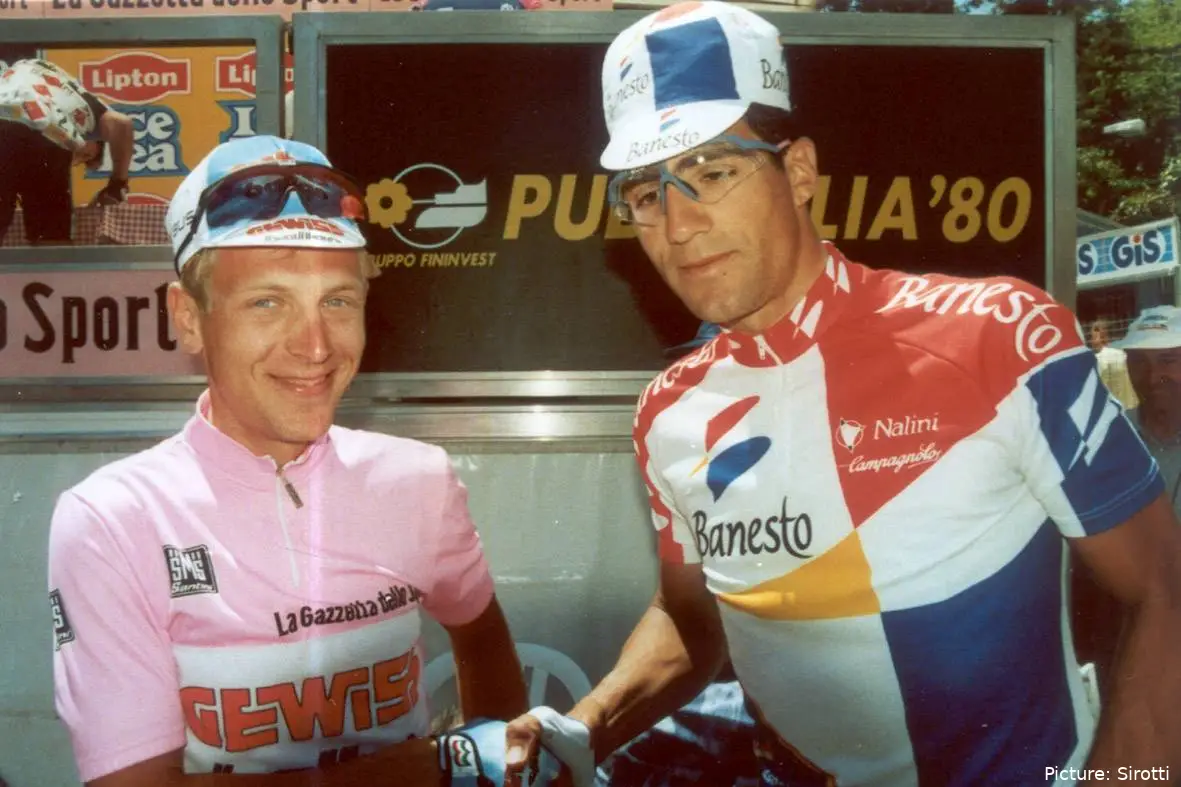
Miguel Induráin seemed virtually unbeatable at the Giro d’Italia. After winning the 1992 and 1993 editions, the Spaniard returned in 1994 aiming to secure his third consecutive victory. However, an unexpected rival emerged and changed the course of that edition: Eugeni Berzin.
The Russian rider, born on 3 June 1970 in Vyborg, had yet to make a major impact in professional road cycling. Until then, his career had been closely tied to the track, where he had won several world titles, before making the full switch to the road in 1993.
His first appearance at the Giro d’Italia had ended in a modest 90th place, more than two hours behind Induráin. A year later, everything would be different. Berzin arrived in Italy after an outstanding spring, during which he had won Liège-Bastogne-Liège and produced other impressive results in one-week races.
The 1994 edition began in Bologna on 22 May and finished in Milan on 12 June. The route comprised 22 stages and 3,726 kilometres, with 153 riders taking part. The field included some of the leading names of that generation, such as Induráin, Marco Pantani, Claudio Chiappucci and Gianni Bugno.
Berzin rode for the powerful Gewiss-Ballan, which also featured Moreno Argentin, Bjarne Riis and several other top riders. The team gave him the support to take on the race, although he was not initially considered the main challenger to the Spaniard.
The Russian claimed the maglia rosa and began building his case for victory with outstanding performances against the clock. Time trialling was his specialty, honed during the years he had spent developing his talent on the track.

Yevgeni Berzin won the Giro d’Italia in 1993
Berzin stunned Induráin against the clock
One of the defining moments came in the time trial from Grosseto to Follonica. Berzin scored a hugely prestigious victory by beating Induráin, who had dominated this discipline in Grand Tours for years.
The Russian recalled that performance in a 2011 interview with Sky Sport Italia. “I beat a monster like Induráin in the time trial and held off Pantani’s attacks,” he said, reflecting on his victory.
Berzin also admitted that journalists had little faith in his ability to hold the lead. “I was young, and all I thought about was pedalling. I had a strong team, from Argentin to Riis, but the journalists said I would lose the maglia after three days.”
Pantani put the Russian champion to the test too
Berzin’s victory was not built on his time trialling alone. In the mountains, the Russian also had to defend himself against Marco Pantani, who was beginning to show the world his extraordinary climbing ability.
The Italian, just 24 years old, was one of the edition’s leading protagonists. His attacks forced the race leader to manage his advantage and defend himself on terrain much better suited to climbers.
Berzin acknowledged that resisting those accelerations was one of the biggest challenges of his Giro. His time-trial strength, combined with his ability to limit his losses on the climbs, proved decisive.
The team’s contribution was also crucial. Gewiss-Ballan had a highly competitive setup, with experienced riders capable of protecting their leader on the toughest days.
The Russian held the maglia rosa for 19 days, a responsibility that was not always easy to manage. He particularly remembered the tension of the final stage, when victory was all but secured but he still feared that a crash could ruin everything.
“It is always difficult to win after wearing the maglia rosa for so many days. I was young, and all I thought about was pedalling,” he told Sky Sport Italia.
Induráin acknowledged his conqueror’s superiority
The result confirmed one of the biggest surprises in the Giro’s recent history. Berzin won in a time of 100 hours, 41 minutes and 21 seconds, ahead of Pantani and Miguel Induráin.
The Navarrese rider had to settle for third place after winning the previous two editions. For Berzin, beating a rider of Induráin’s calibre was particularly significant.
In his interview with Sky Sport Italia, the Russian recalled how the Spaniard reacted to the defeat. “Induráin has been the strongest of all time. In 1994, he congratulated me reluctantly because he hadn’t expected me to beat him.”
That victory made Berzin the first Russian rider to win the Giro d’Italia. It capped an extraordinary season in which he had also won Liège-Bastogne-Liège and the Russian national time trial title.
His performance was no fluke. Berzin returned to the Giro in 1995 and reached the podium again, this time finishing second behind Tony Rominger.
Read also
He also wore the yellow jersey for two stages at the 1996 Tour de France. However, he never again reached the level he had shown during that unforgettable 1994 season.
Berzin ended his professional career in 2001, after nine seasons at the top level. His palmarès was defined by two major victories: Liège-Bastogne-Liège and, above all, that Giro d’Italia, where he defeated two historic figures, Pantani and Induráin.
Juan LarraCycling Journalist
Juan Larra is a writer for Cyclinguptodate and editor-in-chief of Ciclismoaldia, where he has played a central role since its inception. Under his leadership, the website has become a trusted source for professional cycling coverage, offering in-depth analysis, news, and feature stories.
A sports journalist with over 20 years of experience, Juan earned his degree in Journalism from the University of Seville in 2007. He began his career covering a wide range of sports—including football, basketball, Formula 1, MotoGP, tennis, and cycling—for platforms such as the official La Liga app, Vodafone and Movistar websites, NBA Blogdebasket, and Cadena Cope, honing his skills in writing and editorial management.
In addition to his work at Ciclismoaldia, Juan contributes to Cyclinguptodate and serves as editor-in-chief for the tennis-focused site Tenisaldia. Throughout his career, he has conducted exclusive interviews with cyclists and sports figures, provided detailed analysis of competitions ranging from local Spanish races to major international events, and acted as a special correspondent at prestigious races including Paris-Roubaix, the Tour de France, and the Vuelta a España.
Juan’s combination of experience, expertise, and direct access to athletes has established him—and the platforms he leads—as authoritative voices in professional cycling.
claps 0visitors 0
Just in
Popular news
Latest comments
- I've no doubt they were all doped, but saying those three weren't GC riders to start is just plain wrong. Who looked at Chiapucci and thought "That's my man for the Classics"?megasmacky26-11-2026
- Maybe a poor translation, but what does “snubbed off” mean?Lozza25-11-2026
- well he is in the wrong team then why comment and basically says im no.2 and will have to wait to be No.1 when he could have a team built around him. but then maybe he gets things from UAE . this is the rider trek should have targeted instead of ayuso.
 Davide25-11-2026
- A classic career from the doping era, basically. He may have had the engine from his track days, but the sudden rise and the ongoing fade and fall-off look like so many results from so many people across so many sports in that era.RidesHills25-11-2026
- This makes sense, and shows maturity and patience. They are separated by 5 years in age, basically. When he's 27 and Pogačar is 32, they will have had plenty of time for a gracious handing over of the leadership in many races, and the already phenomenal del Toro will be in a place to lead. Until then, he rides for his leader, when appropriate, and that's one of the reasons this is a team sport, not a solo sport.RidesHills25-11-2026
- They were all doping hard, not just him. Bugno, Chiapucci, Induráin... they were not GC riders to start with. Bugno and Ullrich were much younger so it is harder to tell whether they were naturally climbers
 Rafionain-Glas25-11-2026
- He's got quite the sprint, I would not rule him outRafionain-Glas25-11-2026
- Watch Fleche Wallone where all 3 riders from Gewis get 1 2 3 lolpaultryan200225-11-2026
- I wish Primož all the best, after all he's my compatriot, like Pogi. But I don't see him winning races where the best cyclists will show up: Pogi, Remco, Del Toro, Seixas, Jonas, Lipowitz, etc. etc. I just hope Primož will be satisfied and happy with the races he wins. That's all that counts.PogiSloFans25-11-2026
- Andy Gosler is using philosophy and rhetoric against Dawkins book-The Selfish Gene, which is the skill of using language effectively and persuasively to influence and motivate his delusional followers. He's a so-called intellectual BS'ter!!!PogiSloFans25-11-2026
Loading
5 Comments