Miguel Indurain: Five consecutive Tour de France victories, a bitter team dispute and retirement at just 32
Cycling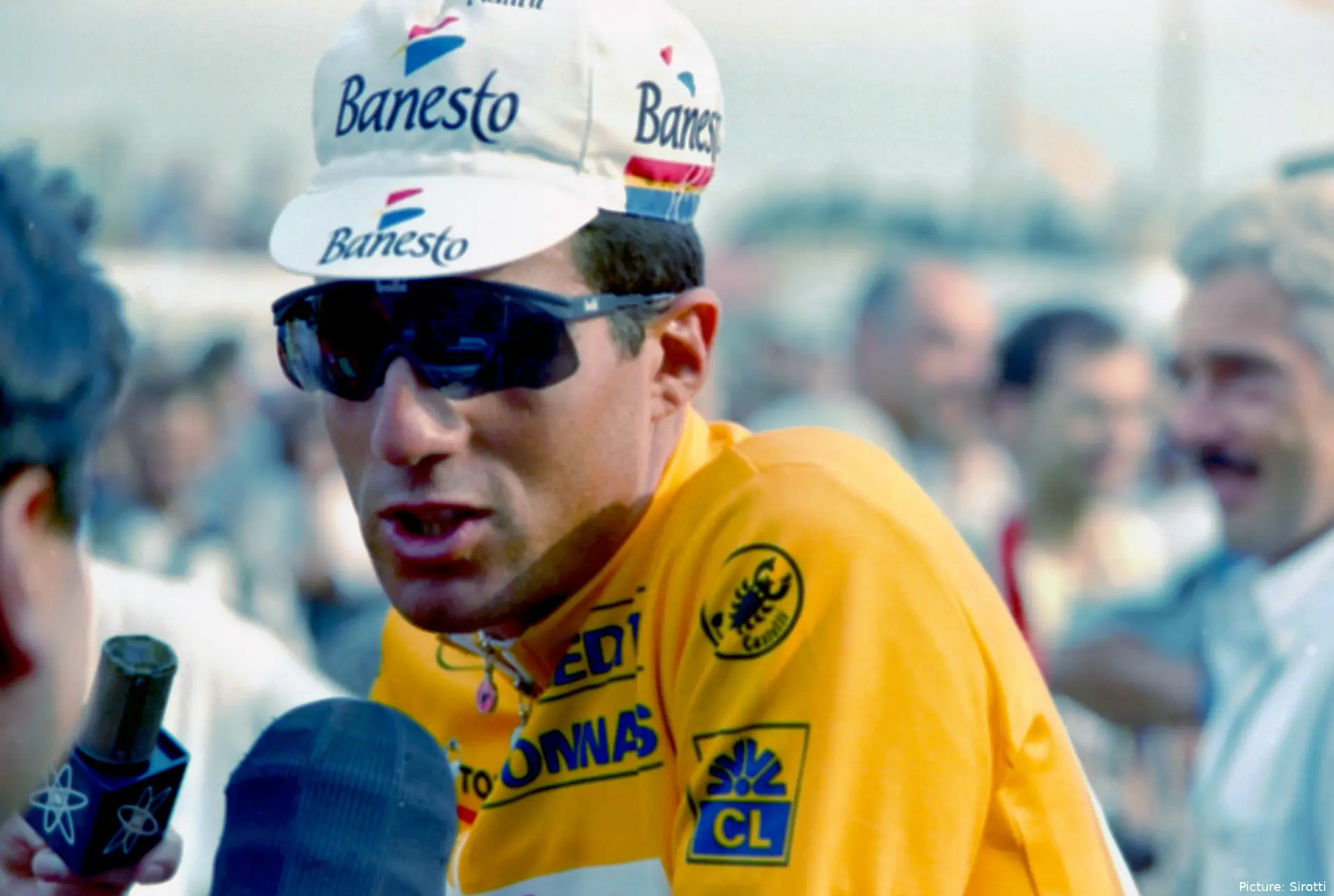
Miguel Indurain was 32 when he decided to bring his professional career to an end on 2 January 1997. The Navarrese rider, a five-time Tour de France winner and two-time Giro d’Italia champion, left cycling after a season that had completely changed the course of his career. His farewell came just months after he won gold in the Olympic time trial at the Atlanta Games, a result that seemed to confirm he still had plenty to offer on the bike.
However, 1996 had been an especially difficult year for the Banesto rider. After five consecutive Tour de France victories, Indurain could not extend his dominance in the French race, finishing 11th and falling well short of the expectations created by his record. Denmark’s Bjarne Riis took the victory, ending a reign that had seemed almost unassailable. Although his Atlanta Olympic gold brought him back into the spotlight, the accumulated strain of the season was beginning to take its toll.
The final chapter came at the Vuelta a España, a race he returned to after five years away and had never won. Obliged to take part because of his team’s circumstances, the Navarrese rider started the Spanish race without being in suitable physical condition. A viral illness, breathing problems, and obvious exhaustion ultimately forced him to abandon the race on 20 September 1996, as the race headed towards Lagos de Covadonga.
But Indurain’s retirement was not simply a sporting decision. His relationship with the Banesto organization had also deteriorated, particularly with directors José Miguel Echávarri and Eusebio Unzué.
The Navarrese champion was hurt by being required to ride the Vuelta and began to seriously consider leaving. He even received an offer from ONCE to continue his career, but financial differences eventually closed that door. That is how a farewell took shape that still prompts questions about whether Spain’s greatest-ever cyclist could have extended his career.

Lance Armstrong alongside Miguel Indurain after the 1993 Oslo World Championships
The 1996 Vuelta a España: the beginning of the end
Indurain’s participation in the 1996 Vuelta a España was the episode that finally changed his relationship with professional cycling. After a demanding season in which he had lost his Tour crown and needed to rediscover his form for the Olympic Games, the Navarrese rider did not believe another Grand Tour was the right decision.
However, Banesto management, led by Echávarri and Unzué, felt he needed to line up in Spain’s race.
Expectations for his return were enormous. Indurain had not ridden the Vuelta since 1991, when he finished second behind Melchor Mauri. His absence during his years of dominance in France had made his comeback one of the biggest stories of that edition.
However, he was far from his best, and the first signs that something was wrong soon appeared. Accumulated fatigue and a viral illness stopped him responding as he normally would.
On 20 September, the moment that would define his career finally arrived. On the stage heading to Lagos de Covadonga, Indurain began to lose contact on the climb to the Fito pass. Unable to hold the peloton’s pace, he abandoned before reaching one of Spanish cycling’s great landmarks.
“That’s it, I’m out,” he said, summing up the moment. Later, speaking to TVE cameras, he explained his difficulties: “Yes, the cold could be the reason I’m out of form. It’s not too serious, but it’s still stopping me from performing at my best.”
Physical exhaustion and the break with Banesto
That abandonment had consequences far beyond the Vuelta standings. According to Benito Muñoz in a report published by El Mundo on 3 January 1997, Indurain had been particularly troubled by being required to ride a race he did not want to tackle in those circumstances.
The season had taken a significant toll, but the feeling that he had not been allowed to decide his own schedule further strained relations with his sporting directors.
The relationship between Indurain, Echávarri, and Unzué had been central to building one of the most successful periods in cycling history. However, the 1996 Vuelta showed that their once-close understanding had changed.
The rider felt hurt and needed time to reflect. His love of cycling and his pride, which made him reluctant to bow out after a difficult season, led him to consider continuing, even though circumstances had changed. The lack of communication between the parties ultimately became a decisive factor.
In fact, the Navarrese rider seriously considered another option: signing for ONCE. The team was ready to build its structure around him and offer a sporting project aimed at challenging for the 1997 Tour de France again. The chance to pursue a sixth victory in Paris was still alive.
However, financial differences prevented an agreement. ONCE was unwilling to match the salary terms he had at Banesto, where, according to reports at the time, he earned close to 500 million pesetas net. With no alternative that fully convinced him and his relationship with the team badly damaged, retirement began to look increasingly likely.

Miguel Indurain at the Tour de France
Could he have won a sixth Tour de France?
The great question left unanswered by Indurain’s retirement was whether he still had what it took to compete at the highest level. His doctor and coach, Sabino Padilla, maintained that he remained physically capable of performing and that the decision depended largely on his own wishes.
There was no irreversible injury or physical problem that forced the Navarrese rider to leave the sport. His retirement was therefore a personal choice shaped by fatigue, sporting circumstances, and the situation he faced at Banesto.
ONCE offered him the chance to start afresh with a team built around his ambitions. The 1997 Tour also presented a different challenge from the one he had faced during his years of dominance. Bjarne Riis, the 1996 winner, was emerging as one of the leading contenders, while Indurain would have needed to reclaim the spotlight against a new generation of rivals.
A sixth Tour victory was far from certain, but it did not seem entirely out of reach. His experience, time-trialing ability, and record in the French race remained powerful assets.
On 2 January 1997, Miguel Indurain officially announced his retirement. He was 32 and left behind five consecutive Tour de France victories (1991–1995), two Giro d’Italia titles (1992 and 1993), a time trial world title, and the Olympic gold medal from Atlanta. He did not want to extend his career until he became a shadow of his former self or chase a sixth Tour at any cost.
Read also
He left without a final victory in France but also without enduring the prolonged decline that has affected other great champions.
His farewell may have seemed premature, especially as he was still capable of competing, but exhaustion, disagreements with Banesto, and a lack of motivation ultimately outweighed the prospect of making more history. Indurain chose to get off his bike while he still held the prestige of having been cycling’s dominant force.
Javier RampeCycling Journalist
Javier Rampe is a sports analyst with more than 15 years of experience. He holds a degree in Economics from the University of Rome and a Diploma in Business Studies from the University of Cádiz. Despite coming from an academic background not particularly associated with cycling, his passion for both cycling and journalism was instilled in him from an early age. He grew up following Miguel Indurain and José María “El Chava” Jiménez. An admirer of Michael Robinson’s communication style and journalistic approach, he was inspired to pursue a degree in Journalism at the University of Buenos Aires, which he is currently completing.
He has always maintained close ties with the worlds of sport and culture, contributing from a young age to sports blogs and film and music review websites. His work has appeared in media outlets such as Cope, RAI, and Radio Con Vos. He is also the founder of the cycling-focused podcast El Contraanálisis and the football interview channel Días De Fútbol, dedicated to conversations with professional footballers.
In addition to his work at Ciclismoaldia, Javier has interviewed some of the most influential figures in modern cycling, including Alejandro Valverde and Tadej Pogačar, as well as key voices in anti-doping policy such as Alberto Yelmo, David Varillas, and Marcelo Milano. Marcos Maynar, in relation to the ‘Operación Ílex’ case, is also among the personalities he has interviewed. He enjoys conducting in-depth analysis of the cycling ecosystem and has attended major events such as Strade Bianche, the Vuelta a Andalucía, and Itzulia, as well as numerous national cyclo-cross races.
His background in economics, combined with extensive experience in marketing and corporate communications, drives his continuous study of positioning strategies and ensures that he always keeps his focus on crafting compelling and evocative headlines.
claps 0visitors 0
Just in
Popular news
Latest comments
- Also has a questionable history with doping suspicions
 Front24218-11-2026
- I agree, he had some really good results this year. I was really surprised he managed to finish 5th on GC at the Tour. Just some of the headlines and stories on this site (and others) are such bs.Lozza18-11-2026
- Always the same (stupid) story.MajorPayne18-11-2026
- Decoration, for the sake of this conversation, is strictly monetary and anti gender at that.flyer18-11-2026
- Good correction but everyone went off road with it for combat.flyer18-11-2026
- Still nauseating ! gag !frieders318-11-2026
- Go get em Wout!JoeyC18-11-2026
- I don't take my phone with me while I'm running, cycling, or swimming. And even if I had it with me, I don't need the selfie to remember or appreciate the meeting forever. The selfie is good for showing off to friends, but otherwise it's more of a TikTok vibe than something to bother with while jogging, walking, ...flyer18-11-2026
- Mas: “What I enjoy is the process leading up to the races and the racing itself.” That's always good to read. I hope his good form continues in 2027.flyer18-11-2026
- I wasn't sure if he wanted to win the TDF... some day (who would have thought it isn't about 2027). Silly me.flyer18-11-2026
Loading
Write a comment