“The expectations of all of us were that the guys would last a little longer” - Slovenian icon admits disappointment as Primoz Roglic misses medals in Montreal
Cycling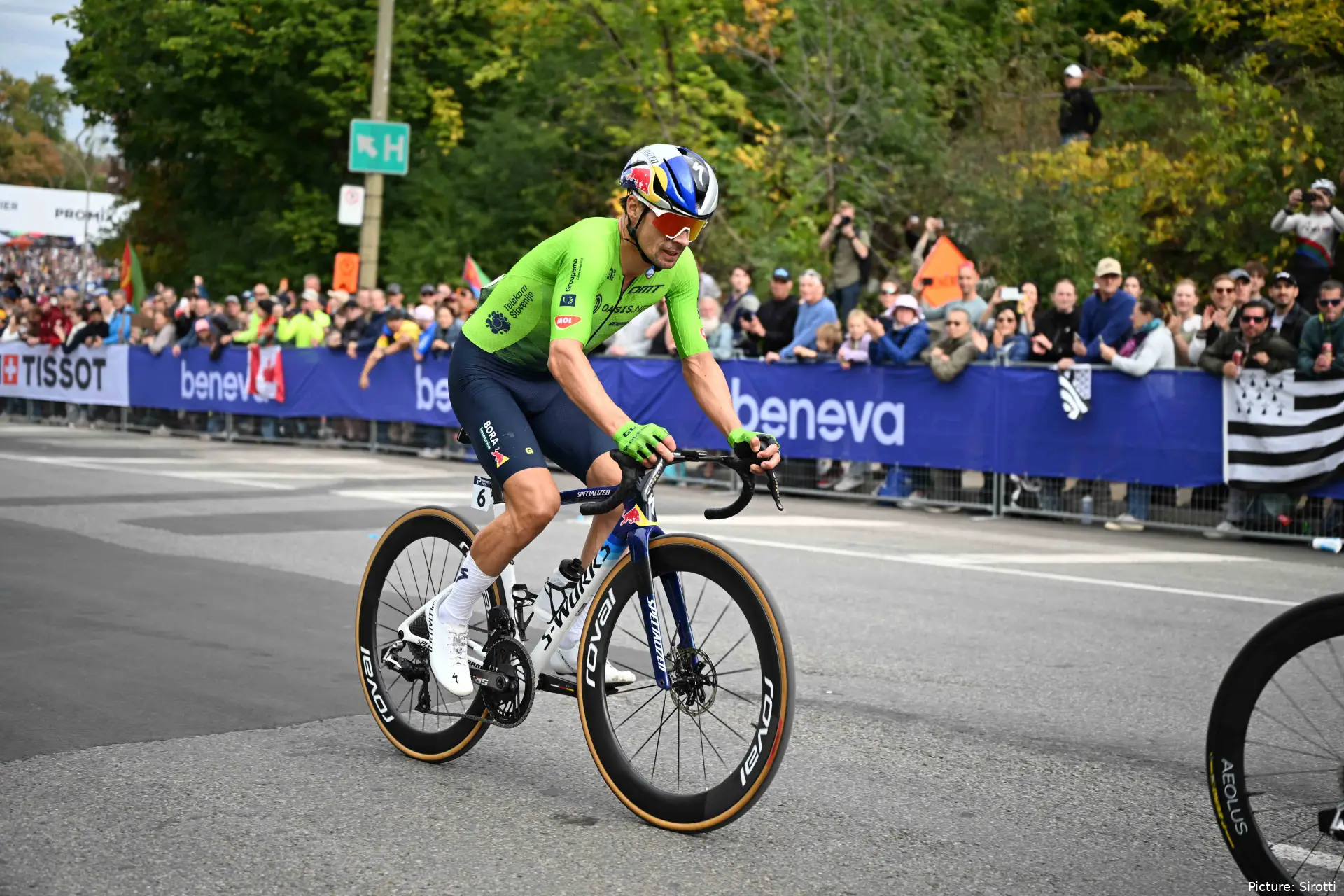
Slovenia came away from the 2026 World Championships in Montreal without a medal, despite Primoz Roglic spending a sizeable part of an extraordinary race right in the thick of the fight.
The 36-year-old repeatedly worked his way back after losing contact and even found himself at the front alongside Mathieu van der Poel and Quinn Simmons as the race began to fracture. For a while, Roglic looked capable of hanging around in the medal battle deep into the finale, but the repeated efforts eventually caught up with him and he faded to 21st, 3:29 behind new world champion Brandon McNulty.
There was encouragement in the way Roglic raced, but Bogdan Fink, director of the Tour of Slovenia and technical director of the upcoming European Championships, admitted Slovenia had hoped for more from the team as a whole.
“The expectations of all of us, both the fans and the coaching staff, were that the guys would last a little longer,” Fink said on the Tour 202 podcast. “But when the French arrived on the circuit, they set such a hard pace that a lot of riders were dropped. After that there was no way back.”

Primoz Roglic in action at the 2026 Montreal World Championships
Roglic refuses to disappear
Roglic had already done well simply to remain involved once the favourites began attacking from distance. When Van der Poel accelerated out of the six-man move containing Wout van Aert, Oscar Onley and Simmons, Roglic initially could not follow the Dutchman's burst. Rather than trying to respond immediately, he settled into his own rhythm and slowly rode his way back. Later, when the front split again, he repeated the trick.
“Roglic was dropped twice and came back twice,” Igor Tominec reflected. “Then I thought that somehow, through his persistence, even if he no longer has that same explosiveness he had in his best years, he might still be able to hold his position near the front.”
Fink also felt the small group around Roglic had an opportunity to press its advantage harder before the race came back together. “The three or four riders who were at the front should, in cycling terms, have pushed on and made a bigger difference,” he said. “But behind them were riders who wanted to come back and had the race under control.”
Roglic had spoken in similar terms himself after the finish, describing a day when there had been little point holding anything back. “There was nothing to hide. I was all in, racing,” he said. “At the end I just ran out of energy. Empty.”
Fink had watched the same pattern unfold from the Slovenian camp. “We saw several times that Primoz also came back,” he said. “But if your legs are gone after 250 kilometres, then there is no way back.”
Tominec reached much the same conclusion once Roglic finally lost contact for good. “But in the end he completely ran out of strength,” he said. “I think he actually did the right thing by riding at a controlled pace to the finish. After all, Slovenia will also be counting on Roglic at the upcoming European Championships.”
Read also
Slovenia wanted more riders in the fight
Roglic ultimately became the only Slovenian to reach the finish. Matej Mohoric and Jan Tratnik were both out early, while Tilen Finkst at least gave the team representation in the opening break. Matevz Govekar hung on with the main field for considerably longer, and Gal Glivar produced perhaps the most encouraging ride of the supporting cast by remaining with Roglic deep into the race and even trying an attack of his own.
“Gal Glivar attacked well, Finkst was also up the road early on, but there was no opportunity that could put our riders into a good position for the closing laps,” Fink said.
France's relentless work once the race reached the Montreal circuit played a large part in stripping the peloton down so early, but Slovenia had hoped to carry more options into that phase. With Tadej Pogacar absent, Roglic was always the obvious leader, though a race which opened with more than 90 kilometres remaining made life increasingly difficult once his support began disappearing.
Roglic still left Canada with something positive from his own performance. Rather than sounding deflated after another day without a World Championship medal, he took some satisfaction from having been able to race aggressively against Van der Poel, Simmons, Van Aert and the other major names for so long. “I was enjoying it today. I put really everything on the road,” he said. “It’s always even more beautiful when you finish it.”
The attention now turns quickly towards the European Championships in Slovenia, where Roglic and Jakob Omrzel are expected to share leadership duties. Montreal showed Roglic can still put himself into the middle of a race at the very highest level; the bigger question for Slovenia next time will be how many teammates can stay there with him.

Kieran WoodDeputy Editor-in-Chief
Kieran Wood is a sports journalist based in Wales and has been active in journalism since 2022. He regularly contributes to DartsNews.com and CyclingUpToDate.com, where he covers professional cycling and darts. In cycling, his work includes liveblogs from major races, including the Tour de France, the Giro d’Italia, and La Vuelta a España, alongside race reports and analysis. He has also conducted interviews with professional riders.
His reporting spans the full racing calendar, from one-day classics to stage races, with a focus on accurate, real-time coverage and clear contextual analysis. For statistics, results, and historical context, he regularly uses resources such as ProCyclingStats. To support reporting on rider activity and training context where relevant, he also references Strava.
In his work, Kieran places strong emphasis on careful sourcing, editorial accuracy, and updating articles as new, verified information becomes available.
claps 0visitors 0
Just in
Popular news
Latest comments
- What a cheater Jay Vine is. Remco gained on everyone else pretty much evenly. But Vine? After he was caught, the gap grew at a suspiciously slow rate. Typical UAE
 Rafionain-Glas18-10-2026
 - Strade? Never saw him as a gravel rider that can handle it.mij18-10-2026
- It surprises me that anyone still believes any professional (or amateur!) sport is clean--much less wants it to be. The best you can hope for is a reasonably level playing field that doesn't expose young, ambitious athletes to health risks they don't understand. In that regard, World Tour cycling appears to do a better job than almost any sport with independent, random testing. There are certainly fewer mysterious midnight "heart attacks" these days. If you want to see what an uneven playing field looks like, show up to masters nationals. It is also certainly the case that no major pharmaceutical corporation has developed a multi-billion dollar miracle drug just to give it only to one or two anointed ectomorphs in a minor non-revenue sport. If you don't like that all sports run on PEDs these days and you can't be bothered to contribute as a tester, a federation official, or pharmaceutical representative, then just turn off the TV and play outside.
 MarkFour18-10-2026
 - Good grief, who proofreads this stuff? Errors abound.wrsty18-10-2026
- You can add weight to a bike and limit gears or make it single speed if you like. I doubt that would reduce crashes. It would just add another dymanique. All good and well, but It wont stop cars getting on to the course.Cyclingsbestfan18-10-2026
- Seixas is probably second best in the World on short climbs. But that hasn't translated as well to long climbsRafionain-Glas18-10-2026
- Idiotic fellaRafionain-Glas18-10-2026
- Nothing. Against Pogi nothingabstractengineer18-10-2026
- He didn't even try to sprint all outvappaxbipmv18-10-2026
- Campenaerts looked like a rolling pumpkin with that all orange leaders skinsuit !frieders318-10-2026
Loading
Write a comment