ANALYSIS - The five hardest stages that Tadej Pogacar could target at the 2026 Vuelta a Espana
Cycling
The Vuelta a España 2026 will start on Saturday, August 22nd, with a short nine‑kilometre individual time trial through the streets of Monaco, but the route designed by the organisers will quickly raise the bar for the general classification contenders. The race opens at full throttle, with mountains from the first days and several stages capable of creating major time gaps.
Among the 21 stages, five stand out for their blend of elevation gain, climbs, summit finishes, and accumulated toughness. The first week packs much of the initial fight, with Font-Romeu, Andorra, and Aitana as key reference points before the first rest day.
The second half of the race will offer no respite either. The finishes at Calar Alto, Sierra de la Pandera and, especially, the penultimate stage ending at Collado del Alguacil look decisive for riders aiming to win La Vuelta.
With Tadej Pogacar targeting his first-ever win of the Spanish Grand Tour, there's a number of stages that suit the Slovenian's superior climbing level as he seeks to compete the set of the Grand Tour wins.
Picking the five hardest stages means weighing not only elevation gain or climb categories, but also race timing, heat, distance, and the likelihood that gaps between favourites will widen. These are the five days set to shape the general classification.
What are the most demanding stages?
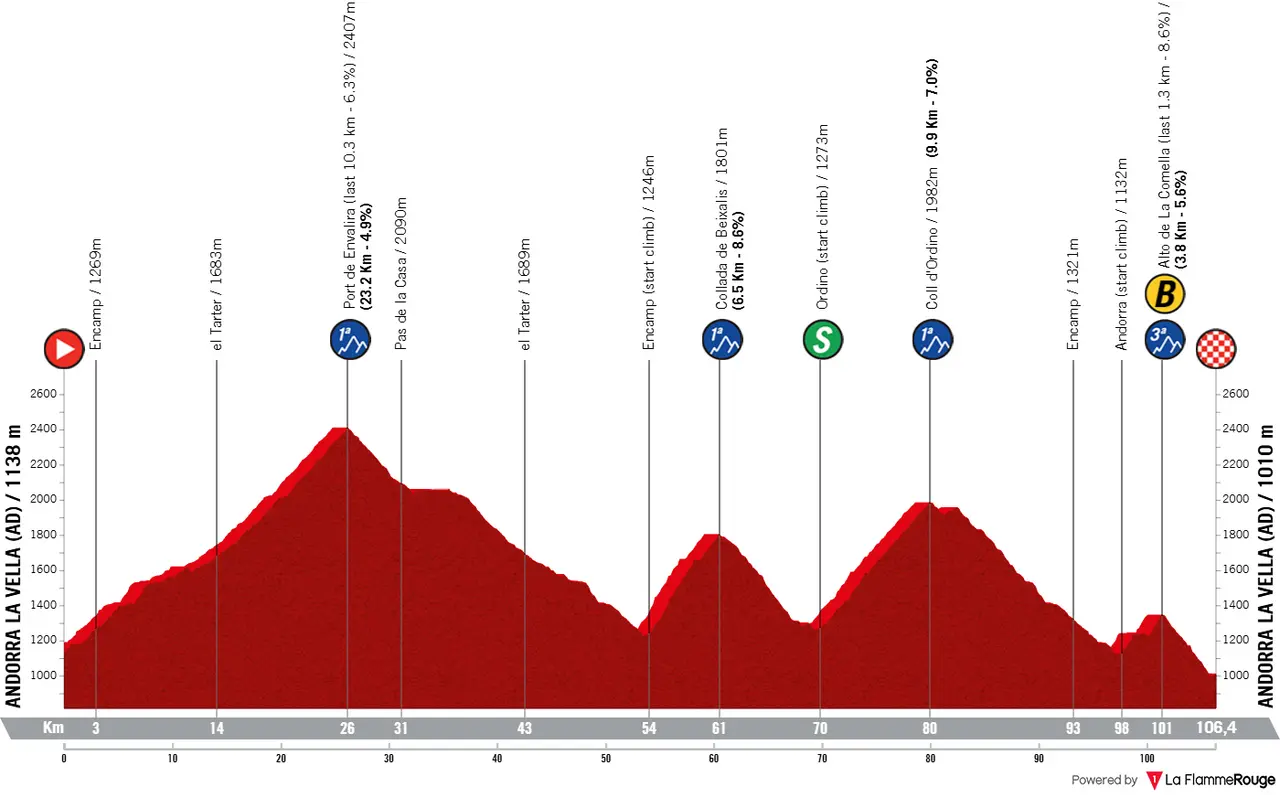
Andorra la Vella - Andorra la Vella, 106 kilometres
Stage 4: Andorra la Vella–Andorra la Vella, 104 kilometres
The first major showdown between the favourites will come very early, in a short but extraordinarily tough fourth stage. The 104 kilometres planned in Andorra conceal a succession of climbs that will allow the peloton scarcely any respite and could turn the day into one of the race’s first big sieves.
The Port d'Envalira will open the sequence of difficulties with a first‑category ascent. Then come the Collada de Beixalís and the Coll de Ordino, also first category, before tackling La Comella, a third‑category climb. Packing so many climbs into so few kilometres will be key to wearing down the riders.
Given the short distance, the pace could be especially high from the gun. There will be little room to hide in the bunch and any weakness could quickly translate into significant time loss. Rather than deciding La Vuelta, this stage could start to reveal who is truly ready to fight for the top 10.
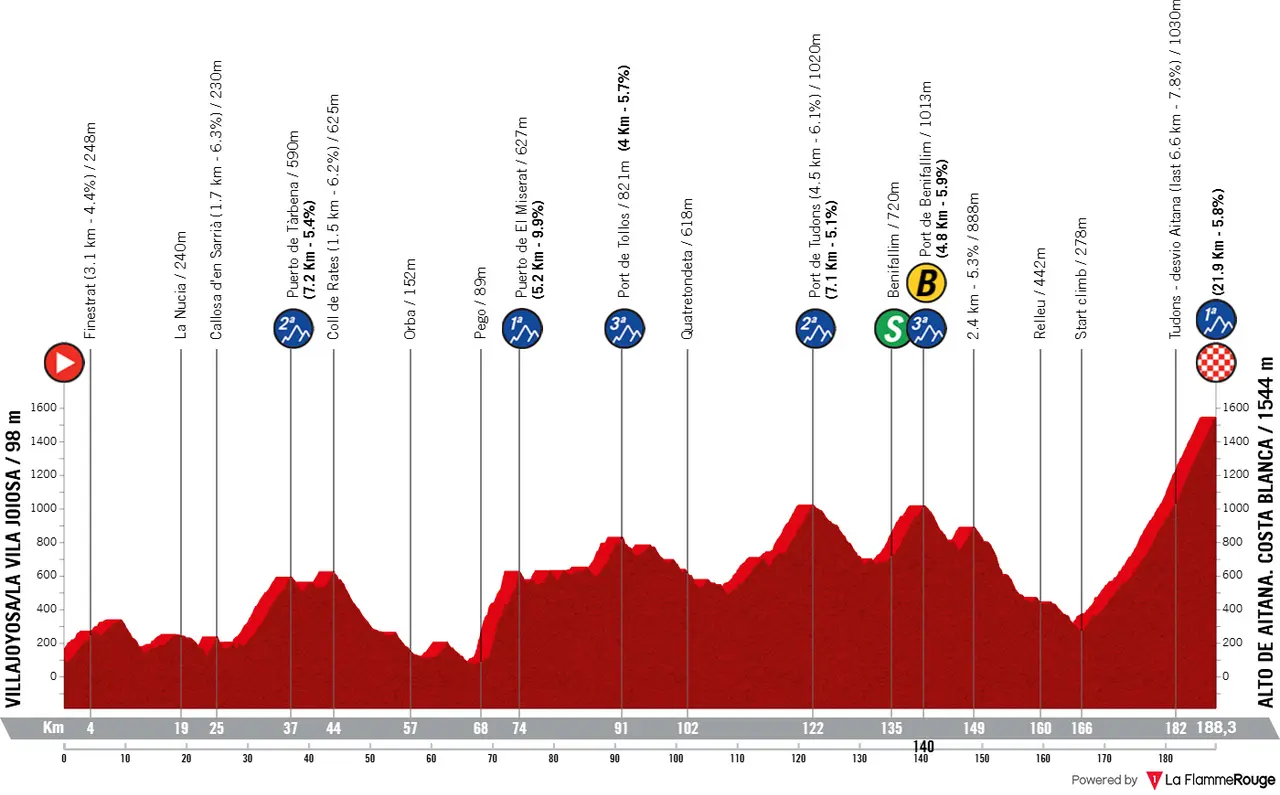
Villajoyosa - Alto de Aitana, 188 kilometres
Stage 9: La Vila Joiosa–Alto de Aitana, 187 kilometres
The first week will end with a genuine high‑mountain stage. Between La Vila Joiosa and the Alto de Aitana the riders must climb more than 5,000 metres of elevation gain, a figure that automatically makes this one of the toughest days of the entire race.
The route includes six climbs and blends relentless wearing terrain with two particularly important points: El Miserat, first category, and the final ascent to Alto de Aitana. The chain of difficulties could force the selection long before the decisive ramps.
Heat could also prove decisive. Reaching Aitana after more than 180 kilometres and thousands of metres of climbing will demand perfect effort management. For the favourites, it is a day when gaps can grow significantly and that will test recovery after a very intense opening week. A good day to gauge Movistar Team and its leaders: Enric Mas and Cian Uijtdebroeks.
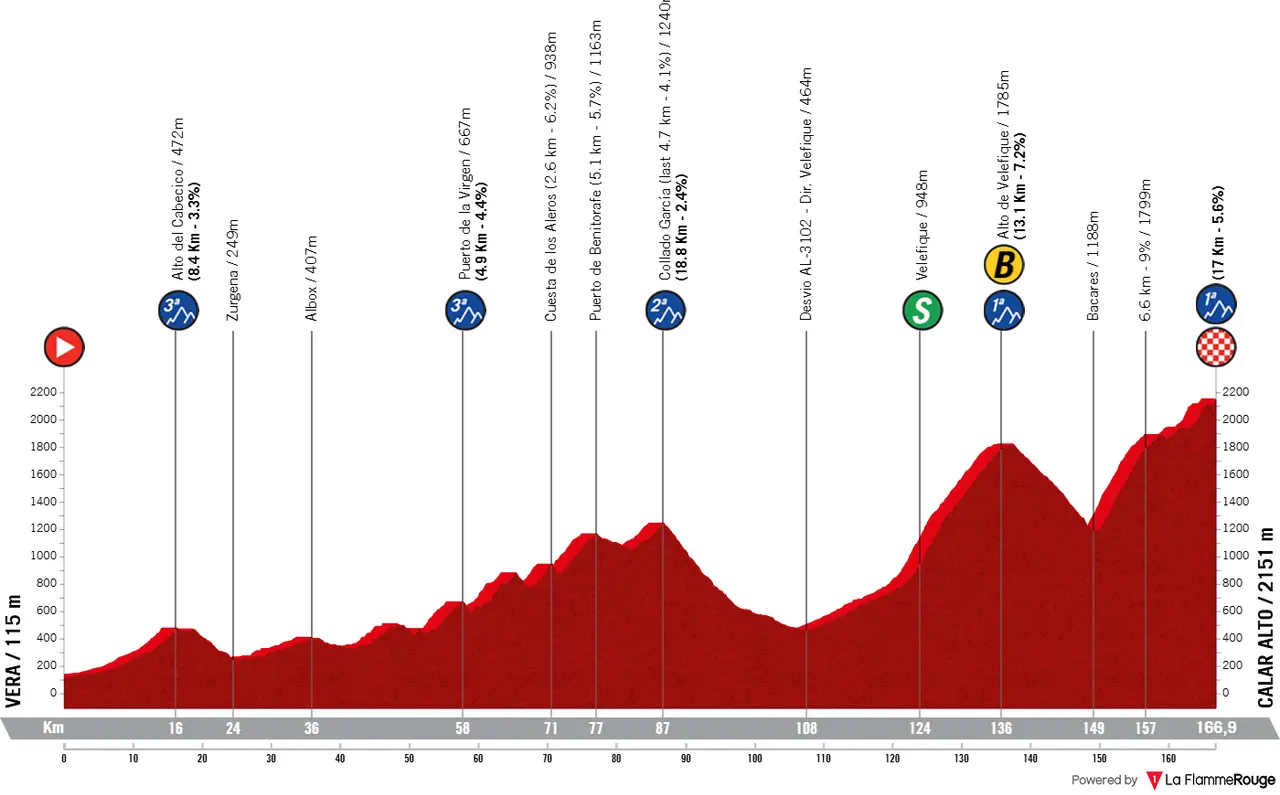
Vera - Calar Alto, 167 kilometres
Stage 12: Vera–Calar Alto, 166 kilometres
The mountains return to centre stage in Andalucía with a 166‑kilometre stage between Vera and Calar Alto. It will be the first major mountain day after the rest day and, therefore, a test of how the favourites have absorbed the opening week.
The combination of Velefique and Calar Alto concentrates much of the difficulty. Both climbs form a classic pairing on Almería’s roads and will force the riders into a long day of ascending and attrition. The approach will not be entirely straightforward either, so accumulated fatigue will matter.
The summit finish also provides a direct opportunity to measure forces among the GC contenders. After the first mountain block, any rider who has lost time will have to try to claw it back, while the leaders must defend. It is a stage that could mark the start of a new phase of the race. Without doubt, a demanding day with a double final ascent and a trap that Tadej Pogacar will want to navigate on the downhill approach between climbs.
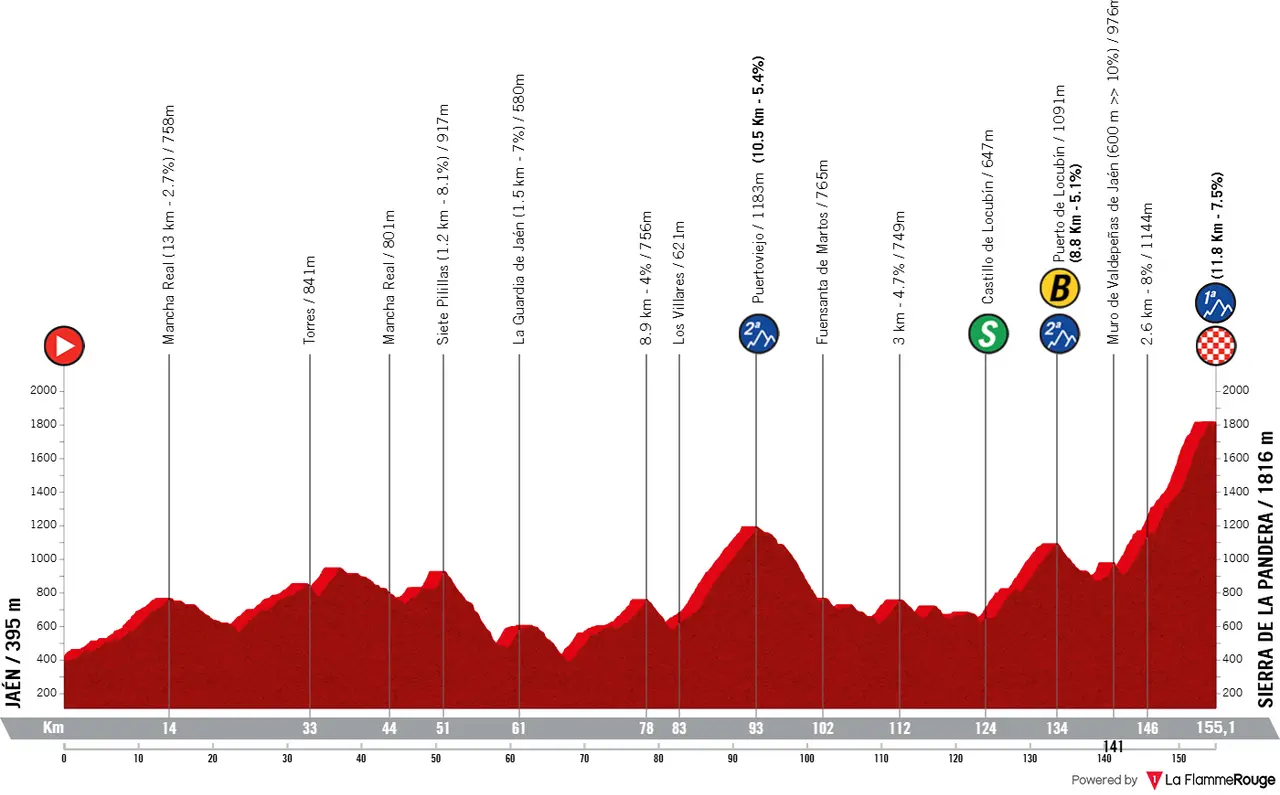
Jaén - Sierra de la Pandera, 155 kilometres
Stage 14: Jaén–Sierra de la Pandera, 152 kilometres
Two days after Calar Alto comes another day tailor-made for climbers. The stage between Jaén and Sierra de la Pandera covers 152 kilometres and puts the mountains back in the spotlight, with an extra factor that could raise the difficulty even further: the heat.
La Pandera is one of the most demanding finishes of the route and arrives at a point in the race when legs will be heavily depleted. The day could turn into a war of attrition, especially if the favourites’ teams choose to harden the race from afar.
The main danger awaits riders who hit an off day. By now, accumulated gaps mean any time loss can have serious consequences in the general classification. A crisis on the final ramps could spell a definitive goodbye to podium ambitions, or even to a top placing. Gruelling stage: heat and elevation gain with a fireworks finale over the Jaén sierras.

La Calahorra - Collado del Alguacil, 187 kilometres
Stage 20: La Calahorra–Collado del Alguacil, 187 kilometres
The queen stage of this selection arrives on the penultimate day of racing. The route between La Calahorra and Collado del Alguacil remains almost as hard as originally planned despite the course change forced by landslides that affected access to Alto de Hazallanas.
The organisers replaced Hazallanas with the unprecedented climb to Puerto de El Duque, preserving the spirit of a day meant to decide La Vuelta. The riders will tackle two passages over Puerto de El Purche and one ascent of Puerto de El Duque before facing the new finish at Collado del Alguacil.
The point in the race makes this more than just another mountain day. With only one day left before Granada, the favourites will be at their limit and any gap could be decisive. The 187 kilometres, the accumulation of climbs and the new finale make stage twenty the last big chance to reshape the general classification. If the race reaches that point tightly bunched, all signs suggest Collado del Alguacil could become the stage for the definitive battle for the red jersey.

Gavin QuinnCycling Journalist
Gavin Quinn is a cycling journalist and ultra-distance cyclist with a BA in Journalism from Dublin City University. Formerly the Press & Communications Officer for Cycling Ireland, Gavin has worked inside the national team at the World Championships and has reported for the Irish Mirror, Mirror UK, and The42.
His expertise is backed by elite-level access, having interviewed stars like Sam Bennett and Ben Healy, as well as immense personal endurance. In 2025, he completed a 12,000km solo cycle from Ireland to Vietnam, following a 4,600km tour across Europe. From the cobbles of Paris-Roubaix to the gradients of the Tourmalet, Gavin’s writing focuses on the "romance and brutality" of the sport. Having visited 50+ countries, he brings a global, cultural perspective to his coverage of the pro peloton for CyclingUpToDate.
claps 0visitors 0
Just in


Popular news
Latest comments
- How broke is visma now? wtf they cant even fight moviestar and decathlon for riders and lose both their mid targets based on their budget and they cant even get those? Crazy...:/miguel13-10-2026
- TT But he won by a minute so he could have cut down on some of it
 Rafionain-Glas13-10-2026
 - weight is measurable. power is measurable. So why didn't he prepare that way from the TDF if he wanted to beat Pogi and after Pogi wasn't going to be there, to win.abstractengineer13-10-2026
- I hope Thibau and Tibor don't do the sameRafionain-Glas13-10-2026
- Seixas is exactly what I would like Pogi to be mentally and in his statements. Both come across as shy and who don't talk much but with Seixas, you can see that he enjoys success, that it boosts his ego, unlike Pogačar who seems to feel increasingly uncomfortable the more he wins. He's won so many times, people are saying he's boring. The french media hate him for winning so much, the french cycling fans are booing him... etc. etc. But remember one thing, Seixas will never physically reach Pogi's level. He's excellent, but he isn't at that level nor will ever be. His talking to the media, his relationship with people is already at a high level.PogiSloFans13-10-2026
- Paul Seixas is now the second-best rider in the world.megasmacky13-10-2026
- When will they start dropping Pogi? Oh yeah, when Pogi reaches 40+ years, that's when young cyclists will start dropping him. But until then... eat your hearts out and cry. Pogi will remain the G.O.A.T. for years to come. Capish?PogiSloFans13-10-2026
- I figure he would have found out how to outsprint Paul and take the win, maybe. He's 28 now but I would say he's right at the peak of his powers. It was great race though, Paul showed me something different about himself.awp13-10-2026
- Slowly, very slowly... 5-7 yrs. ;)MajorPayne13-10-2026
- Up to this point: "It is just not yet at the level of Vingegaard and Pogacar." First Jonas, and then level of Tadej. Period!MajorPayne13-10-2026
Loading
Write a comment