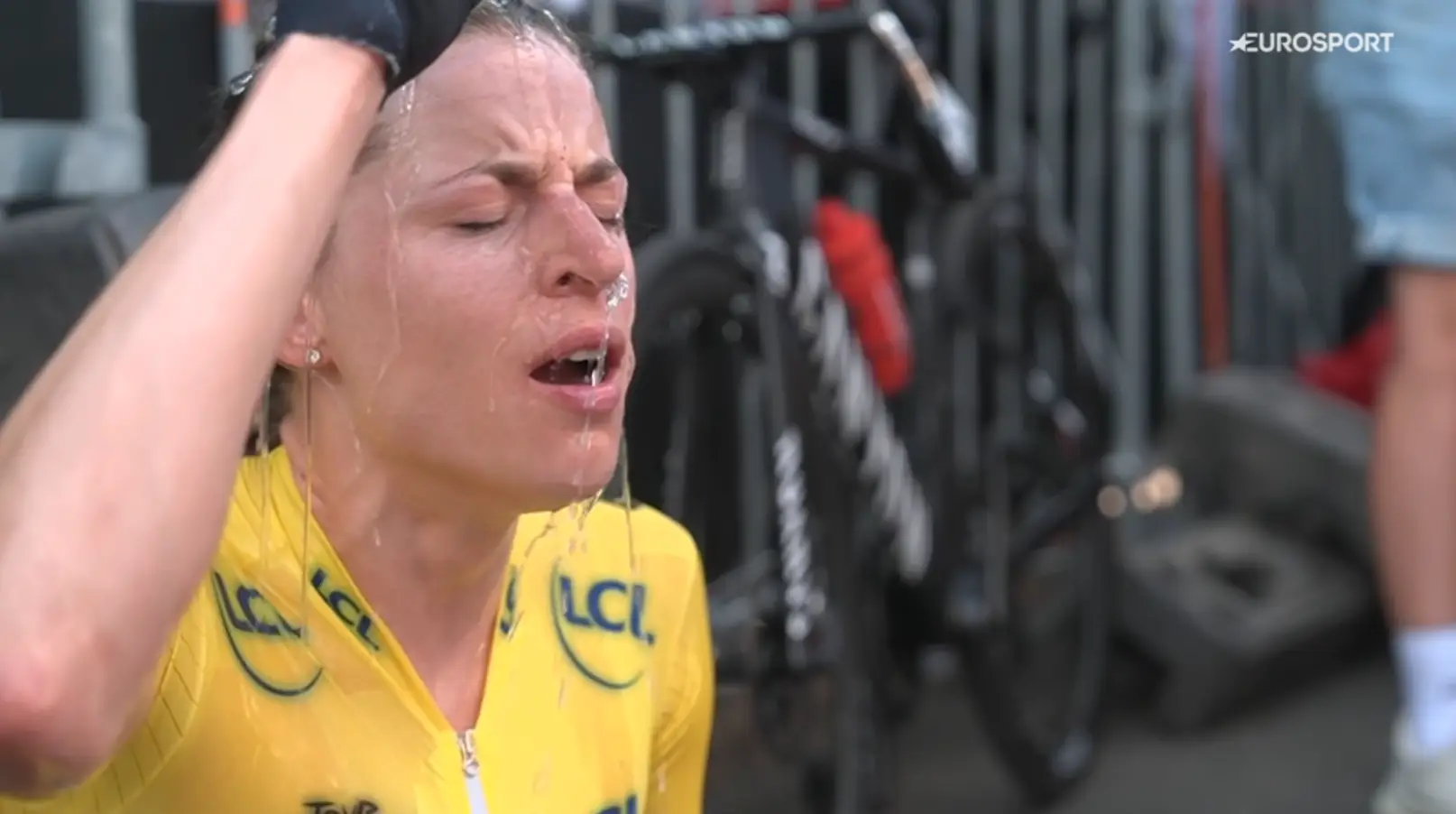
"She has lost several victories over something so marginal": Annemiek Van Vleuten reacts to Wiebes' Giro disqualification
Cycling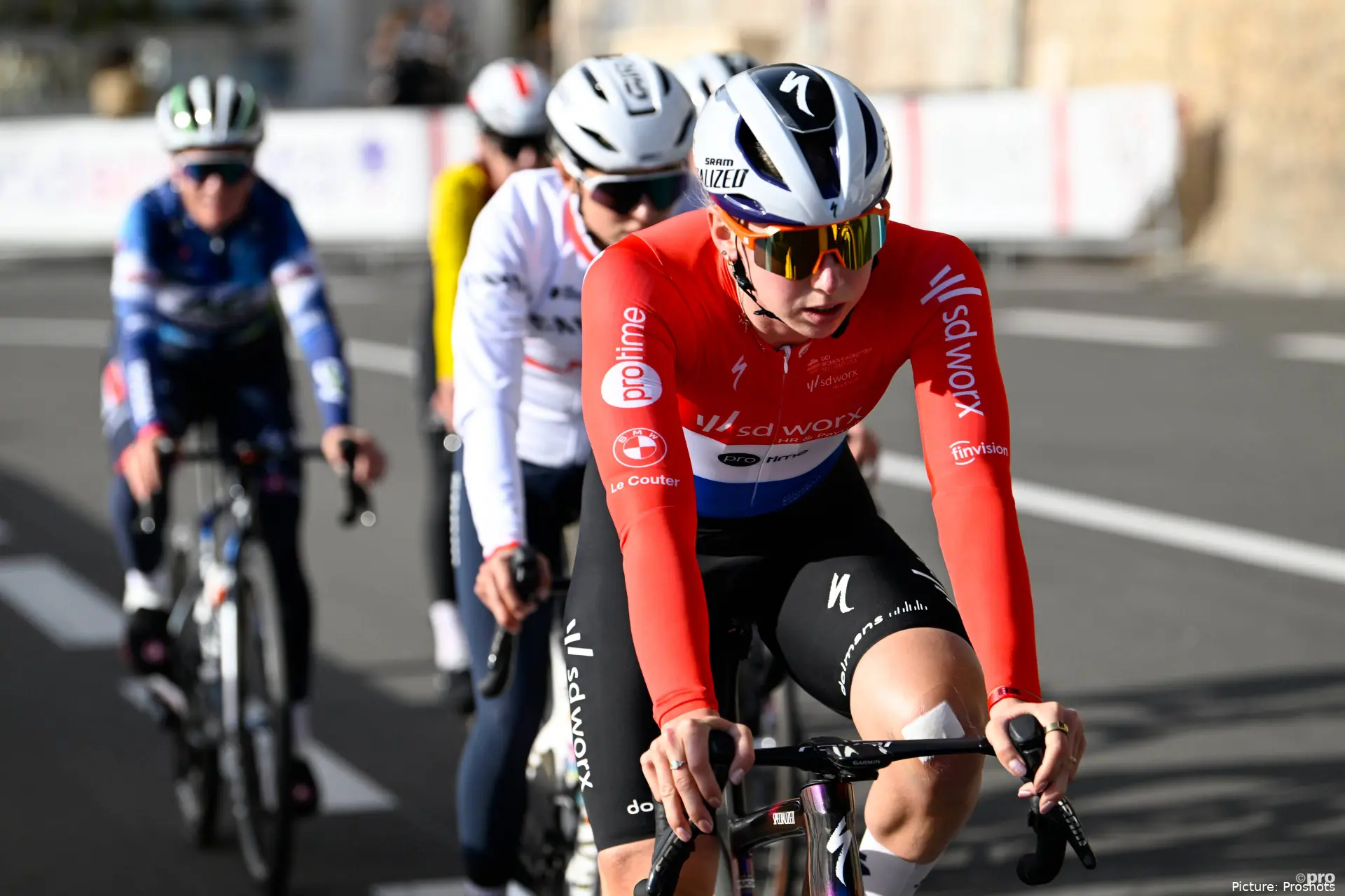
The disqualification of Lorena Wiebes from the 2026 Giro d’Italia Donne continues to stir debate in the peloton. The Dutch rider was removed from the race just hours after a brilliant opening-day performance, once it was found her bike fell below the UCI’s minimum weight.
Wiebes’s bike underwent a post-stage inspection and the result showed it weighed twenty grams less than permitted by the regulations. That seemingly tiny margin led to the rider’s exclusion from the race.
Annemiek van Vleuten admitted that, on instinct, she would have preferred a less severe sanction.
"My first reaction would be to strip the stage win and let her start the next day on a compliant bike. However, the rules are the rules and they are clearly defined. Teams know they must respect them," she clarified for NOS.
No advantage
The former rider also showed empathy for Wiebes’s situation, arguing that the infringement did not deliver a real sporting benefit.
"It’s a very tough situation. She has lost several victories over something that gave her no advantage. We’re talking about barely four tea bags. Maybe on a climb there could be some difference, but certainly not one that decides a win. And even less so in a completely flat stage," she said.
Team management under scrutiny
Team SD Worx - Protime explained that Wiebes had raced all season on the same bike. Even so, Van Vleuten believes that argument does not justify what happened.
She noted that seemingly minor tweaks can change the final system weight. "Swapping the chainring, fitting a different front derailleur, or even adding a bit more sealant in the tires can account for those twenty grams. That’s why it doesn’t look like a particularly careful approach."

Lorena Wiebes
The Dutchwoman also questioned why a team would take such a big risk when the potential gain is virtually nil. "It’s a good question. You expose yourself to a huge sanction for something that really adds nothing. In 2019 I also had a bike that was exactly 6.8 kilos. My team decided to add a twenty-gram counterweight to build in a safety margin. It felt odd to add weight, but it was far better than risking a disqualification."
Van Vleuten finally reminded that the UCI allows no tolerance in these measurements, so she considers that edging up to the limit is never the best strategy.

Ondrej ZhasilCycling Journalist
Ondřej Zhasil is a cycling journalist at CyclingUpToDate and has been part of the team since 2023. He is based in Ostrava, the third-largest city in the Czech Republic, and covers professional cycling across the main UCI competitions, including the Tour de France, the Giro d’Italia, and La Vuelta a España. A key focus of his work is startlist analysis and pre-race coverage, where he examines team selections, rider line-ups, and tactical scenarios ahead of major events.
Alongside WorldTour coverage, Ondřej has developed specific expertise in junior cycling and in racing across East Asia, including competitions in China and Japan. He also maintains a broad working knowledge of other disciplines and levels, including cyclocross, while continuing to expand his understanding of mountain bike racing.
Ondřej holds a bachelor’s degree in Mathematics and Physics, which supports his analytical, data-driven approach to performance and race analysis. In his reporting, he regularly uses ProCyclingStats for results, statistics, and historical context. He places strong emphasis on careful sourcing, editorial accuracy, and updating articles promptly when new, verified information becomes available.
claps 0visitors 0
Just in

Popular news
Latest comments
- Individual Gautherat is the most exciting given his age too I agree. But Frigo and Balderstone for uae will be super valuable as doms areound those leaders. UAE just quitly uppgrade w/stronger and younger guys. Sivakov was on the down and Frigo replace all that with bigger engine. Balderstone seems like another brilliant under the radar pickup UAE is masters off....so exhausting they never missmiguel25-10-2026
- Surprised it’s that inexpensive!Lozza25-10-2026
- Nah, I like it here. I like a challenge, against the people who hate me here. Jumping John, you ain't getting rid of me :))PogiSloFans25-10-2026
- Pogi deserves every penny he gets paid... and he's the only cyclist that should be paid more. If he's two classes above everyone else, his salary should also be. Ad acta.PogiSloFans25-10-2026
- It’s not only that, it’s this obsession with running after money, whether it be teams, riders, sponsors, broadcasters. As soon as one player gets ahead, others feel obliged to match their moves with increases for fear of losing out and for fear of someone else following in your place instead without looking at the long-term consequences of blindly following. Other sports ahead (or behind depending on how you look at it) in such matters should serve as a warning but humanity has a habit of heading straight into walls even when the writing is on it. When financial objectives and limits aren’t clear, it’s impossible to manage any organisation, you can’t even recruit the right riders or tell them what is needed to make sure they’re a good fit because you can’t clearly explain what they can expect. Not all riders are motivated by money alone and some of the teams are proof of that.Jumpyjohn25-10-2026
- To be honest, their signings weren't actually too bad. Oscar and Kevin had great 2025 seasons. Most of the top leaders were signed. But Red Bull, Lidl-Trek and Pinarello showed that that's not actually the coast. So team culture is probably the foremost reason. Whether there's a bad sporting culture now is debatable, but certainly there's the past. 2024 was the end of the old Ineos (it was not actually transition, it was slow decline)
 Rafionain-Glas25-10-2026
 - FYI. Pogi made his World Tour debut at the TDU in 2019. I remember it well because someone said watch out for Pogi as he did a good time up Corkscrew during training. Who would have thought he'd end up as the GOAT.Santiago25-10-2026
- FYI. Pogi's first World Tour race was at the TDU in 2019. I remember it well because someone said watch out for Pogi as he did a good time up Corkscrew during training. Who would have thought he end up as the GOAT.Santiago25-10-2026
- 50 million isnt low. But if you hire super domestiques for a million and 3rd rung leaders for 3-5 million, natural you dont have money left not the results expected. Most monuments and TDF are out of reach due to Pogi. But there were a promising 2nd rung leaders on the market and they went for broke to get Onley and Kevin. I put their entire troubles due to mismanagementabstractengineer25-10-2026
- I think it’s becoming clear that cycling got way ahead of itself for a few reasons and is now coming to the realisation that some rider salaries just exploded without justification and it snowballed until sponsors started pulling money out because THEY did not see any return on increased costs. Cycling is still a dying sport (that never moved out of the niche family) and will remain so if it doesn’t embrace and promote new ventures or manage to attract new markets. Even within cycling, fans are basically compartimentalised, (almost nobody here follows track for example), and the multiplication of possibilities hasn’t grown the sport, it has just split it into a larger number of smaller branches. If it weren’t for nation state sponsors (far too numerous already) other teams would never have (had to resort to) raised bigger budgets that are now leading to sponsor abandonment. That’s the difference between long-term steady growth and financial doping, the latter can also just blow up in your face. I will venture to wager that apart from one or two exceptional cases, rider salaries will no longer go up and are quite likely to actually drop over the next decade.Jumpyjohn25-10-2026
Loading
1 Comments