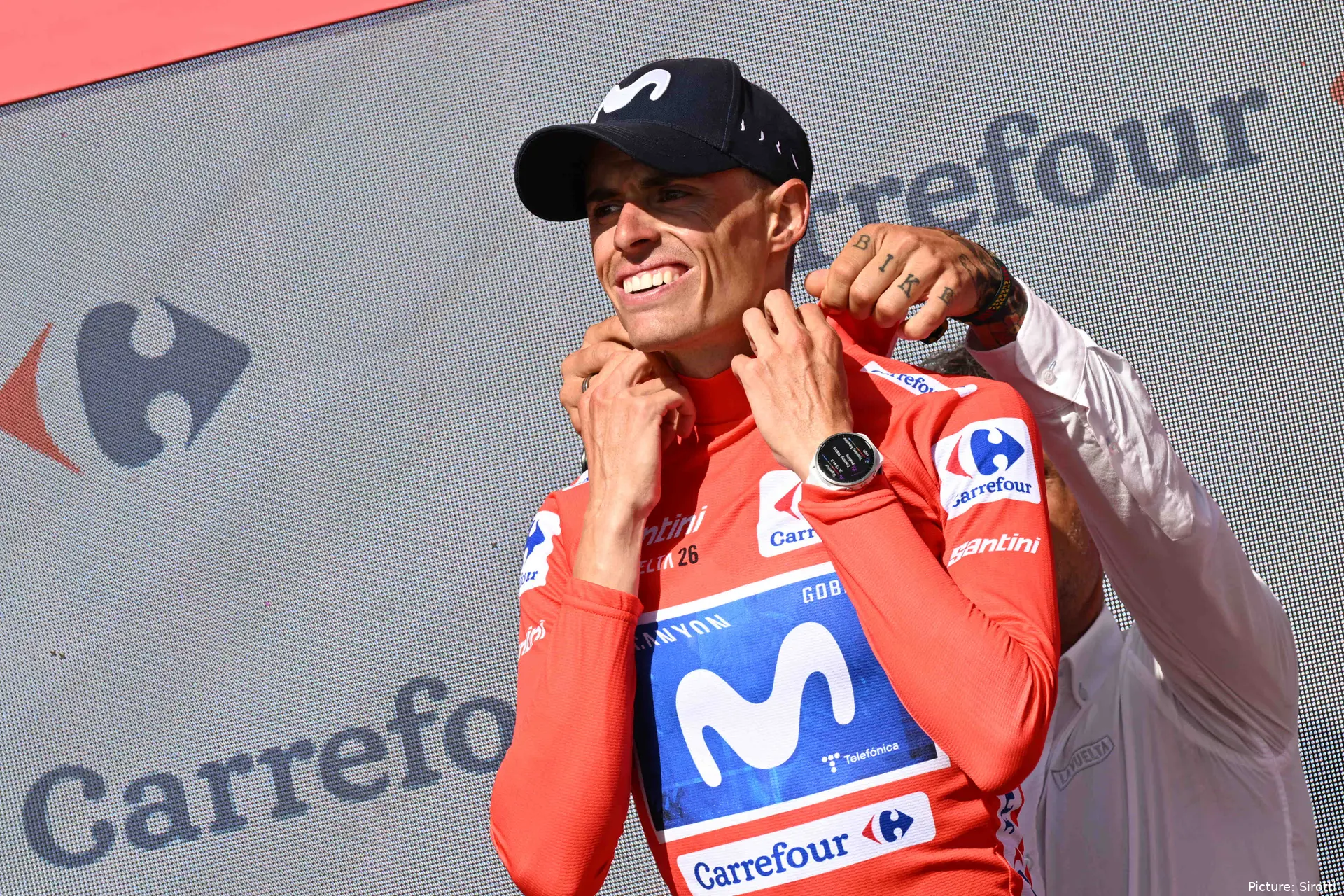
Enric Mas is living one of the defining moments of his career in this Vuelta a España. The red jersey and his form in the mountains have completely changed the narrative around the Movistar Team rider, who in recent years has had to live with constant pressure and at times particularly harsh criticism. His present status is explained not only by results, but also by his capacity to endure and start again.
The transformation gains even more weight with perspective. After a season in which doubts even cast a shadow over his future at the highest level, Mas has found in the Vuelta the perfect stage to reclaim himself. The Balearic has regained confidence, aggression, and consistency in the mountains, rising to the race lead and becoming one of the key figures of this edition.
Alberto Contador, speaking to Cadena Cope, assessed Mas’ situation from an angle that goes beyond times and classifications. The reflection highlighted everything the rider has had to withstand to get here. “There’s something with a truly beautiful value that we need to appreciate, that we need to be aware of,” he said, putting the rider’s evolution into context.
The memory of the criticism Mas received also surfaced in the conversation. “Quique, you’ve lived it, you’ve seen the criticism Enric took. It was heavy,” he noted. Faced with that backdrop, the rider chose to carry on. He did not quit, did not step away from cycling, and did not allow a negative spell to define his future. His answer is now arriving on the bike.
Reinvented Enric Mas
The Giro d’Italia was cited as one of the most difficult moments in that process. A race in which Mas again failed to find his best legs and which brought criticism even from within his own circle. Yet, far from getting stuck there, he managed to reinvent himself. “So many other athletes would have given up and probably said, ‘Hey, I’m leaving sport,’ and in Enric’s case he kept going,” was one of the Pinteño’s reflections.
The change is especially significant because it’s not limited to physical improvement. Mas appears to have also recovered a confidence that had long been in doubt. In this Vuelta he has raced differently, taken responsibility, and answered his rivals’ attacks. “He has reinvented himself and we’re seeing the best version of Enric,” Contador underlined during his analysis.

Social media criticism
The story also takes on a social dimension in a context shaped by criticism on social media. Harassment and so-called digital bullying hit young athletes especially hard, who can end up internalizing pressure that is hard to manage. That’s why Mas’ case was presented as an example of resilience and self-belief. “We have to fight against that and believe in ourselves,” he said, adding an even more important idea: losing does not mean failing forever.
Perhaps one of the most telling images of this transformation is the reaction from some of his former critics. Those who were particularly tough on Mas for months are now starting to acknowledge it publicly. “People admitted they’d been haters, literally, that they were against him and now they regret it,” he told Juanma Castaño.
Read also


That shift in perception neatly sums up the turnaround experienced by the rider. The same results once used to question him now serve to validate him. And although the Vuelta is not yet over, Mas has already achieved something that goes far beyond a general classification: he has regained the respect of those who stopped believing in him.
From elsewhere in Europe, following the race away from the immediate peloton environment, that change is also evident. “That’s why, honestly, I’m really delighted,” reflected Contador. Because Enric Mas’s story in this Vuelta is not only about cycling, victories, or jerseys. It’s about perseverance, rebuilding after criticism, and proving that a bad day, however hard, never has to become the end of a career.
Javier RampeCycling Journalist
Javier Rampe is a sports analyst with more than 15 years of experience. He holds a degree in Economics from the University of Rome and a Diploma in Business Studies from the University of Cádiz. Despite coming from an academic background not particularly associated with cycling, his passion for both cycling and journalism was instilled in him from an early age. He grew up following Miguel Indurain and José María “El Chava” Jiménez. An admirer of Michael Robinson’s communication style and journalistic approach, he was inspired to pursue a degree in Journalism at the University of Buenos Aires, which he is currently completing.
He has always maintained close ties with the worlds of sport and culture, contributing from a young age to sports blogs and film and music review websites. His work has appeared in media outlets such as Cope, RAI, and Radio Con Vos. He is also the founder of the cycling-focused podcast El Contraanálisis and the football interview channel Días De Fútbol, dedicated to conversations with professional footballers.
In addition to his work at Ciclismoaldia, Javier has interviewed some of the most influential figures in modern cycling, including Alejandro Valverde and Tadej Pogačar, as well as key voices in anti-doping policy such as Alberto Yelmo, David Varillas, and Marcelo Milano. Marcos Maynar, in relation to the ‘Operación Ílex’ case, is also among the personalities he has interviewed. He enjoys conducting in-depth analysis of the cycling ecosystem and has attended major events such as Strade Bianche, the Vuelta a Andalucía, and Itzulia, as well as numerous national cyclo-cross races.
His background in economics, combined with extensive experience in marketing and corporate communications, drives his continuous study of positioning strategies and ensures that he always keeps his focus on crafting compelling and evocative headlines.
claps 2visitors 2
Just in

Popular news
Latest comments
- FYI. Pogi made his World Tour debut at the TDU in 2019. I remember it well because someone said watch out for Pogi as he did a good time up Corkscrew during training. Who would have thought he'd end up as the GOAT.Santiago25-10-2026
- FYI. Pogi's first World Tour race was at the TDU in 2019. I remember it well because someone said watch out for Pogi as he did a good time up Corkscrew during training. Who would have thought he end up as the GOAT.Santiago25-10-2026
- 50 million isnt low. But if you hire super domestiques for a million and 3rd rung leaders for 3-5 million, natural you dont have money left not the results expected. Most monuments and TDF are out of reach due to Pogi. But there were a promising 2nd rung leaders on the market and they went for broke to get Onley and Kevin. I put their entire troubles due to mismanagementabstractengineer25-10-2026
- I think it’s becoming clear that cycling got way ahead of itself for a few reasons and is now coming to the realisation that some rider salaries just exploded without justification and it snowballed until sponsors started pulling money out because THEY did not see any return on increased costs. Cycling is still a dying sport (that never moved out of the niche family) and will remain so if it doesn’t embrace and promote new ventures or manage to attract new markets. Even within cycling, fans are basically compartimentalised, (almost nobody here follows track for example), and the multiplication of possibilities hasn’t grown the sport, it has just split it into a larger number of smaller branches. If it weren’t for nation state sponsors (far too numerous already) other teams would never have (had to resort to) raised bigger budgets that are now leading to sponsor abandonment. That’s the difference between long-term steady growth and financial doping, the latter can also just blow up in your face. I will venture to wager that apart from one or two exceptional cases, rider salaries will no longer go up and are quite likely to actually drop over the next decade.Jumpyjohn25-10-2026
- You know you can post all this on idlprocycling too with your account(s) don’t you? There’s a whole bunch more articles and people there to inform.Jumpyjohn25-10-2026
- That’s the kind of word my foreign grandma would have rendered fashionable again, like flabbergasted (at her time) ;-) Perhaps he should get a pro to fill out his papers and pack his bag too, customs have become keen on controlling anyone from the balkans.Jumpyjohn25-10-2026
- Alternatively, just call Rod StewardJumpyjohn25-10-2026
- I will be in Adelaide in a shot if Pogi comes to the Tour Down Under. Fingers and toes crossed that this will eventuate, he has just got to remember to stay aware of kangaroo’s, as Jay Vine can attest to. Though can’t be any worse than some of the passionate fans in EuropeSearider25-10-2026
- "The Spaniard also highlighted Florian Lipowitz, third in the recent World Championship time trial, as a rider to watch as he continues to gain experience." Please stop the AI slop
 Rafionain-Glas24-10-2026
 - I think it's great! Now there's a real reason forcing the people-who-don't-fix-the-potholes to fix the potholes... or notRafionain-Glas24-10-2026
Loading
Write a comment