Nearly 400 watts for 90 minutes - The extraordinary power demands of riding at the front for Tadej Pogacar's UAE team
Cycling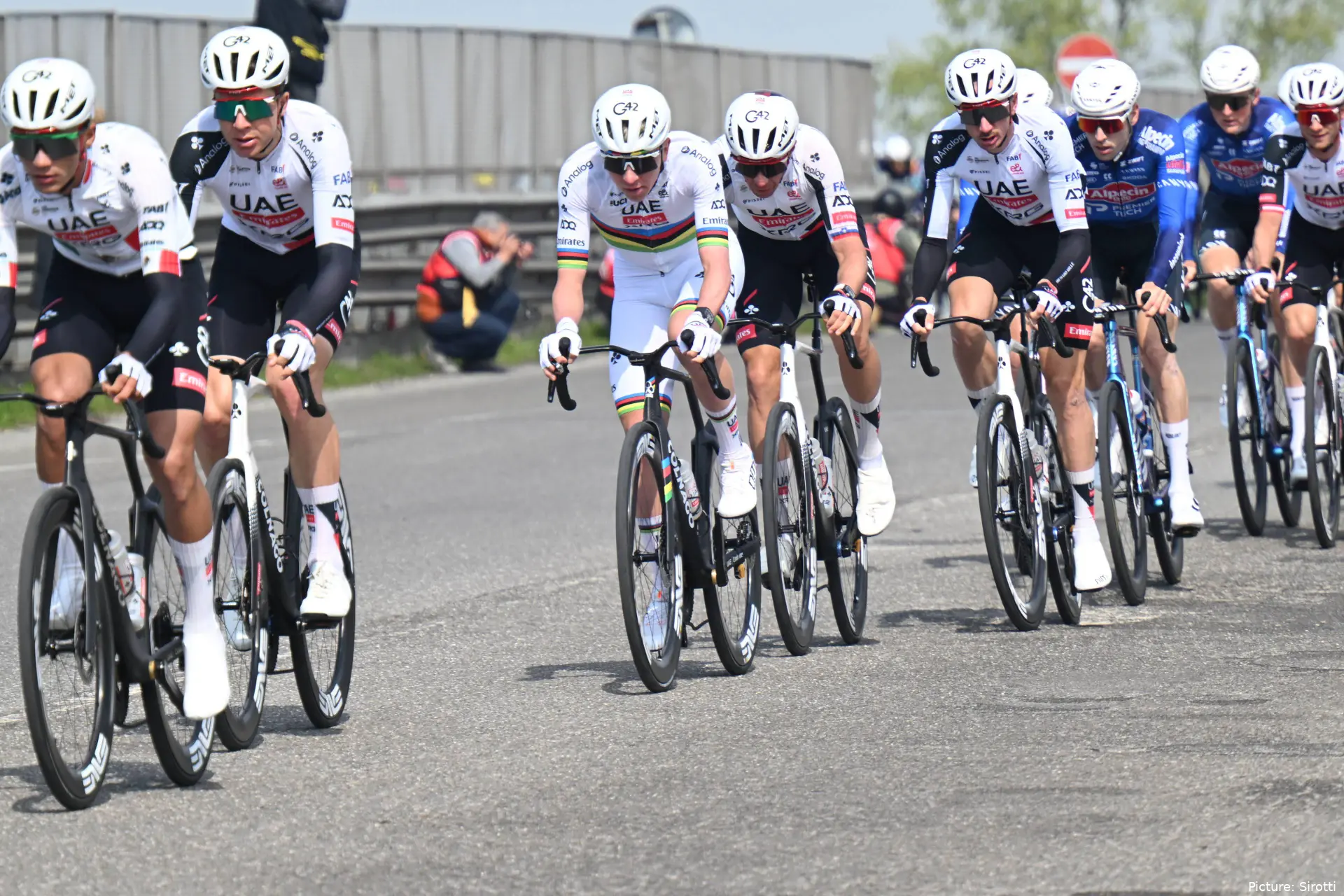
Mikkel Bjerg has revealed the extraordinary power figures required to control races for UAE Team Emirates - XRG, recalling an effort at the Tour of Flanders that saw him average almost 400 watts for an hour and a half. Yet for the Danish rider, who regularly spends hours at the front of the peloton on behalf of Tadej Pogacar and his teammates, there was still a hint of disappointment about falling just short of that particular milestone.
"At the Tour of Flanders, I spent an hour and a half averaging just under 400 watts," Bjerg revealed on Eurosport's Radio Tour. "It's a bit of a shame I didn't quite break that barrier. I think that would have been pretty impressive."
And the 27-year-old is accustomed to producing remarkable numbers over extended periods. "Otherwise, it's usually around 370-380 watts," he continued. "But you can keep that up for a long time, especially when you're as heavy as I am."
Bjerg's reputation as a powerful rider was established long before his arrival at UAE in 2020. He won three consecutive under-23 world time trial titles between 2017 and 2019, before claiming his first individual WorldTour victory against the clock at the 2023 Criterium du Dauphine. His fourth place at the 2024 Tour of Flanders also demonstrated his ability to translate that strength into results on the cobbles.
His individual opportunities have increasingly taken a back seat to his responsibilities within UAE's formidable squad. While Pogacar regularly makes the headlines with his attacks in the decisive kilometres, Bjerg is among those entrusted with controlling the race long before the Slovenian makes his move.
Why Bjerg prefers to start working before the breakaway gets too far
Bjerg prefers to begin controlling the breakaway early rather than allow it to build a substantial advantage, maintaining an effort he can sustain without exhausting himself before the decisive kilometres.
"If you've got five riders with specific jobs to do, you might use one or two of them to control the breakaway," he explained. "I just know that, for me, it's much easier to say: OK, I'll start riding on the front early. Then you're riding in something like an LT1 power zone, where you can keep going for a really long time without blowing up."
That preference has developed in contrast to the more traditional method of allowing the breakaway several minutes before beginning a much harder pursuit. "In the past, you'd give them five minutes, ride the first half of the race really easily, and then go full gas in the second half," Bjerg recalled. "You'd be riding at something like threshold and really trying to open things up."
With several teammates often assigned specific responsibilities later in the race, UAE can benefit from having one powerful rider shoulder much of the early workload. "It's more economical for the team," Bjerg said. "You can use one rider on the front instead of two."
The Dane's ability to perform that role has remained important despite a disrupted 2026 campaign. Fractures suffered in a crash involving a kangaroo at January's Tour Down Under interrupted his preparation for the spring Classics, but he returned to competition in March and subsequently completed the Giro d'Italia, where he again worked in support of UAE's wider objectives.
Read also
Why shorter races can present a bigger problem than the Tour of Flanders
Despite the enormous effort he recalled from Flanders, Bjerg believes the length of cycling's biggest one-day races can actually make controlling a breakaway more straightforward.
"I've ridden on the front at Flanders. It's a bit easier because the race is so long," he explained. "It's the same at a World Championships. When a race is that long, the breakaway will eventually come back because of the distance and because they're riding so hard behind."
Shorter sprint stages can prove more troublesome, with breakaway riders capable of maintaining their efforts much closer to the finish. "It's more those 180-kilometre sprint stages where everyone is strong for three or four hours, but the final 25 minutes are hard," Bjerg said.
For Bjerg, spending several hours on the front can mean having little left when the favourites begin fighting for victory. "It's quite easy for a rider to say: OK, I'm going to spend three hours of this race doing this. And after that, you've done what you can for the team."
There is also a difference between emptying himself during a Monument and doing the same on a stage of a Grand Tour. In a one-day race, a domestique who has completed his work can abandon. During a three-week race, he must still reach the finish within the time limit and recover sufficiently to race again the following day.
"In some races, you can abandon, whereas in others it's a stage race and you have to keep going," Bjerg explained.
At this year's Giro d'Italia, Bjerg had to manage precisely that balance, completing the three weeks while also finding enough energy to finish eighth in the stage 10 time trial. For a rider accustomed to spending hours controlling the peloton, opportunities to ride for his own result are comparatively rare.
Kieran WoodDeputy Editor-in-Chief
Kieran Wood is a sports journalist based in Wales and has been active in journalism since 2022. He regularly contributes to DartsNews.com and CyclingUpToDate.com, where he covers professional cycling and darts. In cycling, his work includes liveblogs from major races, including the Tour de France, the Giro d’Italia, and La Vuelta a España, alongside race reports and analysis. He has also conducted interviews with professional riders.
His reporting spans the full racing calendar, from one-day classics to stage races, with a focus on accurate, real-time coverage and clear contextual analysis. For statistics, results, and historical context, he regularly uses resources such as ProCyclingStats. To support reporting on rider activity and training context where relevant, he also references Strava.
In his work, Kieran places strong emphasis on careful sourcing, editorial accuracy, and updating articles as new, verified information becomes available.
claps 0visitors 0
Just in


Popular news
Latest comments
- That sucks for him. I've always wondered what guys like him do after retiring from cycling - go back to uni? He's still a very young manCrashjames03-11-2026
- Good Point, I wonder if he's been testedmhfrvz03-11-2026
- A busy boy!Lozza03-11-2026
- I hope 2027 is his year.mij03-11-2026
- why does he have to? many GT riders from Froome to Contador to Indurain didn't do them.mij03-11-2026
- I think Jonas would have lost the TDF by 4+ minutes (at the least) and might not have even been in the top 3. Too much talent in the younger riders to say anyone not named Pogačar would have been top 3md197503-11-2026
- this is just stupid. you already have 23%, gravel is over the topabstractengineer03-11-2026
- There was once a time when Lance was supremely popular and he used his artificial "It's Not About the Bike: My Journey Back to Life" persona to lead his mob in going after Greg. There was no one Lance did not abuse in protecting his phony hero image. Lance promoted himself as a divine megastar and he let down millions of cancer victims and gullible devotees who clung far too long to the charade. Lance is the epitome of a corrupt person and because of his power, many around him, including business enterprises, succumbed to the evil. All who got in Armstrong's way were mercilessly attacked by him and his minions. This remarkably continues today with a new generation. LeMond was a number one enemy and paid a huge price. Who do you think slandered who?Yepperoni03-11-2026
- You despise him because he calls out the truth....OK clown !frieders303-11-2026
- JV is really slighting himself with not doing the 1 dayers.. 🤷
 leedorney02-11-2026
Loading
Write a comment