Michael Matthews chases elusive Rainbow Jersey 11 years after Worlds silver - can he and Ben O’Connor keep under-strength Australia in Montreal contention?
Cycling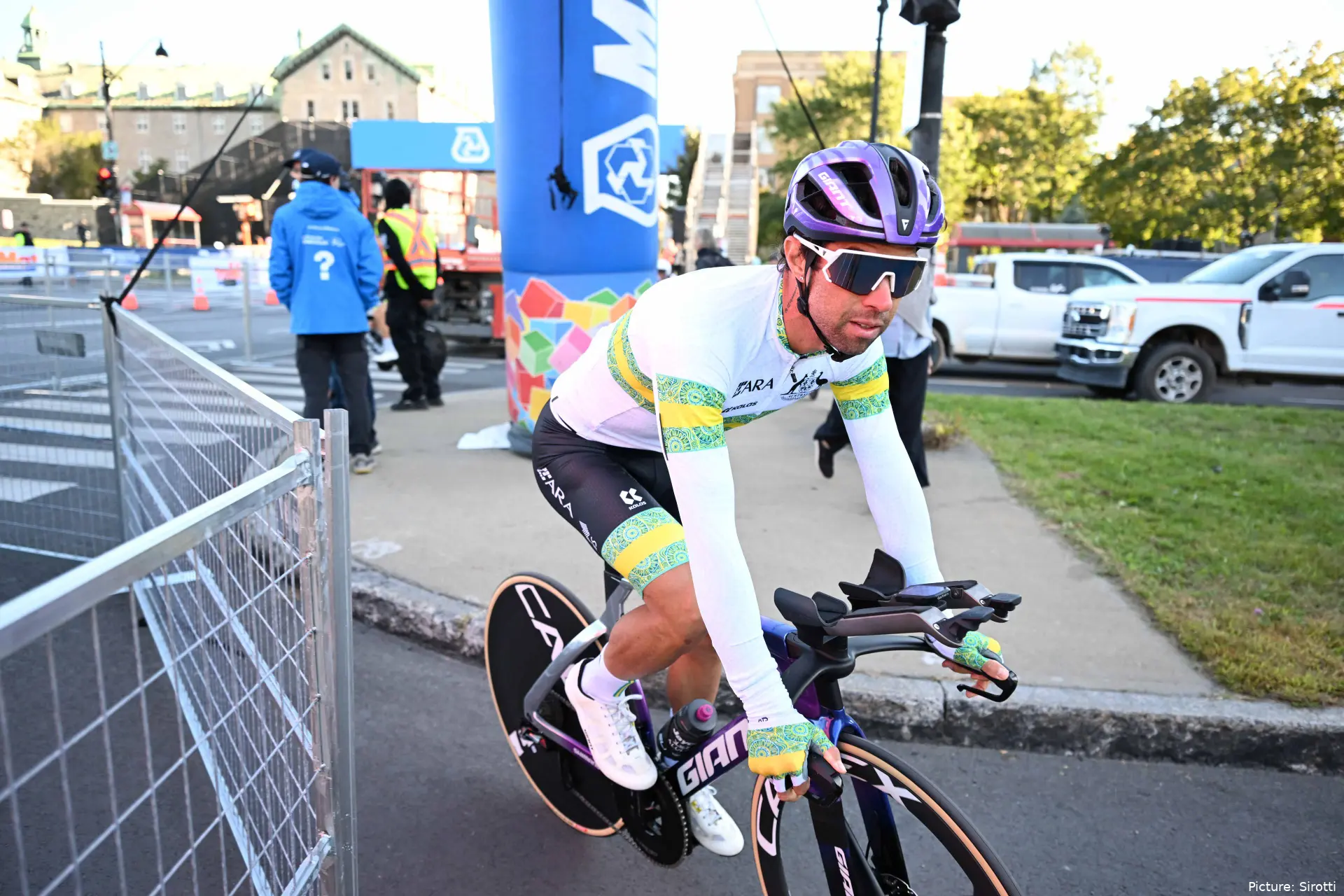
Eleven years after Michael Matthews came within one place of becoming elite road world champion in Richmond, the Australian returns to North America for the 2026 World Championships another chance on terrain carrying some of his finest career memories.
Matthews will turn 36 on the eve of the men’s road race in Montreal, where Australia arrive without Jay Vine and Luke Plapp. Sebastian Berwick had also been selected before illness disrupted his preparation and forced him to withdraw, leaving Jack Haig, Jai Hindley, Ben O’Connor, Michael Storer and 22-year-old debutant Luke Tuckwell alongside Matthews.
It is not the full-strength lineup Australia might have envisaged, yet nor can a squad containing two former elite road race medallists, two members of the 2026 Giro d’Italia top seven and one of the breakout climbers of the season be discounted. Matthews provides the finishing speed, O’Connor the freedom to attack, while the depth behind them gives Australia several ways to influence a race expected to gradually dismantle the peloton.
Australia’s men’s elite road race lineup
| Rider | Trade team | Age | Likely role |
| Jack Haig | Netcompany INEOS | 33 | Road captain and climbing support |
| Jai Hindley | Red Bull - BORA - hansgrohe | 30 | Climbing lieutenant and attacking option |
| Michael Matthews | Team Jayco AlUla | 36 | Protected leader for a reduced finish |
| Ben O’Connor | Team Jayco AlUla | 30 | Co-leader and late attacking option |
| Michael Storer | Tudor Pro Cycling Team | 29 | Long-range attacker and climbing wildcard |
| Luke Tuckwell | Red Bull - BORA - hansgrohe | 22 | World Championships debutant and aggressive wildcard |
The 273.7-kilometre race begins in Brossard before reaching the 13.4km Mont-Royal circuit, which the riders will complete 12 times. There are no Alpine passes, but the repeated climbing adds up to 3,803 metres of elevation and almost 60 kilometres more racing than the GP de Montréal held on the same circuit earlier this month.
That WorldTour rehearsal did not offer Australia much encouragement. Isaac del Toro and Paul Seixas finished together at the front after separating themselves from the other contenders, while Matthews crossed the line 54th at 15:43. Two days earlier, however, he had taken sixth at the GP de Québec, finishing in the group immediately behind winner Remco Evenepoel and runner-up Giulio Ciccone.
Those contrasting results underline the narrow route Matthews must navigate. If Montreal becomes a succession of attacks between the outstanding climbers, Australia risk losing their fastest finisher long before the medals are decided. If their climbing contingent can absorb those attacks and help deliver him into a small group, few riders likely to remain will welcome the sight of Matthews still alongside them.

Michael Matthews recons the 2026 World Championships course in Montreal
Eleven years of chasing the elite Rainbow Jersey
Matthews will make his 14th appearance in the elite men’s road race, continuing a Worlds career which began in Valkenburg in 2012. The Rainbow Jersey itself is already familiar to him: he won the under-23 road race in Geelong in 2010 and formed part of Australia’s victorious mixed relay teams in 2024 and 2025.
The missing title is the elite men’s road race. Peter Sagan denied him in Richmond in 2015, before Matthews added bronze medals in Bergen two years later and on home roads in Wollongong in 2022. Fourth in Doha in 2016 and seventh at Imola in 2020 add to a record which has repeatedly placed him near the front without delivering gold.
Michael Matthews’ elite road World Championships history
| Year | Host | Result |
| 2012 | Valkenburg | DNF |
| 2013 | Florence | DNF |
| 2014 | Ponferrada | 14th |
| 2015 | Richmond | 2nd - silver medal |
| 2016 | Doha | 4th |
| 2017 | Bergen | 3rd - bronze medal |
| 2019 | Yorkshire | 24th |
| 2020 | Imola | 7th |
| 2021 | Flanders | 25th |
| 2022 | Wollongong | 3rd - bronze medal |
| 2023 | Glasgow | DNF |
| 2024 | Zurich | DNF |
| 2025 | Kigali | DNF |
| 2026 | Montreal | 14th elite road race appearance |
Canadain roads have traditionally brought out some of Matthews’ best racing. He completed the Québec-Montréal double in 2018 and has won in Québec on three occasions, most recently in 2024. His familiarity with the Mont-Royal circuit is unmatched within the Australian team, although the 2026 season has left more uncertainty around his condition than those Canadian results might suggest.
Victory at the Gran Premio Castellón and third place at Trofeo Ses Salines gave Matthews an encouraging start to the year before a training crash in March left him with fractures to both wrists. The accident wiped out his entire spring Classics campaign and kept him out of competition for more than three months.
He returned at the Tour Auvergne-Rhône-Alpes and completed the Tour de France, where seventh and ninth were his best stage finishes. His sixth place in Québec was his strongest result since returning, but the heavy defeat on the Montreal circuit two days later was a reminder of how quickly the race can move beyond him when the leading climbers commit.
O’Connor offers Australia a second route to the medals
Australia’s chances do not disappear if Matthews is distanced. O’Connor returns to the World Championships two years after taking silver in Zurich, where he escaped from the chasing group late in the race after Tadej Pogacar’s 100km attack had already carried the Slovenian towards gold.
O’Connor’s ride was built around endurance, timing and an acceptance that waiting for the sprint would leave him empty-handed. Montreal could demand a similar approach. He is unlikely to beat Matthews, Evenepoel, Tom Pidcock or several of the leading puncheurs from a small group, but he can anticipate their attacks or exploit hesitation behind the strongest rider.
His 2026 campaign has been steady without approaching the level that carried him to second at both the Vuelta a Espana and the Worlds in 2024. O’Connor finished 10th at the Tour Down Under, 13th at the Volta a Catalunya and eighth at the Tour of the Alps before beginning the Giro d’Italia with podium ambitions.
He remained fifth overall approaching the final week but eventually slipped to 16th, then placed 28th at the Tour de France. A winless season and the physical cost of a Giro-Tour double hardly make him an obvious favourite, although Zurich showed how dangerous he can become once a championship race has splintered and the medals are being contested away from the principal favourite.
O’Connor should consequently begin as more than Matthews’ climbing domestique. Australia need him available to follow a move that Matthews cannot, especially when the repeated ascents begin separating the pure climbers from the heavier Classics riders.
Read also
Giro podium finishers give Australia climbing strength
Hindley brings the strongest major result of anyone in the team after finishing third at the Giro d’Italia. The 2022 Giro winner added 15th at the Tour de France and has finished 18th and 16th in the last two elite Worlds road races, on demanding courses in Zurich and Kigali.
A sprint is unlikely to deliver Hindley the Rainbow Jersey, but Australia can use his climbing level to follow the riders capable of breaking the race apart. He is equipped to bridge into a dangerous group, maintain a high pace for O’Connor or attack before faster finishers begin controlling one another.
Storer placed seventh at the same Giro and may be Australia’s most dangerous rider to underestimate. Fourth at the Tour of the Alps, 10th at Milano-Torino and fourth at the Memorial Marco Pantani supplement a season that has confirmed the consistency of his climbing.
His third place at Il Lombardia in 2025 also separates him from the image of a rider suited only to stage-race support. Storer has already converted his climbing into a major one-day performance and finished 19th at last year’s attritional World Championships in Kigali. Sending him up the road 50 or 60 kilometres from the finish would give Australia representation without immediately exposing Matthews or O’Connor.
Haig completes an experienced climbing trio. The 2021 Vuelta podium finisher has spent much of 2026 working for others, first at the Giro and then as an important road captain around Oscar Onley’s sixth place and white jersey at the Vuelta. Haig’s last elite Worlds appearance came in 2019, but his 19th place on the mountainous Innsbruck course a year earlier showed his ability to survive a particularly difficult championship.
At 33, and without an individual result this season to justify protected status, Haig’s greatest value should come through positioning Matthews, organising the response to attacks and preventing the leaders from spending energy before the most important laps.

Tuckwell is set for a senior World Championship debut in Montreal
Tuckwell arrives ready to embrace the chaos
Tuckwell is the only Worlds debutant in the team, but his first WorldTour season has quickly made him more than a selection for the future. Second at the 2025 Giro Next Gen, the young Australian finished sixth at the Tour de Romandie this May before taking second overall at the Tour Auvergne-Rhône-Alpes. He briefly led that race and eventually finished behind Del Toro but ahead of Juan Ayuso, offering an early indication that he can already compete against established Grand Tour riders.
Tuckwell has since completed his first Grand Tour at the Vuelta, working in support of Primoz Roglic. Montreal will take him beyond 270km for the first time at this level, but his climbing and recent race conditioning give Australia another rider capable of reaching the decisive part of the race.
“This is hard. It’s almost like a GC rider World Champs course without looking like mountains,” Tuckwell said after testing himself in the Grand Prix Cycliste de Montréal.
The 22-year-old also outlined an Australian strategy based around repeated attacks rather than waiting behind the strongest nations. “Honestly, the more chaos, if it’s like what it was on Sunday, I think the better it is for us as Aussies,” he assessed. “We have such a united front, let’s say, of guys all on a good level. You can just keep putting guys in moves up the road and if it comes back, you put another. It comes back, you put another.”
That approach may offer Matthews his best chance. Australia do not possess the overwhelming favourite or the collective strength to control almost 274km for one rider, particularly after losing Vine, Plapp and Berwick. They can instead force Belgium, France, Mexico and the other leading nations to chase Hindley, Storer, Tuckwell or O’Connor, preserving Matthews for the increasingly unlikely moment when a reduced group reaches the finish together.
Matthews remains the Australian most capable of converting survival into victory. O’Connor remains the rider most likely to salvage a medal if the circuit proves too hard for him. Between those two possibilities sits a climbing-heavy team capable of keeping Australia involved, even if the six riders who reach the Montreal start line are not the six originally imagined.

Kieran WoodDeputy Editor-in-Chief
Kieran Wood is a sports journalist based in Wales and has been active in journalism since 2022. He regularly contributes to DartsNews.com and CyclingUpToDate.com, where he covers professional cycling and darts. In cycling, his work includes liveblogs from major races, including the Tour de France, the Giro d’Italia, and La Vuelta a España, alongside race reports and analysis. He has also conducted interviews with professional riders.
His reporting spans the full racing calendar, from one-day classics to stage races, with a focus on accurate, real-time coverage and clear contextual analysis. For statistics, results, and historical context, he regularly uses resources such as ProCyclingStats. To support reporting on rider activity and training context where relevant, he also references Strava.
In his work, Kieran places strong emphasis on careful sourcing, editorial accuracy, and updating articles as new, verified information becomes available.
claps 0visitors 0
Just in
Popular news
Latest comments
- And, if I’m correct, the first monument win for this legendary team which I still call AG2R with their garish brown shorts ;)anonymouscyclist10-10-2026
- Seixas just raced a splendid race, with timing and patience and leveraging the work of all the other teams - Yates led him out beautifully, oops. A beautiful ride, truly showing off what was made clear at Strade Bianchi and Liége-Bastogne-Liége. Well deserved champion, and a new first time Monument winner for the first time in quite a while (Philipsen 2024)!RidesHills10-10-2026
- Phwoar… Chapeau Seixas. Chapeau. Taking Lombardia today has all the makings of a generational breakthrough. I have a feeling we’ll be looking back at this win as his career-defining moment.anonymouscyclist10-10-2026
- Is Del Toro goin to sh*t his pants back there???? Yep...he sh*t his pants!!!PogiSloFans10-10-2026
- Imagine being a cycling analyst and not knowing off the top of your head, a handful of riders who wanted to do the very thing he is saying no rider has ever wanted to do. There are many riders, both men and women, who choose to take a break, and spend more time with their family. Jonas, WvA, Carapaz, and Lizzie Deignan come to mind. Give me a break.anonymouscyclist10-10-2026
- Enter Paul Sexias, Bye Remco no ballsabstractengineer10-10-2026
- Bravo Seixas!!! It just goes to show what BS UAE and Del Toro are without Pogi. It just goes to show that Remco "the great" is not great. Did he win the WC? NO!!! Is he going to win Il Lombardia-a Monument? NO!!! He won a BS second class race in Slovenia (my country), but when it comes to the "big boys" he's nothing (not including ITT). In the end of the cycling season 2026, we can all see why Pogi is THE GOAT...and we can all see a new rising star PAUL SEIXAS. Everything else is a sad sad story.PogiSloFans10-10-2026
- This aged badly…anonymouscyclist10-10-2026
- Come on Seixas! This will be transforming for the young Frenchman’s career if he wins this…anonymouscyclist10-10-2026
- I know, news flash - a Dad isn’t a baby sitter. he is a parent. I can only assume something was lost in translation.mij10-10-2026
Loading
Write a comment