The world champion with a point to prove on home roads - Can Magdeleine Vallieres silence the ‘fluke’ questions after entire rainbow season without a podium?
Cycling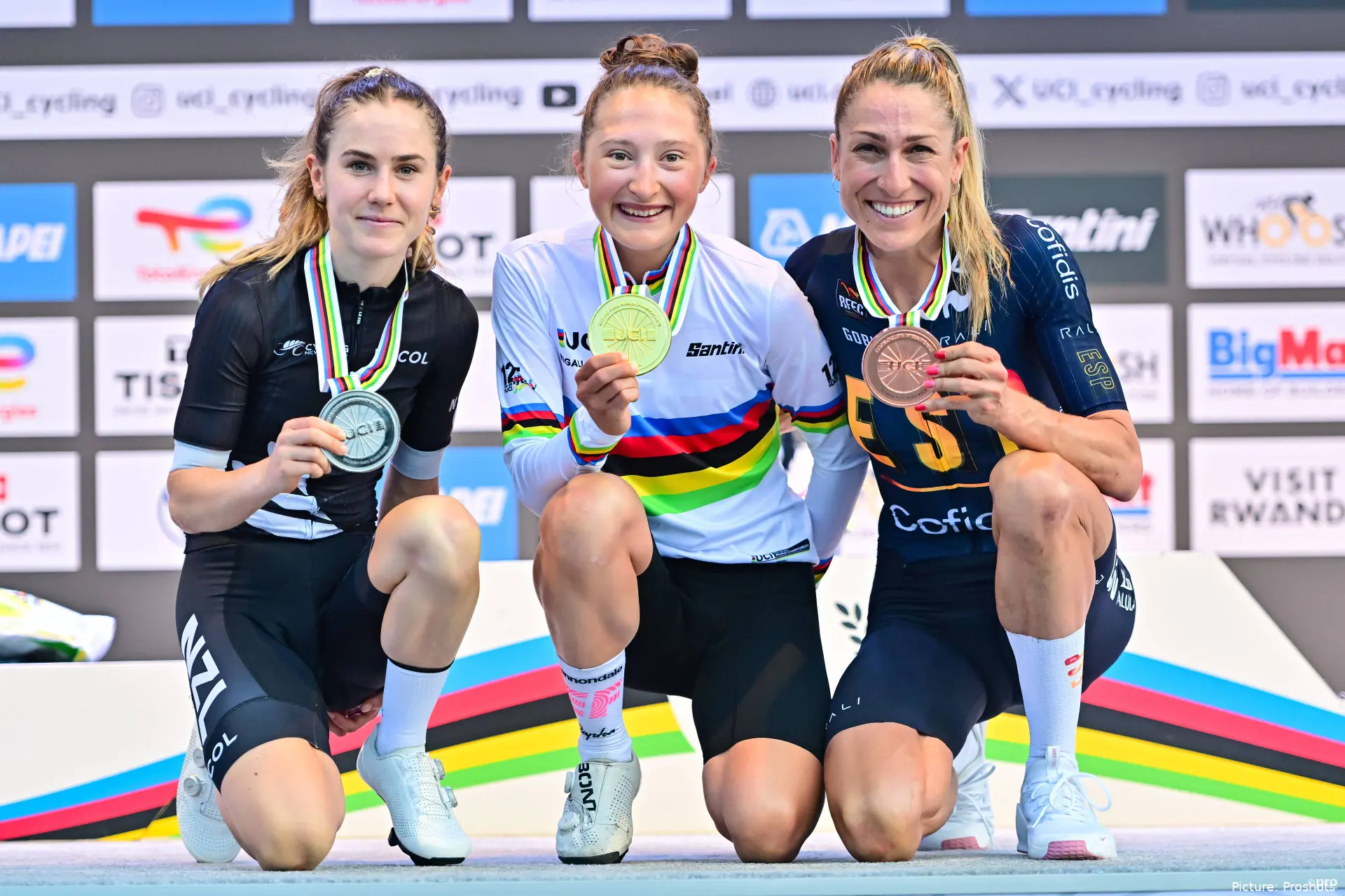
Magdeleine Vallieres produced one of the shocks of the 2025 World Championships when she rode away in Kigali to become Canada's first-ever elite road race world champion. Almost twelve months on, she heads into a home title defence in Montréal having experienced a very different kind of rainbow season, one in which she has not finished on the podium once.
According to research highlighted by CyclingBottle, Vallières is the first reigning women's road world champion in at least three decades to go through her rainbow year without a single top-three finish. Fifth at Strade Bianche remains her best result of 2026, with sixth at La Flèche Wallonne and eighth at Liège-Bastogne-Liège her other standout one-day performances.
Those are hardly poor results, particularly for a rider who spent much of her early professional career working for others. They also sit awkwardly alongside the expectations that come with the rainbow jersey, especially after a World Championship victory that was so unexpected in the first place.
Vallières entered the 2025 Worlds with just one previous professional victory, the 2024 Trofeo Palma Femina. She had already shown flashes at the highest level, including 14th in the 2024 World Championship road race in Zurich, but she was nowhere near the top line of favourites in Rwanda.
After surviving a punishing 164.6-kilometre race, Vallières made the decisive selection before attacking Niamh Fisher-Black and Mavi García on the final ascent of the Côte de Kimihurara. Neither could follow and the Canadian rode alone to a victory that instantly changed her career.

Vallieres finished 8th at Liege-Bastogne-Liege 2026
From Kigali outsider to one of the most visible riders in the peloton
The rainbow jersey changed Vallières' position in the peloton almost overnight. A rider who had built much of her reputation through support work was suddenly impossible to miss, and she has spoken openly this year about adapting to the extra attention and expectation that followed Kigali.
Her results have also become more consistent. Fifth at Strade Bianche came after she survived into the decisive group and attacked on the climb towards Siena, before sixth at Flèche Wallonne and eighth at Liège followed during the Ardennes. She also finished sixth overall at Setmana Ciclista Valenciana and 12th at the Giro d'Italia Women.
| Race | Result |
| Strade Bianche | 5th |
| La Flèche Wallonne | 6th |
| Liège-Bastogne-Liège | 8th |
| Setmana Ciclista Valenciana | 6th GC |
| Giro d'Italia Women | 12th GC |
| Itzulia Women | 13th GC |
| Tour de France Femmes | 18th GC |
Yet September has arrived without a victory, second place or third place, and that unusual record prompted debate when CyclingBottle highlighted it ahead of the Worlds. "Silly take when she was working for her team at the front of most of her races this year, being very visible and active," analyst Benji Naesen replied.
CyclingBottle pushed back: "The rainbow jersey is associated with riding finals and even victories. I lowered the bar for her to podium spots, because I can't expect her to suddenly win a lot of races, but even that bar was too high. As a Worldchampion, you should demand the lead too."
Vallières has continued to work for teammates while wearing rainbow. At the Tour de France Femmes, for example, she spent time in the break before later dropping back to help Cédrine Kerbaol limit her losses, while EF Education-Oatly have used her aggressively elsewhere without always treating her as an unquestioned sole leader.
But the team were equally clear after Kigali that her role was supposed to evolve. "When she was a helper, our team could always count on Mags to pull during the hardest moments of the hardest races," EF said when announcing her contract extension through 2028. "Now, we'll count on her to go on the attack."
Vallières made similar ambitions clear herself. "I learned a lot from helping others. I won the worlds because of it," she said. "Now, I am looking forward to taking a different approach and trying to bring everything I learned to race more as a leader."
Before the season she also spoke of wanting more opportunities for herself and specifically targeted winning one of the Ardennes Classics. EF have given her chances to do exactly that. At Strade Bianche, Vallières and Noemi Rüegg initially shared responsibility before the world champion became the team's rider in the final selection, while at Flèche Wallonne and Liège-Bastogne-Liège she remained one of EF's protected options deep into the finale.
She has certainly not enjoyed the kind of automatic hierarchy that surrounds some of the sport's biggest stars, but neither has the season been spent entirely in service of others.
Read also
A stronger rider without the result to show for it
Perhaps the strangest part of Vallières' rainbow year is that the rider underneath the jersey arguably looks stronger than the one who won it. Before Kigali, she was primarily known as a dependable teammate with flashes of promise in hard races. Since becoming world champion, she has produced a run of top-level results that points towards clear progress, even without the win or podium that would normally underline it.
Kigali remains one of only two professional victories on Vallières' palmarès, and almost a year spent in the rainbow bands has failed to add another one despite repeated appearances near the front of major races.
She has also admitted that the jersey brought a psychological adjustment alongside the sporting one. The extra attention was unfamiliar, while moving from helping teammates to being expected to contest finales required greater confidence and a different way of racing. That development has been visible through the season, even if the standout result has never arrived.
Montréal offers the perfect answer
Few defending world champions get an opportunity quite like this one. Vallières will start the elite women's road race in Montréal with number one on her back, racing in her home province of Quebec in front of family, friends and a Canadian crowd that watched her make history twelve months earlier.
The 180.4-kilometre course gives her legitimate reason to believe she can be involved again, with around 2,500 metres of climbing and repeated ascents of Mount Royal, including eight passages over Camillien-Houde. The repeated efforts should suit a rider whose best performances in the rainbow jersey have come on demanding terrain where attrition gradually strips the race down.
The obvious difference is that nobody will overlook her this time. Vallières arrived in Rwanda as an outsider; she starts in Montréal as defending champion, on home roads, with every rival fully aware of how dangerous she can be if she survives into the final selection.
Her season since Kigali has produced stronger consistency without delivering the second defining result that would fully alter the conversation around her title. Montréal gives her one last, and by far the biggest, opportunity to do that.
If Vallières keeps the rainbow jersey in Canada, the lack of a podium in the months leading into the race will quickly become little more than an odd statistical footnote. If she cannot, that unusual record will remain one of the defining details of a rainbow year that has shown clear progression without ever producing the result expected to confirm it.

Kieran WoodDeputy Editor-in-Chief
Kieran Wood is a sports journalist based in Wales and has been active in journalism since 2022. He regularly contributes to DartsNews.com and CyclingUpToDate.com, where he covers professional cycling and darts. In cycling, his work includes liveblogs from major races, including the Tour de France, the Giro d’Italia, and La Vuelta a España, alongside race reports and analysis. He has also conducted interviews with professional riders.
His reporting spans the full racing calendar, from one-day classics to stage races, with a focus on accurate, real-time coverage and clear contextual analysis. For statistics, results, and historical context, he regularly uses resources such as ProCyclingStats. To support reporting on rider activity and training context where relevant, he also references Strava.
In his work, Kieran places strong emphasis on careful sourcing, editorial accuracy, and updating articles as new, verified information becomes available.
claps 1visitors 1
Just in
Popular news
Latest comments
- Remcos ego got between the line and success
 leedorney10-10-2026
 - Well, that is a good point but probably no one. Seixas might be close. We will see in the next two to three years.PogiSloFans10-10-2026
- Things do need to change. Everyone, journalists in particular need to hold the UCI’s feet to the fire and bring about real change so this isn’t repeated!Paul53110-10-2026
- There is one common denominator in all of these situations, the UCI. If the race organisers ignore the recommendations of SafeR or they fall below the standards expected or a reasonably competent race organisation by allowing vehicles onto the course and endangering riders lives then surely the one organisation that can exercise sanctions is the UCI. It seems that the UCI big wigs are very happy to drink champagne in the VIP enclosures and bask in the glory of these events but are a toothless tiger when things go wrong. How many Finley Tarling or Muriel Furrer incidents does the sport have to endure until the UCI starts acting? I have to say that it’s encouraging the riders have made a protest and full marks to Adam Hansen for his endeavours, it can’t be easy trying kick such an intransigent organisation to actually do something more useful that legislate on sock lengths and handlebar widths!Paul53110-10-2026
- Oh come on!Lozza10-10-2026
- I left a comment after Pidcock nearly stopped racing the other day but cyclinguptodate either terminated the article or archived it. Basically what I said was that cycling journalists need to keep following up on these type of situations and constantly asking the UCI and organisers what they are doing on the back of these protests. It’s not just a test of the regulators and the organisers but a test of how independent you journalists are. Is it just that you don’t want to rock the boat too much or are you prepared to push these things through and hold people to account? Time will tell.Paul53110-10-2026
- Thing is, who will ever be as good as Pogi?Lozza10-10-2026
- Once again Del Toro proved he will NEVER be Pogi... NEVER... not even close. People were already talking about him going to another team, so he wouldn't only be Pogi's domestique, but no... he better stay in UAE, help Pogi, and Pogi will help him and give him a win or two every year.PogiSloFans10-10-2026
- Once again Del Toro proved he will NEVER be Pogi... NEVER... not even close.PogiSloFans10-10-2026
- A little harsh, especially on del Toro who’s had a great couple of seasons! Suffering with a bad knee and probably shouldn’t have been racing today. I’m no Remco fan, so not sad to see him lose out today! As a massive Pogi fan I really hope Pogi will be back to his imperious best SOON!Lozza10-10-2026
Loading
Write a comment