DISCUSSION | Tour of Flanders 2026 - Race commissaires afraid? Railway crossing chaos & a victory handed to Tadej Pogacar on a silver platter?
Cycling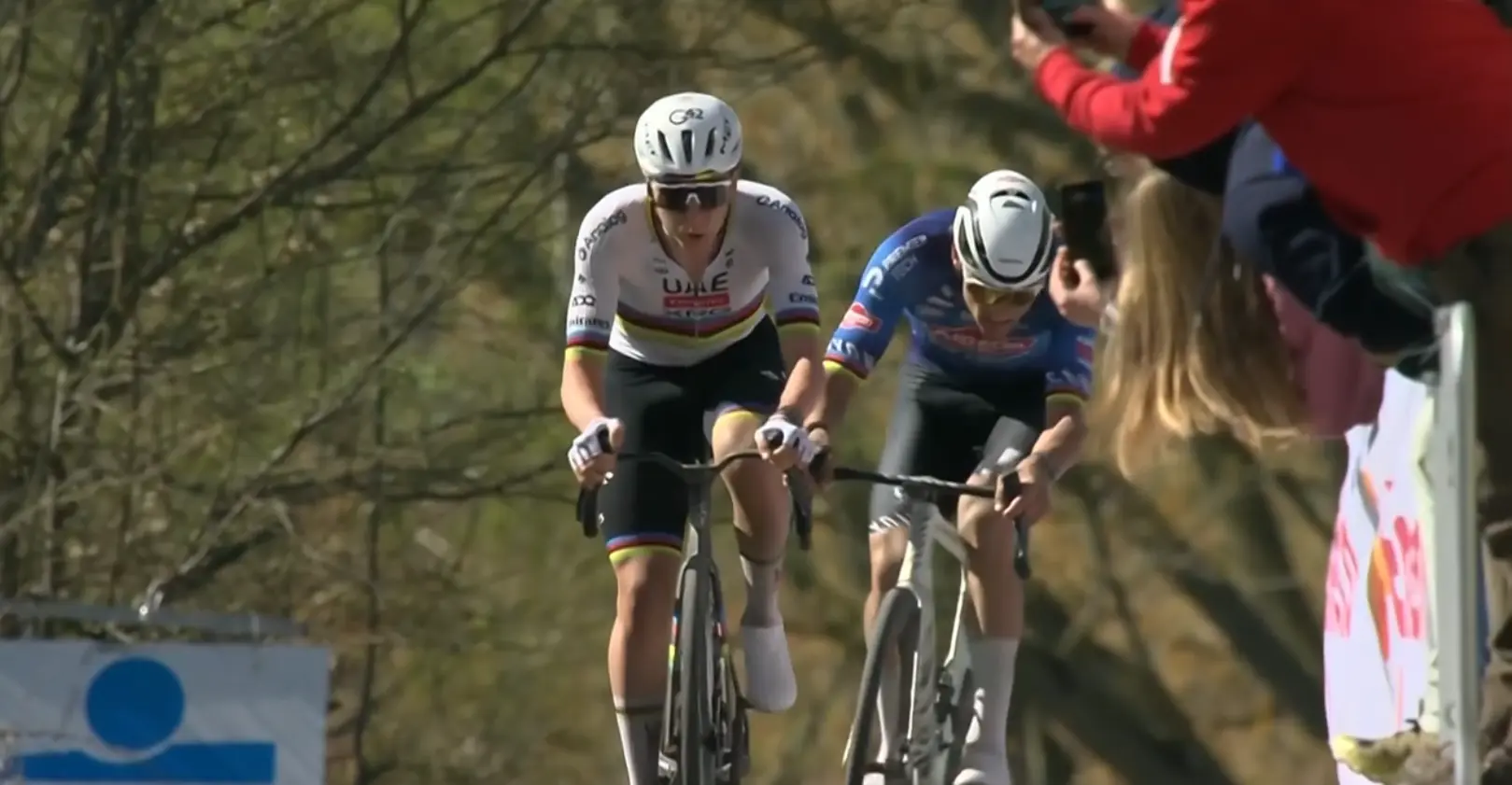
Tadej Pogacar and Demi Vollering produced two of the most authoritative performances of the spring classics season, each conquering the Tour of Flanders with long-range attacks on the Oude Kwaremont that left their rivals scattered across the Flemish hills.
In races defined by attrition, positioning, and explosive climbing, both riders imposed themselves with strikingly similar dominance, turning two already selective contests into exhibitions of individual strength.
Pogacar claims a third Flanders crown
In the men’s race, Tadej Pogacar added a third Tour of Flanders title to his growing list of Monument victories, delivering a performance that combined tactical patience with repeated, punishing accelerations.
The Slovenian world champion ultimately rode alone into Oudenaarde after distancing Mathieu van der Poel on the final ascent of the Oude Kwaremont, settling a duel that had animated the decisive phase of the race.
The 278km contest did not ignite immediately. Following the start in Antwerp, it took nearly 30 kilometers for a breakaway to establish itself after a flurry of unsuccessful attacks. When the move finally went clear, it featured 13 riders, including notable engines such as Silvan Dillier - a key teammate of Van der Poel - as well as a mix of WorldTour and ProTeam representatives.
The peloton hesitated just enough to allow the gap to stretch, with UAE Team Emirates content to control rather than chase aggressively in the early phase.
The break’s advantage hovered around three minutes under the steady pacing of riders like Nils Politt and Mikkel Bjerg, but the race’s rhythm was disrupted in unusual fashion with more than 200 kilometers still to race.
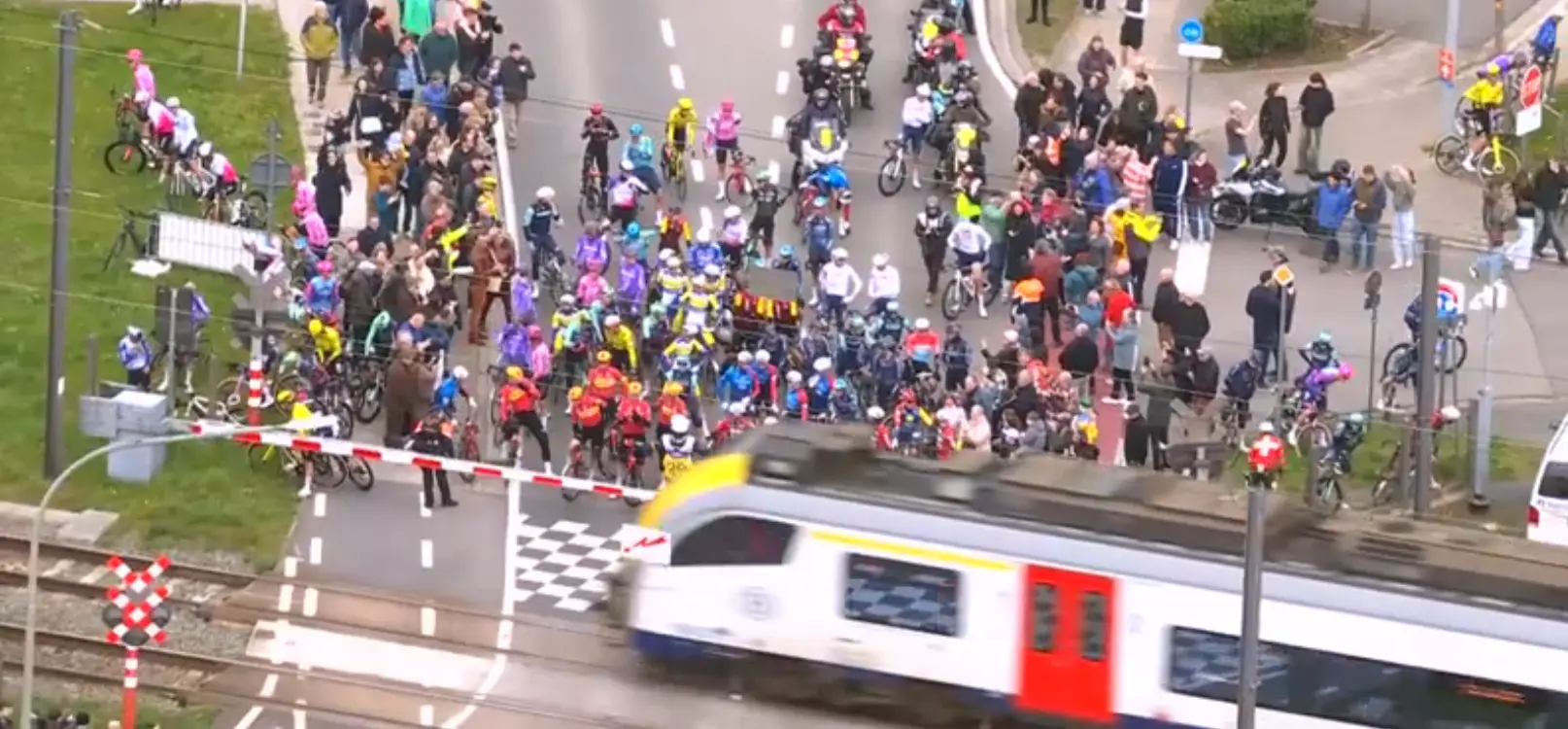
A railway crossing incident split the peloton, with a front group - including Pogacar - passing before the barriers came down, while a significant portion of the bunch, including Van der Poel, was forced to stop.
Race officials intervened, instructing the leading group to wait in order to restore fairness. Although UAE Team Emirates initially appeared reluctant to ease up, the pace was eventually neutralized, allowing the race to regroup.
No riders were disqualified, but the interruption handed the breakaway a larger advantage, which swelled to more than five minutes heading into the first ascent of the Oude Kwaremont.
From that point, the race gradually rebuilt its tension. The gap began to fall as the peloton increased the tempo, with accelerations appearing on climbs like the Wolvenberg and Molenberg. Teams began positioning their leaders, and the early break’s cohesion started to fracture under pressure from behind.
The decisive phase began in earnest over the sequence of cobbled climbs where the favorites revealed themselves. UAE Team Emirates - XRG lifted the pace significantly, and a powerful move from Florian Vermeersch helped split the peloton, leaving a reduced front group of around 15 riders. This elite selection included all the major contenders: Pogacar, Van der Poel, Remco Evenepoel, Wout van Aert, and Mads Pedersen among others.
As the race moved deeper into the final 80 kilometers, the remnants of the breakaway were gradually reeled in, and the contest reset among the strongest riders. Attacks and counterattacks followed in rapid succession, with riders like Christophe Laporte attempting to anticipate the decisive moves. However, it was clear that the race would be settled on the iconic climbs that define Flanders.
Pogacar made his intentions clear before the second ascent of the Oude Kwaremont, launching a sharp acceleration even before the cobbles began. Van Aert reacted immediately, with Pedersen and Evenepoel also responding, while Van der Poel briefly found himself out of position before clawing his way back into contention.
The pace proved too much for some. Van Aert began to struggle near the top of the climb and was eventually distanced, leaving a leading trio of Pogacar, Van der Poel, and Evenepoel to push on. Over the Paterberg, Evenepoel attempted to seize the initiative, but Pogacar responded forcefully, countering the move and putting the Belgian under pressure.
Soon after, Evenepoel was dropped, leaving Pogacar and Van der Poel alone at the front with around 50 kilometers remaining. The two riders, long-time rivals with contrasting styles, began a tense collaboration, though the balance of power appeared to favor Pogacar, who repeatedly tested his companion with short, explosive efforts.
Evenepoel refused to concede, hovering within striking distance for several kilometers and briefly threatening to reconnect. However, each time he edged closer, Pogacar found another acceleration, gradually eroding the Belgian’s resistance. Behind, Van Aert and Pedersen were locked in a separate battle, unable to close the gap to the leaders.
The race-defining moment came on the final ascent of the Oude Kwaremont. Pogacar attacked early on the climb, immediately opening a gap. Van der Poel initially limited the damage and even appeared to regain some ground near the summit, but the effort had taken its toll. On the run toward the Paterberg and beyond, the gap began to grow once more.
By the foot of the final climb, Pogacar held a small but decisive advantage. He extended it further on the Paterberg and then powered away on the flat run-in to Oudenaarde. With each kilometer, his lead increased, transforming a narrow gap into a commanding margin.
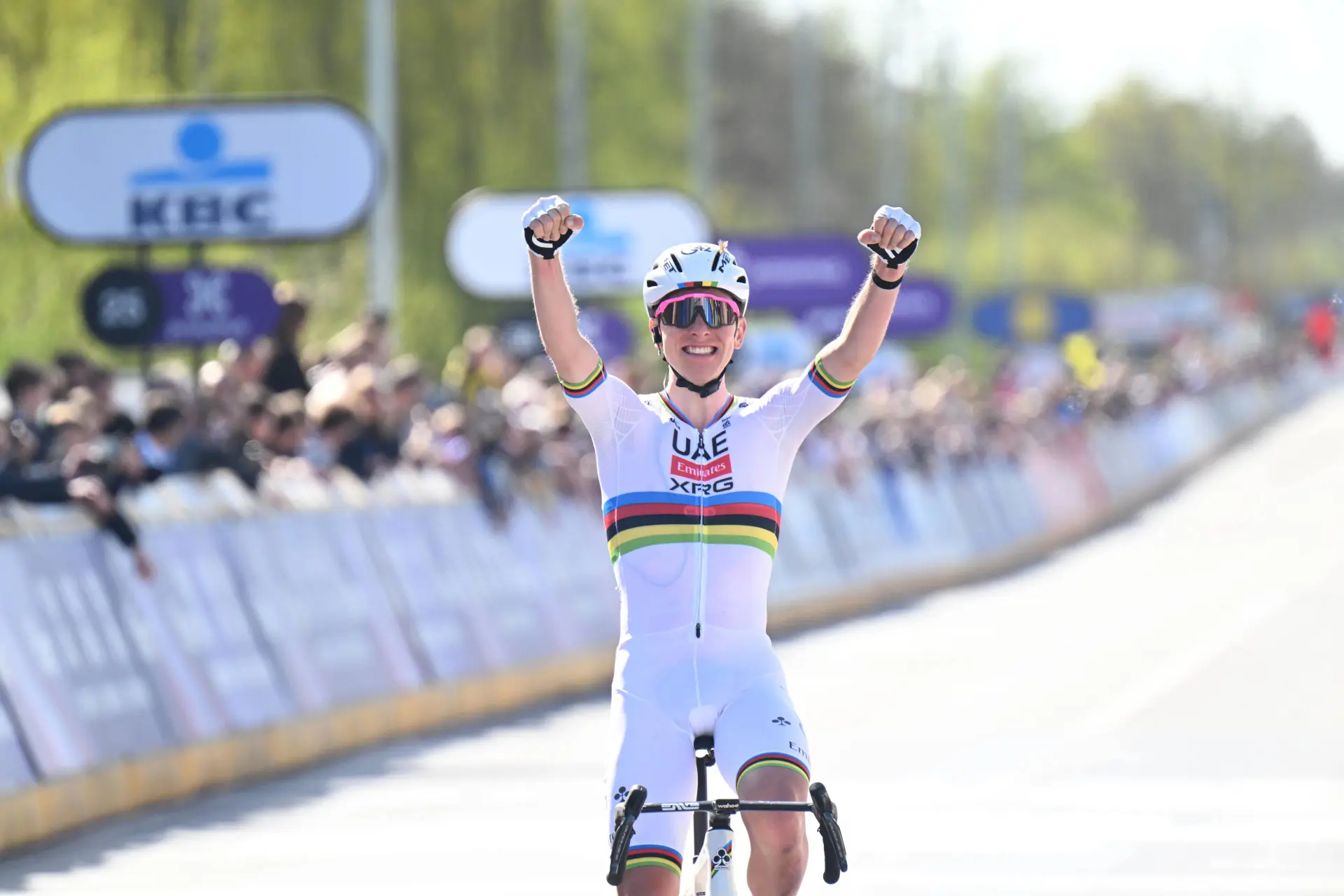
Tadej Pogacar crossed the line alone, celebrating a third Tour of Flanders victory. Mathieu van der Poel followed in second place, while Remco Evenepoel secured third after a determined solo chase. Wout van Aert and Mads Pedersen completed the top five, both having been distanced in the decisive moments.
Vollering mirrors dominance in women’s race
The women’s race unfolded in much the same way, with Demi Vollering securing a resounding victory thanks to a devastating attack on the final climb of the Oude Kwaremont.
The 164km race began aggressively, with numerous riders attempting to form a breakaway. An initial group of four eventually expanded to six riders, who established a maximum advantage of around six minutes over the peloton. However, the race was far from straightforward, as crashes disrupted the chasing group.
Among those caught up in incidents were Lorena Wiebes, who was able to continue after an early fall, and Marlen Reusser, who was later involved in a more significant crash that forced her out of contention. These moments contributed to a fragmented and tense race environment as teams attempted to regain control.
As the race approached the decisive climbs, the breakaway was gradually reeled in. The peloton thinned under increasing pressure, particularly on climbs like the Molenberg and Koppenberg, where tempo changes forced splits and exposed weaknesses.
A select group of favorites emerged, including Vollering, Lotte Kopecky, Pauline Ferrand-Prévot, Puck Pieterse, and others. The group briefly expanded again as riders rejoined, setting up a tense run toward the final climbs.
The decisive move came on the last ascent of the Oude Kwaremont. Vollering attacked with precision and power, immediately distancing her rivals. Ferrand-Prévot attempted to follow but was unable to hold the wheel, gradually slipping back before being joined by Pieterse.
Behind them, Kopecky and others attempted to organize a chase, but the cohesion was lacking, and the gap continued to grow. Vollering, meanwhile, rode with increasing confidence, extending her lead over the rolling terrain toward Oudenaarde.
On the Paterberg, Pieterse briefly distanced Pauline Ferrand-Prévot, but the two later reunited and cooperated in pursuit of second place. Despite their efforts, they were unable to make significant inroads into Vollering’s advantage.
The Dutch rider maintained a strong, steady pace all the way to the finish, crossing the line alone to claim victory in her sixth participation in the race. Pauline Ferrand-Prévot outsprinted Puck Pieterse for second place, while Lotte Kopecky won the sprint from the chasing group to secure fourth.
Carlos Silva (CiclismoAtual)
What a day of racing. What more could a cycling fan ask for when the very best in the world line up on the same roads? Now that a few hours have passed since the finishes, I’m left feeling satisfied - still digesting everything I’ve just witnessed.
Let me start with a word for the race commissaires. What on earth was that at the railway crossing? Half the peloton got through, the other half was forced to stop. Many riders ignored the warning signals - both lights and sound - and rode through the level crossing regardless.
Why didn’t the commissaires act according to the regulations? And as if that wasn’t enough, they compounded the problem by failing to neutralise the breakaway, which suddenly saw its advantage jump from three to five minutes. How is it possible to restart a race under those conditions?
Wout van Aert and Mads Pedersen were at their very best. A hard-earned place in the final top five, behind Tadej Pogacar, Mathieu van der Poel and Remco Evenepoel, is a result of real value. Pogacar rode exactly the race he wanted - accelerating at will, gradually dismantling the group of favourites until only the Dutchman from Alpecin remained.
Evenepoel was distanced but hovered in that in-between zone all race long - at times almost bridging back to the leaders, then losing a few seconds again. But he never gave up. He fought alone against two machines until the final climbs. A debut at Flanders that leaves you wanting more.
Van der Poel was exactly himself: brave, relentless. He gritted his teeth whenever Pogacar attacked and threatened to pull away, never hiding from the workload, even knowing that if the world champion went all-in, he would likely struggle to follow. A true champion.
Ruben Silva (CyclingUpToDate)
A race where you can't really do any analysis. As a cycling fan, it was a big disappointment to see 'De Ronde' come down to a race that looked to follow a script, the exact same script as 12 months ago - almost like an off-season Tour de France criterium.
The fight for the win came down to the exact same details. Pogacar attacks the 2nd Oude Kwaremont and makes a selection, attacks the Koppenberg and goes along with just Mathieu van der Poel; and then on the final Kwaremont he attacks and drops van der Poel to take a solo win. There were only 2 victory contenders and they actually just replicated last year's race to the smallest of details.
Remco Evenepoel did a time trial for third, which isn't a surprise seeing as the race had no tactics or positioning into the key moments, so he could climb without needing the experience to be at the front in the right moments, only W/Kg efforts up the many cobbled climbs; Whilst Wout Van Aert and Mads Pedersen also looked their best and time trialed into the last places in the Top-5.
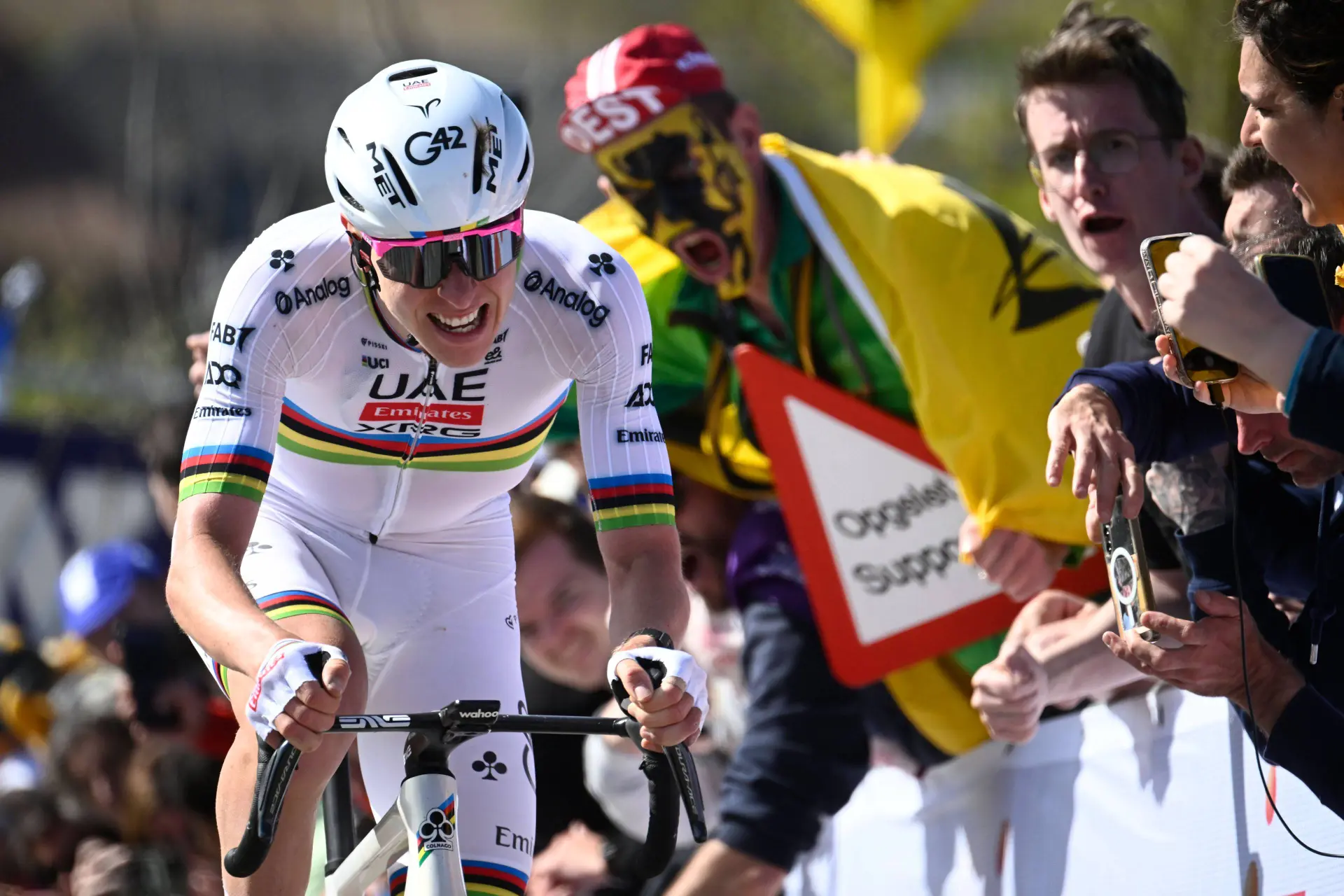
All-in-all, everyone finished exactly where you'd expect, and in the way you'd expect. Tadej Pogacar was the man to beat, and as we expected, the strongest on the climbs. When he attacked the Kwaremont Remco Evenepoel began working with him, trying to seal a place in the podium and quickly showing that he wasn't trying to challenge Pogacar - whilst leaving Wout Van Aert behind.
Then Evenepoel himself was dropped, but the gap to Van Aert had grown to a point where he couldn't find an ally to come back. Then Mathieu van der Poel does the exact same mistake. He works with Pogacar, fully knowing he is likely to get dropped later if he does so, and in the process, distancing the one rider who might be an ally to him.
In any case van der Poel shouldn't have worked. Firstly he was already proven to be the 2nd strongest in the race; Secondly if he did not work and even if several riders came back, the difference between second and fourth or fifth is meaningless to a rider like him; Third he NEEDED Evenepoel's presence in order to have the chance of putting Pogacar under pressure by forcing him to close gaps or take longer periods of rest to regain his explosivity.
But the Dutchman chose to work and the outcome was a literal deja vu. The explanation is respect, I guess? But it's an unanimous bowing down to a superior rival instead of putting him under pressure.
The race opened early, to the credit of UAE who split it up, and I can't blame the riders for not trying too hard to anticipate the second Kwaremont as the pace was high, but there was even less tension or anticipation than last year, none of the secondary favourites were in early attack aside from a few attempts from Christophe Laporte.
One must wonder how Peter Sagan must feel at home watching Pogacar's rivals all work with him instead of doing what they can to win the race (which applies in many other scenarios)... In a regular race that is fine but this is a monument, and ultimately a race I love.
This afternoon I just watched the race with a constant "you know you shouldn't do that, right?" feeling all along and completely unsatisfied. And a race that was once a spectacular, open and tactical race has seen the same fate (only more drastic) of Liège-Bastogne-Liège or Il Lombardia where it almost feels like you're watching a scripted exhibition race.
Jorge Borreguero (CiclismoAlDia)
Tadej Pogacar’s victory in the 2026 Tour of Flanders is not just another Monument. It is, quite possibly, one of the most complete performances ever seen in this race… and that is saying a great deal.
Because Pogacar didn’t win on the counter-attack or by capitalising on a mistake. He won by imposing his will from afar, as if Flanders were the domain of a dominant stage racer… when in reality it is the sanctuary of the specialists
. Attacking at 57 km, shaking off all the favourites, and still having the composure - and the legs - to finish it off on the Oude Kwaremont is simply outrageous. The most significant thing is not that he dropped Wout van Aert, who had been putting in outstanding performances without a win in the previous races, or Mads Pedersen.
It is that he also ended up breaking Remco Evenepoel… and, above all, he won the head-to-head battle against Mathieu van der Poel, who is the true barometer in this type of race. And here lies the key: Pogacar has learnt to ride the Tour of Flanders.
Before, it was pure momentum, constant attacks, perhaps excessive exertion. Today he remains aggressive, but far more intelligent. He chose the exact moment, the perfect terrain and the right opponent. And when he opened up a gap, there was not a single doubt.
Moreover, the context makes the victory even more impressive. He had just won Milan–Sanremo, a race that had eluded him. And now he has 12 Monuments to his name, closing in dangerously on the legend of Eddy Merckx. We are no longer just talking about the best rider of the moment: we are talking about someone who is building a truly historic legacy.
The most striking thing? That the focus now shifts to Paris-Roubaix. And given this level of performance, the question is no longer whether he can win it… but who can stop him.
And you? What’s your opinion on Tour of Flanders 2026? Tell us what you think and join the discussion.
Carlos Silva is a writer for CyclingUpToDate.com, where he contributes race reports, interviews, analysis pieces, and live coverage of the international cycling calendar. Holding a degree in Sports from the Jean Piaget Institute, he combines academic knowledge of performance, training, and competition with hands-on journalism experience in professional cycling.
Throughout his career, Carlos has conducted interviews with leading figures in the sport, including Alberto Contador, Joaquim Rodríguez, Óscar Pereiro, João Almeida, Isaac del Toro, Derek Gee, John Degenkolb and Geraint Thomas. These conversations reflect direct engagement with Grand Tour winners, Classics specialists, and emerging talents.
He has provided on-site coverage at major events ranging from the Vuelta a España to the Tour de France, alongside stage races such as Vuelta a Andalucía, Volta ao Algarve, Volta a Portugal and O Gran Camiño. Covering the mythical climbs of the Giro d'Italia remains one of his professional ambitions.
Carlos is responsible for liveblog coverage of all major WorldTour races and beyond, including the Tour de France, Giro d'Italia and Vuelta a España. His reporting integrates verified data from ProCyclingStats to ensure statistical accuracy, contextual depth, and analytical precision.
A lifelong cycling enthusiast, he approaches storytelling across written, photographic, and video formats with a focus on credibility, tactical insight, and informed race interpretation.
claps 3visitors 3
Just in

Popular news
Latest comments
- With the exception of Axel Laurence, the rest are in their 30's. My opinion is I think, perhaps, we're beginning to see the effects of younger riders coming into the pro ranks. I believe we're going to see those effects in the coming years. All teams are looking for the next Pogi, Jonas & Seixas. Of course, Seixas hasn't proved himself yet. He's just a kid. I believe he will though. Remco is a strange case. I believe if he can overcome being erratic, he should wn a few Tours, What do you guys think?Paggss27-10-2026
- And, at 2% he'll still destroy the competition...Paggss27-10-2026
- I agree.Paggss27-10-2026
- I hear you, I'm 73 with C5 & C6 fused. Also, I'm two aortic valve replacements and three pacemakers down. Yea, Father time is catching up. I'm just glad I can ride at a good level. Uphills are not my favorite however, I love those downhills! I guess I give us 'old guys' some inspiration. :~ )Paggss27-10-2026
- Prove otherwise... I'm sure there's thousands of Glaswegians will be happy to tell you their version of it!slappers6627-10-2026
- they should allow teams to add to the roster limit if they are adding riders in other disciplines. for example, you can have 30 road riders, 3 gravel, 3 mountain bike, 3 cyclocross. that way a team isn't penalized by losing road riders by expanding into other disciplines. of course it needs to be policed as does a team classify Pidcock, MVDP or WVA as cross, mountain, or what? But that is workable.mij27-10-2026
- great guy and a winner if he can stay healthy.mij27-10-2026
- Utter rubbish
 Rafionain-Glas27-10-2026
 - Ha! For “spring” read “sprint”.Lozza27-10-2026
- Well, for all the whinging about UAE’s massive budget allowing them to buy up all the talent at the expense of the other teams, just take a look at the last couple of seasons of transfers and I think you’ll find UAE aren’t the ones snapping up all the talent!Lozza27-10-2026
Loading
3 Comments