Concerns for the future? Guillaume Martin admits still being "physically and mentally scarred" by “violent crash” which fractured two vertebrae at La Vuelta 2025
Cycling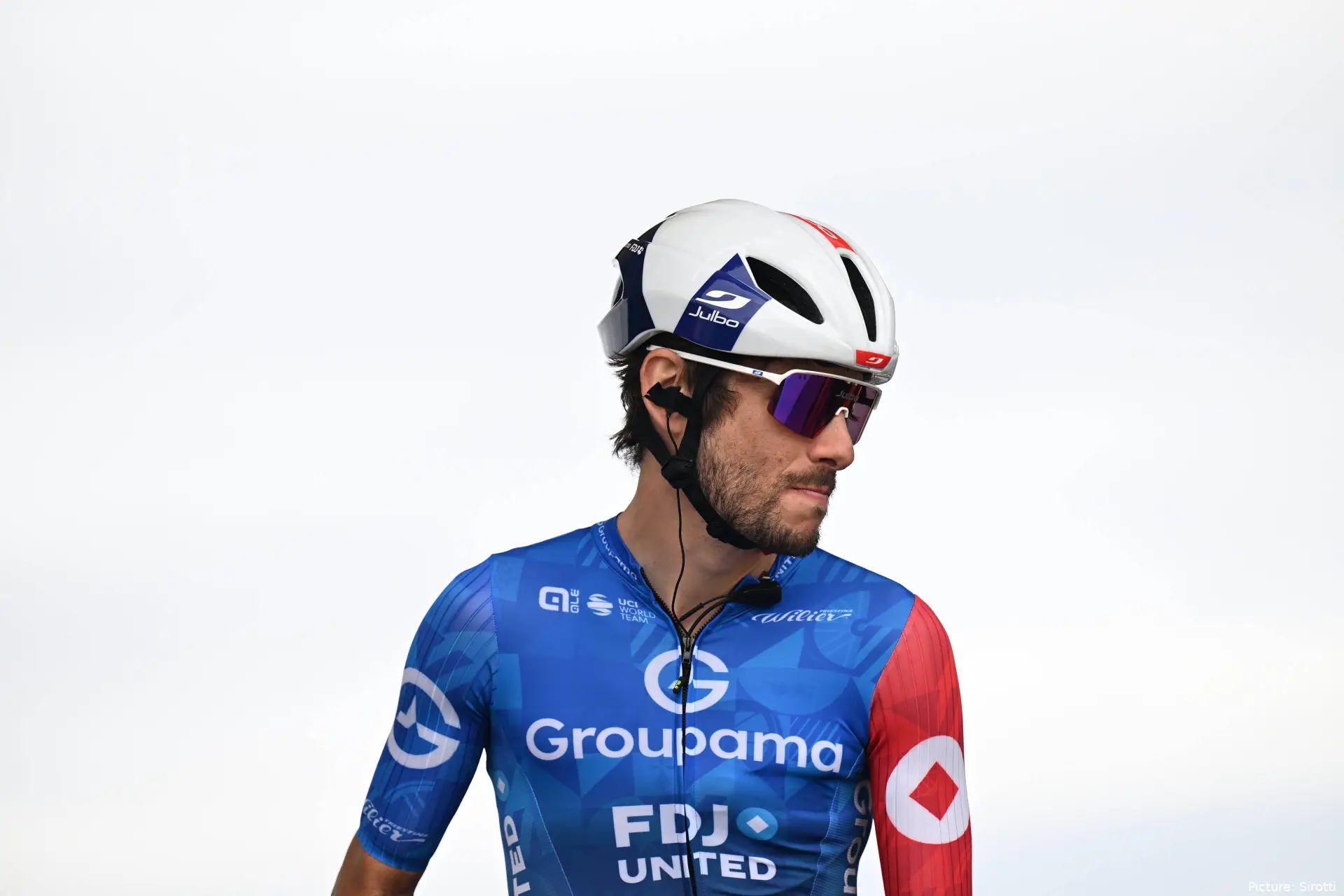
Guillaume Martin has revealed the full physical and psychological toll of the crash that ended his Vuelta a Espana and, arguably, defined the second half of his 2025 season.
Speaking candidly to DirectVelo, the 32-year-old climber admitted that the violent fall on Stage 2 — which left him with two fractured vertebrae — has left scars that may linger well beyond this year. “I’ve been marked physically, but also psychologically,” Martin admitted honestly. “I was far from comfortable on the technical, wet descents at Il Lombardia.”
Despite making it back to the startline for the autumn Italian classics, Martin failed to finish Il Lombardia — a race that, on paper, suits his style but continues to elude him. “I’ve never had good sensations here,” he admitted. “I suffer from asthma, and I think it has something to do with the air — there’s a kind of hazy veil caused by pollution.”
The 2025 Il Lombardia marked his fifth appearance at the Race of the Falling Leaves, and for the fifth time, he was unable to factor in the race’s final hour. His DNF in Bergamo was also his first all season. Coming just weeks after returning from injury, it reinforced the reality that the crash in Spain was a season-defining — and perhaps career-shaping — moment.
Fighting back – but not at full power
Martin’s decision to continue racing into October, starting with the Coppa Agostoni and ending at the Veneto Classic, was about more than form or results. It was about taking control of his narrative — and not allowing the Vuelta crash to be the final word.
“It gave me a target, something to motivate me to get back on the bike,” he said. “I’m not at a great level right now, but at least I’ve resumed a normal calendar and can take an off-season break at the same time as everyone else. It means I don’t have to start training again too early in the winter — otherwise, it can feel endless.”
The effort was clearly more symbolic than competitive. “Even though I’m a fighter,” Martin conceded, “there was just no way I could finish Lombardy in this state.”
His decision to race on, however, wasn’t just about fitness; it was about reclaiming rhythm, routine, and psychological stability — not allowing trauma to dictate the off-season. “These races at least stop me from dwelling on the crash all winter.”

Martin in action at La Vuelta before his stage 2 crash
A season in two halves — early promise, late frustration
The 2025 season promised something of a renaissance for Martin. After a long stint with Cofidis, his move to Groupama–FDJ was seen as both a return (he was a stagiaire at FDJ in 2014) and a reset.
The early months were turbulent, with a knee injury stalling his momentum. But by April, signs of form began to emerge. He took two victories in as many days at the Classic Grand Besançon Doubs and Tour du Jura, both in the Franche-Comté region — a hotbed for climbing specialists. He backed that up with a top‑10 overall at the Critérium du Dauphiné and 12th at the Itzulia Basque Country, suggesting he was building toward a solid Grand Tour campaign. “Thankfully, I had those two wins in Franche-Comté — there were a few bright spots in that period. That’s when I was going best. The Dauphiné was decent too.”
The Tour de France, though, brought mixed fortunes. Sixteenth overall was respectable, but Martin was held back by underlying health issues. “I was held back by biological values that were a bit low — especially iron levels.”
His season — and perhaps his confidence — then unravelled at the Vuelta. Just two stages in, on a damp descent, he crashed heavily and abandoned. The diagnosis: two fractured vertebrae.
The rest of the season became a balancing act — managing expectations, regaining fitness, and processing trauma. “I never felt I could fully express my potential at any point this season. It’s been quite frustrating. If you just look at the results on paper, it’s fairly disappointing — one of my weakest seasons, really.”
Team support and looking ahead to 2026
Despite the setbacks, one positive stands out in Martin's reflections: how well he integrated into his new team. “I’m really pleased with the change and how warmly I was welcomed. I feel good in the team. After my crash, I felt genuinely supported — and it’s easy to feel sidelined in moments like that.”
That feeling of belonging has helped shape his outlook for 2026. Determined to avoid stagnation, Martin is considering beginning his season at the Tour Down Under in January — a race he’s never ridden. “I’d like to shake up the winter routine. I’m seriously considering riding the Tour Down Under — I’ve always wanted to experience Australia at least once. It’s not confirmed yet, but there’s a good chance I’ll go.”
Still, he’s not planning a revolution in his calendar. The monuments remain non-negotiable. “There are races I’m really attached to, like the Tour de France and Liège–Bastogne–Liège. In 2026, what I really hope is to get back to the level I had earlier this year — especially in the spring.”
He will head into the off-season with more questions than answers: about his body, his recovery, and what level he can realistically return to in 2026. Yet, amid the frustration and uncertainty, there remains the quiet defiance of a rider unwilling to let a crash define him.
Kieran WoodDeputy Editor-in-Chief
Kieran Wood is a sports journalist based in Wales and has been active in journalism since 2022. He regularly contributes to DartsNews.com and CyclingUpToDate.com, where he covers professional cycling and darts. In cycling, his work includes liveblogs from major races, including the Tour de France, the Giro d’Italia, and La Vuelta a España, alongside race reports and analysis. He has also conducted interviews with professional riders.
His reporting spans the full racing calendar, from one-day classics to stage races, with a focus on accurate, real-time coverage and clear contextual analysis. For statistics, results, and historical context, he regularly uses resources such as ProCyclingStats. To support reporting on rider activity and training context where relevant, he also references Strava.
In his work, Kieran places strong emphasis on careful sourcing, editorial accuracy, and updating articles as new, verified information becomes available.
claps 19visitors 2
Just in
Popular news
Latest comments
- While none of us know if they are doping, I prefer to believe they aren't until it comes out, if it ever does. I think it's a disservice to the top riders who constantly have to defend themselves.awp28-11-2026
- I'm surprised because he seemed pretty happy with things, at least a few years ago. He was saying the racing was believable and the teams were more open than ever.megasmacky28-11-2026
- When?
 Rafionain-Glas27-11-2026
- No need to apologize. You make excellent points!RidesHills27-11-2026
- The cycling world typically doesn't like ambition, and likes deference to team leadership deciding what to race and the team for one's win. It's uncouth, in a way, to be so blunt about desires. But I get it. He wants to win, and claims to be good enough to do so. Of course, there's that middle ground, why not become a second option for Mads? Why do I like this idea? To pick but one race each, one of them has attacked repeatedly in Lombardia, the other has attacked repeatedly in Flanders, and both are great to watch when they do it. One of them is a past world champion, and the other could have been had he not been reeled back in (while the next attack from the US squad wasn't reeled in, and there you go). Meaning: this could be fun, if it happens. Or it could be a disaster, two egos not making space. Who knows, until it happens.RidesHills27-11-2026
- Merckx raced against plumbers and pipefitters. There is no comparison, had Tadej and Jonas been racing in Merckxs' day he would have never won a grand tour.awp27-11-2026
- Is Paul writing another book? He must be..awp27-11-2026
- I don't know if they're doping, and I'm not sure I care. I almost stopped watching the sport in the early 2000's because I couldn't enjoy a race without wondering if the performances were real. So I decided I liked watching bike races more than I cared about the doping. There is, however, reason to believe that Pogacar is being honest. Besides the insane speeds today, I don't see any of the usual evidence of a heavily doped peloton that we saw in the 90's and 2000's. We're not seeing unknown riders suddenly winning big races. We're not seeing ridiculous sights like George Hincapie winning the queen stage at the 2005 Tour. We're not seeing largely Classics riders suddenly turning into the greatest GT rider of his generation(cough, Armstrong, cough). One of the problems with EPO especially was it levelled up the peloton. These days, top riders start attacking with 80kms or more left, because they know only the very best will be able to follow. If you attacked with 80 k's left in 2002, 150 riders would follow, and the DS would be screaming into your ear that you wasted energy. So we saw hard Monuments with intact pelotons 15 kms from the finish. I used to bitterly joke that LBL was a 240 km training ride with a 15 km race tacked onto the end. Roleurs were suddenly climbers, and on and on. Now the best riders win, either alone or in a small group of elite riders, just like it was before EPO. As far as the speeds go, even though we all scoff at the claims of tech and training improvements, that is true. Training programs even from half a decade ago are badly outdated. The riders are far, far lighter than they've ever been. The big thing though, and I don't see this spoken about at all, is the riders are arriving at races perfectly prepped and fresh. With the exception of the rare top rider going for the double, we're not seeing riders arriving at the Tour with the Giro and the Dauphine and the Tour de Suisse in their legs. Pogacar did the classics and Romandie, and then he buggered off for altitude training. Evenepoel spent over two months at altitude, arriving perfectly prepared and fresh. If you go back to pre-EPO days, look at LeMond in '86. He started racing in February, did all the classics including Roubaix, rode the Giro and finished 3rd, did the Dauphine and Tour de Suisse(I think), then won the Tour, did a bunch of crits, raced Worlds, and the old Coors Classic. All of those were raced hard and raced to win. There were no tune-ups, nothing, just hard racing for almost 9 months. Do you think he was ever fresh? Now they can all target and prep for individual races or race blocks. That has never happened in the history of the sport, and people are surprised the guys are crazy fast? I don't know if they're doping, maybe I'm just gullible or delusional. I doubt the sport is completely clean. But if a midlevel rider micro doses a little EPO so he can do his job, and if small-scale doping isn't really affecting the race results or the racing, then I'm fine with it. Sorry for the long comment.megasmacky27-11-2026
- let Quinn attack. it takes pressure off Mads. One of the other big players - MVDP, Tadej, WVA - will track him down. Or the team will. And Mads can profit off their work. the mano a mano thing isn't working out too well for Mads. He is winning huge races, but no monuments yet.mij27-11-2026
- I had kids later. To me, children are such a blessing, there is no wrong time to have children.mij27-11-2026
Loading
Write a comment