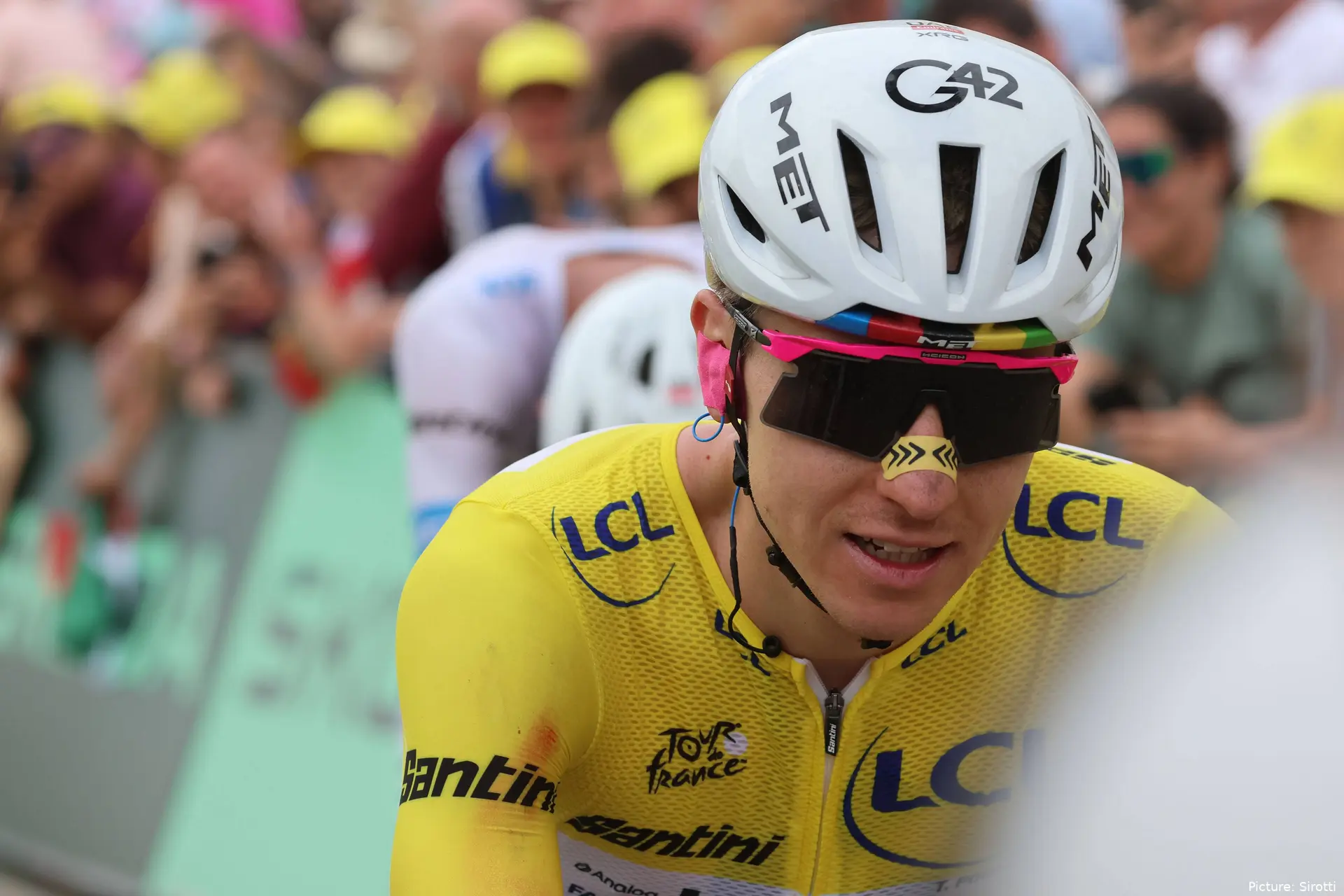
The biggest debate in world cycling right now has a single protagonist: Tadej Pogacar. As of 31st of July, the Slovenian still hasn’t confirmed whether he will line up at the start of La Vuelta a España 2026, a decision that could define both the end of his extraordinary season and the course of his historical legacy. What are the pros and cons of such a decision.
After reclaiming the Tour de France and producing another near-flawless year, Pogacar faces a dilemma with no easy answer. Racing the Spanish Grand Tour would open the door to one of the few major goals still missing, but it would also mean taking on a workload that could affect his next targets. The balance has strong arguments on both sides.
The big incentive: completing the set of all three Grand Tours
The first argument in favour is obvious. If Pogacar starts La Vuelta, he would be the outstanding favourite to win the race. The Slovenian has already shown that, when he reaches a Grand Tour at full strength, he has few real rivals. Winning in Spain would complete the Giro, Tour and Vuelta set, placing him in the select group of riders who have conquered all three Grand Tours.
It would also be another step in that constant comparison with Eddy Merckx as cycling’s historical benchmark. Each season, Pogacar keeps ticking off outstanding goals and edging closer to the Belgian’s legacy. La Vuelta is one of the few major titles still missing from his palmarès. It would also draw him level with Jonas Vingegaard in that regard, after the Dane has already managed to win all three major stage races.
An almost perfect season
Pogacar’s numbers in 2026 explain why many see this as the ideal moment to try. So far he has racked up only 37 race days, but his performance has been outstanding. Apart from a second place at Paris–Roubaix, he has won absolutely every major target he has entered. His victory list includes:
| Race | Result |
| Strade Bianche | 🥇 Winner |
| Milano–Sanremo | 🥇 Winner |
| Tour of Flanders | 🥇 Winner |
| Liège–Bastogne–Liège | 🥇 Winner |
| Tour de Romandie | 🥇 Winner |
| Tour de Suisse | 🥇 Winner |
| Tour de France | 🥇 Winner |
An almost perfect campaign that looked set to follow the familiar pattern of previous years: rest after the Tour, prepare for the Worlds carefully, and close the year at Il Lombardia. However, bringing La Vuelta into play changes the picture completely.
The workload would not be unfamiliar
One of the most discussed factors is the race volume that competing in the Spanish Grand Tour would entail. He currently totals 37 race days. If he added La Vuelta’s three weeks, he would reach 58 days of competition, the same number he logged in 2024, the year he won both the Giro d’Italia and the Tour de France. And if he then rode the Worlds, Il Lombardia and a tune-up race, he would finish above 60 race days.
At first glance, that might seem an excessive calendar, but the reality is Pogacar has already shown he can deliver with similar loads. In 2019, during his first full season at WorldTour level, he raced 62 days, even stepping onto the Vuelta a España podium and winning several stages. He reached that figure again in 2021, when he won Liège–Bastogne–Liège and his second Tour de France. In other words, the race volume would not be new to him.

If Pogacar races La Vuelta, will his World title be at risk?
The big question mark: the Worlds
However, the main counterargument appears immediately. How would Pogacar arrive at the World Championships if he first rides a full-gas Vuelta? The Slovenian’s two rainbow jerseys came off a very specific plan. After the Tour de France, he enjoyed a substantial recovery period before a tailored build-up to the Worlds. That model allowed him to hit peak form right when he needed it most. If he races La Vuelta, the scenario changes entirely.
Historically, many riders used the Spanish Grand Tour as World's preparation, but there was a key difference: they usually didn’t fight for the general classification. They raced some stages flat out and used the rest as high-intensity training. Pogacar, by contrast, would have to take on all three weeks with the obligation to fight for victory from start to finish. That could reduce his chances of reaching the Worlds with the same physical level as in previous seasons.
Read also
Is this the best year to do it?
There’s another compelling line of reasoning. This might be precisely the right moment to conquer the Vuelta. Next year the Worlds route will suit sprinters far better, so his chances of defending the rainbow jersey would be considerably lower. From that angle, both Pogacar and UAE Team Emirates might find it more logical to reserve the Vuelta for a season when the Worlds don’t fit his profile as well. However, you can also make the exact opposite case.
Pogacar is in one of the best spells of his entire career. He has just dominated the Tour de France and looks virtually unbeatable. If he can win the Vuelta now, why wait? In cycling, no one can guarantee that the same superiority will still be there in a year’s time.
A dominance that invites striking while the iron is hot
Another very important point is the absence of the rival who has defined the last few years. Jonas Vingegaard will not be at the Vuelta. That means Pogacar would start as an even clearer favourite than usual. After the overwhelming superiority he showed at the Tour de France, it’s hard to see who could challenge him in a race that, on paper, has a lower level than the Grande Boucle.
Barring a crash or an unexpected physical issue, the feeling is that victory would be within reach. And that is precisely why many believe delaying that goal could be an unnecessary risk.
A rider obsessed with winning everything
There’s another detail that helps explain the Slovenian’s possible change of plan. Pogacar has shown throughout his career that he wants to win every major race on the calendar. This year he added two events he had yet to win to his palmarès: the Tour de Romandie and the Tour de Suisse. They didn’t look essential to race, but he chose to ride them… and to win them. His collection is becoming virtually complete.
Among the Grand Tours and the one-week races, only the Vuelta a España and Itzulia remain. As for the Monuments, his major unfinished business is still Paris–Roubaix. Everything suggests his motivation is no longer just to keep piling up wins, but to complete as many historic races as possible.

Tadej Pogacar is likely to race the Vuelta in 2026
The risk of paying for the effort in 2027
Perhaps UAE’s greatest concern isn’t about what might happen this autumn, but about next season. When Pogacar did the Giro–Tour double in 2024, debate also flared about trying to win all three Grand Tours in the same year. The team ruled that out because of the enormous toll it could take on the following season. While doing the Tour and Vuelta isn’t comparable to riding the Giro, Tour, and Vuelta consecutively, it would still require sustaining a sky‑high level for almost all of the year.
From March, with Strade Bianche, to October, with Lombardia, Pogacar would string together top-tier targets without the break he usually enjoys between the Tour and the Vuelta. That pause has been part of his planning in recent years and would disappear completely if he chooses to race in Spain. There are also recent precedents of riders who paid in cash for seasons with overly demanding calendars, which fuel doubts about whether it’s worth taking that risk.

Pogacar won his fifth Tour de France
A decision that will shape the end of the season
For now, only Pogacar and UAE know the final plan. The arguments for going to the Vuelta are numerous and strong: complete the set of three Grand Tours, capitalise on a period of absolute dominance, and keep building a palmarès ever closer to the sport’s greatest legends. But there are also reasons for caution. The Worlds, Il Lombardia, and, above all, the potential impact such a demanding schedule could have in 2027 make the decision far from simple.
The only certainty is that, if Pogacar does line up at La Vuelta, he will have the chance to add another historic chapter to a career that keeps growing. And if he chooses to wait, it will be because he believes there are still many seasons to keep expanding a legacy that already ranks among the most extraordinary cycling has seen.
Juan LarraCycling Journalist
Juan Larra is a writer for Cyclinguptodate and editor-in-chief of Ciclismoaldia, where he has played a central role since its inception. Under his leadership, the website has become a trusted source for professional cycling coverage, offering in-depth analysis, news, and feature stories.
A sports journalist with over 20 years of experience, Juan earned his degree in Journalism from the University of Seville in 2007. He began his career covering a wide range of sports—including football, basketball, Formula 1, MotoGP, tennis, and cycling—for platforms such as the official La Liga app, Vodafone and Movistar websites, NBA Blogdebasket, and Cadena Cope, honing his skills in writing and editorial management.
In addition to his work at Ciclismoaldia, Juan contributes to Cyclinguptodate and serves as editor-in-chief for the tennis-focused site Tenisaldia. Throughout his career, he has conducted exclusive interviews with cyclists and sports figures, provided detailed analysis of competitions ranging from local Spanish races to major international events, and acted as a special correspondent at prestigious races including Paris-Roubaix, the Tour de France, and the Vuelta a España.
Juan’s combination of experience, expertise, and direct access to athletes has established him—and the platforms he leads—as authoritative voices in professional cycling.
claps 8visitors 3
Just in

Popular news
Latest comments
- He is a great teammate.
 MarkFour21-10-2026
 - Given that the headline did not restrict the conversation to men’s cycling and only asked about cycling as a whole, perhaps mention of Lorene Wiebes would be appropriate? She had an astonishing season, 24 wins, though not all WT level like Pogačar. He has always won with a higher percentage of WT wins than almost anyone else.RidesHills21-10-2026
- POGI NEEDS NO TEAM! Entire UAE squad liquidated, Pog's salary jumps to 50m Euros. Will win every stage at all 3 GTs in 2027 and break the speed of sound at Worlds! ET ACTAAAAAAAwrsty21-10-2026
- Will be a big test for Trek with their GC riders barring Skelly who was their best this year closely followed by Cicco who has left. Jury out on why they signed Gee. Lots of changes in the Mens and Womens WT some good (Kasia) some puzzling and off the bike too.
 Davide21-10-2026
 - "And we’ll avoid rushing from race to race"...LOL he took all that time off between the end of the Tour and the Canadian one day races ! That got him one win and a failed worlds RR title ! Only thing he got a was TT titles and a Euro championship against a weak field !frieders321-10-2026
- Rasmussen hasn't been relevant for years and that's only because he was booted out of the tour wearing the yellow due to failed doping !frieders321-10-2026
- Yep Pogi can't win the Vuelta if he doesn't cross the finish line in stage 21! PogiFanStalker can't seem to understand that.frieders321-10-2026
- This PogiFanStalker can't seem to help himself with his constant nonsensical comments here.frieders321-10-2026
- Only thing boring here is reading your constant drooling comments about him!frieders321-10-2026
- So much clickbait hereDAS21-10-2026
Loading
1 Comments