How long it took eight legends to join cycling's elite Grand Tour club - which doesn't include Tadej Pogacar
Cycling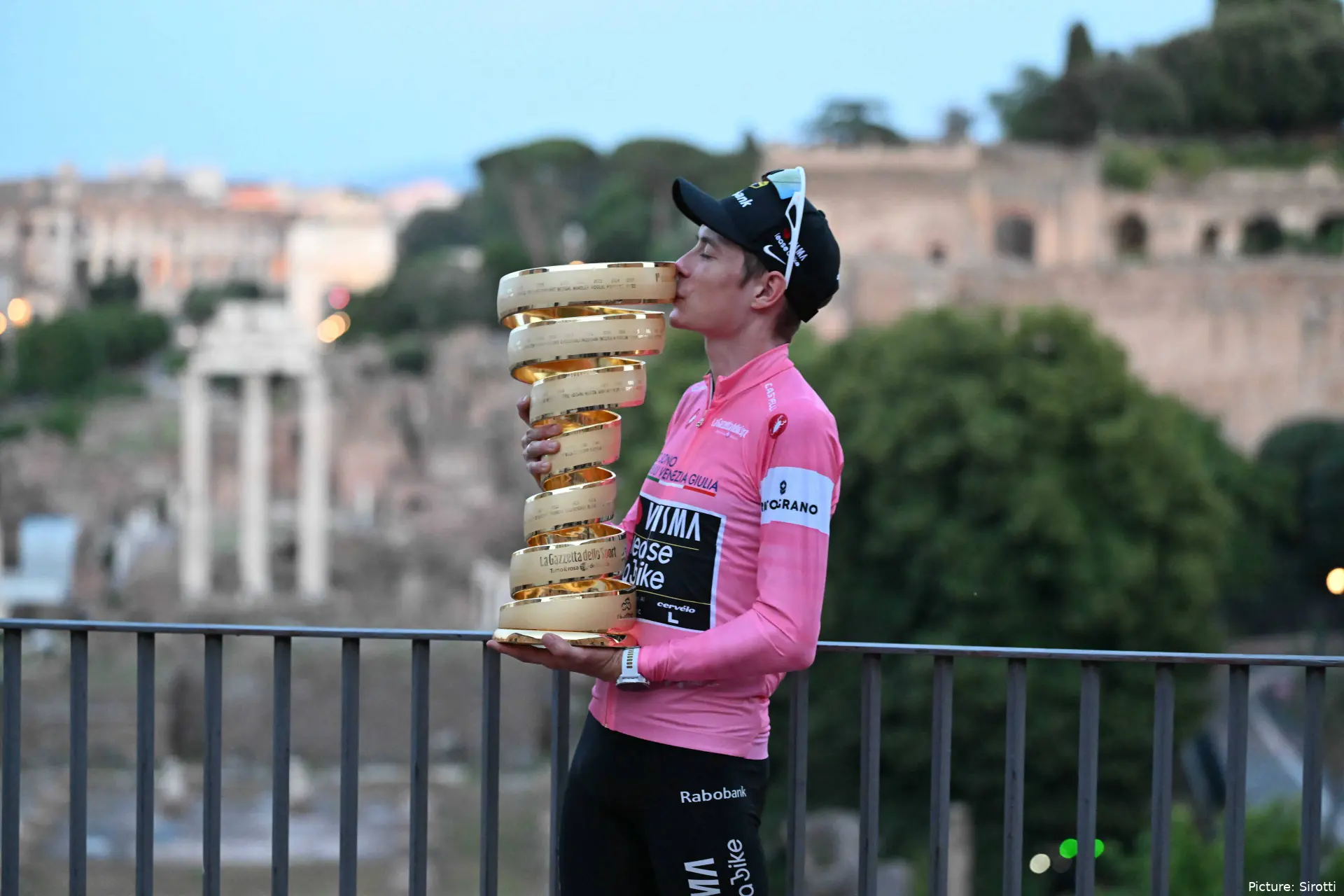
Only eight riders in history have managed to complete stage racing’s ultimate challenge: winning the Tour de France, the Giro d’Italia and La Vuelta a España at least once. The latest is Jonas Vingegaard, who in 2026 added the Giro to his previous Tour and Vuelta titles.
The Dane thus became the eighth member of a club previously joined by Jacques Anquetil, Felice Gimondi, Eddy Merckx, Bernard Hinault, Alberto Contador, Vincenzo Nibali and Chris Froome.
Reaching that level was never about winning three races in isolation. Each had to overcome different eras, routes and rivals of the highest class. Some needed years to complete the set; others did it with astonishing speed. Contador, for instance, took all three within just two seasons, while Vingegaard needed four years from his first Tour.
The degree of difficulty also shifted over the decades. The Tour in the 1950s and 60s was longer, with vast gaps between stages, whereas modern Grand Tours feature scientific preparation, highly specialised teams and far deeper international depth. In every case, though, the challenge was the same: endure three weeks of mountains, time trials, fatigue and pressure.
These are the years in which each rider first won each of the three Grand Tours and, crucially, how those victories built one of the most exclusive clubs in sporting history.
Read also
Jacques Anquetil
Anquetil broke trail in 1957, winning his first Tour de France at just 23. It was a commanding triumph that announced a time trial specialist set to dominate the decade. He faced climbers like Federico Bahamontes and riders of Marcel Janssens’ calibre. The Frenchman leaned on his formidable ability against the clock to offset losses in the mountains and ultimately imposed an authority few expected from someone so young.
Three years later came the 1960 Giro. Italy proved far trickier, with Gastone Nencini as the main rival and a battle that forced Anquetil to meter his efforts carefully. He prevailed in an edition shaped by the mountains and by the need to resist attacks from Italian specialists. That win confirmed his dominance wasn’t confined to the Tour and brought him closer to the select target of all three Grand Tours.
The 1963 Vuelta completed the circle. Anquetil became the first rider to conquer all three, doing so in a particularly demanding Vuelta for the era. The Spanish victory also had a strategic edge: once again he relied on consistency and time trial strength to keep his main rivals in check. The result turned a collection of major wins into a lasting legacy.
Felice Gimondi
Gimondi began his trilogy at the 1965 Tour, on debut. The Italian stunned the field, beating illustrious rivals and showing a rare blend of climbing and time trialling. The race was defined by the severity of the Alps and Pyrenees, but Gimondi maintained the steadiness needed to outlast Raymond Poulidor and other specialists of the time.
In 1967 he seized the Giro d’Italia, his first Grand Tour at home. It was a far more open contest, with rivals like Jacques Anquetil and Italian riders intimately familiar with the terrain. Gimondi faced a long, mountainous route where endurance mattered as much as punch. The victory confirmed that the 1965 Tour winner could also command the Corsa Rosa.
La Vuelta arrived in 1968 and with it Gimondi’s entry into the club Anquetil had founded. The Italian mastered a demanding route and an international field packed with quality. His win in Spain carried huge symbolic weight: it proved he could adapt to varied terrain and remain relentlessly consistent over three weeks.

Eddy Merckx in action in 1974.
Eddy Merckx
Merckx opened his Grand Tour collection at the 1968 Giro d’Italia. He had yet to win the Tour but was already an extraordinary force. In Italy he faced Felice Gimondi and the era’s best, imposing a blend of power, endurance and aggression that heralded the dominance to come.
A year later came the 1969 Tour de France. It was Merckx’s definitive unveiling as cycling’s supreme ruler. The Belgian did far more than control the standings: he won mountain stages, time trials and built vast gaps on rivals such as Felice Gimondi and Roger Pingeon. The brutality of that edition was reflected in the scale of his victory.
The 1973 Vuelta completed his personal trilogy. Merckx had to face Luis Ocaña and José Manuel Fuente, two exceptional climbers, in a race shaped by Spain’s mountains.
The win was especially significant because it came after years of dominance at the Giro and the Tour. With it, Merckx joined the select group of riders who held all three Grand Tours on their palmarès at the same time.
Bernard Hinault
Hinault captured La Vuelta in 1978, in the first great season of his dominance. The Frenchman faced Joop Zoetemelk, Joaquim Agostinho and other specialists in a demanding race that he won with authority. It was the opening act of an extraordinary campaign, with the Tour looming just weeks later.
At the 1978 Tour, Hinault confirmed his arrival among the greats. Zoetemelk was his main rival and even wore yellow, but Hinault settled the race in the final time trial. The edition was notably hard and further marked by the expulsion of Michel Pollentier, who had led the standings before being sanctioned for attempting to cheat the anti-doping control.
Two years later, Hinault won his first Giro. The 1980 Corsa Rosa pitted him against Wladimiro Panizza, Giovanni Battaglin and Giuseppe Saronni. The Frenchman had to navigate a mountainous and tactical race, but ultimately imposed his superiority to claim the maglia rosa by more than five minutes over Panizza.

Alberto Contador on the ascent to the Colle delle Finestre at the Giro d’Italia
Alberto Contador
Contador opened his path at the 2007 Tour de France. At just 24, the Spaniard prevailed in a race defined by parity and the constant pressure of riders like Cadel Evans and Levi Leipheimer. The mountains proved decisive and Contador used his punch to become the youngest winner of that edition.
In 2008 he conquered the Giro d’Italia, a particularly complex victory as he was drafted in late and had to face Riccardo Riccò and Danilo Di Luca. The battle stayed open until the final time trial in Milan, where Contador defended his narrow lead. He became the first Spaniard to win the Giro since Miguel Indurain.
Months later he completed the trilogy at La Vuelta. The 2008 edition featured Levi Leipheimer, Carlos Sastre and Alejandro Valverde as chief rivals. Contador seized the lead after the Angliru and consolidated it in the mountains and the time trial. At just 25 he became the first Spaniard to conquer all three Grand Tours.
Vincenzo Nibali
Nibali began his collection with the 2010 Vuelta. The Italian had to overcome Joaquim Rodríguez and Ezequiel Mosquera in a race of severe climbing. The fight stayed alive to the end and Nibali showed outstanding composure both on the ascents and through the transition stages.
His first Giro arrived in 2013. The edition was marked by bad weather and mountains, with Rigoberto Urán and Cadel Evans as main rivals. Nibali had been third in 2010 and second in 2011 before returning to finally claim the maglia rosa. Urán finished second and Evans third, underlining the quality of the podium.
In 2014 came his masterpiece: the Tour de France. With Chris Froome and Alberto Contador out of the final fight, Nibali faced Jean-Christophe Péraud, Thibaut Pinot and Alejandro Valverde. The Italian controlled the race from the opening week and won by a wide margin. It was his most emphatic triumph and the one that completed his set.
Chris Froome

Chris Froome in action at La Vuelta a España 2017
Froome’s first major title was the 2011 Vuelta, although the race was initially awarded to Juan José Cobo. After the Spaniard’s later sanction, Froome was recognized as the winner. That Vuelta was extremely tight and the Briton finished just 13 seconds behind Cobo in the original standings, after also duelling with Bradley Wiggins and Bauke Mollema.
The 2013 Tour was his breakthrough. Froome arrived as Wiggins’s heir and had to measure himself against Nairo Quintana, Joaquim Rodríguez and Alberto Contador. The French mountains and the time trials allowed him to build a solid advantage and win his first Tour, launching the Sky era of dominance.
Five years later, Froome completed the trilogy at the 2018 Giro. It was one of the peloton’s most spectacular victories: Simon Yates dominated much of the race, but Froome overturned the general classification with his long-range attack on the Colle delle Finestre. He finally beat Tom Dumoulin and Miguel Ángel López. He also became the first Briton to win the Corsa Rosa.
Jonas Vingegaard
Vingegaard began his path at the 2022 Tour de France, defeating Tadej Pogačar for the first time in a battle that reshaped modern cycling. The race was marked by heat, echelons, cobbles and, above all, an intense fight in the mountains. The Dane imposed himself on the Slovenian thanks to growing superiority in the Alps and the Pyrenees.
In 2025 came La Vuelta. Vingegaard faced João Almeida and Tom Pidcock in an especially demanding edition, with finishes like the Angliru and the Bola del Mundo. The Dane won by 1:16 over Almeida and 3:11 over Pidcock. His victory was also framed by protests that interrupted the final stage in Madrid.
The last step arrived at the 2026 Giro. On his Corsa Rosa debut, Vingegaard won five of the six summit finishes and ended 5:22 ahead of Felix Gall and 6:25 ahead of Jai Hindley. The 3,466-kilometre race with over 49,000 metres of climbing confirmed the scale of the challenge. In Rome, the Dane completed the trilogy and became the eighth man in history to win all three Grand Tours.
Eight names, eight eras and eight different routes. Anquetil opened the door in 1963; Gimondi, Merckx, Hinault, Contador, Nibali and Froome kept it a guarded preserve for decades. Now Vingegaard has added his name to a list that seems ever harder to expand. In a sport where winning a single Grand Tour already demands an exceptional blend of talent, team, endurance and luck, conquering all three remains one of the greatest tests of greatness.
Javier RampeCycling Journalist
Javier Rampe is a sports analyst with more than 15 years of experience. He holds a degree in Economics from the University of Rome and a Diploma in Business Studies from the University of Cádiz. Despite coming from an academic background not particularly associated with cycling, his passion for both cycling and journalism was instilled in him from an early age. He grew up following Miguel Indurain and José María “El Chava” Jiménez. An admirer of Michael Robinson’s communication style and journalistic approach, he was inspired to pursue a degree in Journalism at the University of Buenos Aires, which he is currently completing.
He has always maintained close ties with the worlds of sport and culture, contributing from a young age to sports blogs and film and music review websites. His work has appeared in media outlets such as Cope, RAI, and Radio Con Vos. He is also the founder of the cycling-focused podcast El Contraanálisis and the football interview channel Días De Fútbol, dedicated to conversations with professional footballers.
In addition to his work at Ciclismoaldia, Javier has interviewed some of the most influential figures in modern cycling, including Alejandro Valverde and Tadej Pogačar, as well as key voices in anti-doping policy such as Alberto Yelmo, David Varillas, and Marcelo Milano. Marcos Maynar, in relation to the ‘Operación Ílex’ case, is also among the personalities he has interviewed. He enjoys conducting in-depth analysis of the cycling ecosystem and has attended major events such as Strade Bianche, the Vuelta a Andalucía, and Itzulia, as well as numerous national cyclo-cross races.
His background in economics, combined with extensive experience in marketing and corporate communications, drives his continuous study of positioning strategies and ensures that he always keeps his focus on crafting compelling and evocative headlines.
claps 2visitors 2
Just in
Popular news
Latest comments
- Denmarks coach reveals 2027 Rainbow Jersey has been targeted by Jonas for years !?!?!? PS: What??? No one believes this meaningless babbling. It's like saying: "The 2027 Monument - Il Lombardia has been targeted by Jonas for years."PogiSloFans16-10-2026
- I made a mistake and already fixed it. Hey twat, thanks.PogiSloFans16-10-2026
- Davide Piganzoli said: "Pogacar looked less brilliant at TDF than usual." We all see how stupid this comment is. What is happening to his brain cells? ... Hey Piganzoli, Tadej Pogačar’s record breaking ascent of Alpe d’Huez was one of the standout performances in the history of the Tour de France. Pantani's 1995 ascent stood for 31 years. Pogi went more than a minute faster. He accelerated near the foot of the climb, despite the leading breakaway being around three and a half minutes ahead. But in your delusional brain Pogi looked less brilliant???? .... Why don't you go find a corner and bang your head against a wall for about 10 minutes. Everyone is making fun of you.PogiSloFans16-10-2026
- MTB WC ? If he doesnt compete maybe allows MvDP to have a crack
 Davide16-10-2026
 - Jonas is declining now. A podium next year would be a good result for him.Renz16-10-2026
- unpredictability is not an issue. Most riders not named Pogi have that. The excuses are and the blaming teammates and other riders for insufficient support and blocking are. if weight is an issue get a nutritionist. If aircon is not working switch rooms. Position yourself or get your teammates and DS to keep reminding you of basic stuff if it is difficult to remember in a long race. Dont whine about other riders not working with you, use tactics yourself or get your DS to develop the tactics. Dont talk about noballs when you yourself have no ballsabstractengineer16-10-2026
- It’s worth remembering that cycling journalism has entered it’s “Shit-Stirring Hot Takes Winter” now in order to keep the clicks and views trickling in.wrsty16-10-2026
- Well that would be a major disappointment. The last two years are the first times I have bothered watching the last day. Maybe at worst it could be the 2nd last day but two classic finishes and then wompWaranga16-10-2026
- Vingegaard was the one showing signs of weakness. He was looking more likely to lose a podium spot or two than to make inroads on Tadej.Papijan16-10-2026
- Disagree with Ardennes, he has never done well there, not even a top 10. Giro Vuelta, avoid the stacked TDF where crashes can derail the rest of the season and even if he avoid that, at best a top 5 is possible. He is 31, no more time left for testing/trying.abstractengineer16-10-2026
Loading
Write a comment