On the occasion of the 2026 Montreal World Championships, to be held from 20th to the 27th September and bringing the road showpiece back to Canada, it is worth looking back at some of the brightest pages written by Spanish cycling in the history of the Worlds.
Spain has built much of its World Championships prestige around era-defining names. Abraham Olano, Miguel Induráin, Óscar Freire, and Alejandro Valverde delivered performances that transcended results and became forever linked to the rainbow jersey.
From the epic altitude of Duitama to the mountains of Innsbruck, via Freire’s speed and Olano’s time trial precision, Spanish cycling has found some of its most memorable stages at the Worlds.
Five moments sum up much of that story. Five days when Spanish cycling not only climbed the podium but turned a world title into an indelible episode in the collective memory.
Duitama 1995: the day Spain conquered the world
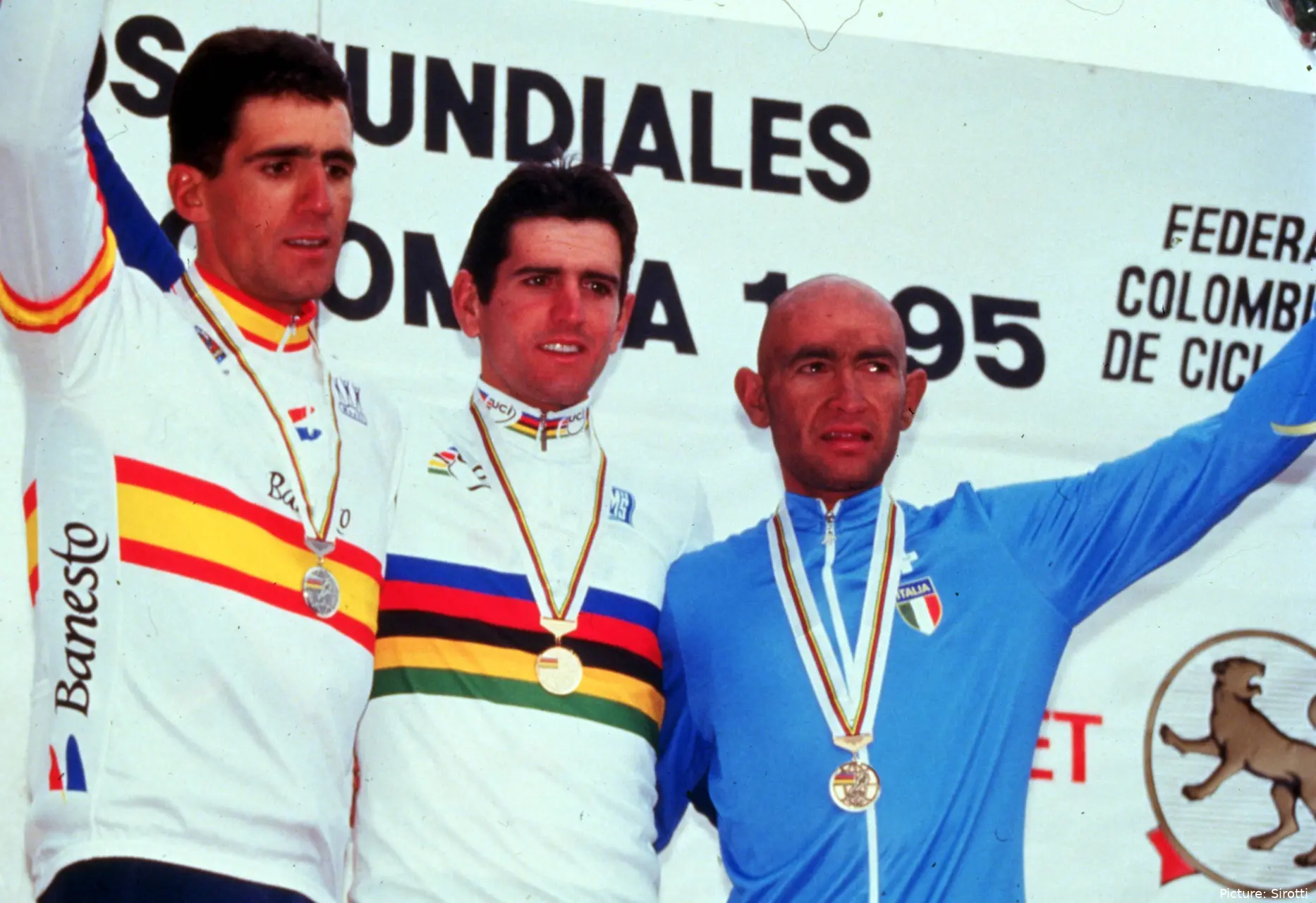
The Duitama Worlds remain one of the most extraordinary chapters in Spanish cycling. In the Colombian mountains, at an altitude that turned the 265.5 kilometres into a true survival test, Abraham Olano was crowned world champion and Miguel Induráin finished second. Marco Pantani completed the podium.
The race was marked by Spanish superiority and by a partnership between Olano and Induráin that has entered folklore. When it looked like the Navarrese could go for gold, he worked for his teammate. Olano even tackled the final kilometres with a puncture in his rear wheel, yet he held the gap and reached the line alone.
The result was historic: Spain took gold for the first time in the Worlds professional road race and, moreover, filled the top two places. The championships had also opened with another Spanish triumph, as Induráin won the time trial and Olano was second.

Abraham Olano is one of Spain's few World Champions
Valkenburg 1998: Olano rules the time trial too
Three years after his unforgettable triumph in Duitama, Abraham Olano pulled on the rainbow again. This time there was no epic finale or altitude battle: the stage was the time trial. In Valkenburg, the rider from Gipuzkoa prevailed over 43.5 kilometres between Maastricht and Vilt.
Olano stopped the clock at 54:32, 37 seconds ahead of compatriot Melchor Mauri, with Ukrainian Serhiy Honchar rounding out the podium. The result confirmed the Spaniard’s remarkable versatility, able to shine both on the road and against the clock.
That Worlds made Olano an even rarer figure. After winning road race gold and time trial silver in Duitama, he claimed the world title in the time trial four years later. Valkenburg was, in a sense, the definitive confirmation of his status as a top-tier specialist.
Verona 1999: the Óscar Freire legend is born
In Verona, a name emerged that had not featured among the world’s leading favourites. Óscar Freire, just 23, stunned the international peloton and became world champion in a sprint finish that launched one of the most brilliant careers in modern Spanish cycling.
That win was far more than an upset. Freire showed an exceptional knack for reading races and being in the right place at the right time. His victory in Verona opened a collection of three rainbow jerseys, completed with the titles in Lisbon 2001 and, again in Verona, 2004.
The scale of that first victory is clearer with time. Freire became one of the few riders to win the road Worlds three times, a mark reserved for a very select group of champions. His name is forever tied to the rainbow.

Óscar Freire, three-time world champion
Freire and the third rainbow: Verona 2004
The fourth great moment again stars Freire. In 2004, five years after his breakthrough in Verona, he returned to the Italian city to claim his third Worlds. He had already repeated the feat in Lisbon 2001 and lined up with the stature of an established champion.
One historical note: the 2002 Zolder Worlds were won by Mario Cipollini; Freire’s third title came in Verona 2004. That victory made the Cantabrian a triple world champion and confirmed a rare gift few could match: reading mass sprints.
His third rainbow closed an extraordinary cycle, matching the previous record which still stands to this day. Freire won in different settings and contexts, proving he was not a one-race specialist but a rider able to survive decisive kilometres and appear when the Worlds were settled by speed.
Innsbruck 2018: Alejandro Valverde’s reward
The most recent chapter belongs to Alejandro Valverde and one of the most emotive finales by a Spanish rider at a Worlds. In Innsbruck, at 38 and after six World Championships podiums, the Murcian finally claimed the gold that had eluded him for so many years.
Valverde had been second in 2003 and 2005; and third in 2006, 2012, 2013, and 2014. Twelve participations after his Worlds debut, he found in the brutal Alpine route the chance to complete an extraordinary medal set with the only metal he lacked.
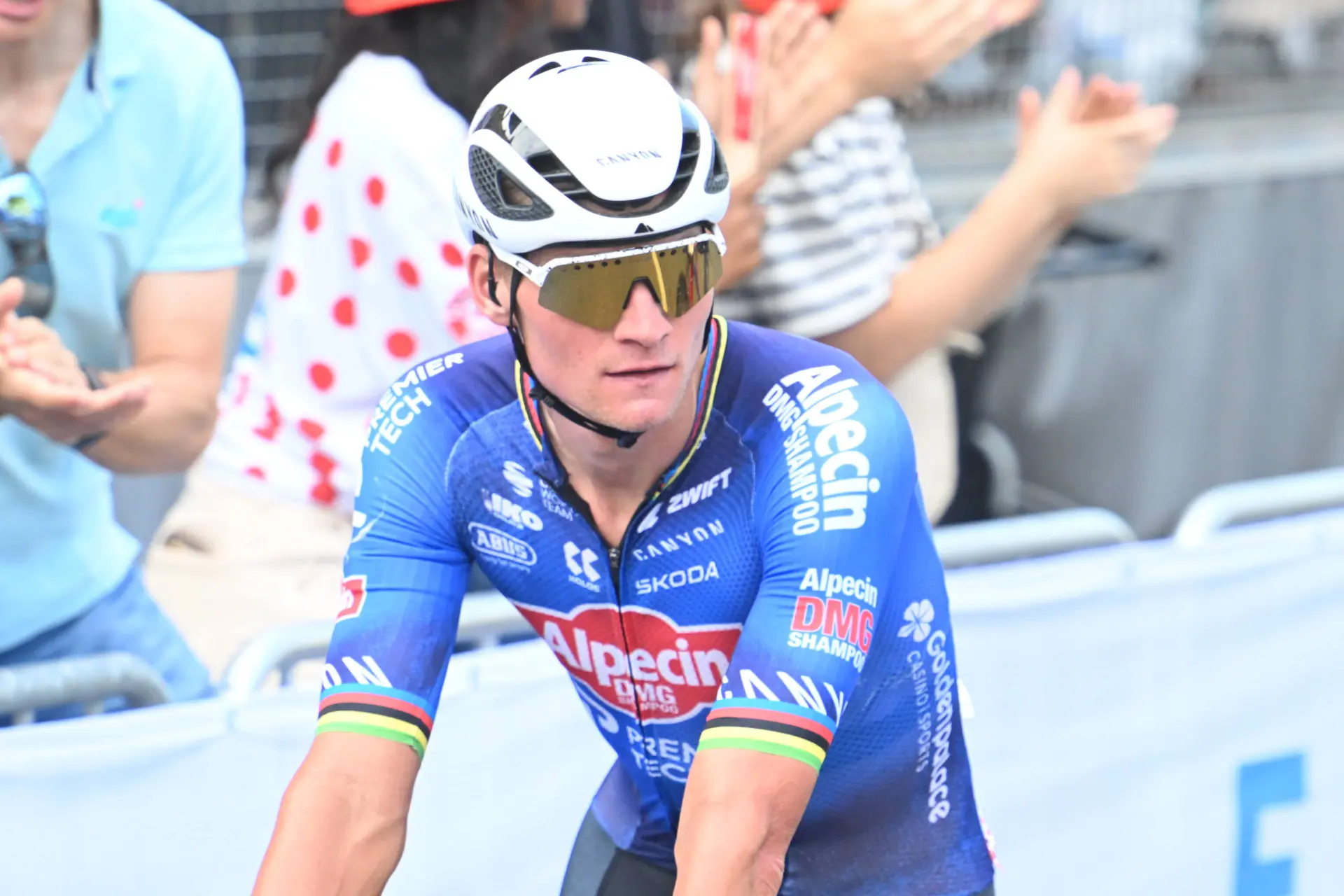
The finish matched his career. Valverde won the sprint from a select group of four, ahead of France’s Romain Bardet and Canada’s Michael Woods. It was Spain’s first men’s elite road gold since Freire’s third title in 2004 and the perfect conclusion to a long pursuit of the rainbow.
Montreal now turns the Worlds’ page once more. The Canadian city, which in 1974 hosted the first road World Championships held outside Europe, will again be the stage in 2026. The final Mount Royal circuit, 13.4 kilometers with 269 meters of elevation per lap, promises another chapter in a story to which Spain has already contributed some of its most brilliant pages.
Javier RampeCycling Journalist
Javier Rampe is a sports analyst with more than 15 years of experience. He holds a degree in Economics from the University of Rome and a Diploma in Business Studies from the University of Cádiz. Despite coming from an academic background not particularly associated with cycling, his passion for both cycling and journalism was instilled in him from an early age. He grew up following Miguel Indurain and José María “El Chava” Jiménez. An admirer of Michael Robinson’s communication style and journalistic approach, he was inspired to pursue a degree in Journalism at the University of Buenos Aires, which he is currently completing.
He has always maintained close ties with the worlds of sport and culture, contributing from a young age to sports blogs and film and music review websites. His work has appeared in media outlets such as Cope, RAI, and Radio Con Vos. He is also the founder of the cycling-focused podcast El Contraanálisis and the football interview channel Días De Fútbol, dedicated to conversations with professional footballers.
In addition to his work at Ciclismoaldia, Javier has interviewed some of the most influential figures in modern cycling, including Alejandro Valverde and Tadej Pogačar, as well as key voices in anti-doping policy such as Alberto Yelmo, David Varillas, and Marcelo Milano. Marcos Maynar, in relation to the ‘Operación Ílex’ case, is also among the personalities he has interviewed. He enjoys conducting in-depth analysis of the cycling ecosystem and has attended major events such as Strade Bianche, the Vuelta a Andalucía, and Itzulia, as well as numerous national cyclo-cross races.
His background in economics, combined with extensive experience in marketing and corporate communications, drives his continuous study of positioning strategies and ensures that he always keeps his focus on crafting compelling and evocative headlines.
claps 0visitors 0
Just in
Popular news
Latest comments
- Yes, question is, why is Ineos so easy to convince ?Mistermaumau09-10-2026
- Or maybe they’ll just abandon the sport and focus on RE, unless they can revive MU. Maybe it’s all just about budget adjustments in preparation for takeover by the new sponsor who might have no use for some people in their idea of a projectMistermaumau09-10-2026
- Sounds like management did their job pretty well then ;-)Mistermaumau09-10-2026
- Tour down under awaits... and nothing beyond that
 Rafionain-Glas09-10-2026
 - God, what a crowd gathers in these comments. You post a quote from a true champion—a quote that has nothing to do with his tragic accident (on the contrary, with his very passion)—and people interpret it however suits them.MajorPayne09-10-2026
- What needs to be understood? That you're linking a single statement to his death? Could it get any more stupid?MajorPayne09-10-2026
- Are you saying that statement led him somewhere related to religion? Could it get any more stupid?MajorPayne09-10-2026
- A broken contract by mutual agreement is perfectly fine. The problem is if one side does it without the other agreeing which isn't the case in this situationvappaxbipmv09-10-2026
- Maybe Ineos are planning to concentrate on GC after recent statements about getting back to winning the Tour?Lozza09-10-2026
- lol maybe a better questionmij09-10-2026
Loading
Write a comment