"If I do a few more of them, I can learn to love it a little bit more": Zoe Bäckstedt reflects on first elite Worlds TT medal
Cycling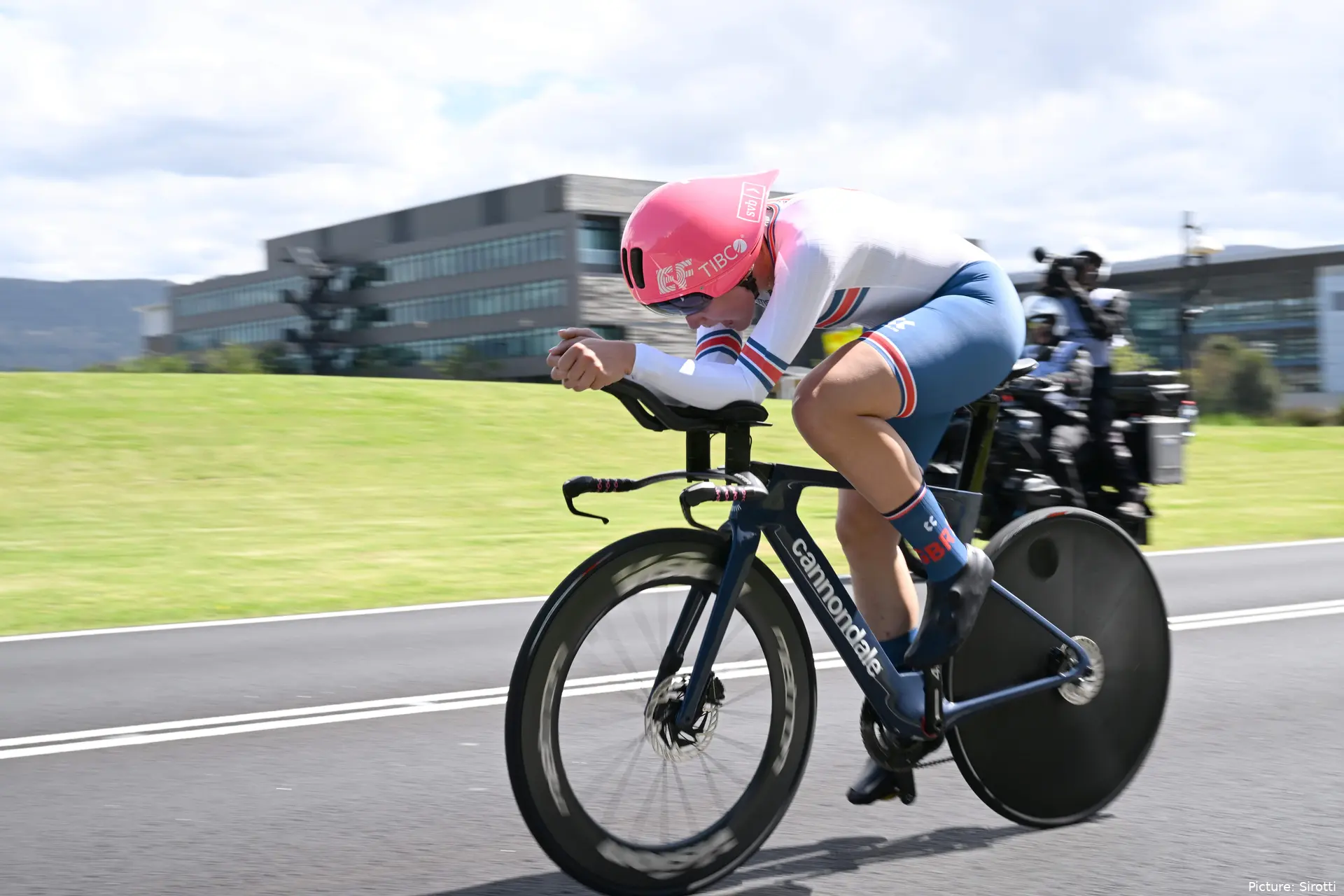
Zoe Bäckstedt left Montréal with her first elite individual time trial medal at the World Championships, but the silver medalist admitted that the 39.2-kilometer course pushed her beyond the distance she currently considers her specialty.
The 21-year-old Briton produced one of the fastest starts of the women's time trial, taking the lead at the opening 10.5-kilometer checkpoint and maintaining her advantage over Germany's Franziska Koch through the middle section of the race. Bäckstedt ultimately finished 40.11 seconds behind defending champion Marlen Reusser, while Koch took bronze.
For Bäckstedt, the result represented another step forward after she won the U23 world time trial title last year. Her ride also showed that she can challenge for medals at the elite level, even on a course that demanded significantly more endurance than the time trials she is accustomed to racing.
“Very happy. As I've said in a few interviews, of course I would have loved to go home with the rainbow jersey today, but Marlen was super strong and full credit to her,” Bäckstedt said after the finish.

Reusser was the main favourite for the ITT and she delivered
Breaking the race into sections
Bäckstedt's challenge was particularly impressive given how she approached the opening kilometers. Reusser was expected to be one of the major favorites, but the Briton established an early 10-second advantage and continued to lead after the second checkpoint.
The Swiss rider gradually erased that deficit, drawing level with Bäckstedt before taking control of the race in the second half. Reusser eventually moved 13 seconds clear at the third split and continued to extend her advantage all the way to the finish.
Bäckstedt said the length of the course had made pacing one of the most important parts of her preparation and execution. “The pacing strategy was basically just not to go out too hard. We're used to racing over 20 to 25 km, so doing 40 km is a big difference in how you mentally approach the race,” she explained.
The course itself helped her manage that challenge, as Bäckstedt divided it into several smaller sections, allowing her to focus on the demands immediately ahead of her.
“It was a good course because you could break it up quite a lot. You had the first section with a lot of corners, then the stretch to the F1 circuit with a few laps there, then the way back, a few more corners, and the finishing climb. It was really quite easy to break it up and think, ‘Okay, I've got maybe 5 or 6 minutes of riding hard here.’”
“So pacing was just about not going out too hard and making sure you had something left for the final, and I think it worked out that way.”
Read also
The final climb exposed the distance
The hardest part for Bäckstedt came after the final U-turn, when the course headed toward the finish and climbed toward the line. By that point, Reusser had already established a decisive advantage, while Bäckstedt was focused on protecting her position ahead of Koch.
“Don't get me wrong, I was really tired, and from the U-turn back to the finish was such a hard part of the course for me—again, just being that extra bit longer than what I'm used to,” she said. “But I gave it everything I could coming over that climb. I felt like I was going snail speed, super slow, but it is what it is.”
Asked whether she enjoyed the long, relatively flat course in Montréal, Bäckstedt was open about the learning curve still ahead. “Yeah, I think so. If I do a few more of them, I can learn to love it a little bit more. But currently, I think maybe 25 to 30 km is my prime distance.”
Félix SernaCycling Journalist
Félix Serna is a writer at CyclingUpToDate and has been part of the team since 2025. He covers professional cycling across both the men’s and women’s calendars, with a focus on UCI rankings, race developments, and rider performance. His work includes interview-based reports, liveblogs, and tournament coverage designed to provide clear, accurate context throughout the season.
In his reporting, Félix regularly uses ProCyclingStats for results, statistics, and historical reference. He places strong emphasis on careful sourcing, editorial accuracy, and updating articles promptly when new, verified information becomes available. He holds a bachelor’s degree in International Studies.
claps 0visitors 0
Just in
Popular news
Latest comments
- Maybe Ineos are planning to concentrate on GC after recent statements about getting back to winning the Tour?Lozza09-10-2026
- lol maybe a better questionmij09-10-2026
- Does Ineos?Mistermaumau09-10-2026
- ThanksMistermaumau09-10-2026
- It depends on your religion or opinion of science but if you feel he did the right thing I suggest you go complain to guys like Mohorič, Mas, etc. for reminding him not to try to copy Senna too much.Mistermaumau09-10-2026
- yeah that was poorly written, but Gulio was in the pink, and they didn’t work for him to protect the jersey. they let a group get up the road. the transfers are out of hand. what is a contract for?mij09-10-2026
- does he make it two years?mij09-10-2026
- A lot of things should not be happening but everything seems to be getting worse, not just in cycling or sport or professional surroundings. People are abandoning (common) standards in their belief they are only responsible towards themselves and have lost the ability to care, consider or understand consequences for others. If you ride , you should have noticed by now. I’m not one to stick to rules per se but when, I don’t go round aggressing or criticising others who don’t either. On the bike you constantly get hooted, harassed, insulted or nudged off by drivers who broke at least double the number of rules you did before they point yours out. That said, I haven’t seen many specifics on this case yet so I’m not going to comment specifically, for now. If anyone knows more…Mistermaumau09-10-2026
- it is crazy. is this UAE at the end of Tadej’s reign? it happens!mij09-10-2026
- Not *all* Remco's wins have been without Tadej around. Tadej has beaten Remco in 2 direct head-to-head TT encounters, but the rest, with both present, Remco has taken the crown. If we're going to state facts, let's be accurate and give Remco credit where it is due, that man is often unbeatable in a TT.anonymouscyclist09-10-2026
Loading
Write a comment