From Sepp Kuss to Daniel Martínez - Five of the best Giro d'Italia domestiques in modern history
Cycling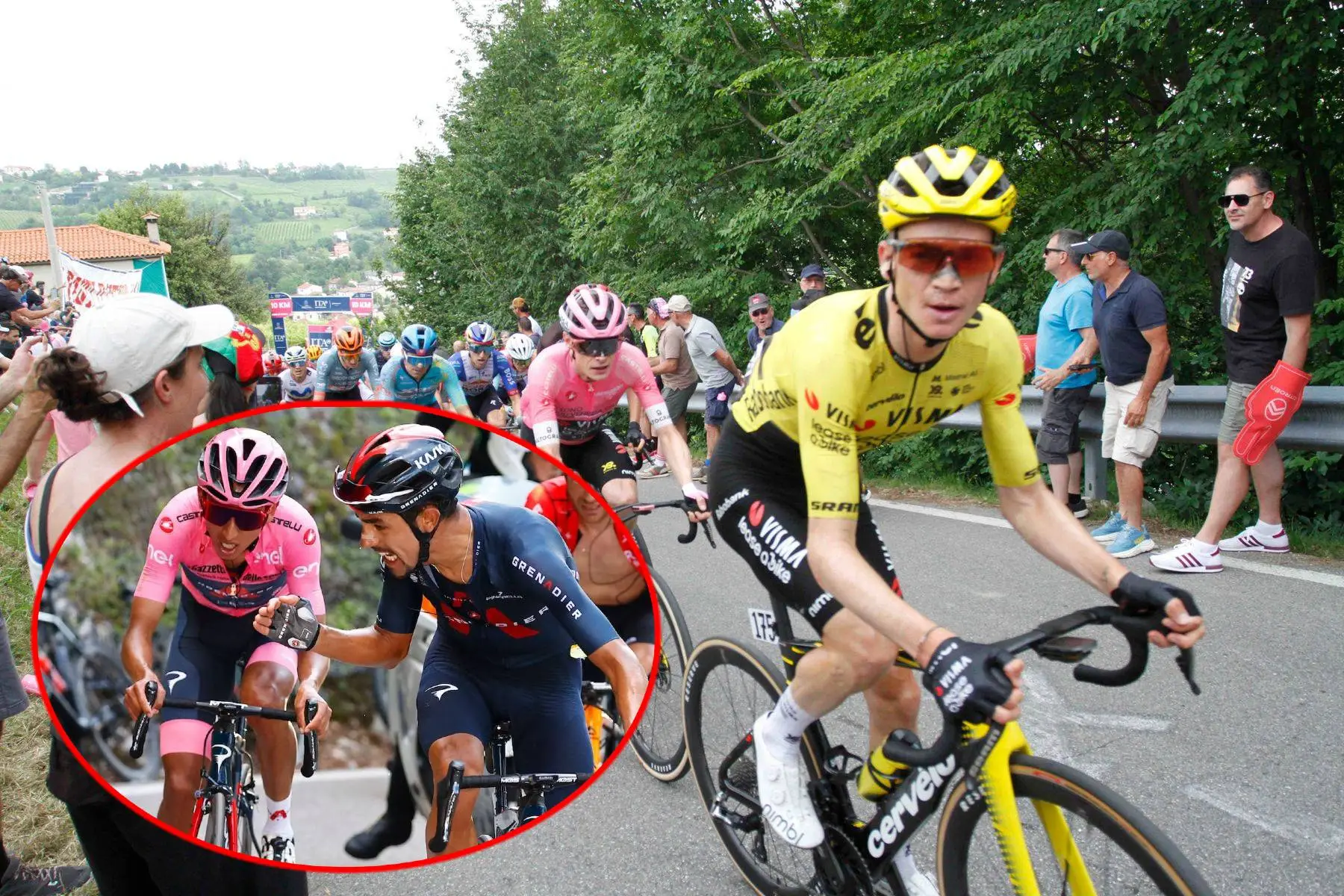
The Giro d’Italia is one of the races that best illustrates the importance of teamwork in cycling. Its unrelenting climbs, changeable weather and the accumulated strain of three weeks make every edition a test of physical and mental endurance. In a race where a crisis can reshape the general classification in minutes, domestiques play an essential role in helping their leaders pursue the Maglia Rosa.
Their work goes far beyond setting the pace in the mountains. They must protect their team leaders in the peloton, control breakaways, bring them bottles and food, limit time gaps when the race becomes difficult, and stay with them when their strength begins to fade.
Their success is rarely measured in personal victories. Instead, it is reflected in their leaders’ results and in a team’s ability to control the race over three weeks.
Throughout the history of the Italian race, many riders have built their reputations through such dedication. Some have stood out for their longevity and consistency, others for their ability to support the favourites on major climbs, while a select few have combined teamwork with outstanding individual results.
They all represent an essential side of a sport in which a leader’s talent depends on the support of a team ready to respond to every situation.
Among the riders who span different eras of the Giro are Vladimiro Panizza, Alberto Leanizbarrutia, Daniel Felipe Martínez, Sepp Kuss and Davide Piganzoli. Their careers reflect how the role of the domestique has evolved, from cycling in the 1970s and 1980s to the modern World Tour.
Their stories also remind us that while only one rider pulls on pink at the final podium, every great victory is built on shared sacrifice.

Jonas Vingegaard won the 2026 Giro d'Italia
Alberto Leanizbarrutia, an all-rounder and Intergiro winner
Alberto Leanizbarrutia was one of those riders whose contribution to a team cannot always be judged by stage wins or the general classification. The rider from Biscay raced professionally from 1985 to 1998 and was known for his versatility, consistency and experience in Grand Tours.
He rode for teams including Teka, CLAS-Cajastur and ONCE, as part of a generation of Spanish cyclists accustomed to competing at the highest level in stage races.
His career was closely associated with Manolo Saiz’ ONCE, a team that placed exceptional emphasis on tactical discipline and collective performance. Leanizbarrutia shared the peloton with some of the leading riders of the 1990s and competed in all three Grand Tours, a demanding schedule that required excellent fitness and recovery.
At the Giro, he was marked by his consistency and his contribution to the team, although his most notable Italian result came in a secondary classification.
In 1991, Leanizbarrutia won the Intergiro classification, which rewarded consistency at intermediate points set along the stages. That achievement showed his ability to seize the opportunities offered by a three-week race and became one of the highlights of his palmarès.
He was also among the few riders to complete the Giro, Tour de France and Vuelta a España in a single season, doing so in 1991. He embodied the reliable, resilient and versatile rider every team needs to sustain its ambitions in a Grand Tour.
Daniel Felipe Martínez, Egan Bernal’s guardian angel
Daniel Felipe Martínez earned his place in the recent history of the Giro d’Italia with one of the race’s most memorable performances by a domestique. The Colombian is a complete rider, capable of performing in the mountains, holding his own in time trials and competing for individual results in one-week races.
Yet in May 2021, he took on a different role from the one his abilities might have suggested: working for compatriot and Ineos Grenadiers teammate Egan Bernal in the fight for the general classification.
Martínez was crucial to Bernal’s defence of the Maglia Rosa against rivals such as Simon Yates and Damiano Caruso. His defining moment came on stage 17, on the road to Sega di Ala, when the Colombian leader began to struggle under his rivals’ attacks.
Martínez gave up his own chance to contest the stage win and dropped back to help Bernal, staying with him on the climb and preventing him from losing more time. His intervention helped the leader limit his losses on a day that threatened to seriously undermine his ambitions, with a gesture towards Bernal that day which stuck in the sport's memory.
Bernal went on to win the 2021 Giro, while Martínez finished a commendable fifth overall. His efforts earned him the award for the edition’s best domestique, as well as another prize for his team spirit.
That performance cemented his reputation as a rider capable of making the difference even when his own ambitions take a back seat. His story shows that a top-level domestique is more than a cyclist who works for someone else. He is a competitor with the ability to change the course of a race when his leader needs him most.

Egan Bernal won the 2021 Giro d'Italia with the support of Daniel Martínez
Vladimiro Panizza, the Italian rock star who defied time
Vladimiro Panizza was one of the leading figures in Italian cycling during the 1960s, 1970s and 1980s. Known as “Miro” and nicknamed “La Roccia” for his remarkable resilience, he enjoyed a long professional career, distinguished both by his climbing ability and his willingness to work for other riders.
He competed in an era dominated by larger-than-life personalities, when being a domestique meant making constant sacrifices and accepting that the leader would receive much of the public recognition.
Throughout his career, he rode for teams such as Bianchi and Gis, and worked alongside major Italian cycling figures, including Francesco Moser and Giuseppe Saronni. His ability to withstand the effort and recover from one day to the next made him particularly valuable in Grand Tours.
He started the Giro d’Italia 18 times and finished 16 editions, an extraordinary record that reflects his longevity and familiarity with a race demanding a high level of performance over three weeks.
His best result in the Italian race came in 1980, when he finished second overall, behind only France’s Bernard Hinault. At 35, Panizza also wore the Maglia Rosa for six days, capping a career full of notable performances. He also finished fourth at that year’s World Championships in Sallanches.
Although he had the ability to pursue results of his own, his reputation was also shaped by his generosity as a teammate and the resilience that kept him racing until the age of 40. His story represents a generation of cyclists who built their standing through perseverance and day-to-day work.

Davide Piganzoli and Jonas Vingegaard before stage 20 of the 2026 Giro d'Italia
Davide Piganzoli, Vingegaard’s young bodyguard
Davide Piganzoli represents a modern version of the mountain domestique: a young rider who can sustain a high pace on climbs and still has room to develop into a contender for the general classification.
The Italian joined Team Visma | Lease a Bike at the end of 2025 from Polti-VisitMalta, having emerged as one of the most promising riders in Italian cycling. His arrival strengthened the team’s climbing group ahead of the 2026 Giro d’Italia, where Jonas Vingegaard was its leading contender for victory.
Piganzoli’s role was to support the Dane in the high-mountain stages and help control his main rivals on the decisive days. His performance showed he could meet the demands of a team aiming to dominate the Grand Tours. In a race shaped by accumulated fatigue and the gaps opened on the toughest climbs, a climber like Piganzoli can help his leader save energy, hold a good position and respond to rival attacks with greater confidence.
The 2026 Giro also offered a glimpse of the Italian’s individual potential. Piganzoli finished eighth overall, confirming his ability to compete among the best in a Grand Tour even while taking on a supporting role within the team. Vingegaard himself praised his teammate’s pace in the mountains and acknowledged that his work had helped set up the stage finish.
That blend of selfless teamwork and personal performance makes Piganzoli a particularly compelling rider: a domestique capable of helping win a Grand Tour, while also possessing the credentials to pursue his own goals in the future.
Sepp Kuss, the climber who completed his Grand Tour collection
Sepp Kuss has established himself as one of the finest mountain domestiques of his generation. The American, winner of the 2023 Vuelta a España, has spent much of his career in a team structure that made collective effort one of its main strengths.
His light frame, endurance and ability to maintain a high pace on climbs have allowed him to support leaders such as Primož Roglič and Jonas Vingegaard at decisive moments in Grand Tours. At the 2026 Giro d’Italia, his role was once again tied to the success of the Dutch team and Vingegaard’s ambitions.
Over the three weeks of racing, Kuss took on mountain support duties to protect his team leader’s advantage. His experience in three-week races and understanding of race tactics made him an important part of the team’s defense of the lead. However, he also had the chance to pursue a result of his own when the race situation allowed, a common opportunity for trusted domestiques when their work for the leader is under control.
The American made the most of that freedom on stage 19 of the 2026 Giro, regarded as the queen stage of that edition. Kuss won the high-mountain stage, which featured more than 5,000 metres of climbing and the ascent of the Passo Giau, after catching and passing Giulio Ciccone in the final kilometres.
The victory completed his set of stage wins across all three Grand Tours, following his successes at the Tour de France and Vuelta a España. Meanwhile, Vingegaard retained the overall lead. The result perfectly summed up Kuss’ qualities: a domestique who can make the difference for his leader and, when given the opportunity, prove that he belongs among the peloton’s elite climbers.
Javier RampeCycling Journalist
Javier Rampe is a sports analyst with more than 15 years of experience. He holds a degree in Economics from the University of Rome and a Diploma in Business Studies from the University of Cádiz. Despite coming from an academic background not particularly associated with cycling, his passion for both cycling and journalism was instilled in him from an early age. He grew up following Miguel Indurain and José María “El Chava” Jiménez. An admirer of Michael Robinson’s communication style and journalistic approach, he was inspired to pursue a degree in Journalism at the University of Buenos Aires, which he is currently completing.
He has always maintained close ties with the worlds of sport and culture, contributing from a young age to sports blogs and film and music review websites. His work has appeared in media outlets such as Cope, RAI, and Radio Con Vos. He is also the founder of the cycling-focused podcast El Contraanálisis and the football interview channel Días De Fútbol, dedicated to conversations with professional footballers.
In addition to his work at Ciclismoaldia, Javier has interviewed some of the most influential figures in modern cycling, including Alejandro Valverde and Tadej Pogačar, as well as key voices in anti-doping policy such as Alberto Yelmo, David Varillas, and Marcelo Milano. Marcos Maynar, in relation to the ‘Operación Ílex’ case, is also among the personalities he has interviewed. He enjoys conducting in-depth analysis of the cycling ecosystem and has attended major events such as Strade Bianche, the Vuelta a Andalucía, and Itzulia, as well as numerous national cyclo-cross races.
His background in economics, combined with extensive experience in marketing and corporate communications, drives his continuous study of positioning strategies and ensures that he always keeps his focus on crafting compelling and evocative headlines.
claps 0visitors 0
Just in
Popular news
Latest comments
- Arrieta I think has more potential than Frigo and Balderstone. Ramírez is one who can become a GC rider, Fabries is more of a diesel climber. He only really does well in MTTs. When you add Molano and Sivakov, it seems a transfer loss overall. However, comparing the transfer season of a stacked team like UAE to lower teams isn't fair anyway. Riders tend to diffuse outwards anyway
 Rafionain-Glas26-10-2026
- There's quite a large range of time where van der Poel is less likely to race than not, possibly a month. The Worlds sit in that window. So it seems that its more likely than not that he'll not race.Rafionain-Glas26-10-2026
- Maybe ruben silva still dont get it but visma is broke they aint signing anyone. They desperately need tier one climberse but all they can buy is fabio jakobsen..Typing is on the wall there to say the least...:(miguel26-10-2026
- I didn't say Tadej should ride it. I'm stating HE wanted to ride it and as a matter of fact had to be talked out of it. The other accidents mentioned in this headline were so much worse.mij26-10-2026
- I'm not downplaying the impacts. He would have been a fool to ride EU. I'm commenting that Roll's position is idiotic - to compare Tadej's two broken bones and a concussion to what Froome/Bernal/Jonas went through and suggest it could hold Tadej back is equally foolish. As bad as it might have been, Tadej's accident was a joke compared to what the others went through.mij26-10-2026
- If others agree and you do the same, maybe we have a shot at getting them to reverse the obvious deterioration they’ve decided to embark on. It would also leave you know mou more or less in an echo chamber.Jumpyjohn26-10-2026
- if you have three leaders , it has never worked in cycling properly. If you have two, one attacks the other follows as the US did it to perfection in the worldsabstractengineer26-10-2026
- Besides Pogi they dont need anybody else. I think that UAE is a bad team for development. One is the race is done at Pogi's intensity which is bad for a developing rider and you can only do part of the race, no energy left for the rest.abstractengineer26-10-2026
- Very distorted headlineKatla26-10-2026
- Agreed, but nobody thinks ahead that much, especially so-called fans, they are the first to demand their rights to joy and entertainment, regardless of the price their hero pays. You only have to look at boxing/rugby research on past athletes’ problems in retirement to see how little their OWN fans really care.Jumpyjohn26-10-2026
Loading
Write a comment