“Fatal accidents could have been prevented” – UCI medical chief delivers stark warning as cycling continues to delay mandatory GPS trackers
Cycling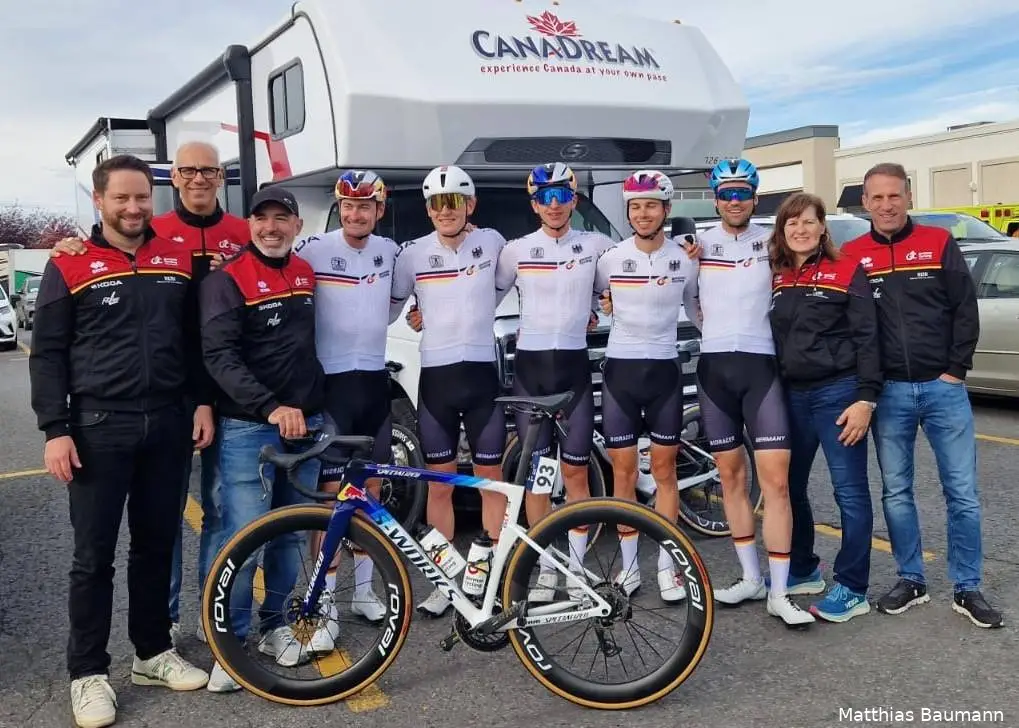
Dr. Matthias Baumann, UCI Medical Commission president, has spoken to CyclingUpToDate and RadsportAktuell about multiple issues in the safety are of the cycling space. In the wake of Muriel Furrer's passing, he strongly argued that GPS trackers could've had a role in preventing the tragedy that rocked the cycling world.
“I am firmly in favor of requiring GPS trackers," Baumann said to us. "This issue is repeatedly debated, but the decisive measures have yet to be approved. The fatal accidents of the past that could have been prevented are reason enough to show that this measure is long overdue".
Whilst race radios and GPS trackers on the riders are regular features during races on the regular calendar, they are not at the World and European Championships—as well as the Olympic Games. At the 2024 Worlds, female junior rider Muriel Furrer crashed off-road into a wooded area during the race.
There was no alarm of a fall, and her absence was only noticed as she did not cross the finish line during the circuit race. The then 18-year-old rider was only found over an hour later and later died of her injuries.
"The tragic death of Muriel Furrer is a case in point. The Swiss junior rider crashed so badly in a wooded area during the 2024 World Championships in Zurich that she died the next day from a severe traumatic brain injury. Because she lay undiscovered in the undergrowth, she was not found until hours later."
The tragedy ignited the discussion on radios and GPS trackers, with many arguing they should be mandatory for all riders. Baumann, the head of the UCI's medical commission, believes this would've helped medical staff attend Furrer earlier, potentially avoiding what followed.

Muriel Furrer died at the 2024 World Championships in Zurich
"A GPS tracker could have helped rescuers find and treat her sooner. However, as the Medical Commission, we can only make recommendations; they are not mandatory. Any measures that must be followed have to be approved by the UCI Management Committee and added to the UCI regulations.”
Are today's concussion protocols enough?
But the sport has, over the past decade, become more and more dangerous. Dozens are the accounts of riders taking extreme risks, fights for positioning multiplying, and the increasing speeds only increasing the likelihood and consequences of such falls.
The UCI's concussion protocol has also been under scrutiny. Whilst applied more often, many times riders abandon crash scenes and are later diagnosed with concussions.
These can affect the riders' senses and perception, not only jeopardizing their safety for later in the race; but also that of the other riders.
“This issue must not be underestimated, even though most concussions fortunately have no serious consequences. Every athlete must still undergo a thorough examination afterward before returning to training.”
Tadej Pogacar recently abandoned the Vuelta a España with multiple injuries, one of them being a concussion which would've potentially prevented him from continuing the race even if he hadn't suffered fractures elsewhere.
But Baumann argues that there is no simple solution when riders and teams are encouraged to pursue performance and results, for their own livelihood.
“This is a complex, multifaceted issue, and I take a very critical view of it. The racing calendar is truly packed. Teams naturally want their riders to line up at races, but an individual rider can quickly end up doing too much," he explains.
The UCI cannot force teams into certain situations, only recommend: "As a commission, though, all we can do is issue warnings and recommend reducing the number of races. Ultimately, we cannot and must not interfere in the teams’ affairs.”
Do teams have their hands tied?
Managing injuries and dozens of riders' health for professional teams is often a complicated task, and one that is difficult to manage. “Basically, yes. And until the UCI introduces a universally applicable rule, teams have little choice but to accept the status quo".
Baumann argues that it is the teams' job to ensure the safety of their riders outside of racing, and avoid having them race without lasting injuries.
"When there are so many races on offer, teams are almost obliged to send riders to different events. This is especially true for young riders. They move straight from the junior ranks into the professional scene, with hardly any time to find their feet gradually. Ultimately, riders and their teams have to find a sensible middle ground.”
“But it is a potential area of tension. On the one hand, riders have to—and want to—honour their contracts".

The pursue of one's maintenance in the cycling world then often depends on the riders' willingness to take risks.
"On the other, nobody benefits if an athlete develops myocarditis and has to end their career prematurely. We doctors are caught in the middle and have to find a diplomatic way forward. We cannot get into arguments with team officials, and that would not help anyone anyway. We offer advice and issue warnings.”
Rúben SilvaEditor-in-Chief
A founding contributor to CyclingUpToDate since its launch in January 2022, Ruben Silva has played a central role in shaping the site’s editorial direction and long-term growth. Before joining the project, he built his experience through independent blogging at Echelons Hub and by producing race previews for Ciclismo Internacional, developing a strong analytical voice rooted in daily engagement with professional cycling.
Beyond editorial work, he has been closely involved in the expansion and coordination of CyclingUpToDate’s wider network, helping establish and support sister platforms across multiple languages. This includes ongoing collaboration with CiclismoAlDia (Spanish), CiclismoAtual (Portuguese), WielrennenUpToDate (Dutch), and RadsportAktuell (German), contributing to a shared editorial vision and consistent international coverage.
He also helps oversee editorial governance across the network, setting standards for accuracy and consistency and coordinating updates or corrections when needed.
Originally from the Porto metropolitan area in Portugal, he holds a bachelor’s degree in Geography. His path into cycling journalism was shaped not through formal media training, but through independent reporting, community engagement, and sustained on-the-ground involvement in the sport.
Over the course of his career, he has conducted approximately 100 interviews across road cycling and cyclocross, ranging from one-to-one conversations and online formats to press conferences and on-site pre- and post-race coverage. His interviews include leading riders, team managers, and prominent figures within cycling media: Tadej Pogacar, Jonas Vingegaard, Mathieu van der Poel, Primoz Roglic, Wout van Aert, Joao Almeida and Tom Pidcock; managers like Patrick Lefevere and Joxean Matxin; and YouTube personality Bryan Kennedy (BKXC)...
Within 18 months of launch, he helped grow CyclingUpToDate’s English-language platform into one of the most-read cycling news websites, built entirely from the ground up. As both a professional journalist and lifelong cycling enthusiast, his focus remains on delivering accurate, timely, and well-contextualized coverage.
claps 0visitors 0
Just in


Popular news

Latest comments
- So gracious to offer something no-one would be prepared to pay for. The Giro is not the Tour and doesn’t command the same interest or attract the same “elite” (those willing to pay to be a part of something they consider has ego boosting potential). Roadside viewing will always largely remain free for everyone outside circuits. Introduction of a symbolic entrance to mountain climbs is worthy of exploration. Asking 1-2€ isn’t going to repulse real fans (most will spend 50-100€ on their outing that day all things included) but will prevent a portion of the total knobhead thrillseekers who will join in any large gathering as long as it’s free, just because they’re attracted to crowds, without which it it difficult for them to work up their anti-social behaviour.Jumpyjohn07-11-2026
- How is radio going to help when someone went over a cliff or bridge or off the roadside into a forest unnoticed and is laying there unconscious?Jumpyjohn07-11-2026
- Yep, next we’ll be accusing F1 drivers of avoiding Le Mans.Jumpyjohn07-11-2026
- But on what is that opinion based? Are you holding him to a different standard than others? Are you saying he should do learn to like something he doesn’t Are you saying he hasn’t achieved enough Are you saying he pretends to be better than his results? It’s actually a really strange opinion to oust if you consider it objectively or rationally. Try applying it to others or yourself by asking if not EVERYONE should then be doing more? Nobody in athletics or swimming gets criticism for not expanding their repertoire when a rival or someone else does. In fact, most who move to another event get accused of running from their rival. Opinions are boring, the reasons behind them are what count.Jumpyjohn07-11-2026
- for a medical chief to throw things like is just bad. There are already radios which were banned for spectacle. allow radios. Gps trackers are not a complete solutionabstractengineer07-11-2026
- Yeah man...PogiSloFans07-11-2026
- any rider less than 25 whether they are really ready for the position of leadership of GT is probably not the case. I think Pogi himself suffered when he was defeated by Jonas in the TDF twice. But that would be the team's job to ensure support so that they can bounce back. It requires a team and time to get back up and win after getting knocked down.abstractengineer07-11-2026
- I'm very glad he got the big late Quickstep Vuelta win and I hope he has a few left for Euskaltel-Euskadi.flyer07-11-2026
- My memories of Ivan Basso aren't good but I liked his sister Elisa ok.flyer07-11-2026
- I'm picking .... .... Never mind 🫥flyer07-11-2026
Loading
2 Comments