“We don’t know whether it was a GoPro or a stone” - Tadej Pogacar “in a bad way” says UAE boss Matxin, as confusion reigns over cause of Vuelta-ending crash
Cycling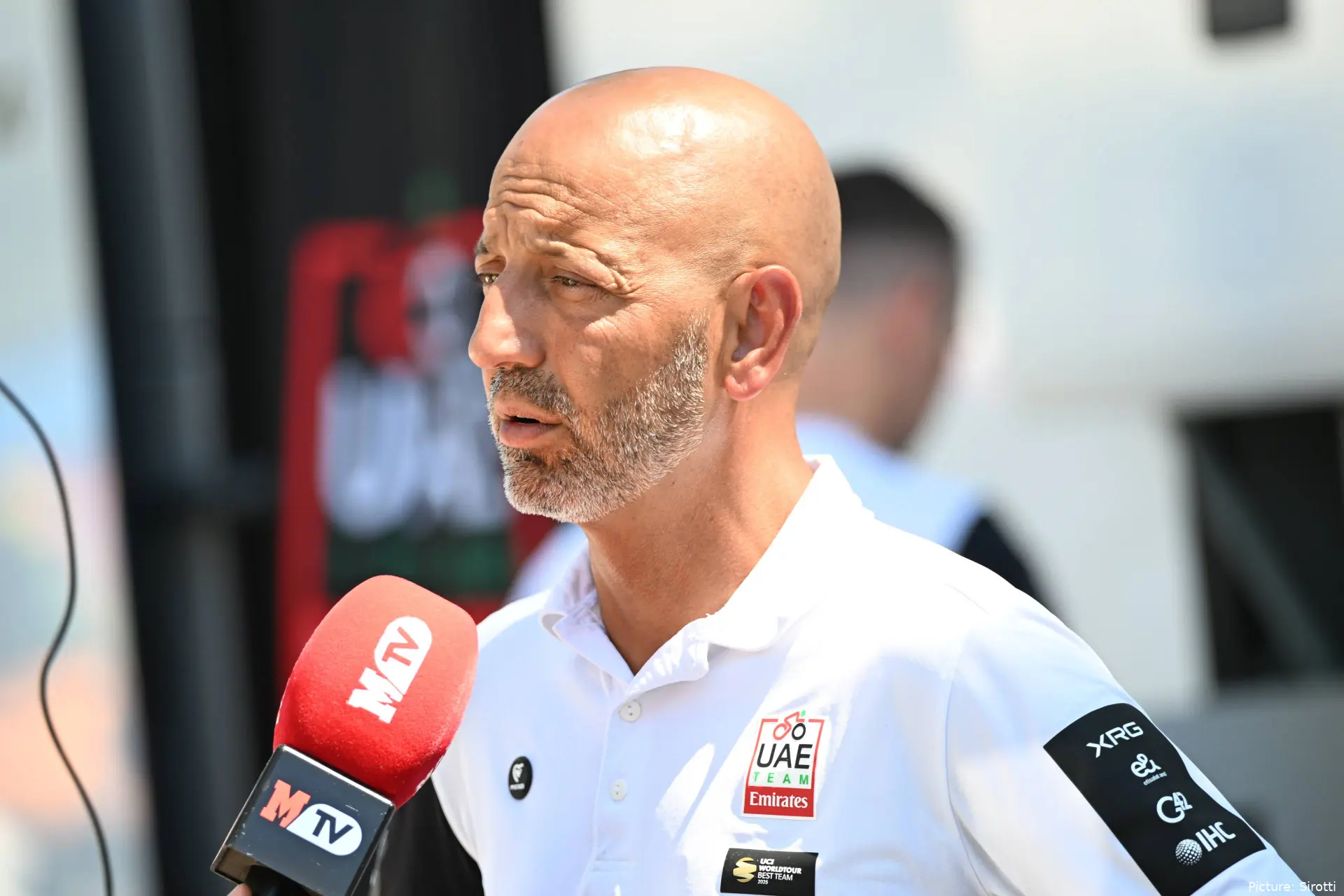
UAE Team Emirates - XRG's Joxean Matxin has provided an update on the condition of Tadej Pogacar, describing the Slovenian as being “in a bad way” as uncertainty continues over precisely what sent the general classification leader crashing out of the 2026 Vuelta a Espana on Stage 8.
Pogacar suffered a concussion, displaced fracture of his left collarbone, stable C7 cervical fracture and multiple abrasions in the high-speed fall with approximately 32 kilometres remaining. UAE Team Emirates – XRG confirmed that no neurological damage had been discovered, but surgery on his clavicle has been delayed under concussion protocols.
The Slovenian offered some reassurance on Sunday morning by sharing a photograph from his hospital bed accompanied by Stayin’ Alive. Matxin’s assessment ahead of Stage 9 nevertheless conveyed the physical and emotional severity of what had happened. “He’s in a bad way. Honestly, he’s in a bad way,” the UAE boss told MARCA.
Pogacar had led the Vuelta since winning the opening time trial in Monaco and held a 3:50 advantage over Enric Mas. His attempt to win the only Grand Tour missing from his palmares ended inside an ambulance, having already taken three stage victories during the opening week.
“He was leading the race and on course to win the Vuelta a Espana,” Matxin said. “On paper, if something like this hadn’t happened, we had every reason to be optimistic. Unfortunately, though, this is another stone in the road, just like in life generally.”
Stone or GoPro? UAE cannot yet explain crash
Television footage showed Pogacar suddenly lose control while riding close to the front of the peloton. He veered to his right, made contact with another rider and was thrown heavily over his handlebars.
A sizeable object could be seen on the road, but UAE have not determined exactly what Pogacar struck. “We don’t know whether it was a GoPro or a stone,” Matxin admitted. “What is certain is that he was drinking with one hand, meaning he only had one hand on the handlebars. That appears to be what happened, because it was otherwise a calm moment in the race.”
Matxin stressed that several riders had negotiated the same section before Pogacar encountered the object. “Six riders passed the stone or GoPro without anything happening, and then it caught him,” he continued. “These are circumstances that riders sometimes escape, but on this occasion it happened to him.”
Surgery delayed under concussion protocol
Pogacar was initially taken to hospital in Gandia before being transferred to Barcelona for further treatment. His collarbone fracture requires surgery, although the concussion means doctors cannot immediately proceed with the operation.
“Under the concussion protocol, he has to wait 24 hours before undergoing surgery,” Matxin explained. “He will then be operated on. Once the operation has taken place, we will have a better idea of the rehabilitation timescale.”
The medical consequences extend beyond Pogacar’s abandoned Vuelta. His planned defence of the world road race title in Montreal, the European Championships on home roads in Slovenia and Il Lombardia must all remain uncertain until UAE receive a clearer recovery schedule.
“Until we have that information, the team’s medical department will be responsible for communicating those details,” Matxin added. “I don’t have them at the moment.”
UAE promise an aggressive response
Pogacar’s teammates stopped after the crash and eventually crossed the finish line together almost 12 minutes behind the peloton. That collective gesture ended UAE’s remaining GC presence but underlined where the team’s priorities lay once their leader had been taken away.
“The team’s attitude deserves enormous credit,” Matxin said. “Every rider waited so that they could finish together, regardless of whether that meant losing five, 10, 11 or 14 minutes. That is what being a team means. I could not be prouder of the riders’ commitment and their attitude.”
UAE began Stage 9 without a realistic overall contender but with several riders capable of pursuing victories during the remaining two weeks. Matxin challenged them to respond by racing aggressively and attempting to dedicate a stage win to Pogacar. “One door has now closed, the one involving Tadej, the best cyclist in the world,” he said. “But another opens for the best team in the world. We must now race aggressively and be on the attack. We have lost the general classification, but every remaining stage and every day provides another opportunity.”
Asked how he was coping personally, Matxin offered another one-word answer: “Devastated.”
The team that had controlled the opening week must now reinvent its Vuelta without the rider who won three of its first six completed stages. UAE’s immediate objective is no longer defending red, but proving Matxin’s claim that the strongest collective in the race remains even after losing its leader.

Kieran WoodDeputy Editor-in-Chief
Kieran Wood is a sports journalist based in Wales and has been active in journalism since 2022. He regularly contributes to DartsNews.com and CyclingUpToDate.com, where he covers professional cycling and darts. In cycling, his work includes liveblogs from major races, including the Tour de France, the Giro d’Italia, and La Vuelta a España, alongside race reports and analysis. He has also conducted interviews with professional riders.
His reporting spans the full racing calendar, from one-day classics to stage races, with a focus on accurate, real-time coverage and clear contextual analysis. For statistics, results, and historical context, he regularly uses resources such as ProCyclingStats. To support reporting on rider activity and training context where relevant, he also references Strava.
In his work, Kieran places strong emphasis on careful sourcing, editorial accuracy, and updating articles as new, verified information becomes available.
claps 28visitors 7
Just in

Popular news
Latest comments
- I watched Il Lombardia today... :) What a loser Remco is!MajorPayne10-10-2026
- Couldn’t agree more, @RidesHills. CyclingUpToDate endeavours to ban him, but he continues to create new accounts. He was banned from CyclingNews. Whilst I used to argue against his negativity, I’ve simply lost interest. He is so utterly boring. I was initially worried he'd bully other fans, but nobody's having it. Most of us simply pay him no mind, anymore. At this point, everybody just scrolls right past him. He is quite a coward though, I’ll tell you that. His toxic comments on this site are nothing compared to what he is able to post on Twitter.anonymouscyclist10-10-2026
- C’mon, don’t follow in Horner’s footsteps. At least he had the courage to post HIS prediction ahead, I didn’t see many others disagreeing or claiming it was ridiculous.Mistermaumau10-10-2026
- @SLO: Your ridiculously rude language about riders makes it really hard to read your consistently condescending comments. "BS losers," how is it ok to talk about people like that? Also, you truly sound like you do not understand that this is a team sport, where del Toro rides for his leader and therefore doesn't follow his attacks. We can all agree that we are watching a once in a generation (really, a once in a century) rider in Pogačar, and that's great, but come on, you don't have to be a jerk when it comes to other riders. It's clear that I prefer to praise the positive in what I see, mostly because I am in awe of what these humans can do (including the ones who don't win), but your negativity about anyone but your idol is just so very very exhausting.RidesHills10-10-2026
- Huh??? You’ve obviously forgotten all the contrary you’ve been trying to sell us the last weeks. Shall I dig some out for you?Mistermaumau10-10-2026
- Doesn’t sound like it from his post-race interview. That old record you’re still playing is starting to jump a bit too often.Mistermaumau10-10-2026
- Sorry but who is this guy? If HE doesn’t know that « much » about Seixas by now, I’m recalibrating my opinion of his finish line questioning. As for PS, the most amazing thing about him so far is not what he’s won or almost won at this age, although that’s already phenomenal, it’s how consistent, numerous and long this seasons’ results have been. I don’t think there’s ever been a 19/20 year old quite as developed. Of course, you can’t expect development at this level to go backwards in time but it’s amazing to witness a rider you assume won’t be able to keep things up forever prove you wrong.Mistermaumau10-10-2026
- I agree, it was a good feeling to end the season this way... and only hope the knee injury held Del Toro back. Some how I have a feeling it wasn't just that... I wish my feelings are wrong.PogiSloFans10-10-2026
- Seixas is an amazing rider. Remco disappointed. Del Toro should rather have withdrawn if he had an injury linked to over-training. Anyway, a satisfying end to the season.Hills3310-10-2026
- History books won't care who had good legs or bad legs, or who did or didn't get laid last night; what the history books say is that Del Toro and Remco are two losers, while Seixas is a Monument winner at the age of 20. Let's not forget who was the only one that could follow Pogi in Strade Bianche. Paul Seixas, not Del Toro. Ad acta!!!PogiSloFans10-10-2026
Loading
Write a comment