Mandatory GPS trackers, concussion protocol and cycling's extreme risks – Interview with UCI Medical Commision president Dr. Matthias Baumann
Cycling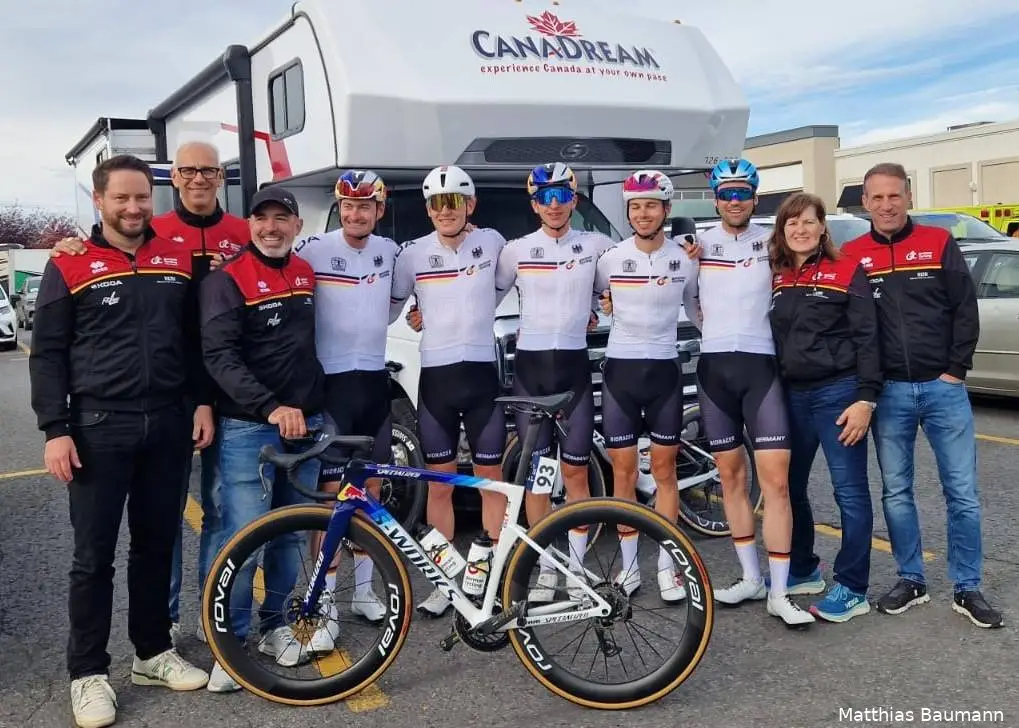
UCI Medical Commission president Dr. Matthias Baumann has spoken to CyclingUpToDate and RadsportAktuell regarding several major topics within the current cycling safety debate: Where the UCI representative stands on GPS tracking, concussion protocols and much more.
The 2026 cycling calendar for women and men once again featured a series of top-level national and international cycling events. They included the familiar stage-races and, of course classics such as Il Lombardia - where there was a protest regarding safety in cycling.
Dr Matthias Baumann, president of the UCI Medical Commission, has spoken to us regarding some of the most pertinent questions on the sport's current safety measures. He has offered plenty of insight into both the professional peloton and the World Championships, as well as the wide range of aid projects he runs through his association, Sherpa Nepalhilfe e. V..
Matthias Baumann opened up during his daily commute to the SRH hospital in Sigmaringen, where he has been serving as chief physician for trauma surgery, orthopedics and sports traumatology since 2021.
Baumann's career in cycling began in 2013, when he became team doctor for the German Cycling Federation (BDR), now known as German Cycling.

UCI Medical Commission president Matthias Baumann has discussed cycling's security issues
Full interview with UCI Medical Commission president Matthias Baumann
CyclingUpToDate: “After so many years, is one World Championships much like any other, apart from the location? Or is it still a unique experience?”
Matthias Baumann: “From a medical perspective, the challenges specific to each host country are always a priority. Depending on the country, we need to analyze in advance exactly what conditions and scenarios we might encounter. Planning for a World Championships in Africa is far more complex than for one in Canada. Montréal was relatively straightforward to organize. Essentially, we only had to account for the time difference. There were no concerns about food or the risk of diseases such as malaria.”
CyclingUpToDate: “So local conditions play an extremely important role for the athletes?”
Matthias Baumann: “Absolutely. Every athlete’s body responds differently to external factors under extreme exertion. At the World Championships in Kigali, some riders decided not to take part because they did not want to expose themselves to these unpredictable factors. Even as a doctor, you can never anticipate every possible effect in advance. Not everyone is willing to take that risk. The riders earn their living with their professional teams. If someone gets injured at a World Championships or is ill for weeks afterwards, taking part simply hasn’t been worthwhile.”
CyclingUpToDate: “How does your work differ when looking after experienced stars and younger riders?”
Matthias Baumann: “I mainly look after the elite riders. They are all highly experienced and know the procedures and everything that goes with them inside out. It is more daunting for the juniors. For many, Montréal was their first World Championships and their first major trip. As team doctor, I have to give them much more support and guidance.”
Florian Lipowitz – Germany's strongest card for the future

Matthias Baumann and Florian Lipowitz at the Road World Championships in Montréal
CyclingUpToDate: “Who selects the riders for the World Championships team? Is it purely about performance, or do teamwork and individual strengths also count?”
Matthias Baumann: “The national coaches make the selections. In Canada, five road cycling national coaches were involved, covering the junior women’s, junior men’s, women’s, men’s and under-23 categories. The riders are, of course, free to decide whether they want to take part. Selection depends heavily on the course profile. On a demanding route with a lot of climbing and steep ascents, a climber is more likely to be selected than a pure sprinter. But teamwork is also crucial.”
CyclingUpToDate: “After his serious crash at the Tour de France and a broken collarbone, Florian had to work hard to make his comeback. He fought his way through the race in Montréal in sensational fashion. As a team doctor, how closely do you support a rider through that process, both mentally and physically? When does the doctor give the green light for such a brutal World Championships race?”
Matthias Baumann: “It depends entirely on the speed of the rider’s individual recovery. The professional teams have their own doctors, who monitor the process. Before the World Championships, however, we federation doctors coordinate very closely with the team doctors.”
CyclingUpToDate: “Florian Lipowitz has proved, through his performances at the Tour de Romandie and his strong start to the Tour de France, that he can contend in the biggest three-week stage races. Matthias, you see him up close within the team: where do you see Florian in the next two or three years? Does he have what it takes to challenge for the yellow jersey at the very top?”
Matthias Baumann: “Florian definitely has what it takes to compete at the front. He has the racing toughness and the perspective needed to read race situations perfectly. He knows when it is worth attacking or taking a chance on a breakaway. It will be fascinating to see how he develops over the next few years, both personally and within Red Bull – Bora – hansgrohe.”

Florian Lipowitz in action at the 2026 Montreal World Championships
CyclingUpToDate: “How does one become president of the UCI Medical Commission? It is not exactly a job that is officially advertised on conventional recruitment websites. How does the selection or application process work? Are people nominated because they have built a reputation in the sport through their experience?”
Matthias Baumann: “That is exactly how it works. Through my many years as a federation doctor with German Cycling, I have looked after the German team at many Olympic Games. A few years ago, the UCI approached me and asked whether I would like to join the Medical Commission. I was appointed president of the commission in 2021.”
CyclingUpToDate: “Are the current measures enough to protect riders from serious crashes? What needs to improve?”
Matthias Baumann: “I am firmly in favor of requiring GPS trackers. This issue is repeatedly debated, but the decisive measures have yet to be approved. The fatal accidents of the past that could have been prevented are reason enough to show that this measure is long overdue. The tragic death of Muriel Furrer is a case in point. The Swiss junior rider crashed so badly in a wooded area during the 2024 World Championships in Zurich that she died the next day from a severe traumatic brain injury. Because she lay undiscovered in the undergrowth, she was not found until hours later. A GPS tracker could have helped rescuers find and treat her sooner. However, as the Medical Commission, we can only make recommendations; they are not mandatory. Any measures that must be followed have to be approved by the UCI Management Committee and added to the UCI regulations.”
CyclingUpToDate: “Another question concerns a recurring issue: How to deal with concussions? Are the current crash protocols sufficient to assess the severity of a concussion accurately? And how can we prevent riders from being cleared to race again too soon?”
Matthias Baumann: “This issue must not be underestimated, even though most concussions fortunately have no serious consequences. Every athlete must still undergo a thorough examination afterward before returning to training.”
CyclingUpToDate: “With the race calendar growing ever more demanding and crowded, where is the line between maximizing performance and putting riders’ health at genuine risk?”
Matthias´Baumann: “This is a complex, multifaceted issue, and I take a very critical view of it. The racing calendar is truly packed. Teams naturally want their riders to line up at races, but an individual rider can quickly end up doing too much. As a commission, though, all we can do is issue warnings and recommend reducing the number of races. Ultimately, we cannot and must not interfere in the teams’ affairs.”
CyclingUpToDate: “So, in a way, are team managers’ hands tied?”
Matthias Baumann: “Basically, yes. And until the UCI introduces a universally applicable rule, teams have little choice but to accept the status quo. When there are so many races on offer, teams are almost obliged to send riders to different events. This is especially true for young riders. They move straight from the junior ranks into the professional scene, with hardly any time to find their feet gradually. Ultimately, riders and their teams have to find a sensible middle ground.”
“But it is a potential area of tension. On the one hand, riders have to—and want to—honour their contracts. On the other, nobody benefits if an athlete develops myocarditis and has to end their career prematurely. We doctors are caught in the middle and have to find a diplomatic way forward. We cannot get into arguments with team officials, and that would not help anyone anyway. We offer advice and issue warnings.”
Professional cycling and humanitarian work
CyclingUpToDate: “To round off, I’d like to return to mountaineering and your extensive humanitarian work. As mentioned at the outset, you have been a keen mountaineer for years and have even climbed Mount Everest. In 2014, you witnessed an avalanche disaster in the Himalayan region. Afterwards, you founded Sherpa Nepalhilfe. You have completed many projects, including establishing a hospital at an altitude of 3,200 metres. After the devastating floods in Nepal in July, you and your foundation were very active again. Are any further expeditions or aid projects planned in the near future?”
Matthias Baumann: “There are no expeditions planned at the moment. Nor is my personal presence there as a trauma surgeon currently essential. The hospital staff are now so well trained that basic medical care is assured and everything runs independently. However, I stay in regular contact with my friends and colleagues in Nepal.”
CyclingUpToDate: “There is a world of difference between the luxury of professional cycling and the harsh realities of rural Nepal. Does this humanitarian work keep you grounded?”
Matthias Baumann: “Absolutely. We have such a good life here in Europe. We are very privileged, and I am glad to give something back. It makes me happy to help—not just because I am a doctor, but because it matters to me personally and gives me a great deal in return.”
CyclingUpToDate: “Do you still do any sport yourself, or is there no time between family, work and your UCI duties?”
Matthias Baumann: “Of course I still exercise regularly! Triathlon is difficult at the moment because of the high training demands, but there is always time to run. It is easy to fit around everything else. I try to run one marathon a year and take part in several granfondos.”

Matthias Baumann was on the ground after a major earthquake in Nepal
Meet the interviewee
To find out more about Matthias Baumann and his humanitarian work, visit:
This aspect undoubtedly deserves much more attention. That is precisely why the riders recently staged an open protest at Il Lombardia — they wanted to draw attention to the importance of the issue and the glaring shortcomings that exist.
What are your thoughts on safety in cycling? Feel free to leave us a comment.
Footnote: References to coaches, athletes, drivers, and juniors naturally also encompass female coaches, female athletes, female drivers, and female juniors.
Bettina Heck combines journalistic expertise with extensive personal experience in competitive cycling and triathlon. For many years, she has been an active participant in road races, mountain time trials, and triathlons — giving her a perspective on endurance sports that is both professional and deeply rooted in personal experience. Her achievements include winning the 2012 Open Württemberg Championship for amateur cyclists, as well as numerous appearances in national and international triathlon events, ranging up to the full Ironman distance. In addition to her athletic background, Bettina has pursued further professional training as a freelance editor, with a focus on strategic and digital communication, as well as press and public relations. As an editor for RadsportAktuell.de, she covers international professional cycling, blending rigorous journalistic research with the insights gained from her own active involvement in the sport.
claps 0visitors 0
Just in
Popular news

Latest comments
- As far as i saw the tour He dropped both Sexias and Remco on multiple stages even after the Giro, so rather they will be under pressure from him since he will be behind. He has already won the TDF, they haven't, he has nothing to lose.abstractengineer30-10-2026
- "Naturally, we want the suspense to last as long as possible," there is no suspense, we already know the result. If they design routes like this it will be like 2017 where Froome just win based on his TT and Uran just followed wheels into 2nd, a very horrible tour but times were pretty close by without major actions.abstractengineer30-10-2026
- Breakthrough win came from breakthrough tactics not breakthrough performance. Mcnulty will still be the same. Del Toro was inconsistent, at Dauphine he was good and at TDF he was struggling. He has not yet won any monument or GT, he will but he has not yet. None of them are close to pogi, >1 level down. Del Toro should not be at the TDF if he is going to slow down Pogi.abstractengineer30-10-2026
- same risk as every year. even if he crashes and breaks a collarbone or the like, there would be enough time to heal and regain fitness for the vuelta, which - although not the tour - is probably the more worthy season goal for his palmares.Ketterechts30-10-2026
- I Agree he should skip the tour, Pogi will win by 10 minutes, Remco will Crash and burn. Del Toro and Sexias will finish on the podium. THen they will again design for Jonasabstractengineer30-10-2026
- it's just that he won't be able to win the vuelta with pogi finishing up what he started this year.Ketterechts30-10-2026
- Wins from 20 different riders for the 3rd year in a row!Lozza30-10-2026
- 2023 was the triple year when Kuss won the Vuelta.Lozza30-10-2026
- If Pogi doesn’t win after taking his 5th TdF title, 3 monuments, 22 wins and finishing as UCI world no. 1 for the 6th year in a row, despite his crash, then it’ll be a total farce!Lozza30-10-2026
- As you are describing Jonas fighting before he'd had time to build back the muscle he'd lost from the crash, I still feel uncomfortable about it. It felt like crossing a line from driven to a bit obsessed with winning three Tours in a row. Jonas must still have been unwell when he made the decision to go all-in for that Tour instead of, say, targeting the Vuelta, wonder if he was put under any pressure. I guess I won't get much support in this view!Hills3330-10-2026
Loading
Write a comment