“It’s the equivalent of having an asterisk next to your name” – Tadej Pogacar crash will taint legacy of Vuelta 2026 winner, argues Olympic champion
Cycling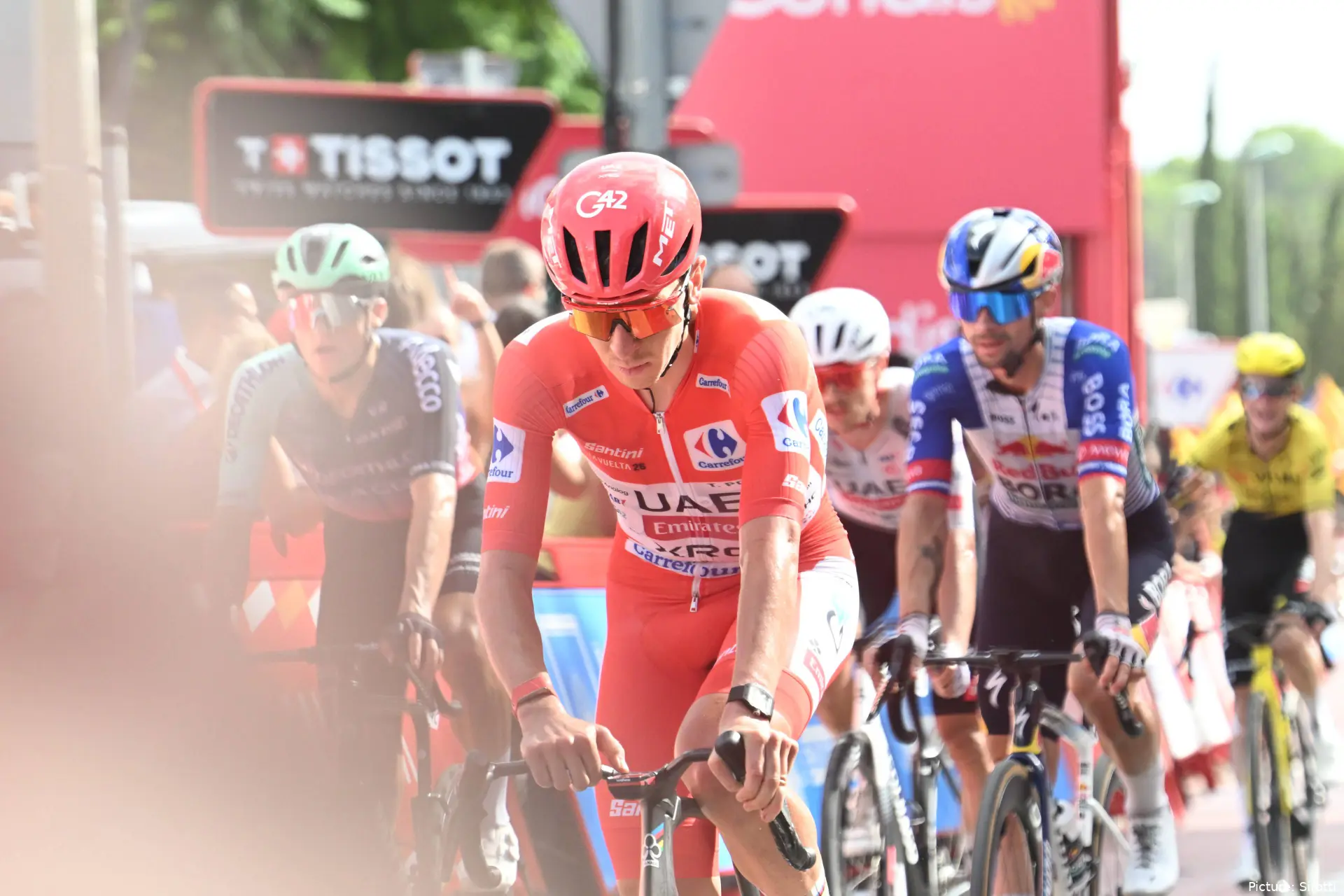
Grace Brown has questioned how the eventual winner of the 2026 Vuelta a Espana will be remembered after Tadej Pogacar’s commanding race lead was erased by a crash rather than overturned by one of his rivals.
Pogacar had already won three stages and built an advantage of 3:50 when he went down on the road to Xeraco. He left the race with concussion, a displaced left clavicle fracture, a stable C7 cervical fracture and multiple abrasions.
The Vuelta that emerged from the accident immediately looked very different. Enric Mas inherited the red jersey and then won on the Alto de Aitana, but Primoz Roglic, Felix Gall and Oscar Onley all reached the first rest day within 2:20 of the Spaniard.
That is the close GC battle many felt Pogacar’s dominance had removed. For the Aussie Olympic champion Brown, however, the manner in which it returned matters more than the uncertainty it created.

An asterisk against the eventual winner
“There’s now a shadow over whoever wins, with the knowledge that if it hadn’t been for that supposed rock, Tadej Pogacar would have had his name in the history books as the victor,” Brown said on SBS Unclipped. “It’s the equivalent of having an asterisk next to your name on an honour roll.”
The official record will make no distinction between a winner who defeated Pogacar and one who reached Madrid after the Slovenian abandoned. Cycling’s collective memory is rarely so clinical, particularly when the missing rider had worn red from the opening time trial and appeared to be increasing his advantage almost at will.
Crashes, mechanical failures and illness have always shaped Grand Tours. Remaining upright and healthy for three weeks is part of winning them, but Brown believes Pogacar’s position before the accident makes this case harder to absorb as ordinary racing misfortune.
“You might say staying upright is part of the race. Even Steven Bradbury had his glory this way,” she said. “But when it’s arguably the greatest cyclist of all time, Tadej Pogacar, with a dominant lead already in the first week, who is taken out by a crash, it feels different. This is a certainty that has basically been erased.”
Mas did not take the red jersey from Pogacar through an attack, while Roglic, Gall and Onley were never given the opportunity to reduce the deficit through their own performances. The entire contest was reset in the moment Pogacar struck an apparent obstacle and lost control of his bike.

Enric Mas leads La Vuelta after Pogacar's abandon
The price of a closer GC battle
Stage 9 offered an early demonstration of what the reshaped Vuelta could become. Decathlon CMA CGM Team took control on the Alto de Aitana, Gall attacked, Mas responded and Onley followed the red jersey all the way to the finish.
Only 18 seconds separated the first four riders on the stage. Mas now leads Roglic by 1:18, Gall by 1:39 and Onley by 2:20, leaving several plausible routes towards the overall victory.
Brown does not consider the serious injuries that created those possibilities an acceptable price for a closer race. “I just hate seeing any rider come down like that,” she said. “I’d rather have a predictable race than excitement created by crashes.”
That view is rooted in her own experience of hitting the road during a professional career that culminated in Olympic and world time trial titles.
“Having been the one hitting the tarmac myself, those images are always so raw,” Brown explained. “You have a moment when you’re flying through the air and the ground is rushing towards you, when your life flashes before your eyes. You know how badly it can end in a split second. You’re just bracing yourself for the consequences.”
Pogacar was treated beside the road before being placed in an ambulance, with his concussion subsequently delaying surgery on the displaced collarbone fracture. The sight of the world’s leading rider suddenly unable to continue cut through the sense of invincibility established during the opening week. “Watching others crash reminds me of the fragility of life and how human our heroes are,” Brown said.
What makes the Vuelta compelling
Before the accident, discussion around the race had increasingly focused on whether Pogacar was too dominant and whether only misfortune could prevent him from completing his Grand Tour collection.
“People were saying that the only way he doesn’t win is if he crashes or has some other misfortune,” Brown recalled. “Well, here we have it. He crashed and he’s out. Did we all jinx it? And the more pertinent question: are we all more entertained now by this Vuelta?”
Brown does not view the overall classification as the only source of the Vuelta’s appeal. Stage 3 had already produced one of the most extraordinary scenes of the race when a severe hailstorm forced riders to seek refuge inside a hotel and brought the racing to an early end.
“Whether Pogacar is there or not, we will still have those quirky storylines,” she said. “So, if you’re celebrating the fact that the general classification is now wide open, I think you’re celebrating the wrong thing, because personally, I never tuned into the Vuelta for the GC battle anyway.”
The 2026 edition may now produce the closely matched title fight that appeared impossible after Pogacar’s opening week. Brown’s objection is to treating the accident responsible for that transformation as another welcome twist in the spectacle. “It’s about time we stopped glorifying crashes as though they add something to the racing,” she said. “The Vuelta is not better for it.”
Mas and his challengers have inherited a genuine contest, but it began with the red jersey leaving in an ambulance rather than losing time on a climb.

Kieran WoodDeputy Editor-in-Chief
Kieran Wood is a sports journalist based in Wales and has been active in journalism since 2022. He regularly contributes to DartsNews.com and CyclingUpToDate.com, where he covers professional cycling and darts. In cycling, his work includes liveblogs from major races, including the Tour de France, the Giro d’Italia, and La Vuelta a España, alongside race reports and analysis. He has also conducted interviews with professional riders.
His reporting spans the full racing calendar, from one-day classics to stage races, with a focus on accurate, real-time coverage and clear contextual analysis. For statistics, results, and historical context, he regularly uses resources such as ProCyclingStats. To support reporting on rider activity and training context where relevant, he also references Strava.
In his work, Kieran places strong emphasis on careful sourcing, editorial accuracy, and updating articles as new, verified information becomes available.
claps 4visitors 3
Just in

Popular news
Latest comments
- Ahem, stage 16 of the 2025 Giro
 Rafionain-Glas11-10-2026
 - Can we get a comment from the UCI on this. The silence from Aigle is deafening! Come on cycling journalists , start annoying them to get a comment please.Paul53111-10-2026
- A shame to see him retire, I really liked him as a rider. His dignified tribute along with Matej Mohorovic to Gino Mader after his death was class and will always live in my memory. Enjoy your retirement.GregT11-10-2026
- A shame to see him retire, I really liked him as a rider. His dignified tribute along with Matej Mohorovic to Gino Mader after his death was class and will always live in my memory. Enjoy your retirement.GregT11-10-2026
- I thought Seixas had hit the end of the road from a fatigue standpoint, after the WC meltdown - and he still finished ok. This was impressive and an amazing return.mij11-10-2026
- totally, eating crow for breakfast this morning. after the world championships I thought we were looking at a late season fade from fatigue. way to go Paul!mij11-10-2026
- Well if UAE the best team in history comes knocking their the only team in the world who can get Seixas. Seixas will become unbeatable and incredible there. Lets see if he stays at decathlon or goes to UAE.miguel11-10-2026
- Pogi would have won the Vuelta at around 10 min. But it would have been boring for fools like you. Capish?PogiSloFans11-10-2026
- Rather than me describing the technology at length on here, If you google. Line-scan cameras. They are also sometimes called Slit-Scan cameras. Either search will fill you in. You can read all about how they. work. Enjoy! Just to be clear the cyclist is saying he wants to see exactly where the digital finish line is in relation to the actual physical finish. At this point we only have the word of the authority that the digital line corresponds to the exact starting edge of the physical finish line. That seems like a reasonable request to me.Prorodsandstuff11-10-2026
- 100% @Jumpyjohn, good point well raised.anonymouscyclist11-10-2026
Loading
3 Comments