"It was Pogacar’s best year on a human level since I’ve known him" - Matxin on UAE leader's 2026 and post-crash Vuelta situation
Cycling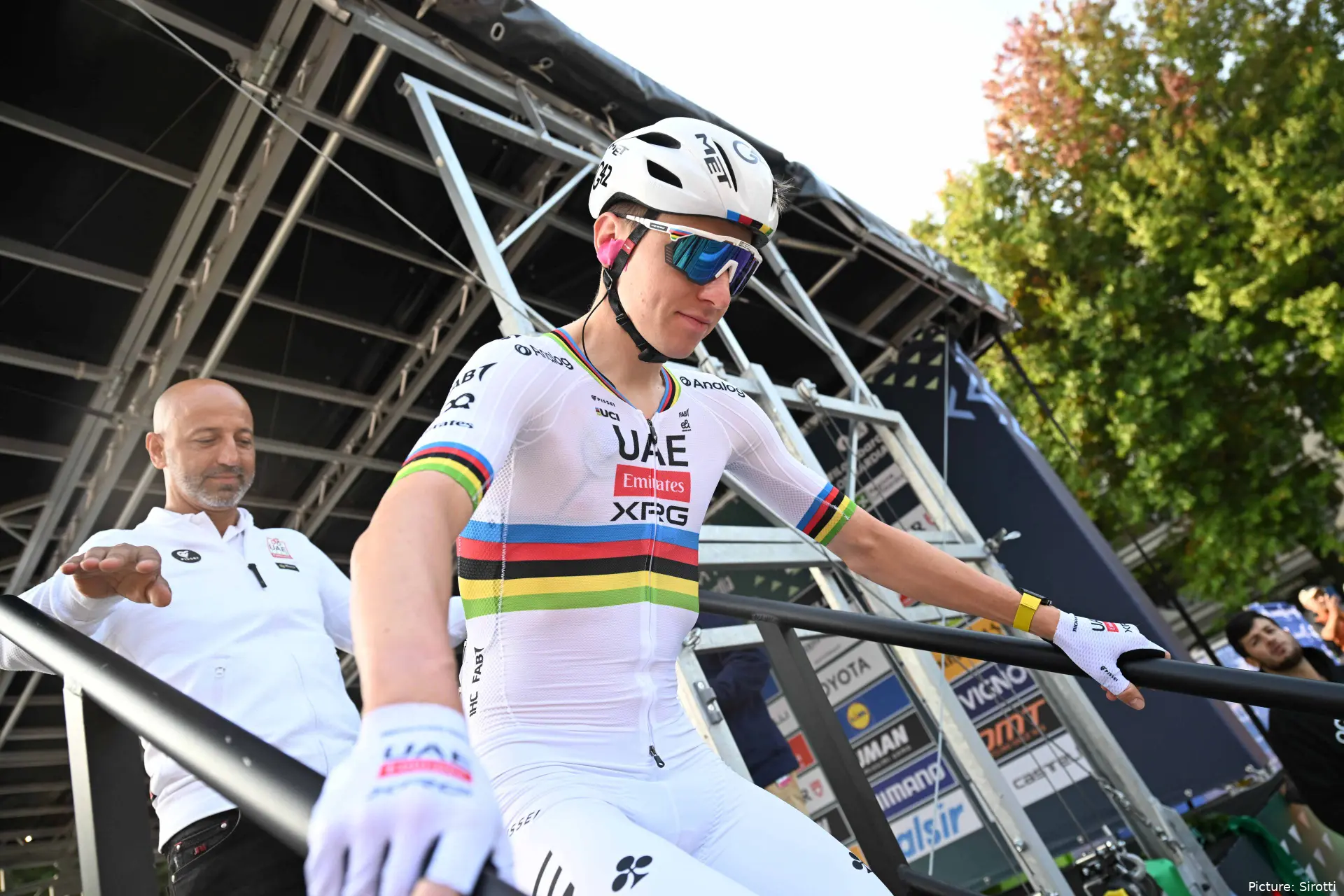
Tadej Pogacar’s crash has completely reshaped UAE Team Emirates XRG’s scenario at the Vuelta a España. The team that started the race in full control is now down to four riders, yet far from slipping into a secondary role, the squad keeps chasing chances every stage. Joxean Fernández Matxin, the Emirati outfit’s manager, defends exactly that competitive mindset.
In talks with Diario AS, the Emirati director highlights that his four survivors — João Almeida, Domen Novak, Ivo Oliveira, and Kevin Vermaerke — are also tackling stages from car number 23, the last in the convoy. A stark contrast to the first third of the race, when Pogacar wore red.
But the change of script has not dulled their ambition. On the road to La Pandera, three of the four UAE riders made the break, and Vermaerke even dared to dream of victory. The image captures the philosophy Matxin wants to hold to the end: race, seize openings, and refuse to let the loss of their leader turn the team into mere spectators.
“All those who always ask me why we don’t let others win races should come now and see the number on our car. It’s 23 (he refers to the orders of team cars, ed.),” Matxin explains. The Basque underlines the gap between the expectations that come with a Pogacar-led roster and the reality facing a team forced to reinvent itself after losing its reference point.
UAE won’t drop their heads: they want a stage without Tadej Pogacar
Pogačar’s absence is a huge sporting blow, but it has also revealed another side of UAE. Without their leader, the remaining riders have taken on new roles and keep fighting for presence in the breaks. “We’ll keep contesting stages from the break,” says Matxin, convinced that this situation is also part of the learning curve for a team used to battling for everything.
The Emirati director stresses that highs and lows are inherent to sport. “You have to be there in the bad moments just as you are in the good ones,” he notes. For UAE, this Vuelta has become a war of attrition, with four riders trying to keep the team at the sharp end and pounce on any opening.
The conversation inevitably turns to Pogacar. The Slovenian suffered a heavy crash that caused a broken collarbone, a stable injury to the C7 vertebra, and a concussion. After surgery in Barcelona, the team decided he will not return to competition in 2026. For Matxin, accepting that reality was one of the hardest parts of the whole process.
“Accepting the situation was possibly tougher than the crash itself,” he concedes. Pogacar understood during his hospital stay that he needed seven to eight weeks to recover and that there was no point in rushing to make the Worlds. The priority shifted: let the rider rest and complete his recovery without pressure.

Tadej Pogacar's absence from the Vuelta a España has changed the race completely
Pogacar, a renewal to build the future
UAE has no intention of hurrying their star’s return either. Pogacar’s renewal through 2032 was already agreed before the crash, so the team sees no reason to force the timeline. “Why speed up the process?” asks Matxin, who prefers to think long term and bring the Slovenian back in the best possible condition.
A first glimpse of a comeback could arrive at the winter camp, between November and December, but always with maximum caution. The goal is not to get the champion back as soon as possible, but to ensure he returns fully prepared for a new season after a 2026 that had been extraordinary until the fall.
In fact, Matxin believes Pogacar’s season was exceptional not only for his results. The UAE director especially praises his conduct off the bike and his rapport with those around him. “I think it was Pogacar’s best year on a human level since I’ve known him,” he says, highlighting his attitude with teammates, staff, sponsors, and the media.
The Vuelta has shown both faces of UAE: a team that started in command with Pogacar and now survives with four riders, but also a structure that refuses to stop racing. While his riders keep seeking daylight in the breaks, Matxin looks beyond this race. The crash has halted Pogacar’s march, but not the project. With the Slovenian tied to the team through 2032 and a no-rush recovery as the priority, UAE is already shaping the future of its leader.
Javier RampeCycling Journalist
Javier Rampe is a sports analyst with more than 15 years of experience. He holds a degree in Economics from the University of Rome and a Diploma in Business Studies from the University of Cádiz. Despite coming from an academic background not particularly associated with cycling, his passion for both cycling and journalism was instilled in him from an early age. He grew up following Miguel Indurain and José María “El Chava” Jiménez. An admirer of Michael Robinson’s communication style and journalistic approach, he was inspired to pursue a degree in Journalism at the University of Buenos Aires, which he is currently completing.
He has always maintained close ties with the worlds of sport and culture, contributing from a young age to sports blogs and film and music review websites. His work has appeared in media outlets such as Cope, RAI, and Radio Con Vos. He is also the founder of the cycling-focused podcast El Contraanálisis and the football interview channel Días De Fútbol, dedicated to conversations with professional footballers.
In addition to his work at Ciclismoaldia, Javier has interviewed some of the most influential figures in modern cycling, including Alejandro Valverde and Tadej Pogačar, as well as key voices in anti-doping policy such as Alberto Yelmo, David Varillas, and Marcelo Milano. Marcos Maynar, in relation to the ‘Operación Ílex’ case, is also among the personalities he has interviewed. He enjoys conducting in-depth analysis of the cycling ecosystem and has attended major events such as Strade Bianche, the Vuelta a Andalucía, and Itzulia, as well as numerous national cyclo-cross races.
His background in economics, combined with extensive experience in marketing and corporate communications, drives his continuous study of positioning strategies and ensures that he always keeps his focus on crafting compelling and evocative headlines.
claps 1visitors 1
Just in
Popular news
Latest comments
- Campenaerts looked like a rolling pumpkin with that all orange leaders skinsuit !frieders318-10-2026
- He can take his dumb a$$ politics somehwere else !frieders318-10-2026
- good to have her back. fingers crossed she‘ll be able to stay!Ketterechts17-10-2026
- A tenner and he wins the Tour next year, too 😂anonymouscyclist17-10-2026
- the answer is either stick to classics or GTs but not bothabstractengineer17-10-2026
- the exodus already stared with Ciccone. Already they were struggling with two sprinters, now there are three. Also Ganna will demand leadership. Gall is the most proven GC, Ayuso has the most potential. GC leadership for everybody will be impossible. Literally a UAE style mess without pogi.abstractengineer17-10-2026
- I raced as an amateur for 12 years, including six years on my country’s national road cycling team. I secured two national titles and competed in three World Championships plus more than 15 international stage races. At 23, we travelled to Italy for a training camp—or so I assumed. On a rest day, we watched a presentation about adopting a more “professional” training approach. It was crystal clear what “professional” meant. That moment first exposed me to this dilemma. After returning from Italy, I left cycling—at least at the competitive level I had known. Over the following two years, the whole team was caught doping. I hold that everyone is innocent until proven guilty. In my view, current stakeholders operate on a different scale, and the sums involved are vast. I am unsure whether any doping would ever be revealed. I try to stay positive and enjoy the show. My 2c.
 vannpelt17-10-2026
 - Fiver he wins 🤣
 leedorney17-10-2026
 - “…measures to reduce speeds.” Might as well shorten the race course to just 50km as well? ASO generates at minimum €300m a year and 30- 40% profit. Maybe stop being greedy and spend more of the profit to protect the riders instead.b3tlla17-10-2026
- he also had quite the life off the bike during his pro years. he used his celebrity status to full affect.mij17-10-2026
Loading
Write a comment