From Fabian Cancellara to Remco Evenepoel: The five riders who defined World Championship time trialling
CyclingSunday, 20 September 2026 at 13:48
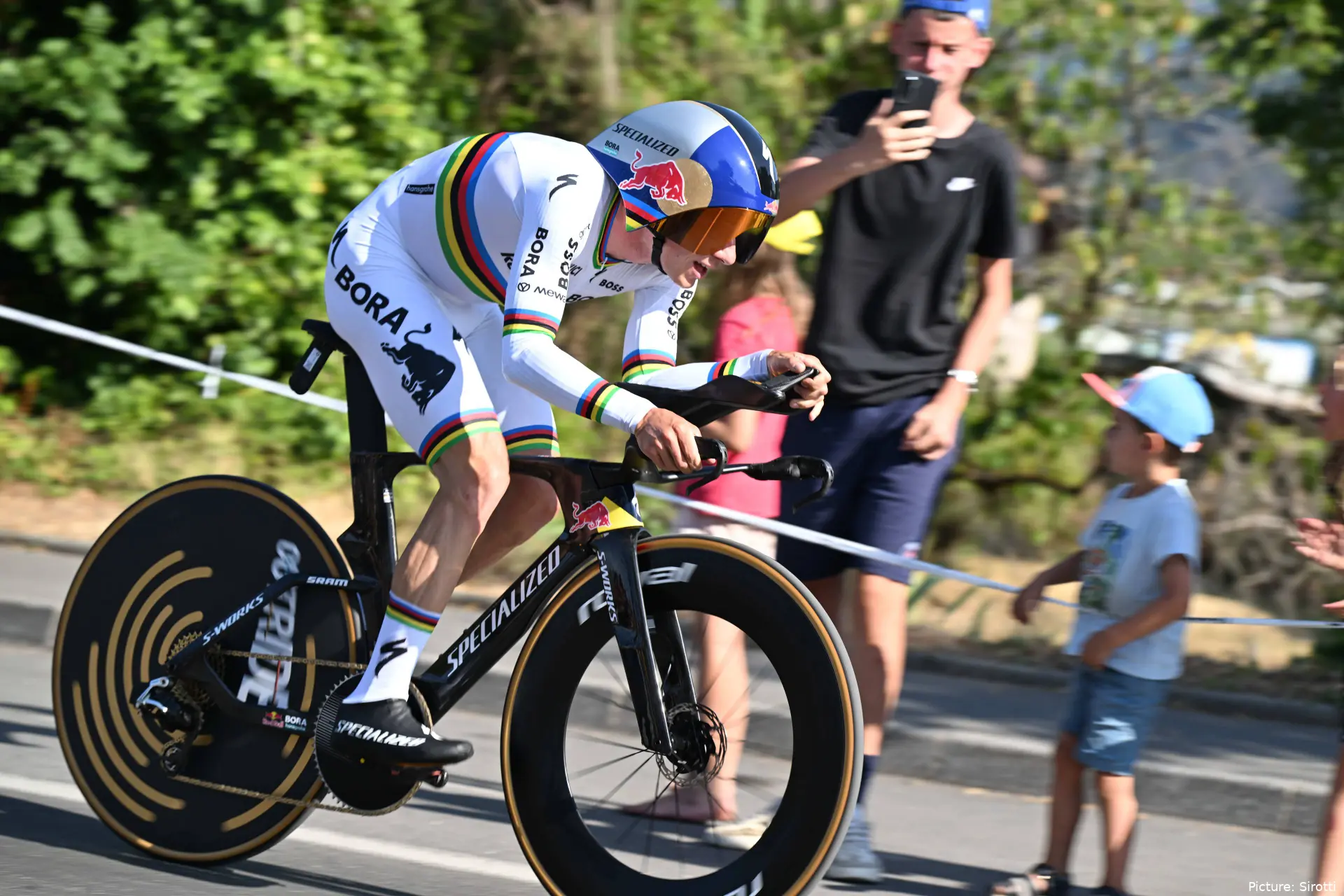
The World Time Trial Championships take center stage today, Sunday, in Montreal, bringing together some of the world’s finest specialists and writing a new chapter in a discipline reserved for riders who can take on the clock alone. Before we meet the next champion, it’s worth looking back at those who have ruled this race.
Since the elite men’s time trial has had its own world championship, several generations of specialists have left an indelible mark. Supremacy has shifted over time: from the powerhouse rouleurs of the 1990s to pure specialists who turned the time trial bike into a precision tool.
For this ranking, the number of world titles is the primary yardstick. Fabian Cancellara and Tony Martin sit at the top with four golds each, while Michael Rogers claimed three straight wins between 2003 and 2005. Behind them are Jan Ullrich and Remco Evenepoel, with two and three titles respectively, though from very different eras. Five riders who embody distinct ways of understanding the fight against the clock.
Some built much of their careers around the discipline; others were grand tour contenders or versatile classics riders who made the time trial one of their sharpest weapons. All, however, had to face generations stacked with specialists.
1. Fabian Cancellara: the great Swiss dominator
Fabian Cancellara is unavoidable when discussing modern time trialling. The Swiss star took four world titles, placing him atop the all-time list alongside Tony Martin. His reign spanned much of the 2000s, with victories in Salzburg 2006, Stuttgart 2007, Mendrisio 2009, and Melbourne 2010.
Cancellara was a specialist with immense physical capacity, built to turn big gears over long distances without losing speed. His power, position on the bike, and ability to sustain high efforts made him a benchmark. As a classics rider, he also excelled on demanding, technical courses, which only broadened his dominance.
His rivalry cut across generations. In 2006 he beat David Zabriskie and Alexandr Vinokurov; a year later he topped László Bodrogi and Stef Clement. In 2009 he overcame Gustav Larsson and a young Tony Martin, while in 2010 he again defeated David Millar and Martin. The roll call of rivals underlines the scale of his era: pure specialists, powerhouse rouleurs, and riders who could contest the grand tours.
2. Tony Martin: four Worlds built on power
Tony Martin forged one of the great dynasties in World Championship time trials. The German won four titles between 2011 and 2016: Copenhagen 2011, Valkenburg 2012, Florence 2013, and Doha 2016. That run allowed him to match Cancellara’s record. His style was that of a towering rouleur, able to produce extraordinary power and hold it virtually from start to finish. Martin turned consistency into a weapon. He did not rely on big accelerations: he imposed a crushing pace and sustained it to the line, with exceptional aerodynamic and physiological efficiency.
To take four titles he had to see off elite rivals. In 2011 he defeated Bradley Wiggins and Cancellara; in 2012 he beat Taylor Phinney and Vasil Kiryienka; and in 2013 he again outpaced Wiggins and Cancellara. His final gold came in Doha 2016, ahead of Kiryienka and Jonathan Castroviejo. These were years when the German overlapped with some of the finest specialists of his generation.

Tony Martin is one of the greatest time trialists in history
3. Michael Rogers: three consecutive titles
Michael Rogers dominated the world time trial from 2003 to 2005. The Australian claimed three consecutive titles, starting in Hamilton and continuing in Verona and Madrid. His hat-trick makes him one of the key specialists of the early 21st century.
Rogers was a complete rider: excellent on the time trial bike, yet also effective in stage races. He blended power, aerodynamics, and sustained effort, allowing him to rule a discipline undergoing rapid technical evolution for three straight seasons.
In 2003 he beat Uwe Peschel and Michael Rich; in 2004 he again prevailed over Rich and Alexandr Vinokurov; and in 2005 he defeated José Iván Gutiérrez and a rising Fabian Cancellara, who was just becoming a global reference. That sequence is telling, as Rogers won his three titles before the Swiss launched his own era of dominance.
4. Remco Evenepoel: the heir of a new generation
Remco Evenepoel embodies the evolution of the modern time trial. The Belgian has claimed three world titles, in Stirling 2023, Zürich 2024, and Kigali 2025, already placing himself among the great specialists in history despite belonging to a still-active generation.
His profile differs from the pure specialists of previous decades. Evenepoel is a Grand Tour and Classics rider, able to climb, attack from distance, and contest wins in almost any scenario. In the time trial, that versatility becomes a huge capacity to hold high speeds even when the course demands changes of pace, elevation, or fine technical precision.
His world-title run has coincided with a formidable generation of specialists. In 2023 he beat Filippo Ganna and Joshua Tarling; in 2024 he again finished ahead of Ganna, while in 2025 he prevailed over Jay Vine and Ilan Van Wilder. Along the way he has also shared the stage with riders such as Wout van Aert, Stefan Küng, and other experts who have turned the race against the clock into one of the most competitive events on the calendar.

Jan Ullrich is the only German to have won the Tour de France
5. Jan Ullrich: German power between two eras
Jan Ullrich rounds out this group of great champions with two world titles, taken in Treviso 1999 and Lisbon 2001. His presence is especially significant because it shows that the time trial was also a decisive weapon for riders built to fight for Grand Tours.
The German was a rider of extraordinary physical power. His ability to hold high speeds over long efforts made him one of the best specialists of his generation, while his immense talent allowed him to pair that strength with outstanding performances in the mountains and in the Grand Tours.
His first title came in Treviso, where he beat Michael Andersson and Chris Boardman. Two years later he reclaimed the rainbow in Lisbon, this time ahead of David Millar and Santiago Botero. Between both triumphs he competed against specialists such as Abraham Olano, Alex Zülle, Laurent Jalabert, and Serhi Honchar, in an era when the time trial remained one of the prime weapons for Grand Tour contenders.
Time trial World Championship roll of honour
| Year | Venue | Champion | 2nd | 3rd |
| 1994 | Catania, Italy | Chris Boardman | Andrea Chiurato | Jan Ullrich |
| 1995 | Tunja, Colombia | Miguel Indurain | Abraham Olano | Uwe Peschel |
| 1996 | Lugano, Switzerland | Alex Zülle | Chris Boardman | Tony Rominger |
| 1997 | San Sebastián, Spain | Laurent Jalabert | Serhi Honchar | Chris Boardman |
| 1998 | Valkenburg, Netherlands | Abraham Olano | Melcior Mauri | Serhi Honchar |
| 1999 | Treviso, Italy | Jan Ullrich | Michael Andersson | Chris Boardman |
| 2000 | Plouay, France | Serhi Honchar | Michael Rich | László Bodrogi |
| 2001 | Lisbon, Portugal | Jan Ullrich | David Millar | Santiago Botero |
| 2002 | Zolder, Belgium | Santiago Botero | Michael Rich | Igor González de Galdeano |
| 2003 | Hamilton, Canada | Michael Rogers | Uwe Peschel | Michael Rich |
| 2004 | Verona, Italy | Michael Rogers | Michael Rich | Alexandr Vinokurov |
| 2005 | Madrid, Spain | Michael Rogers | José Iván Gutiérrez | Fabian Cancellara |
| 2006 | Salzburg, Austria | Fabian Cancellara | David Zabriskie | Alexandr Vinokurov |
| 2007 | Stuttgart, Germany | Fabian Cancellara | László Bodrogi | Stef Clement |
| 2008 | Varese, Italy | Bert Grabsch | Svein Tuft | David Zabriskie |
| 2009 | Mendrisio, Switzerland | Fabian Cancellara | Gustav Larsson | Tony Martin |
| 2010 | Melbourne, Australia | Fabian Cancellara | David Millar | Tony Martin |
| 2011 | Copenhagen, Denmark | Tony Martin | Bradley Wiggins | Fabian Cancellara |
| 2012 | Valkenburg, Netherlands | Tony Martin | Taylor Phinney | Vasil Kirienka |
| 2013 | Florence, Italy | Tony Martin | Bradley Wiggins | Fabian Cancellara |
| 2014 | Ponferrada, Spain | Bradley Wiggins | Tony Martin | Tom Dumoulin |
| 2015 | Richmond, United States | Vasil Kirienka | Adriano Malori | Jérôme Coppel |
| 2016 | Doha, Qatar | Tony Martin | Vasil Kirienka | Jonathan Castroviejo |
| 2017 | Bergen, Norway | Tom Dumoulin | Primož Roglič | Chris Froome |
| 2018 | Innsbruck, Austria | Rohan Dennis | Tom Dumoulin | Victor Campenaerts |
| 2019 | Yorkshire, United Kingdom | Rohan Dennis | Remco Evenepoel | Filippo Ganna |
| 2020 | Imola, Italy | Filippo Ganna | Wout van Aert | Stefan Küng |
| 2021 | Flanders, Belgium | Filippo Ganna | Wout van Aert | Remco Evenepoel |
| 2022 | Wollongong, Australia | Tobias Foss | Stefan Küng | Remco Evenepoel |
| 2023 | Stirling, United Kingdom | Remco Evenepoel | Filippo Ganna | Joshua Tarling |
| 2024 | Zürich, Switzerland | Remco Evenepoel | Filippo Ganna | Edoardo Affini |
| 2025 | Kigali, Rwanda | Remco Evenepoel | Jay Vine | Ilan Van Wilder |
Javier RampeCycling Journalist
Javier Rampe is a sports analyst with more than 15 years of experience. He holds a degree in Economics from the University of Rome and a Diploma in Business Studies from the University of Cádiz. Despite coming from an academic background not particularly associated with cycling, his passion for both cycling and journalism was instilled in him from an early age. He grew up following Miguel Indurain and José María “El Chava” Jiménez. An admirer of Michael Robinson’s communication style and journalistic approach, he was inspired to pursue a degree in Journalism at the University of Buenos Aires, which he is currently completing.
He has always maintained close ties with the worlds of sport and culture, contributing from a young age to sports blogs and film and music review websites. His work has appeared in media outlets such as Cope, RAI, and Radio Con Vos. He is also the founder of the cycling-focused podcast El Contraanálisis and the football interview channel Días De Fútbol, dedicated to conversations with professional footballers.
In addition to his work at Ciclismoaldia, Javier has interviewed some of the most influential figures in modern cycling, including Alejandro Valverde and Tadej Pogačar, as well as key voices in anti-doping policy such as Alberto Yelmo, David Varillas, and Marcelo Milano. Marcos Maynar, in relation to the ‘Operación Ílex’ case, is also among the personalities he has interviewed. He enjoys conducting in-depth analysis of the cycling ecosystem and has attended major events such as Strade Bianche, the Vuelta a Andalucía, and Itzulia, as well as numerous national cyclo-cross races.
His background in economics, combined with extensive experience in marketing and corporate communications, drives his continuous study of positioning strategies and ensures that he always keeps his focus on crafting compelling and evocative headlines.
claps 0visitors 0
Just in
Popular news
Latest comments
- Or automated translation. I suspect hub could be hubris though. I don’t know multilingualism is the reason but it’s really not hard at all to understand what is meant. Or perhaps I’ve gotten too used to reading automatic translations imposed by the likes of Google, Airbnb, Tripadvisor etc. for foreign messages and reviewsJumpyjohn20-09-2026
- If it’s hard for him, imagine how it must be for the others.Jumpyjohn20-09-2026
- And yet, without any research or knowledge you quite liberally assume whatever you feel like about the people you argue with (whilst, I notice, spouting off quite a bit about yourself that we have to assume is true for lack of any verification possibilities). Maybe you should reveal your own identity for us to check out your story? On the other hand, if taking part in a photo shoot (or even two) is given prominence by you, is it worth us looking at your CV?Jumpyjohn20-09-2026
- No Tom Dumoulin?
 DareDevil20-09-2026
 - Indeed, and it doesn’t even seem well correlated to age, some of the older viewers being way more modern than the newer generations.Jumpyjohn20-09-2026
- You are the only one who ever asks, try not to make things too obviousJumpyjohn20-09-2026
- Am surprised we are still discussing what MVDP might do instead of why he did what he did. Is he lacking form or was his approach planned in view of next weekend. He seemed ok on stage 1 and hasn’t seemed interested since. Or has he gotten ill?Jumpyjohn20-09-2026
- If it had gone through it would make it hard for them to complain about big budget teams as was done recentlyJumpyjohn20-09-2026
- I believe it is AI in the first place
 Rafionain-Glas20-09-2026
 - Who's Mou???PogiSloFans20-09-2026
Loading
1 Comments