Why was a trophy taken away from him, only to be given back in a legal battle? Roberto Heras and the 2005 Vuelta a España
Cycling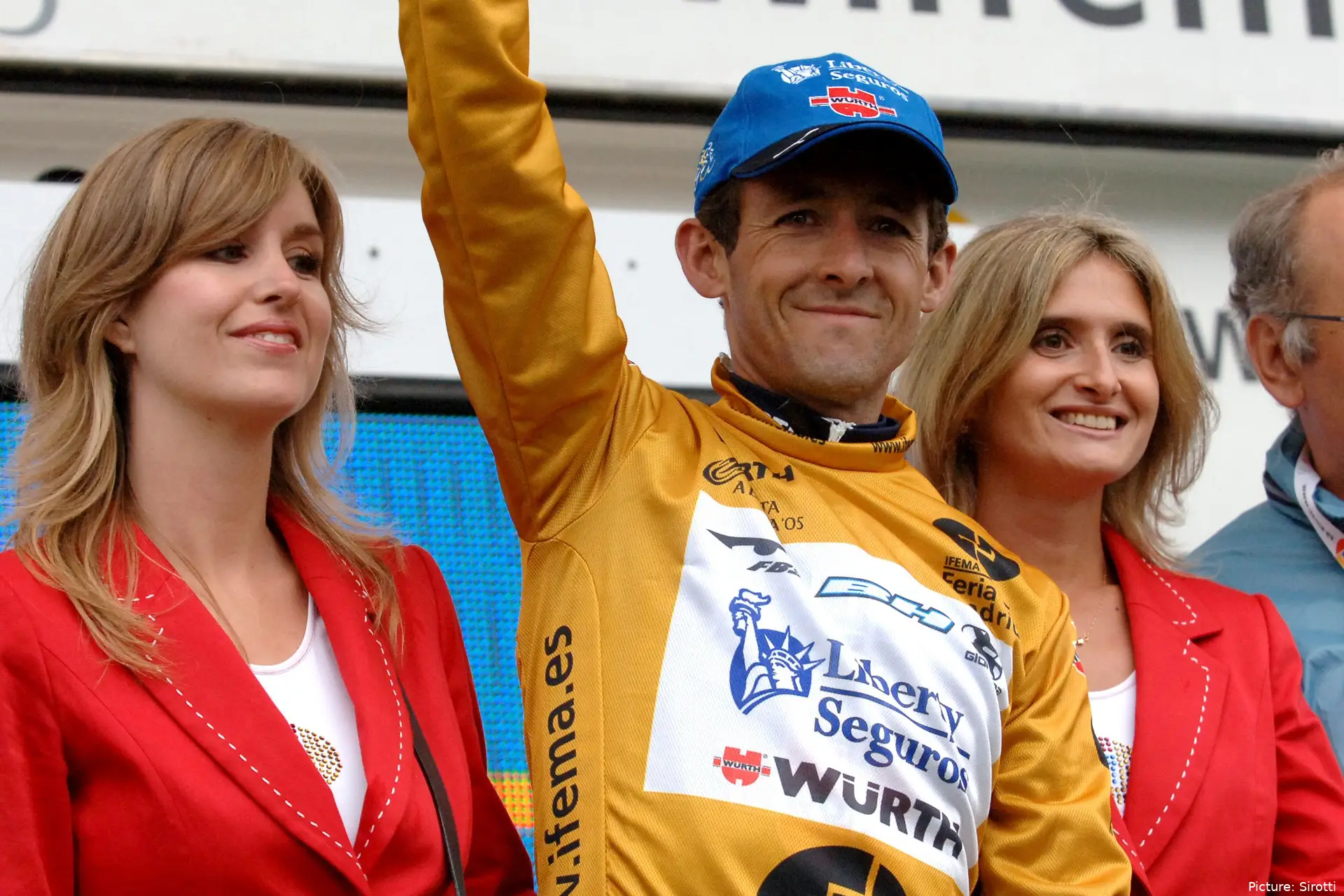
Roberto Heras holds a prominent place in the history of the Vuelta a España, a race in which he built a record few can match. The rider from Salamanca won the Spanish Grand Tour four times, in 2000, 2003, 2004 and 2005. his final victory was overshadowed for years by one of Spanish cycling’s most significant controversies. The dispute was not settled on the road, but ultimately in court.
The rider from Béjar won the 2005 edition after once again demonstrating his ability to manage a Grand Tour. But just as he seemed poised to claim his fourth title, a doping test taken during stage 20 entirely changed the sporting outcome. Analysis of a sample detected recombinant erythropoietin (EPO), prompting his disqualification and a two-year suspension.
The decision immediately changed the general classification. Heras lost the victory, and Russia’s Denis Menchov was declared the winner of that edition. The news dealt a major blow to the Spanish rider, whose result after three weeks of racing had been annulled through an anti-doping procedure. The case, however, was far from over.
The story took a turn several years later, when the ordinary courts overturned the suspension and paved the way for Heras to officially regain his 2005 victory. What had initially been presented as a positive test costing him his fourth Vuelta became a legal battle over the validity of the sample-testing procedure. In December 2012, the Supreme Court upheld the annulment of the suspension, definitively restoring his victory.
A positive test that changed the outcome of the Vuelta
The 2005 Vuelta a España held special significance for Roberto Heras. The Liberty Seguros rider had already won the race three times and was aiming to extend his dominance in a competition that suited his climbing ability particularly well. His consistency and experience had made him one of the Vuelta’s leading figures during the first half of the decade.

Roberto Heras wearing the gold jersey at the 2005 Vuelta a España
Heras finished that year’s edition at the top of the general classification, but news that emerged after stage 20 thoroughly changed the result. A doping test conducted on the 17th September 2005 detected recombinant erythropoietin, a banned substance used to stimulate red blood cell production. The adverse analytical finding triggered disciplinary proceedings that ultimately cost him the victory.
The initial penalty was a two-year suspension, along with the annulment of his race result. Denis Menchov thus inherited the Vuelta victory, while Heras faced a lengthy spell away from competition. The decision also altered the historical record of the Spanish Grand Tour, which listed the rider from Salamanca as a three-time winner instead of the four-time champion he had been on the road.
Court finds irregularities in the procedure
Heras’ defense took the case to the ordinary courts and challenged the conditions under which the samples had been transported and stored. The argument was not limited to disputing the test result; it also questioned whether the procedure had met the necessary standards to safeguard the integrity of the evidence. Concerns included the time taken to deliver the samples to the laboratory and the lack of information about their chain of custody.
One decisive factor was that the samples did not reach the laboratory within the required 24-hour period, arriving almost 40 hours after collection because the delivery date fell on a public holiday. The court ruling also noted that they had been transported at room temperature and that there was insufficient evidence showing who had handled their transport and custody. The defence argued that these circumstances could compromise the integrity of the evidence and, consequently, the validity of the disciplinary procedure.
The High Court of Justice of Castile and León upheld the rider’s appeal on 24 June 2011. The ruling overturned the sanction imposed by the Spanish Cycling Federation and the removal of his results from that Vuelta. It focused on the guarantees of the right to a defense and the need for the responsible bodies to properly establish the chain of custody.
The court did not declare the analytical result scientifically false; rather, it found that procedural irregularities prevented the sanction from standing as imposed.
A dramatic conclusion: the Supreme Court restored his fourth Vuelta title
The 2011 ruling did not bring the dispute to a definitive end. The Spanish Cycling Federation and the General State Administration appealed the decision to the Supreme Court, leaving Heras’ sporting status dependent on a final judicial ruling. The case took on even greater significance: at stake was not only the two-year ban, but also the definitive attribution of one of the most memorable editions of the Vuelta a España in that decade.
The ruling that brought the legal proceedings to a close came on the 21st December 2012. The Supreme Court dismissed the appeals lodged by the Administration and the Federation, upholding the judgment of the High Court of Justice of Castilla and León. This made final the annulment of Heras’s doping ban and the removal of his results from the 2005 edition. The decision restored to the rider from Salamanca the victory he had secured seven years earlier.
The news was welcomed by Heras himself, who had maintained his defence throughout the proceedings. In comments reported by EFE at the time, Heras said he was delighted to regain the 2005 Vuelta title and recalled the difficulties he had faced in the first years after the ban.
He also hoped the ruling would help better protect athletes’ rights. His message was not one of resentment, but of the importance of ensuring that anti-doping procedures are conducted with every safeguard in place.
The ruling restored Roberto Heras’s record in the Spanish Grand Tour. The rider from Béjar was once again listed as the winner of the 2000, 2003, 2004 and 2005 editions, cementing his status as the rider with the most victories in the race’s history. He has since been matched by Primoz Roglic in 2024.
Heras did ultimately retire from the sport after he had been suspended, with the 2025 Vuelta victory as the last race he took on as a professional rider.
The case also set a precedent on the importance of respecting sample-handling and analysis protocols in anti-doping proceedings. It was a story in which a sporting victory, a ban and seven years of litigation ultimately revolved around the same protagonist: Roberto Heras.

Roberto Heras’s palmarès
| Year | Victories and notable results |
| 1997 | 1 stage of the Vuelta a España; Subida al Naranco |
| 1998 | G. P. Primavera; 1 stage of the Vuelta a España |
| 1999 | G. P. Primavera; 1 stage of the Giro d’Italia; 1 stage of the Volta a Catalunya; 2nd in the Spanish Road Race Championships; 3rd in the Vuelta a España |
| 2000 | 1 stage of the Euskal Bizikleta; Vuelta a España (overall, 2 stages and points classification) |
| 2002 | Volta a Catalunya; 2nd in the Vuelta a España (2 stages and combined classification) |
| 2003 | Vuelta a España (overall and 1 stage) |
| 2004 | Euskal Bizikleta; Vuelta a España (overall, 1 stage and combined classification) |
| 2005 | Vuelta a España (overall, 2 stages and combined classification) |

Javier RampeCycling Journalist
Javier Rampe is a sports analyst with more than 15 years of experience. He holds a degree in Economics from the University of Rome and a Diploma in Business Studies from the University of Cádiz. Despite coming from an academic background not particularly associated with cycling, his passion for both cycling and journalism was instilled in him from an early age. He grew up following Miguel Indurain and José María “El Chava” Jiménez. An admirer of Michael Robinson’s communication style and journalistic approach, he was inspired to pursue a degree in Journalism at the University of Buenos Aires, which he is currently completing.
He has always maintained close ties with the worlds of sport and culture, contributing from a young age to sports blogs and film and music review websites. His work has appeared in media outlets such as Cope, RAI, and Radio Con Vos. He is also the founder of the cycling-focused podcast El Contraanálisis and the football interview channel Días De Fútbol, dedicated to conversations with professional footballers.
In addition to his work at Ciclismoaldia, Javier has interviewed some of the most influential figures in modern cycling, including Alejandro Valverde and Tadej Pogačar, as well as key voices in anti-doping policy such as Alberto Yelmo, David Varillas, and Marcelo Milano. Marcos Maynar, in relation to the ‘Operación Ílex’ case, is also among the personalities he has interviewed. He enjoys conducting in-depth analysis of the cycling ecosystem and has attended major events such as Strade Bianche, the Vuelta a Andalucía, and Itzulia, as well as numerous national cyclo-cross races.
His background in economics, combined with extensive experience in marketing and corporate communications, drives his continuous study of positioning strategies and ensures that he always keeps his focus on crafting compelling and evocative headlines.
claps 0visitors 0
Just in
Popular news

Latest comments
- Stuyven was a great signing because he helped get them wins and he competed - unlike the others you mentioned that didn't - and all the others on all teams that didn't. Merlier didn't race much (mostly) early in the season because of a knee but I thought he was good after that so it wasn't such a big deal. His coolness, speed, and experience have carried him, but I doubt he'll be able to keep it up. I hope so though.flyer22-11-2026
- If you look at where Pogi actually needs support, that would be at MSR or PR. THe rest he can do with the 2nd level climbers and roulers. The likes of Almeida or Del Toro should be in the other racesabstractengineer22-11-2026
- Even when he has a big mishap he's lucky in timing so there's a chance it's not slowing him in the least.flyer22-11-2026
- It almost feels like he got a pardon. I don't know about this one but at least it wasn't a politician playing god.flyer22-11-2026
- "The Move" made this garbage for me.flyer22-11-2026
- Nice. Pellizzari is a guy to watch at least have on your team.flyer22-11-2026
- The podcast is apparently new and we fell for looking to see if there was more to tell than there is. It could be worse - had we listened to the whole podcast.flyer22-11-2026
- There's always got to be one. 💩flyer22-11-2026
- they should have had 5 or 6 more victories had Merlier been healthy. yes, Merlier and Magnier had a great year. Landa had an inspired win the Vuelta. no one else did anything. Stuyven was signed o win races, not to be a domestique for a sprinter. They were supposed to reassert themselves in the classics. they did nothing. a lot of riders could have done what Stuyven did. he was supposed to be a winner. he didn't win.mij22-11-2026
- There's your follymorphism for you.flyer22-11-2026
Loading
1 Comments