“When Pogacar punctured, we increased the pace to make him use energy and teammates” - Wout van Aert's right-hand man callously defends controversial Paris-Roubaix tactic
Cycling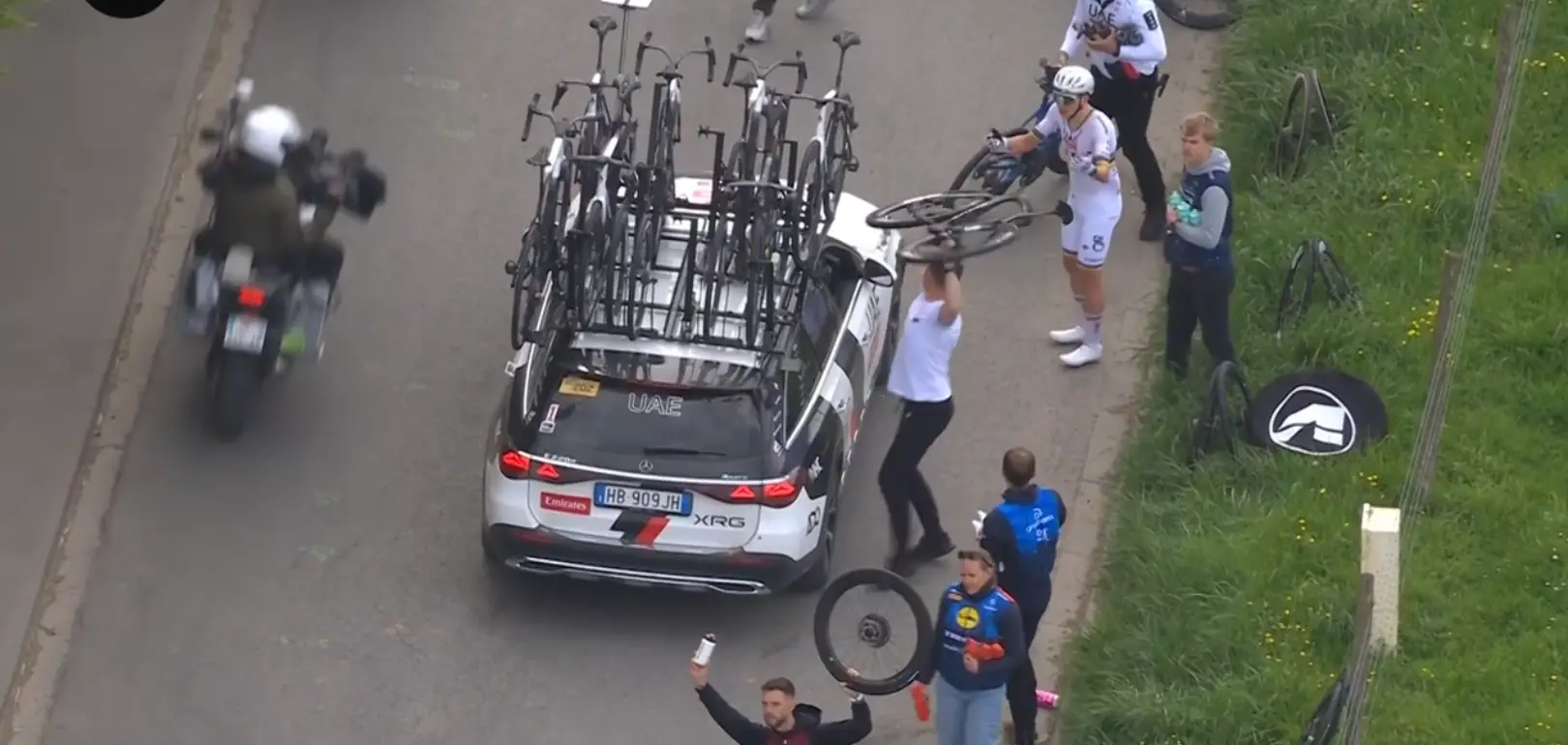
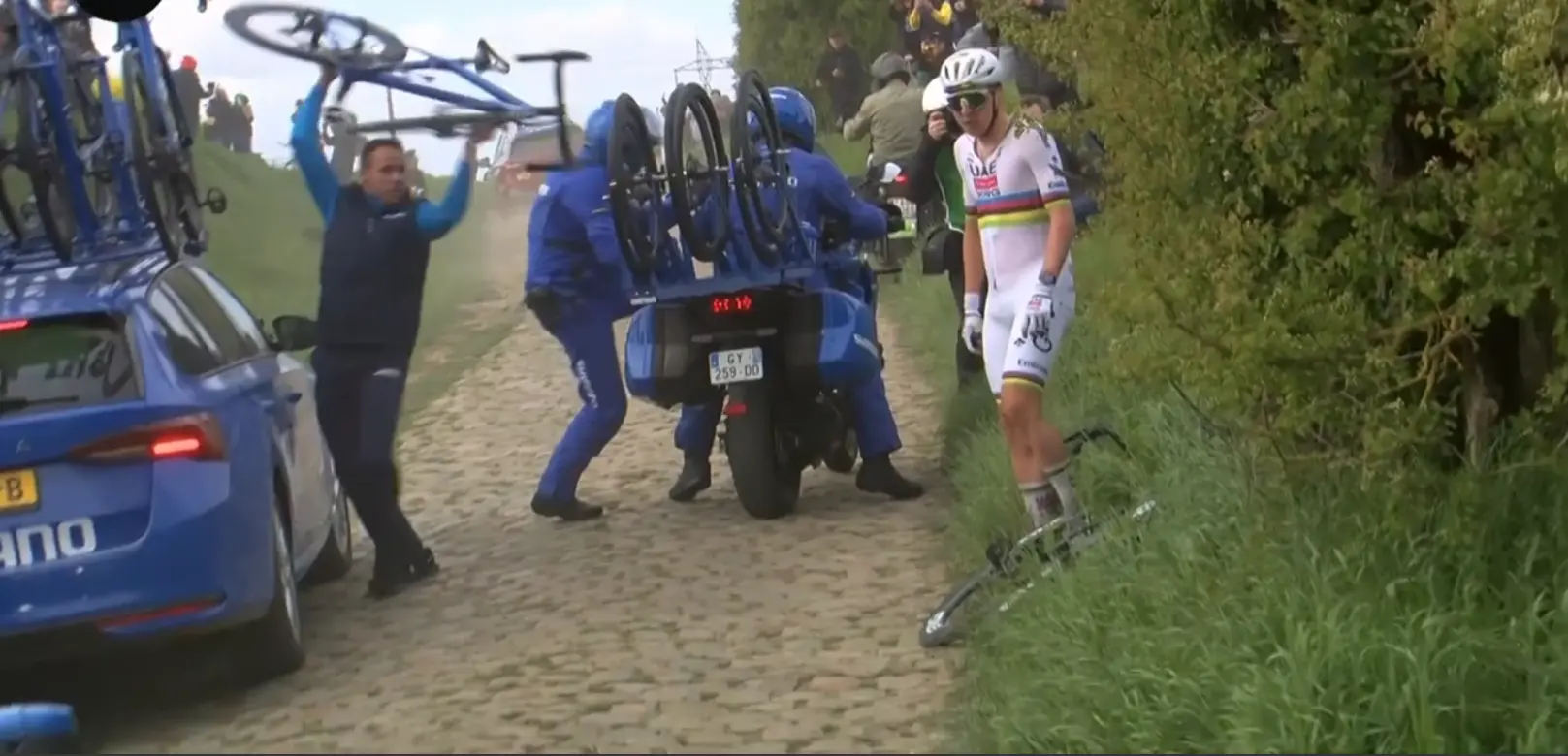
The debate around Paris-Roubaix 2026 has not settled in the days since the finish in the velodrome. If anything, it has sharpened. At the centre of it sits one moment. Tadej Pogacar punctures, loses ground, and the race at the front does not hesitate. The pace lifts. The pressure increases. The gap stretches. For some, it crossed an unwritten line. For others, it was simply Paris-Roubaix.
Now, Wout van Aert's right-hand man in Roubaix, Pietro Mattio has offered a clear insight into how Team Visma | Lease a Bike approached that moment and, speaking to Bici.Pro, there is no attempt to soften the edges. “When Pogacar punctured, we and Alpecin increased the pace to make him use energy and teammates.”
Fury from UAE sets the tone
The reaction in the immediate aftermath made the moment even more significant. Within UAE Team Emirates - XRG, frustration was clear, with Mikkel Bjerg among those to speak out strongly against the tactics used by their rivals.
His comments reflected a view held by parts of the peloton that, while not against the rules, such moves sit in a moral grey area. The idea that a race should not be actively accelerated when a key contender suffers misfortune remains an unwritten code in many situations.
No waiting in Roubaix
Mattio’s position is clear and rooted in the nature of the race itself. “Roubaix is the only race where you can do that. If we had to wait for everyone who punctures, we’d still be at the first sector,” he explained. “It’s part of the game. When Van Aert punctured, nobody waited for him either.”
That framing removes the moral layer entirely. It becomes a race of circumstance, not etiquette. What happens on the cobbles is accepted, not judged.
A tactic, not a reaction
The move was not improvised in isolation. It fitted within a broader approach from Visma, who had already committed to making the race as hard as possible from an early point.
The initial plan had been to isolate the key favourites, Pogacar and Mathieu van der Poel, through sustained pressure across the sectors. Even after Wout van Aert suffered a puncture of his own and the plan had to be adjusted, that aggressive mindset remained.
By the time Pogacar hit trouble, the race was already in a phase where hesitation carried its own risk. For Mattio and his team-mates, the decision was immediate and logical.
The role behind the move
Mattio’s perspective is also shaped by the responsibility he carried on the day. “That’s why I was the rider who always had to stay close to Wout,” he explained. “With similar measurements, I could have given him my bike straight away.”
It is a detail that underlines his function within the team. Not just another rider in support, but a direct, like-for-like backup option in the most critical phases of the race.
That responsibility placed him at the heart of the action when the race began to fracture, and explains why his account of the Pogacar moment carries added weight.

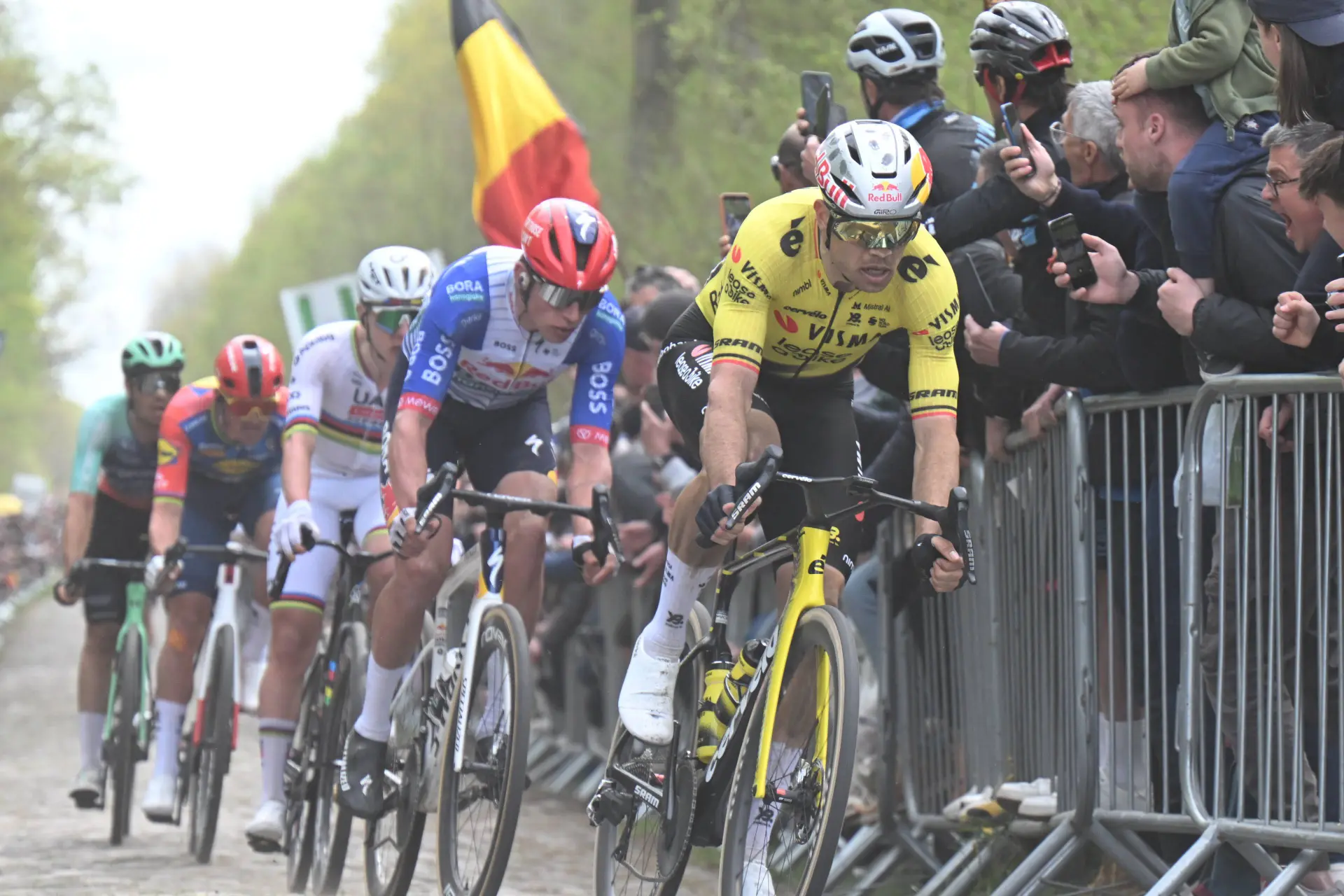
Wout Van Aert at the 2026 Paris-Roubaix
Control at the front
There was also a tactical context behind the decision. “There was a selection that reduced the group to around forty riders. We had five riders there, so everything was going perfectly,” Mattio said.
That numerical strength allowed Visma to dictate the race alongside Alpecin-Premier Tech, increasing the pace at a moment when one of their main rivals was vulnerable.
Pogacar was forced to chase back after the puncture, expending energy and resources that would later shape the finale. The Slovenian still recovered to contest the race at the front, but the cost of that effort has been widely discussed.

From Arenberg to the finish
Mattio’s own race adds another layer to the story. “I did my final pull before the Forest, and from that moment my race was over,” he said.
Tasked with staying as close as possible to Van Aert through the key phases, the Italian had fulfilled his role just before the race exploded across the Forest of Arenberg.
Even from behind, the scale of what was unfolding remained clear. “I thought it would be really hard for him, but I didn’t think he was out of it,” Mattio said of Van der Poel. “Over the radio we were getting time gaps and he was always coming back.”
Those details underline just how fluid the situation remained, even after key incidents had reshaped the race.
A defining moment in a chaotic race
That sequence has since become one of the defining talking points of the race. The criticism that followed has ensured it remains a central part of the post-race narrative, highlighting the tension between tradition and competitive instinct. The question is not whether the move was allowed, but whether it should have been made.
Mattio’s version cuts through that tension with a different perspective. There is no suggestion of doubt, and no indication that anything would have been done differently.
The wider conversation is unlikely to fade quickly. Paris-Roubaix has always operated with its own rules, both written and unwritten. What this edition has done is bring those boundaries back into focus. Was it ruthless? Or simply correct?
Mattio’s answer is clear. In Roubaix, there is no waiting.

Kieran WoodDeputy Editor-in-Chief
Kieran Wood is a sports journalist based in Wales and has been active in journalism since 2022. He regularly contributes to DartsNews.com and CyclingUpToDate.com, where he covers professional cycling and darts. In cycling, his work includes liveblogs from major races, including the Tour de France, the Giro d’Italia, and La Vuelta a España, alongside race reports and analysis. He has also conducted interviews with professional riders.
His reporting spans the full racing calendar, from one-day classics to stage races, with a focus on accurate, real-time coverage and clear contextual analysis. For statistics, results, and historical context, he regularly uses resources such as ProCyclingStats. To support reporting on rider activity and training context where relevant, he also references Strava.
In his work, Kieran places strong emphasis on careful sourcing, editorial accuracy, and updating articles as new, verified information becomes available.
claps 13visitors 10
Just in

Popular news

Latest comments
- I see (elsewhere) that Alaphilippe had more to say than what got relayed in this stub. Me: he was very good early but his latter third trajectory was the pits. His old boss did what he could (huffed and puffed) but Julian couldn't get his greatness back. Sometimes I wonder if crashes that didn't look like much changed the course of the rider.flyer14-11-2026
- I wouldn't classify it as a gift because the nasty consequences of taking it from Sepp would have been great and would persist and he knew it.flyer14-11-2026
- Ok. Tratnik's good and Red Bull's better so Tratnik may get what he wants.flyer14-11-2026
- Ok. So just saying he wasn't enjoying racing anymore is some kind of explanation? Me saying I don't enjoy his explanation is more explaining than he did.flyer14-11-2026
- Buitrago, was he their best rider in 2026? He's the chief loss for them and Martinez and Tiberi (especially) have to step up or they will be overtaken by Bahrain's younger riders like Omrzel. I'm still somewhat high on Martinez but Tiberi, after showing signs of promise, has fizzled. Bahrain still has a good team but they need to improve and exceed expectations. I'd be happy if Mohoric could manage to return to his better form for maybe one last year at least.flyer14-11-2026
- Hmmm, "... I just gained 30 seconds purely off the bike. Because it's really a big, big improvement compared to the previous bike". Is that marketing for Specialized or serious valid hype, or something in between? Very likely the former.flyer14-11-2026
- Nothing revelatory or controversial. Why do we have to report on Bruyneel's or Armstrong's thinking. It's a shame and enough that the Move's on TV and that people watch it .flyer14-11-2026
- Makes sense that training from home is a big asset or advantage but it's still remarkable that he can put in three quality majors and not pay some heavy price for the exertion. I wish he would have won that tour stage that his crash while leading allowed Carapaz the win. He's a darn good rider and teammate.flyer14-11-2026
- Sounds like we all agree with the over under exaggeration: "The German’s signing does not guarantee that Evenepoel will win the Tour in 2027. "flyer14-11-2026
- Seixas appears to be that good but if he isn't (an absolute rival to Pogacar) he would have plenty of company in rising stars that did not go on to fully meet the expectations of many. That Pogacar wasn't the greatest (as great) sooner can't be transposed onto another's development. It may be not that simple.flyer14-11-2026
Loading
5 Comments