“It shows a lot of respect” - Former Strade Bianche winner defends Tadej Pogacar’s decision to keep attacking with the Tour de France already won
Cycling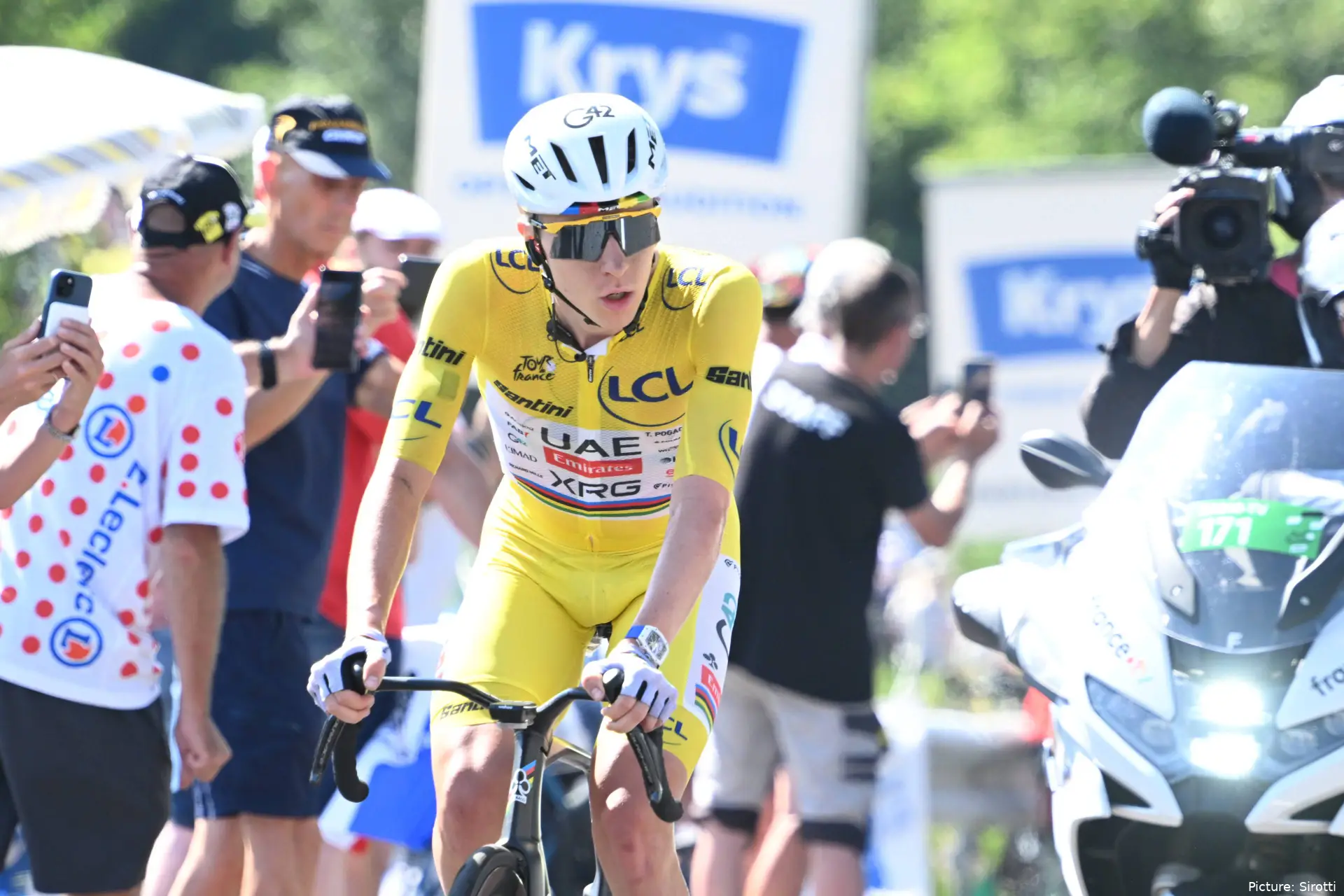
The general classification times were already taken when Tadej Pogacar attacked in the yellow jersey on Montmartre. His fifth Tour de France title was secure, and he was still trying to win the final stage. Mathieu van der Poel took the victory in Paris, but Pogacar’s willingness to keep racing for wins is exactly what Moreno Moser, who won Strade Bianche at 22, admires about him.
“Pogacar has changed the rules, and I think there’s something honourable about that,” Moser told Bici.Pro. “I can see why some people don’t like his approach and why many find it arrogant. To me, it shows a lot of respect for his rivals, the fans and the race itself.”
Pogacar in yellow and Vingegaard in pink
Pogacar’s first move on Montmartre drew out Van der Poel, Remco Evenepoel and Mads Pedersen before the bunch brought them back. On the final ascent, Van der Poel attacked and Pogacar was the only rider who could go with him. They worked together until the last 600 metres, when Van der Poel went clear and held off Jasper Philipsen. Pogacar, who had already won five stages at the 2026 Tour, finished 30th.
“I don’t like it when the bunch plays tactical games and stops caring about the race,” Moser said. “I can accept a leader choosing to give up the race lead for tactical reasons.” At the Giro d’Italia, Jonas Vingegaard had already won four stages when he went clear on the penultimate day in pink. His solo victory on Piancavallo made it five before he sealed the overall in Rome.

Both Vingegaard and Pogacar won Grand Tours in 2026
“They race very little, and when they do race, they want to win,” Moser said. “Years ago they’d race a lot for training, without going there to win every race. The pressure from sponsors was different then, and team managers had more freedom to tell whatever story suited them. If you won the Giro d’Italia, everyone was happy. Now sponsors are hungry for a return on their investment, so they want to get everything they can.”
Pogacar won 22 races in 2026, including five Tour stages and three at the Vuelta before crashing out in the red jersey. Vingegaard and Isaac del Toro each took 12 wins, level with sprinters Jonathan Milan and Matthew Brennan.
2026 win totals and Grand Tour highlights for selected GC riders and sprinters
| Rider | 2026 wins | Grand Tour highlights |
| Tadej Pogacar | 22 | Tour de France overall and five stages, plus three Vuelta stages |
| Paul Magnier | 15 | Three Giro d’Italia stages and the points jersey |
| Tim Merlier | 14 | Three Tour de France stages |
| Isaac del Toro | 12 | One Tour de France stage and third overall |
| Jonas Vingegaard | 12 | Giro d’Italia overall and five stages |
How Paul Magnier won when the Giro looked too hard for a sprint
Magnier had won 19 races in 2025, just one fewer than Pogacar. His tally dropped to 15 in 2026, but he added three Giro stages and took the cyclamen jersey to Rome. At Pieve di Soligo, the Muro di Ca’ del Poggio pitched up at 12.1% for 1.1 kilometres, just nine kilometres from the finish. Magnier was distanced there and needed his Soudal - Quick-Step teammates to bring him back inside the final three kilometres. Jasper Stuyven delivered the lead-out that set up his third stage win.
“There are still plenty of sprint opportunities over a season,” Moser said. “What I do notice is how hard it is for any one sprinter to dominate. One rider used to win 20 races on his own. Now you have three or four sharing that number between them.”
Magnier came close to that mark in 2025. “It’s harder to put a lead-out train together because the sprints are more chaotic,” Moser added. “The strongest rider can win two in a row, but he’ll usually get the third one wrong. Even Magnier, who was the strongest sprinter at the Giro, got a few wrong.”
On stage 15 into Milan, Fredrik Dversnes and three other escapees began the last lap with 50 seconds in hand. By five kilometres to go the chasing teams were already using lead-out riders to try to close the last 25 seconds. Dversnes stayed away to win. Moser sees a deeper peloton making the chase harder even before the riders hit a circuit.
“These days a break of 15 strong riders wears you down. One team can’t close it on its own any more.” In Milan, four riders were enough. “When there are lots of corners, the bunch has less road on which to make up ground,” Moser said. “On a city circuit it can take 10 or 15 minutes just to reach the front. At the speeds they race these days, you’re already spent by the time you get there.”
What would a sprinter like Cipollini be worth today?
Marcel Kittel was the example put to Moser. “In a one-day race, when he’s fresh, that kind of sprinter can still dig deep and get over terrain that doesn’t suit him,” he said. “In a stage race, when you’re already running on half a tank, you blow up. Cavendish won Milan-Sanremo, but he’d have struggled to pull off the same ride after two weeks of racing.”
“A sprinter is probably worth less than he used to be in terms of contracts and prestige,” Moser said. “I don’t know whether Cipollini could become as big a star in today’s cycling as he did back then.”
Pedersen took green at the Tour through a campaign that included a stage win from a breakaway and a decisive haul on the Tour’s hardest mountain stage. Merlier won three stages before withdrawing, and Philipsen closed to within seven points after winning in Voiron. Pedersen could keep collecting points on days when a bunch finish was unlikely. “To win that jersey, sprinting alone won’t do any more,” Moser said. “Riders like Pedersen and Van Aert are more than sprinters, and the same was true of Sagan in his day.”
The opening stages of the 2027 Giro offer another test. The first stage has late climbs around Trieste, the Ljubljana to Koper stage includes the steep Markovec, and even stage three, the first relatively straightforward chance for sprinters, crosses the Forcella Mostaccin inside the last 20 kilometres. “We cycling fans crave excitement, so organisers are always looking for ways to put obstacles in the finale,” Moser said. “I prefer it that way. I think it’s what we need. Stages where you’re left wondering whether the break will make it.”
Read also
Paul Seixas, Il Lombardia and the limits of watts per kilo
“The gaps on the climbs seem huge to me,” Moser said. “If Tadej is there, he wins. If Vingegaard is the only one of the two there and he’s in form, he wins. If neither of them is there, Seixas wins. If Seixas isn’t there, Del Toro wins.”
Seixas’s Il Lombardia victory gave him an example. Seixas attacked on the Civiglio with around 19 kilometres to go and finished 48 seconds ahead of Enric Mas in Como. “The results mirror the relative strengths of the riders so closely that sometimes the magic disappears,” Moser said. “Cycling has become a game of watts per kilo.”
Make a race too selective and “you risk killing the race”, he warned. “Tactics are still the most beautiful part of cycling. When everything comes down to performance, whether it’s on a climb or in a time trial, the difference between the riders is so clear that you could write out the finishing order before the start.”
Why Montreal and Milan-Sanremo stood out to Moser
Paul Seixas and Mads Pedersen were both in contention at the Montreal Worlds, where the repeated ascents of Mont-Royal gave climbers and classics riders several chances to attack over 273 kilometres. Quinn Simmons had already gone clear with Van der Poel and Oscar Onley before Brandon McNulty attacked with 33 kilometres to go. Simmons and Matteo Jorgenson were still in the group behind, free to follow attacks while the other teams had to chase. McNulty’s lead fell to around ten seconds. He held on to win by 13 seconds from Michael Matthews and Van der Poel.
“The course was demanding in a way that brought a wide range of riders into play,” Moser said of Montreal. “The beauty of cycling is seeing the United States win the Worlds through clever teamwork.” At Milan-Sanremo, even the rider at the top of Moser’s pecking order had to find more than one way to put his rivals under pressure. “He made the difference, but he had to come up with an extraordinary ride to do it,” Moser said.
Pogacar crashed before the Cipressa, got back on and attacked. He dropped Van der Poel on the Poggio, but Tom Pidcock stayed on his wheel. The two came onto the Via Roma together.
“I’ve got nothing against marathons, but I don’t like going to races when I already know who’s going to win,” Moser said. In Sanremo, it took a photo finish to give Pogacar the win by four centimetres.

Kieran WoodDeputy Editor-in-Chief
Kieran Wood is a sports journalist based in Wales and has been active in journalism since 2022. He regularly contributes to DartsNews.com and CyclingUpToDate.com, where he covers professional cycling and darts. In cycling, his work includes liveblogs from major races, including the Tour de France, the Giro d’Italia, and La Vuelta a España, alongside race reports and analysis. He has also conducted interviews with professional riders.
His reporting spans the full racing calendar, from one-day classics to stage races, with a focus on accurate, real-time coverage and clear contextual analysis. For statistics, results, and historical context, he regularly uses resources such as ProCyclingStats. To support reporting on rider activity and training context where relevant, he also references Strava.
In his work, Kieran places strong emphasis on careful sourcing, editorial accuracy, and updating articles as new, verified information becomes available.
claps 1visitors 1
Just in


Popular news

Latest comments
- Glad he was caught before the fetish escalated.
 Brucegel17-11-2026
- If he does that, he's doping. It'd be like the transitions that Lance Armstrong, Miiguel Indurain, Gianni Bugno, Claudio Chiapucci etc went through when blood doping came about
 Rafionain-Glas17-11-2026
- Jasper is a versatile sprinter, and he excels in classicman sprint territory, while Merlier is a pure sprinter. It is well known that Jasper is not the fastest pure sprinter. Obviously Mathieu would choose MerlierRafionain-Glas17-11-2026
- Ah well. I was looking forward to itRafionain-Glas17-11-2026
- I hope it comes together. It'll be bigger better and stronger. Lidl-Trek as a team are very pro cyclo-cross so for Sven to battle it out against them to remain independent doesn't make sense, as the Lions are pretty much almost a Lidl-Trek team anyway (it doesn't seem like he's fighting them anyway, despite the headline). A Lidl-Trek team run by Sven Nys would have greater resources and would be far more capable to grow.Rafionain-Glas17-11-2026
- 😆 “I’m your number one fan!”Lozza17-11-2026
- I pity the fools!Lozza17-11-2026
- I'm sure he would, but the reality is he is second fiddle to Mathieu as well. Recently when MVDP was asked to name the characteristics of his dream cyclist, he gave Merlier's name for the sprinter. not that it means anything for this, but kinda telling. MVDP does what he wants w/o regard to his teammates. the teammates exist to support him.mij17-11-2026
- except LA did it on drugs to cheat, so pretty major difference. there is no comparison to be made between Tadej and the doper.mij17-11-2026
- OK @frieders3, just you and me... 1 2 3 ... POGI = BABY HULK = SMASH !!! PS: Now, was that so hard?PogiSloFans17-11-2026
Loading
1 Comments